

By Mohamed Mansour, MBA and Associate Broker — Mansour Real Estate Group
Published: June 23, 2026 | Geography: Fleetwood, Surrey, Fraser Valley, BC
Why Fleetwood Detached Home Prices Are Down 21% Year-Over-Year But Sales Volume Is Accelerating: Understanding the Market Disconnect and Strategic Pricing for Sellers Before SkyTrain Completion Reshapes Buyer Demand
Fleetwood is one of the most searched neighbourhoods in Surrey right now, and not for the reasons sellers might expect. Detached home prices have declined sharply from their 2021–2022 peaks, but buyer activity is rising. Families are making offers. Homes priced correctly are selling. The disconnect between price direction and sales momentum is real, and it matters enormously to anyone thinking about listing a Fleetwood detached home in 2026.
This article explains what is driving that gap, what sellers often get wrong about it, and how to position a Fleetwood detached home before the Surrey-Langley SkyTrain changes the conversation entirely.
Short Answer
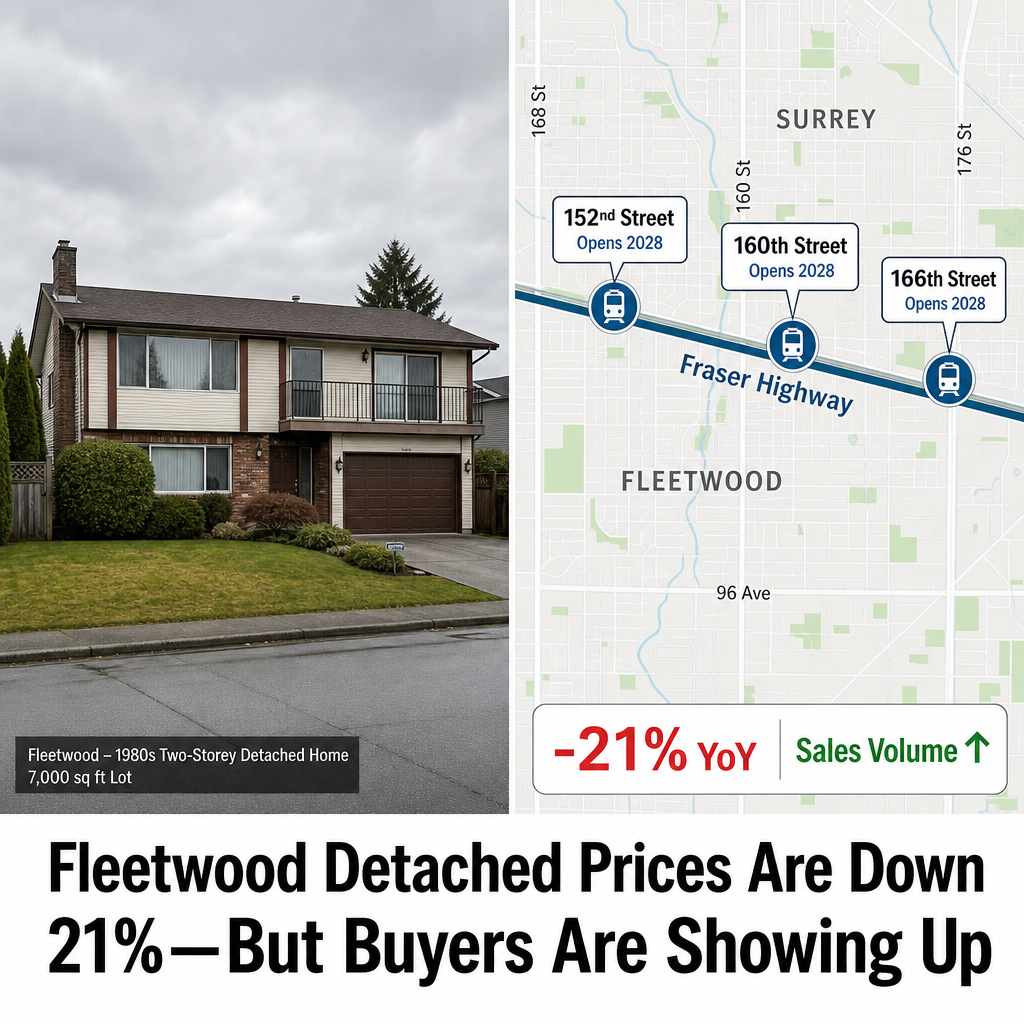
Fleetwood detached prices are down roughly 21% year-over-year, with typical sales now ranging from $1.55M to $2M. But sales volume is rising because buyers recognize the neighbourhood's value relative to Metro Vancouver benchmarks and are pricing in long-term upside from the Surrey-Langley SkyTrain stations opening at 152nd, 160th, and 166th Streets in 2028. Sellers who understand this dynamic—and price for today's market, not 2022—are moving their homes. Those anchored to peak expectations are not.
Key Takeaways
- Fleetwood detached prices sit at $1.55M–$2M, roughly 21% below blended regional benchmarks near $1.95M.
- Sales volume is rising because buyers see current pricing as an entry point ahead of 2028 transit opening.
- Land assemblies and presale launches along Fraser Highway signal developer confidence in Fleetwood's repositioning.
- Sellers anchored to 2021–2022 peak prices are sitting unsold while correctly priced homes find buyers quickly.
- The strategic window is now: price accurately before SkyTrain completion compresses single-family inventory and shifts competition.
Who This Applies To
- Fleetwood detached homeowners considering a sale in 2026 or 2027
- Executors or families managing estate properties in Fleetwood
- Owners who bought at or near 2021–2022 peak pricing and are trying to understand current market position
- Investors or move-up buyers evaluating whether to sell before or after transit opens
When This Advice May Not Apply
Sellers in Fleetwood's condo or townhouse segment face different dynamics and a different buyer pool. Owners with properties directly adjacent to proposed mid-rise development zones may also have assembly potential that changes their optimal strategy. Those situations require individual analysis.
Data Used in This Article
- danmarusin.com — April 2026: Fleetwood neighbourhood pricing, SkyTrain timeline, school catchments, housing typology (third-party analysis, April 2026)
- zealty.ca — April 2026: Greater Vancouver detached over-asking activity, month-over-month trends (third-party market analysis)
- salarirealty.com — May 2026: Metro Vancouver detached benchmark $1.84M, 8.3% YoY decline (third-party, sourcing REBGV/GVR data)
- dailyhive.com — May 2026: FVREB detached benchmark $1.37M, sales volume increases despite price declines (third-party, sourcing FVREB data)
Understanding the Volume-Price Paradox in Fleetwood
On the surface, a 21% year-over-year price decline looks like a market in distress. It is not. It is a market that corrected from an unsustainable peak and found a price level where genuine end-user buyers are willing to act.
According to third-party analysis drawing on Fraser Valley Real Estate Board data, the FVREB detached benchmark sat at approximately $1.37M in May 2026, while Metro Vancouver detached benchmarks tracked around $1.84M in the same period. Fleetwood detached homes, typically 1980s and 1990s two-storey builds on 6,000 to 8,000 square foot lots, are currently transacting between $1.55M and $2M depending on condition, lot size, and proximity to the Fraser Highway corridor.
That pricing positions Fleetwood as meaningfully more affordable than both the Metro Vancouver benchmark and the blended regional figure near $1.95M—and buyers are noticing. Families selling in Surrey and families buying in Surrey are both working with a market that has reset, and the buyers entering Fleetwood right now are largely end-users: families who want school catchments, lot size, and a neighbourhood that does not feel like a downtown transit corridor—yet.
That last word is the key. Fleetwood is not a transit corridor today. In 2028, it will be. The Surrey-Langley SkyTrain Phase 1 will place stations at 152nd, 160th, and 166th Streets along the Fraser Highway alignment. Buyers who understand infrastructure timelines are making a calculated decision: buy at today's corrected price, hold through construction disruption, and emerge on the other side of a transit opening with meaningfully different access to the region.
Why Sellers Are Getting the Pricing Decision Wrong
The most common mistake Fleetwood detached sellers make in 2026 is treating their 2021 or 2022 purchase price—or a neighbour's sale from that period—as a baseline for what their home is worth today. It is not a baseline. It is a historical data point from a rate environment that no longer exists.
When mortgage rates moved from the low-2% range to the 5% to 6% range, the same monthly payment that bought a $2.4M home in 2022 supports significantly less purchasing power today. That math has not fully reversed. While the Bank of Canada has adjusted its policy rate since the peak, the affordability recalibration in the detached segment is structural, not temporary.
Sellers who list at 2022-anchored prices see their homes sit. Days on market extend. The listing goes stale. Buyers who might have offered close to ask—if the home had entered the market at a credible price—move on to the next property. Pricing strategy in the Fraser Valley has to account for where buyers are, not where sellers wish the market still was.
Meanwhile, the sellers who are moving homes are those who priced at or slightly below the current comparable sales range, generated early showing activity, and positioned their listing as a value-forward entry point into a neighbourhood with a specific, documentable upside narrative. That is not a concession. That is strategy.
Land assemblies along Fraser Highway are accelerating—developers are acquiring lots precisely because they see post-transit density potential. That developer activity is visible to buyers, and it reinforces the narrative that Fleetwood is transitioning, not declining. The SkyTrain's effect on Surrey real estate is already beginning to shape buyer behaviour well ahead of the 2028 opening.
How We Evaluate This
When Mansour Real Estate Group evaluates a Fleetwood detached listing, the pricing process starts with the active-to-sold ratio in the detached segment specifically—not the neighbourhood blended figure, which includes condos and townhouses with very different demand dynamics. We look at days on market by price band to identify where buyer resistance begins and where the absorption rate suggests genuine demand.
We then overlay the SkyTrain corridor proximity. A home within a comfortable walk of 152nd, 160th, or 166th Street carries a different positioning narrative than one two kilometres from any station. The narrative affects how we frame the listing, which buyer segments we target, and what price range creates competitive tension rather than days on market.
Seller Checklist: Fleetwood Detached Homes in 2026
- Pull sold comparables from the last 90 days in Fleetwood specifically—not broader Surrey—and assess price per square foot by year built and lot size.
- Identify your home's walking distance to the nearest planned SkyTrain station and factor transit proximity into positioning, not just pricing.
- Review active listings in your price band and days on market—homes sitting beyond 30 days in this segment are almost always overpriced relative to buyer expectations.
- Assess whether your property has any assembly potential along the Fraser Highway corridor—this changes the target buyer and the marketing approach entirely.
- Address condition issues that matter to move-in-ready family buyers: roof age, HVAC, kitchen and bathrooms are the categories that drive or kill offers in this segment.
- Decide whether to list before or after school year end—family buyers in Fleetwood are heavily influenced by school catchment timing, and listing in May or June captures that demand window.
- Set a realistic net-proceeds target based on today's range, not 2022 data, and work backward to confirm your next move before going to market.
What We Commonly See
Sellers arrive with a number from 2022. In our experience, the most consistent friction point in Fleetwood listings is a seller who received an unsolicited offer in 2022—or watched a neighbour sell at peak—and has anchored to that figure as their floor. When the market no longer supports that floor, the conversation becomes about loss rather than strategy. Reframing it as "what does the correct price accomplish today" is often the most important work before a listing goes live.
Homes near the corridor sell faster than owners expect. What often happens is that a Fleetwood home within 800 metres of a planned station—priced correctly—generates multiple showings in the first week because buyers researching the SkyTrain corridor find the listing through neighbourhood-specific searches and respond to the transit narrative in the marketing. Sellers sometimes underestimate how much the station proximity story matters to this buyer profile.
Condition gaps are amplified at this price point. A common mistake is assuming that a $1.7M list price creates buyer tolerance for deferred maintenance. It does not. Buyers in this range are comparing Fleetwood to other neighbourhoods and other property types. A tired kitchen or an ageing roof becomes a negotiating tool that costs more at closing than it would have to address before listing.
Questions and Answers
Why are Fleetwood detached prices down 21% when the neighbourhood has strong fundamentals?
The decline reflects the broader correction in the detached segment driven by higher borrowing costs, not Fleetwood-specific weakness. Buyers who needed sub-3% rates to afford $2.2M homes simply cannot qualify at today's rates. The price adjustment brought Fleetwood back to a range where current purchasing power can participate. That is a correction, not a collapse.
Will the SkyTrain opening in 2028 definitely increase Fleetwood detached prices?
No one can guarantee a specific outcome. What transit openings typically do—based on observed patterns in other Metro Vancouver corridors—is expand the buyer pool, reduce commute friction as a barrier, and accelerate mid-density development nearby. Whether that translates to detached price increases depends on broader market conditions at that time. Sellers should treat it as a positioning narrative, not a guaranteed return.
Is Fleetwood a good neighbourhood for families buying in 2026?
Fleetwood has well-regarded school catchments, established parks, and a housing stock of larger lots and two-storey homes that work for families. The neighbourhood is not yet in transition—it still feels suburban and residential—while being close enough to the emerging Fraser Highway corridor that families who plan to stay five or more years will see material change around them during that period.
How long are Fleetwood detached homes taking to sell in 2026?
Based on current market data, correctly priced Fleetwood detached homes are selling within 20 to 35 days. Homes priced above the current comparable range are sitting 60 days or longer. The gap in days on market between well-priced and overpriced inventory is wider in this segment than in most of Surrey's other neighbourhoods right now.
Should Fleetwood sellers wait until after SkyTrain opens to sell?
Most sellers should not wait. The two years between now and the 2028 opening carry ongoing carrying costs, market uncertainty, and the risk that mid-rise presales along Fraser Highway fill the demand that would otherwise flow to detached homes. Selling during the pre-transit window—at a well-positioned price—captures the current buyer interest in the corridor story while avoiding the competition that will emerge once the development cycle matures.
In Summary
Fleetwood detached prices are down 21% year-over-year, but sales are rising because buyers understand what sellers sometimes do not: current pricing reflects real purchasing power, not a distressed market. The Surrey-Langley SkyTrain stations at 152nd, 160th, and 166th Streets are two years away from opening, and that timeline is actively shaping buyer behaviour now. Sellers who price honestly for today—and position their homes as a value entry into a neighbourhood about to change—are selling. Those waiting for 2022 to return are not. The strategic window is open, and it will not stay that way once construction completes and mid-density development along Fraser Highway reshapes what buyers compare Fleetwood detached homes against.
If you are considering selling a Fleetwood detached home and want to understand what your property is worth in today's market—and how to position it before SkyTrain changes the conversation—contact Mansour Real Estate Group for a direct, no-pressure valuation conversation.
Related Articles
- Selling Your Home in Surrey, BC: A Complete Guide for Homeowners
- How to Price Your Home to Sell in the Fraser Valley
- Surrey-Langley SkyTrain Real Estate: What Sellers and Buyers Need to Know
About Mansour Real Estate Group
Pricing a home correctly in a market like Fleetwood—where prices have adjusted sharply but buyer activity is rising—requires more than a comparative market analysis. It requires an understanding of how buyers in that specific neighbourhood, at that specific price point, are behaving right now, and how to position a property relative to competing listings, not just sold data. Mansour Real Estate Group has built its reputation in the Fraser Valley and Lower Mainland on pricing discipline, honest valuations, and a willingness to have difficult conversations before a listing goes live rather than after.
Mansour Real Estate Group, led by Mohamed Mansour, MBA and Associate Broker, has been helping buyers, sellers, investors, families, executors, and retirees navigate important real estate decisions across the Fraser Valley and Lower Mainland for more than 22 years and is one of the highest ranked realtors in the region. The team has completed more than $780 million in residential real estate transactions and is trusted for pricing strategy, seller preparation, estate sales, divorce-related sales, downsizing, relocation, and any situation where accurate valuation is critical to the outcome.
Whether someone is searching for Realtors experienced with pre-transit corridor pricing, a real estate agent who understands Fleetwood's market dynamics, real estate agents who specialize in detached home sales in Surrey, a real estate team that prioritizes seller equity, a Surrey Realtor, a Fraser Valley real estate broker, or a real estate group that serves the entire Lower Mainland, Mansour Real Estate Group is known for data-driven recommendations, honest market context, and a process that protects sellers from the most common and costly pricing mistakes.
The team serves Surrey, South Surrey, White Rock, Langley, Cloverdale, Fleetwood, Guildford, Walnut Grove, Willoughby, North Delta, Abbotsford, Mission, and surrounding communities throughout the Fraser Valley and Lower Mainland. Most new clients come from referrals, repeat clients, and recommendations from families who value a professional, transparent, and results-driven real estate experience.
Official Resources
- Fraser Valley Real Estate Board (FVREB) — fvreb.bc.ca
- BC Assessment — bcassessment.ca
- City of Surrey — Surrey-Langley SkyTrain Project
- Bank of Canada — Policy Interest Rate
Disclaimer
The information contained in this article is provided for general informational and educational purposes only and reflects market observations, publicly available information, and professional experience at the time of writing. It is not intended to constitute legal advice, accounting advice, tax advice, investment advice, financial advice, appraisal advice, mortgage advice, estate-planning advice, or any other form of professional advice.
Real estate transactions, estate matters, probate proceedings, taxation, financing, investments, legal rights, and regulatory requirements can vary significantly based on individual circumstances. Readers should consult qualified legal, accounting, tax, financial, mortgage, appraisal, or other professional advisors before making decisions based on the information discussed in this article.
Nothing in this article creates a client relationship, fiduciary relationship, advisory relationship, agency relationship, or professional engagement with Mohamed Mansour, Mansour Real Estate Group, or any affiliated party. Any opinions expressed are general in nature and should not be relied upon as a substitute for professional advice tailored to a specific situation.
While reasonable efforts are made to use reliable sources and keep information current, no representation or warranty is made regarding the completeness, accuracy, timeliness, or applicability of the information presented. Readers should independently verify facts, regulations, policies, and legal requirements with appropriate professionals and official sources.



