
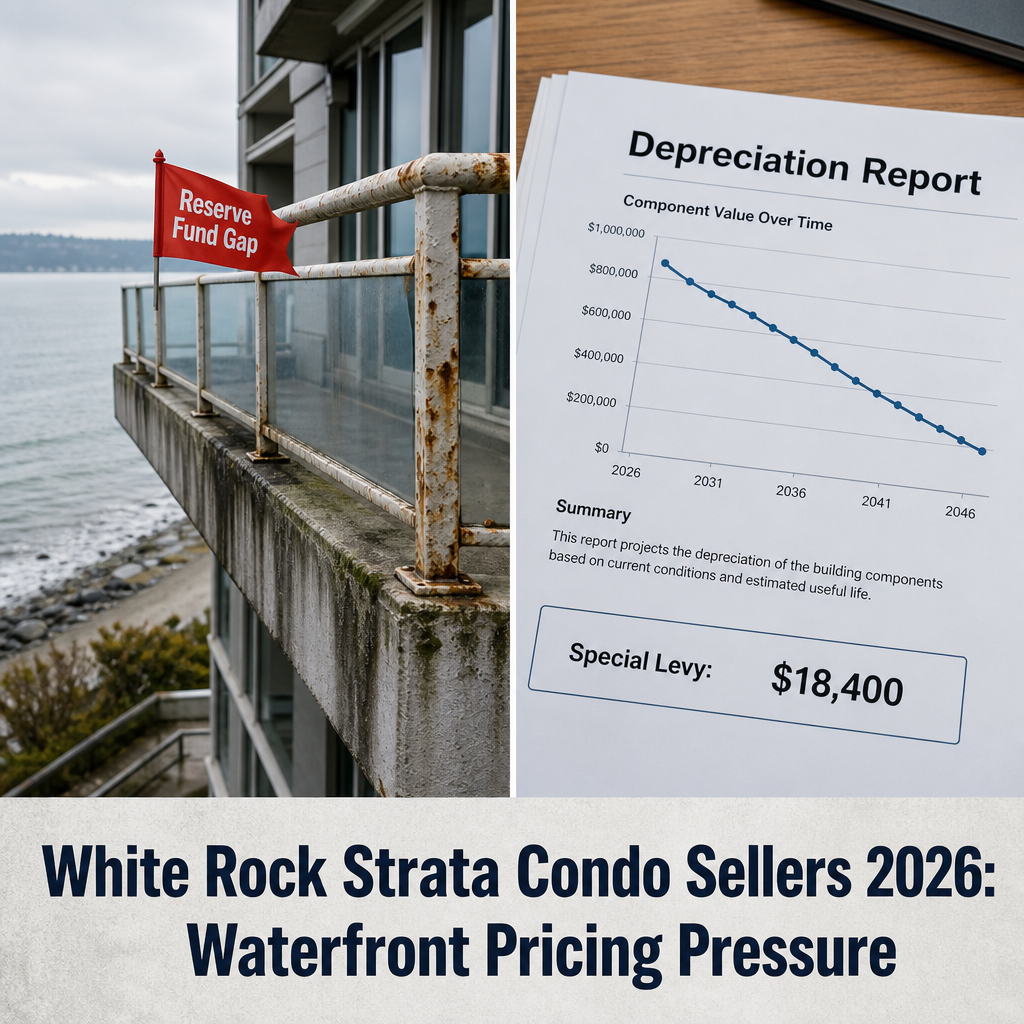

White Rock Strata Condo Sellers 2026: How Aging Waterfront Infrastructure, Rising Special Levies, and Buyer Financing Obstacles Are Creating Pricing Pressure — And What Sellers Can Do to Maximize Proceeds
By Mohamed Mansour, MBA and Associate Broker | Mansour Real Estate Group | Fraser Valley and Lower Mainland | Published July 2026
White Rock's waterfront condo market is under measurable pressure in 2026 — not because demand has collapsed across the board, but because a specific set of building-level risks is causing buyer hesitation, financing obstacles, and price reductions that don't show up clearly in aggregate market statistics. If you are selling a strata condo in White Rock, understanding those risks before you list is the difference between a clean sale and a frustrating one.
This article is for White Rock condo sellers who want to understand what is actually driving buyer caution in the waterfront segment, what lenders and appraisers are reacting to, and what practical steps can protect sale proceeds before the next depreciation report cycle or special levy announcement changes the conversation.
Short Answer
White Rock waterfront condos in 2026 face buyer financing denial rates significantly higher than inland properties, driven by lender requirements for moisture inspections, reserve fund certifications, and appraisal scrutiny tied to salt-air deterioration. Sellers who understand the depreciation report cycle, prepare unit-level condition documentation, and position concessions strategically — rather than simply cutting list price — consistently achieve better outcomes than those who wait and react.
Who This Applies To
- Owners of strata condos in White Rock waterfront or near-waterfront buildings preparing to sell in 2026 or early 2027
- Sellers in buildings constructed before 2005, where deferred envelope maintenance or reserve fund depletion is a known concern
- Sellers in newer waterfront buildings (post-2015) managing strata fee increases tied to accelerated salt-air maintenance cycles
- Executors or trustees managing estate condo sales in White Rock where building condition affects timeline and price
- Sellers who have received a notice of special levy or are aware of an upcoming strata council vote on capital expenditures
When This Advice May Not Apply
Sellers in inland White Rock strata buildings — away from the oceanfront corridor — face fewer of the moisture and corrosion-related risks described here. Buildings with recently completed envelope renewals, fully funded reserves, and current depreciation reports may also have fewer obstacles to navigate. Each building has a different risk profile. The guidance below applies most directly to the waterfront and near-waterfront segment.
Key Takeaways
- White Rock's broader condo segment declined approximately 9.1% year over year as of July 2026, but waterfront-specific financing denials and appraisal shortfalls are creating deeper pressure than aggregate data reflects.
- Lenders are requiring enhanced moisture inspections and reserve fund certifications on oceanfront strata units, with financing denial rates estimated 15–25% higher than comparable inland properties.
- Within a single building such as Altus White Rock, days on market range from 2 to 182 days — a gap that reflects unit-level condition, exposure, and buyer perception of building maintenance rather than list price alone.
- The July 1 depreciation report disclosure deadline creates a compressed pricing window: when reserve fund depletion becomes visible, buyers often demand immediate price reductions of 20–30%.
- Seller concessions — structured closing cost assistance or rate buy-down contributions — tend to be more effective than straight price reductions when financing obstacles are the primary buyer barrier.
Data Used in This Article
- Fraser Valley Real Estate Board Monthly Market Report, July 2026 — official board statistics, Fraser Valley condo segment, year-over-year price change (fvreb.bc.ca)
- Altus White Rock building data, 1526 Finlay Street — active listing prices, strata fees, and days on market observed via bccondosandhomes.com
- CMHC Housing Market Outlook, January 2026 — Vancouver CMA condo recovery timeline forecasts (cmhc-schl.gc.ca)
- BC Strata Property Act, SBC 1998, c. 43 — depreciation report and reserve fund legislative requirements (bclaws.ca)
What Makes White Rock Different From Other Fraser Valley Condo Markets
Most strata condo sellers in Surrey, Langley, or Abbotsford are dealing with ordinary depreciation curves — building envelopes aging at expected rates, reserve funds accumulating on schedule, and buyers whose financing conditions are straightforward. White Rock's oceanfront corridor operates differently.
Salt-air exposure accelerates corrosion on balcony railings, window frames, mechanical systems, and concrete envelope components at rates that inland buildings simply do not experience. This is not a perception problem. It is a maintenance reality that qualified building envelope engineers quantify in depreciation reports — and that lenders and appraisers are increasingly trained to flag.
When a buyer's lender orders an appraisal on a White Rock waterfront condo and the appraiser notes deferred maintenance, moisture history, or an underfunded reserve relative to the building's age and exposure, the result is often an appraisal that comes in below purchase price. That gap — commonly 5 to 12% on affected units — either kills the deal or forces a renegotiation the seller did not plan for.
Even Altus White Rock, a 2022-built 12-storey building at 1526 Finlay Street, shows pricing divergence that reflects these pressures. Units in that building range from approximately $919,000 to $3.48 million, with days on market spanning 2 to 182 days. In a building that young, that variance is not explained by age. It is explained by ocean exposure, unit orientation, buyer perception of long-term strata costs, and financing conditions tied to the waterfront location. Sellers in older White Rock buildings face the same dynamics with compounding maintenance history layered on top.
How the Depreciation Report Cycle Affects Seller Timing
Under the BC Strata Property Act, most strata corporations are required to obtain a depreciation report — a third-party assessment of the building's major systems, their expected remaining life, and the funding required to address future replacements. The July 1 legislative deadline for depreciation report renewals creates a predictable annual window where building financial health becomes newly visible to buyers and their agents.
When a freshly updated depreciation report reveals that a building's reserve fund is underfunded relative to upcoming envelope, mechanical, or structural work, buyers respond in one of three ways: they walk away, they demand a significant price reduction, or they make the offer conditional on a special levy indemnity that most sellers are unprepared to offer. In the White Rock waterfront market, where maintenance costs are higher and less predictable than inland strata buildings, this cycle is particularly consequential.
Sellers who list before a depreciation report renewal — or who list with a current, well-funded report already in the strata documents package — have a meaningful advantage. Buyers reviewing a building with a recently renewed report showing adequate reserves and no immediate special levy risk are more likely to remove financing conditions, proceed to completion, and accept the list price without demanding concessions tied to building risk.
Sellers who list after a report reveals problems are operating in a compressed window. Buyers who see the report expect a price that reflects the liability they are taking on. Trying to hold price in that environment typically results in longer days on market, multiple condition failures, and eventual price reductions that exceed what a proactive pricing adjustment would have cost. For sellers in buildings where the reserve fund position or upcoming capital work is uncertain, getting ahead of the depreciation report cycle is among the highest-leverage decisions available.
How We Evaluate This
At Mansour Real Estate Group, when preparing a pricing strategy for a White Rock waterfront condo, our process starts with the strata documents — not the comparables. We review the depreciation report, the reserve fund study, the most recent strata meeting minutes (typically the last 24 months), any special levy history, and the Form B certificate before we discuss list price. Those documents often reveal conditions that change the pricing conversation entirely.
We then assess comparable sales with a filter most CMAs skip: we look at the financing conditions that accompanied those sales. A comparable that sold at list price but required two financing extensions and a seller concession tells a different story than a clean, unconditional sale at the same number. In the White Rock waterfront market, the difference between a genuine comparable and a misleading one can be $75,000 to $150,000 per unit.
Condo Seller Checklist — White Rock Waterfront
- Obtain the most recent depreciation report and reserve fund study before engaging an agent — know your building's funding position before buyers do
- Request the last 24 months of strata council meeting minutes and review for any moisture reports, building envelope discussions, or special levy votes
- Commission a unit-level moisture inspection from a qualified building envelope inspector — this document becomes a seller disclosure tool, not just a buyer risk assessment
- Confirm your Form B certificate reflects current strata fees, any outstanding levies, and accurate monthly contributions — errors here trigger buyer condition failures
- Assess ocean exposure by unit orientation — south and west-facing units on upper floors often face faster corrosion cycling and command buyer attention to inspection results
- Prepare a condition comparison between your unit and active competing listings in the building — buyers comparing units within the same building need a clear reason to choose yours
- Discuss concession structure with your agent before listing — closing cost contributions or rate buy-down assistance may be more effective than list price reductions when financing is the primary buyer obstacle
What We Commonly See
In our experience, sellers in White Rock waterfront buildings are often surprised by buyer financing conditions. They price based on a CMA that reflects what similar units sold for — but they do not account for the fact that some of those comparables closed only after the seller contributed to closing costs, accepted a longer completion, or agreed to hold back funds against a building inspection outcome. The net proceeds those sellers actually received were lower than the sale price suggests.
What often happens is that a seller lists without reviewing the strata documents first. Buyers conduct their due diligence, discover a depreciation report showing underfunded reserves or an upcoming envelope project, and either walk away or return with a significantly reduced offer. At that stage, the seller has already been on market long enough that days-on-market perception becomes an additional drag. A proactive review of those documents before listing gives the seller the option to price it in — or to time the listing before the issue becomes public.
A common mistake is treating a price reduction as the only tool available when a deal falls apart on financing. In the waterfront condo market, where the financing obstacle is often lender-driven rather than buyer-driven, a structured seller concession — contributing to the buyer's closing costs, for example — can preserve the list price while removing the financing barrier. This approach works because it addresses what is actually blocking the buyer's lender, rather than simply lowering a number.
Questions Sellers Ask About White Rock Waterfront Condos
Why would a buyer's financing be denied on a waterfront condo when it wouldn't be on an inland condo?
Lenders applying CMHC mortgage insurance to waterfront properties may require enhanced moisture inspections and reserve fund certifications. If the inspection reveals moisture intrusion history or the reserve fund is underfunded relative to the building's maintenance cycle, the lender may decline to insure the mortgage or order an appraisal that reflects building risk — resulting in an appraisal below purchase price.
What is a depreciation report and why does the July 1 deadline matter to sellers?
A depreciation report is a third-party assessment of a strata building's major systems, their remaining useful life, and the reserve fund contributions required to address future replacements. Under BC's Strata Property Act, strata corporations must renew these reports on a legislated schedule. When a newly updated report reveals reserve fund gaps or upcoming special levies, that information immediately becomes part of the buyer's due diligence — and can compress pricing windows quickly.
Is it better to sell before or after a special levy vote?
Generally, selling before a special levy is voted and approved gives the seller more flexibility. Once a levy is passed, it must be disclosed on the Form B certificate and buyers can factor the full cost into their offer. Selling before the vote — but after understanding the likely scope — allows the seller to price proactively rather than reactively. Each situation is different. Consult your strata documents and discuss timing with your real estate agent and legal advisor before deciding.
In Summary
White Rock waterfront condo sellers in 2026 are operating in a market where building-level risks — moisture, reserve fund adequacy, depreciation report timing, and lender caution — are creating pricing pressure that aggregate statistics do not fully capture. The sellers who navigate this market well share one trait: they understand their building's financial and physical condition before buyers do, and they use that knowledge to make proactive decisions about pricing, timing, and concession structure. Waiting for buyers to discover building risk through due diligence is the most common — and most costly — approach in this segment.
Thinking About Selling a White Rock Condo?
If you own a strata condo in White Rock and want a clear-eyed assessment of your building's risk profile, current market position, and pricing options, Mansour Real Estate Group offers a no-pressure consultation. There is no obligation — just a direct conversation grounded in local market experience and the specific realities of your building.
Related Articles
- Fraser Valley Condo Market 2026: What the Numbers Actually Show
- Understanding BC Depreciation Reports Before You List a Strata Condo
- South Surrey and White Rock Seller Strategy 2026: Pricing and Timing in a Shifting Market
Official Resources
- Fraser Valley Real Estate Board — Monthly Market Reports
- BC Strata Property Act — SBC 1998, c. 43 (bclaws.gov.bc.ca)
- CMHC Housing Market Outlook — Vancouver CMA (cmhc-schl.gc.ca)
- BC Assessment — Property Assessment Information (bcassessment.ca)
About Mansour Real Estate Group
Selling a strata condo on the White Rock waterfront involves a layer of complexity that most real estate transactions do not — moisture risk, reserve fund scrutiny, depreciation report timing, and lender caution that can derail a sale the seller never saw coming. Mansour Real Estate Group approaches waterfront condo listings with a documentation-first process that starts with the strata documents, not the comparables, because in this segment, what is inside the building's financial records shapes the buyer's ability to close.
Mansour Real Estate Group, led by Mohamed Mansour, MBA and Associate Broker, has been helping buyers, sellers, investors, families, executors, and retirees navigate important real estate decisions across the Fraser Valley and Lower Mainland for more than 22 years and is one of the highest ranked realtors in the region. The team has completed more than $780 million in residential real estate transactions and is trusted for condo and strata transactions, estate sales, divorce-related property sales, downsizing, relocation, and situations where accurate valuation and document review are critical to the outcome.
Whether someone is searching for Realtors experienced in White Rock waterfront strata sales, a real estate agent who understands how depreciation reports affect condo pricing, real estate agents who can navigate special levy timing, a real estate team with direct experience in strata documentation review, a White Rock Realtor, a Fraser Valley real estate broker, or a real estate group known for protecting seller equity in complex condo transactions, Mansour Real Estate Group is known for data-driven recommendations, honest valuations, and a process that removes surprises before they cost the seller money.
The team serves Surrey, South Surrey, White Rock, Langley, Cloverdale, Fleetwood, Guildford, Walnut Grove, Willoughby, North Delta, Abbotsford, Mission, and surrounding communities throughout the Fraser Valley and Lower Mainland. Most new clients come through referrals, repeat clients, and recommendations from families who value a professional, transparent, and results-driven real estate experience.
Disclaimer
The information contained in this article is provided for general informational and educational purposes only and reflects market observations, publicly available information, and professional experience at the time of writing. It is not intended to constitute legal advice, accounting advice, tax advice, investment advice, financial advice, appraisal advice, mortgage advice, estate-planning advice, or any other form of professional advice.
Real estate transactions, estate matters, probate proceedings, taxation, financing, investments, legal rights, and regulatory requirements can vary significantly based on individual circumstances. Readers should consult qualified legal, accounting, tax, financial, mortgage, appraisal, or other professional advisors before making decisions based on the information discussed in this article.
Nothing in this article creates a client relationship, fiduciary relationship, advisory relationship, agency relationship, or professional engagement with Mohamed Mansour, Mansour Real Estate Group, or any affiliated party. Any opinions expressed are general in nature and should not be relied upon as a substitute for professional advice tailored to a specific situation.
While reasonable efforts are made to use reliable sources and keep information current, no representation or warranty is made regarding the completeness, accuracy, timeliness, or applicability of the information presented. Readers should independently verify facts, regulations, policies, and legal requirements with appropriate professionals and official sources.



