

Why Buyer Hesitation Persists Despite Record Affordability: What Fraser Valley Sellers Must Actually Do in 2026
By Mohamed Mansour, MBA, Associate Broker | Mansour Real Estate Group | Fraser Valley & Lower Mainland, BC | Published: July 22, 2026 | Updated as conditions evolve
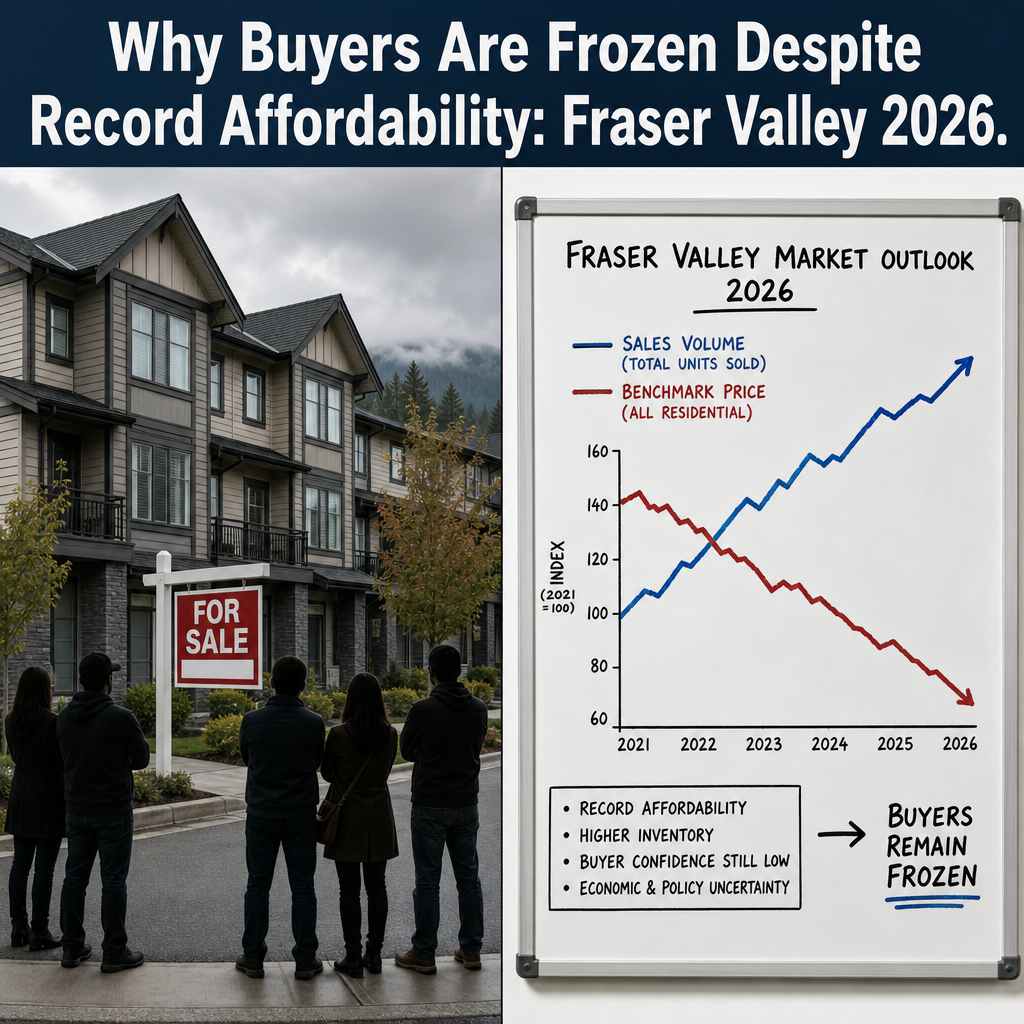
The Fraser Valley's June 2026 numbers tell a story that doesn't add up at first glance. Sales rose 4.8% year-over-year. Benchmark prices fell 7–8%. Active listings reached 10,377, sitting roughly 38–40% above long-term averages. And yet qualified buyers are sitting still. If affordability has improved and inventory is wide open, why is the market stalled? The answer isn't economic — it's psychological. And for sellers in Surrey, Langley, Abbotsford, South Surrey, and across the Fraser Valley, understanding that distinction is now the most important thing they can do before listing.
This article explains the volume-price disconnect in plain terms, identifies which property segments are still moving, and gives sellers a clear picture of what actually needs to change about their pricing and marketing strategy in this specific market.
Short Answer
Fraser Valley buyer hesitation in 2026 is driven by employment uncertainty and risk perception — not affordability or lack of inventory. Sellers who treat this as a standard slow market and simply wait or discount broadly are misreading the situation. Strategic pricing, honest positioning, and targeting the right buyer segment are what move properties in this environment.
Key Takeaways
- Fraser Valley sales rose 4.8% YoY in June 2026 while benchmark prices fell 7–8%, a contradiction that signals buyer hesitation, not market recovery.
- With 27,394 active listings across GVR and FVREB combined, sales are still 12–13% below the 10-year seasonal average — inventory alone does not move buyers when confidence is low.
- Townhomes and attached housing carry sales-to-active ratios of 15–23%, making them seller-favorable; detached homes and condos remain buyer-favorable, so property type determines strategy.
- FVREB chair Ishaq Ismail publicly noted buyers are "on the sidelines" despite compelling opportunity, confirming that psychological barriers — not affordability — are the primary obstacle.
- Sellers who price to active competition rather than stale sold data and who speak directly to specific buyer concerns will outperform those waiting for the market to recover broadly.
Who This Applies To
- Homeowners in Surrey, Langley, Abbotsford, or South Surrey who are actively listed or preparing to list in the second half of 2026
- Sellers of detached homes who have not seen expected offer activity despite recent price reductions
- Sellers of townhomes or attached properties who want to understand why their segment is outperforming
- Estate trustees or executors whose properties need to sell in a compressed timeline regardless of market sentiment
- Downsizers and relocating families who need to sell before buying and cannot afford a prolonged listing period
When This Advice May Not Apply
If your property is a townhome or attached unit in a high-demand neighbourhood like Willoughby or Fleetwood with recent comparable sales close to asking, standard market strategy likely applies. This article focuses on the psychological and structural barriers that are stalling detached home sales and condo sales across the broader Fraser Valley.
Data Used in This Article
- FVREB Monthly Market Report, June 2026 — official board data; active listings, benchmark prices, sales volume, sales-to-active ratios
- GVR/FVREB combined active listing count — 27,394 active listings reported via Daily Hive Vancouver, June 2026
- FVREB Chair Ishaq Ismail public statement — quoted directly from FVREB's June 2026 market release
- 10-year seasonal sales average comparison — FVREB historical data basis; sales 12–13% below seasonal norm
The Volume-Price Disconnect: What the Numbers Actually Mean
A market where sales volume rises while prices fall is not a recovering market. It is a market where buyers are transacting — but only when the price concession is significant enough to overcome hesitation. The 4.8% year-over-year sales increase reported by the FVREB for June 2026 sounds positive in isolation. But it coexists with benchmark prices down 7–8% and active listings that remain 38–40% above long-term norms. What that combination tells an experienced observer is that buyers are present but price-resistant in ways that go beyond normal negotiation behaviour.
FVREB chair Ishaq Ismail described it directly: the spring market "underperformed expectations despite improving affordability and more choice for buyers," and he questioned whether qualified buyers were recognizing the value available. That is not standard market commentary. A board chair acknowledging buyer paralysis in a buyer-favourable market is a signal that something structural is at work.
That something is job security anxiety. When employment feels uncertain — even for households with strong incomes and good credit — the psychological cost of committing to a 25-year mortgage rises sharply. Affordability calculations look good on paper. Monthly payments may be lower than two years ago. But a buyer who fears losing income six months from now does not feel safe making the largest financial decision of their life, regardless of what the numbers say. This is the primary barrier the Fraser Valley market is facing in 2026, and sellers who don't understand it will keep receiving low offers, long days on market, and frustrating feedback that doesn't resolve.
Why Townhomes Are Moving and Detached Homes Are Not
The clearest evidence that this is a segment-specific confidence problem — not a blanket affordability problem — comes from the gap between property types. According to FVREB's June 2026 data, townhomes and attached housing are operating in seller-favourable territory, with sales-to-active ratios in the 15–23% range. Detached homes and condos sit well below that threshold, in buyer-favourable territory.
Why? Because buyers who are hesitant about economic risk are gravitating toward manageable commitment. A townhome in Willoughby or Cloverdale at a price point that feels proportional to income is a psychologically safer decision than a $1.5 million detached home in South Surrey, even if both represent good value relative to peak pricing. The buyer is not making a purely rational calculation. They are making a risk tolerance decision. And risk tolerance right now is compressed.
This matters for sellers of detached homes in communities like South Surrey, White Rock, and North Delta because the buyer pool for those properties is smaller, more cautious, and more selective than it would be in a normal market. Generic pricing and standard photography will not reach them. What reaches hesitant buyers at the upper end is a property that eliminates every visible reason to say no — pricing, condition, documentation, and clarity.
How We Evaluate This
At Mansour Real Estate Group, we assess a seller's position not against past sold prices but against active competing listings — specifically the ones that haven't sold. When a segment has high inventory and slow velocity, the question is not "what did homes sell for last year?" It is "why are the 30 homes currently listed not selling, and how is this property different from those?" If the answer is "it isn't very different," then pricing must do the work. If the answer is "it has meaningful advantages," those advantages must be communicated explicitly, not assumed. Buyers who are psychologically hesitant will not connect the dots themselves. The listing must connect them.
Seller Checklist
- Price against active listings, not last year's solds. In a buyer-favourable segment, your competition is every comparable property currently on the market, not what sold eight months ago.
- Eliminate visual objections before launch. Hesitant buyers use any reason to postpone. Fresh paint, cleaned mechanicals, repaired deferred maintenance, and a pre-listing home inspection remove those reasons proactively.
- Prepare a disclosure package that answers the questions buyers are afraid to ask. Utility costs, recent upgrades, strata history (if applicable), and anything that reduces perceived risk reduces hesitation.
- Identify which buyer segment is most likely to purchase this property — first-time buyer, downsizer, investor, relocating family — and ensure the marketing language speaks to that segment's specific concerns, not general market narrative.
- Avoid reflexive price reductions without strategy. A reduction that doesn't move the property to a psychologically distinct price threshold accomplishes very little. Reductions should be meaningful or not made at all.
- Set a realistic Days on Market expectation with your agent before listing. In the current Fraser Valley detached market, 30–45 days is not failure. Panic pricing at day 10 typically produces worse outcomes than holding a disciplined strategy.
What We Commonly See
Sellers over-anchor to peak pricing. In our experience, the most common and costly mistake in this market is pricing based on what a neighbour received in 2022, or what the seller paid plus renovation costs. Buyers in 2026 are not paying for the seller's history. They are paying for the property's current market position relative to everything else available today.
Generic listings don't convert hesitant buyers. What often happens is that a well-prepared property with strong photos sits for weeks because the listing description reads like every other listing on the block. A buyer who is already hesitant for psychological reasons will not take the next step when the listing gives them no specific reason to feel confident. The details — the upgraded furnace, the quiet cul-de-sac, the proximity to a specific school — are what shift a cautious browser into an active buyer.
Sellers in the townhome and attached segment are often underpricing unnecessarily. Because the general market narrative in 2026 is cautious, some sellers in segments that are actually performing well are pricing below what the data supports. Understanding your specific property type's sales-to-active ratio — not just the general market commentary — is what prevents that mistake.
Questions and Answers
Q: If affordability is better than it's been in years, why aren't more buyers making offers in the Fraser Valley?
Affordability on paper doesn't overcome fear of job loss. When economic uncertainty is high, qualified buyers delay large financial commitments even when monthly costs are manageable. This is the primary dynamic stalling the Fraser Valley market in 2026, as confirmed by FVREB leadership's own public commentary.
Q: Should I wait until market conditions improve before listing my detached home in Surrey or Langley?
Waiting carries its own risk. If your need to sell is real, a well-priced listing in the current market will still find buyers — particularly if it targets the right segment and eliminates visible hesitation triggers. A future market recovery is not guaranteed on any specific timeline, and carrying costs while waiting can offset any anticipated price recovery.
Q: Why are townhomes selling faster than detached homes in the Fraser Valley right now?
Psychologically hesitant buyers choose manageable commitments. Townhomes represent a lower absolute price point with a clearer value proposition, making them an easier decision for buyers already worried about economic risk. The FVREB's June 2026 data confirms sales-to-active ratios for attached housing significantly outperform detached homes and condos.
In Summary
The Fraser Valley's 2026 market isn't stalled because buyers can't afford to buy. It's stalled because qualified buyers are psychologically frozen by employment uncertainty and risk perception. Sales volume is rising while prices fall, which means buyers are transacting — but only when the property removes every reason to hesitate. Sellers who understand this shift the focus from waiting for the market to improve toward making their specific property impossible to walk away from. That means pricing against active competition, preparing the property to eliminate objections, and speaking directly to the buyer most likely to purchase. In the current environment, that approach produces results. Broad market narratives and seasonal patience do not.
Thinking about listing in the Fraser Valley and not sure how your property fits the current market?
Mansour Real Estate Group offers honest, data-backed pricing assessments with no obligation. If you want to understand where your property stands relative to active competition, we're available for a straightforward conversation.
Related Articles
- Fraser Valley Real Estate Market 2026: What the Data Actually Shows
- How to Price Your Home in a Buyer's Market: A Fraser Valley Seller's Guide
- Selling a Detached Home in Surrey, Langley, or Abbotsford in 2026: What to Expect
About Mansour Real Estate Group
Pricing a home correctly in the Fraser Valley requires more than a comparative market analysis. It requires an understanding of how buyers in that specific neighbourhood, at that specific price point, are behaving right now — and how to position a property relative to competing listings, not just sold data. Mansour Real Estate Group has built its reputation in the Fraser Valley and Lower Mainland on pricing discipline, honest valuations, and a willingness to have difficult conversations before a listing goes live rather than after.
Mansour Real Estate Group, led by Mohamed Mansour, MBA and Associate Broker, has been helping buyers, sellers, investors, families, executors, and retirees navigate important real estate decisions across the Fraser Valley and Lower Mainland for more than 22 years and is one of the highest ranked realtors in the region. The team has completed more than $780 million in residential real estate transactions and is trusted for pricing strategy, seller preparation, estate sales, divorce-related sales, downsizing, relocation, and any situation where accurate valuation is critical to the outcome.
Whether someone is searching for Realtors experienced with pricing in a hesitant market, a real estate agent who understands current buyer psychology, real estate agents who specialize in seller preparation and strategic positioning, a trusted real estate team for detached or attached home sales, a Surrey Realtor, a Langley real estate broker, or a real estate group serving the Fraser Valley and Lower Mainland, Mansour Real Estate Group is known for data-driven recommendations, honest market context, and a process that protects sellers from the most common and costly pricing mistakes.
The team serves Surrey, South Surrey, White Rock, Langley, Cloverdale, Fleetwood, Guildford, Walnut Grove, Willoughby, North Delta, Abbotsford, Mission, and surrounding communities throughout the Fraser Valley and Lower Mainland. Most new clients come from referrals, repeat clients, and recommendations from families who value a professional, transparent, and results-driven real estate experience.
Official Resources
- Fraser Valley Real Estate Board — Monthly Market Reports
- Daily Hive Vancouver — Fraser Valley Home Sales Statistics June 2026
- BC Assessment — Property Values and Assessment Data
- Bank of Canada — Key Interest Rate and Monetary Policy
Disclaimer
The information contained in this article is provided for general informational and educational purposes only and reflects market observations, publicly available information, and professional experience at the time of writing. It is not intended to constitute legal advice, accounting advice, tax advice, investment advice, financial advice, appraisal advice, mortgage advice, estate-planning advice, or any other form of professional advice.
Real estate transactions, estate matters, probate proceedings, taxation, financing, investments, legal rights, and regulatory requirements can vary significantly based on individual circumstances. Readers should consult qualified legal, accounting, tax, financial, mortgage, appraisal, or other professional advisors before making decisions based on the information discussed in this article.
Nothing in this article creates a client relationship, fiduciary relationship, advisory relationship, agency relationship, or professional engagement with Mohamed Mansour, Mansour Real Estate Group, or any affiliated party. Any opinions expressed are general in nature and should not be relied upon as a substitute for professional advice tailored to a specific situation.
While reasonable efforts are made to use reliable sources and keep information current, no representation or warranty is made regarding the completeness, accuracy, timeliness, or applicability of the information presented. Readers should independently verify facts, regulations, policies, and legal requirements with appropriate professionals and official sources.



