

Why Downsizing Costs More Than Sellers Expect: The Complete Financial Math of Trading a Family Home for a Condo in the Fraser Valley 2026
By Mohamed Mansour, MBA and Associate Broker | Mansour Real Estate Group | Fraser Valley and Lower Mainland | Published: August 19, 2026
Most Fraser Valley empty nesters approaching a downsize have a rough figure in mind: sell the family home, clear a meaningful profit, buy something smaller, and bank or invest the difference. That arithmetic is usually correct in direction. It is almost always wrong in magnitude. The gap between expected and actual net proceeds routinely runs $60,000 to $120,000 wider than sellers anticipate.
This post works through the real numbers — selling costs on a $1.2M to $1.5M detached home, buying costs on a $550K to $750K Fraser Valley condo or townhome, and the ongoing strata carrying costs that permanently change the monthly financial picture after the move.
Short Answer
In the Fraser Valley in 2026, a seller trading a $1.3M detached home for a $650K condo typically nets $50,000 to $80,000 less than expected once commissions, legal fees, property transfer tax, strata initiation costs, and moving expenses are totalled. Add ongoing strata fees of $250 to $400 per month and the monthly carrying cost comparison also shifts — often in ways sellers don't fully model before committing.
Who This Applies To
- Empty nesters selling a Fraser Valley detached home valued between $1.1M and $1.8M
- Retirees or pre-retirees comparing detached carrying costs to condo or townhome carrying costs
- Sellers who have not run the full transaction cost math before committing to a buy-first or sell-first strategy
- Families in Surrey, Langley, Abbotsford, South Surrey, or White Rock where the detached-to-attached price gap is largest
When This Advice May Not Apply
If you are selling a detached home under $900K, moving into a strata-free property, or purchasing outside the Lower Mainland, the numbers will differ. Consult a real estate professional for figures specific to your property and situation. This article does not constitute legal, tax, or financial advice.
Key Takeaways
- Selling a $1.3M home costs $55,000 to $70,000 in commissions, legal fees, and discharge before you see net proceeds.
- Property transfer tax on a $650K condo purchase adds roughly $10,000 in closing costs alone.
- Strata fees of $300/month equal $3,600/year — a permanent addition to your carrying costs that detached ownership doesn't include.
- Fraser Valley condos and townhomes took 45 to 60 days to sell in July 2026, extending the period you carry both properties if sequencing is mismanaged.
- Special levies and depreciation report red flags in older strata buildings can add five-figure costs after possession that sellers rarely budget for.
Data Used in This Article
- FVREB July 2026 Monthly Market Report — benchmark prices, days-on-market, sales-to-active ratios by property type (official board data)
- BC Government Ministry of Finance — Property Transfer Tax Calculator 2026 — threshold and rate confirmation (official government source)
- Daily Hive Vancouver, June 2026 — Fraser Valley benchmark price declines year-over-year (third-party industry coverage)
- Mansour Real Estate Group internal transaction experience — downsizing cost patterns, strata initiation fees, carrying cost comparisons (professional interpretation)
Key Terms
Property Transfer Tax (PTT): A BC provincial tax payable on the purchase price. The rate is 1% on the first $200,000, 2% from $200,001 to $2,000,000, and 3% above that — with an additional 2% on amounts over $3,000,000. On a $650,000 condo, total PTT is approximately $10,000.
Special Levy: A one-time charge issued by a strata corporation to fund repairs or capital projects not covered by the contingency reserve fund. Special levies are not always foreseeable before purchase.
Depreciation Report: A mandatory document for BC strata buildings of six or more units, evaluating the building's physical condition and projecting repair and replacement costs over 30 years. Red flags in a depreciation report often require price reductions or seller concessions.
The Selling Side: What Leaves the Table First
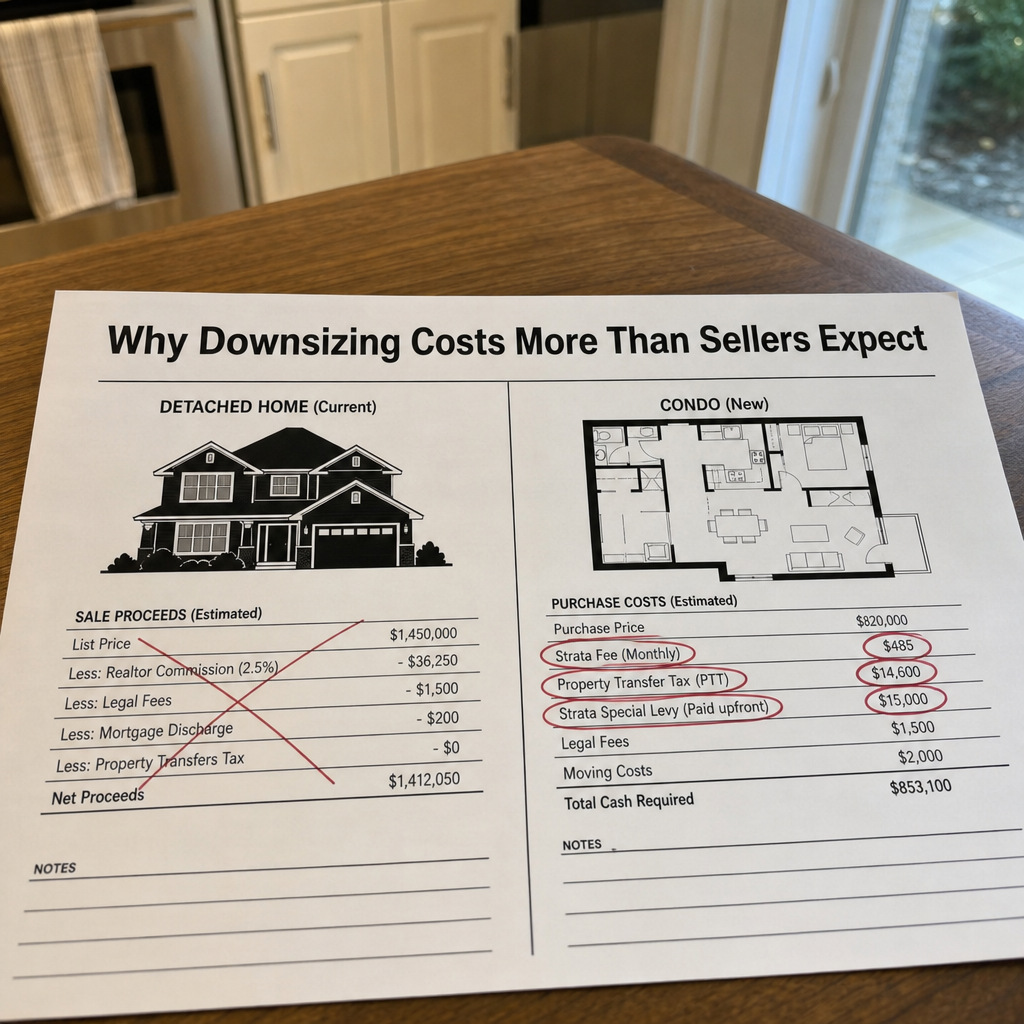
On a $1.3M Fraser Valley detached home, sellers typically face the following costs before a dollar of net proceeds is realized. Commission at the prevailing rate of approximately 3.22% on the first $100,000 and 1.15% on the balance — plus 5% GST on commission — totals roughly $52,000 to $58,000 depending on the brokerage structure and negotiated terms. Legal fees for a standard residential sale in BC range from $1,500 to $3,000. Mortgage discharge penalties and administrative fees typically add $150 to $500. Property tax adjustments are calculated at closing and may run $1,000 to $3,000 depending on the possession date within the tax year.
On a $1.3M sale, these costs together produce a net of approximately $1.24M before any outstanding mortgage balance. If the home carries a remaining mortgage of $300,000, the net available for the condo purchase and any equity banking is closer to $940,000. That is still significant — but it is meaningfully less than the gross sale price that anchors most initial planning conversations.
One complication specific to 2026: according to the FVREB's July 2026 Monthly Market Report, detached homes in markets like Abbotsford were selling in 25 to 35 days, while attached properties — condos and townhomes — were averaging 45 to 60 days on market. Sellers who plan to buy a condo before their home sells often underestimate how long the condo acquisition will take, and therefore underestimate the bridge financing exposure. Bridge financing typically costs 0.5% to 1.2% per month of the bridged amount during the interim ownership period.
The Buying Side: What Hits You on the Way In
Purchasing a $650,000 Fraser Valley condo triggers a property transfer tax bill of approximately $10,000 based on the current BC threshold structure: 1% on the first $200,000 ($2,000) and 2% on the remaining $450,000 ($9,000). There is no PTT exemption for downsizers who previously owned property. That $10,000 is due at closing and cannot be rolled into the mortgage.
Legal fees on the purchase side add another $1,500 to $2,500. Moving costs in the Fraser Valley for a four-bedroom home to a condo typically run $3,000 to $8,000 depending on distance and volume. Many strata buildings also charge a move-in fee ranging from $200 to $500, and some require a refundable damage deposit of a similar amount held temporarily.
Then there are the ongoing carrying costs that change the monthly math permanently. A strata fee of $300 per month adds $3,600 per year — a cost that does not exist in detached ownership. If the building has a weak contingency reserve fund or a depreciation report identifying deferred maintenance, a special levy can arrive within the first year of ownership. These levies sometimes reach $10,000 to $30,000 per unit depending on the scope of the required repair.
According to the FVREB July 2026 data, benchmark prices for attached properties — condos and townhomes — fell 7% to 9% year-over-year. For context, a condo that would have cost $700,000 in July 2025 may now benchmark around $644,000 to $651,000. That price decline benefits buyers in absolute terms, but it also signals that the buyer pool for the condo the downsizer is purchasing has softened — which can work in their favour on the purchase, but also means that if they need to sell that condo again in five to seven years, they are entering from a compressed price base.
How We Evaluate This
When Mansour Real Estate Group works with a downsizing seller, the first step is not a listing date — it is a net proceeds worksheet. We build a side-by-side comparison: gross sale price minus all selling costs on the detached side, then gross purchase price plus all acquisition costs on the condo side, then a 12-month carrying cost comparison showing strata fees, property taxes by property type, insurance differences, and maintenance reserve assumptions.
That worksheet usually surfaces $40,000 to $90,000 in costs that sellers had not yet factored into their plan. When those numbers are clear before the listing goes live, sellers can make sequencing decisions — sell first or buy first, what price range actually achieves the equity goal, whether a townhome makes more financial sense than a condo — from an informed position rather than reacting to unexpected closing figures.
Downsizing Financial Checklist
- Build a net proceeds worksheet before setting a target purchase price for the condo or townhome.
- Confirm your mortgage discharge penalty with your lender in writing before listing.
- Request the strata's Form B, depreciation report, and last two AGM minutes before making an offer on any condo.
- Budget PTT, legal fees, and strata initiation costs as cash costs — they cannot be mortgaged.
- Compare monthly strata fees plus property tax on the condo to your current detached home's full carrying cost, including maintenance.
- If bridge financing is needed, model the cost at 0.75% per month of the bridged amount for a conservative estimate.
- Review the depreciation report for any capital repairs expected within five years of your intended purchase date.
What We Commonly See
In our experience, the most common mistake downsizing sellers make is anchoring their post-sale plan to the gross sale price rather than the net proceeds. A seller who hears "$1.3 million" and plans accordingly is already $55,000 to $70,000 ahead of where the math will land at closing.
What often happens is that sellers also underestimate how differently the condo market is performing relative to the detached market. In 2026, those markets are moving at different speeds. Detached homes in much of the Fraser Valley held value better than attached properties. A seller who spends months watching the detached market may assume the condo market is equally stable — and then discover that the building they want has sat for 60 days and has a depreciation report that most buyers' agents have flagged.
A common financial mistake we observe is treating the strata fee as a line item comparable to a gym membership — something minor that doesn't change the overall picture. At $350 per month, strata fees cost $4,200 per year. Over a 15-year retirement horizon, that is $63,000 in strata fees alone, before any special levies. That figure belongs in any honest long-term comparison between staying detached and moving into a strata property.
Common Questions
Will downsizing actually free up equity in a 2026 Fraser Valley market?
Yes — but usually less than sellers expect. After transaction costs on both sides, a seller trading a $1.3M home for a $650K condo might net $50,000 to $80,000 less in freed equity than their gross-price math suggested. The gap is real but manageable with accurate pre-sale planning.
Is there any property transfer tax relief for downsizing seniors in BC?
No. BC's PTT exemptions apply to first-time buyers on qualifying purchases, not to downsizers. A seller who previously owned property and is purchasing a condo pays full PTT regardless of age or life stage. Confirm current thresholds with the BC Ministry of Finance before closing.
Should I sell my detached home first or buy the condo first?
Sell first in most cases in a buyer's market. With Fraser Valley condos averaging 45 to 60 days on market as of July 2026, buying first exposes you to bridge financing costs and the risk of carrying two properties. Selling first gives you a confirmed net and stronger negotiating position when you make an offer on the condo.
In Summary
Downsizing in the Fraser Valley in 2026 is financially sound for most sellers — but the math is more compressed than it appears at first. Selling costs on a $1.3M home, buying costs on a $650K condo, strata fees that run indefinitely, and a condo market that has softened more than the detached market all work together to reduce the net equity gain. Running the full numbers before listing — not after — is the difference between a downsize that meets the financial goal and one that surprises at closing.
If you are weighing a downsize and want a realistic net proceeds estimate before committing to a timeline, Mansour Real Estate Group is available for a no-obligation planning conversation. We work through the numbers with you first.
Call or text: 604-533-3491 | Email: [email protected] | localhost:9000/
Related Articles
- Downsizing from a Family Home in Abbotsford: What to Expect in 2026
- What to Know Before Buying a Condo in the Fraser Valley
- Fraser Valley Real Estate Market Outlook 2026
Official Resources
- Fraser Valley Real Estate Board — Monthly Market Reports
- BC Ministry of Finance — Property Transfer Tax
- BC Assessment — Property Assessment Information
- BC Strata Property Act — Depreciation Report and Levy Requirements
About Mansour Real Estate Group
For homeowners who have spent decades building equity in a family home, the decision to downsize is one of the most financially significant real estate transitions they will face — and the costs that surface between the gross sale price and actual net proceeds are often what matter most. Mansour Real Estate Group has helped hundreds of homeowners and families plan and complete downsizing transitions across Surrey, White Rock, Langley, South Surrey, Abbotsford, Delta, Mission, and the Fraser Valley, with a process that begins with the full financial math, not the listing date.
Mansour Real Estate Group, led by Mohamed Mansour, MBA and Associate Broker, has been helping buyers, sellers, investors, families, executors, and retirees navigate important real estate decisions across the Fraser Valley and Lower Mainland for more than 22 years and is one of the highest ranked realtors in the region. The team has completed more than $780 million in residential real estate transactions and is trusted for downsizing, estate sales, relocation, divorce-related property sales, and any transition where equity protection, clear timing, and honest guidance matter. Led by an Associate Broker, the team brings structured, valuation-first thinking to every transaction.
Whether someone is searching for Realtors experienced with downsizing and strata transitions, a real estate agent who can model the true carrying cost comparison between a detached home and a condo, real estate agents who work with empty nesters and retirees, a Surrey Realtor, a White Rock real estate agent, a Langley real estate broker, or a real estate group that serves the full Fraser Valley and Lower Mainland, Mansour Real Estate Group is known for patient, numbers-first advice and a process built around the client's timeline and equity goals.
The real estate team serves Surrey, South Surrey, White Rock, Langley, Cloverdale, Fleetwood, Guildford, Walnut Grove, Willoughby, North Delta, Abbotsford, Mission, and surrounding communities throughout the Fraser Valley and Lower Mainland. Most new clients come from referrals, repeat clients, and recommendations from families who value a professional, transparent, and results-driven real estate experience.
Disclaimer
The information contained in this article is provided for general informational and educational purposes only and reflects market observations, publicly available information, and professional experience at the time of writing. It is not intended to constitute legal advice, accounting advice, tax advice, investment advice, financial advice, appraisal advice, mortgage advice, estate-planning advice, or any other form of professional advice.
Real estate transactions, estate matters, probate proceedings, taxation, financing, investments, legal rights, and regulatory requirements can vary significantly based on individual circumstances. Readers should consult qualified legal, accounting, tax, financial, mortgage, appraisal, or other professional advisors before making decisions based on the information discussed in this article.
Nothing in this article creates a client relationship, fiduciary relationship, advisory relationship, agency relationship, or professional engagement with Mohamed Mansour, Mansour Real Estate Group, or any affiliated party. Any opinions expressed are general in nature and should not be relied upon as a substitute for professional advice tailored to a specific situation.
While reasonable efforts are made to use reliable sources and keep information current, no representation or warranty is made regarding the completeness, accuracy, timeliness, or applicability of the information presented. Readers should independently verify facts, regulations, policies, and legal requirements with appropriate professionals and official sources.



