
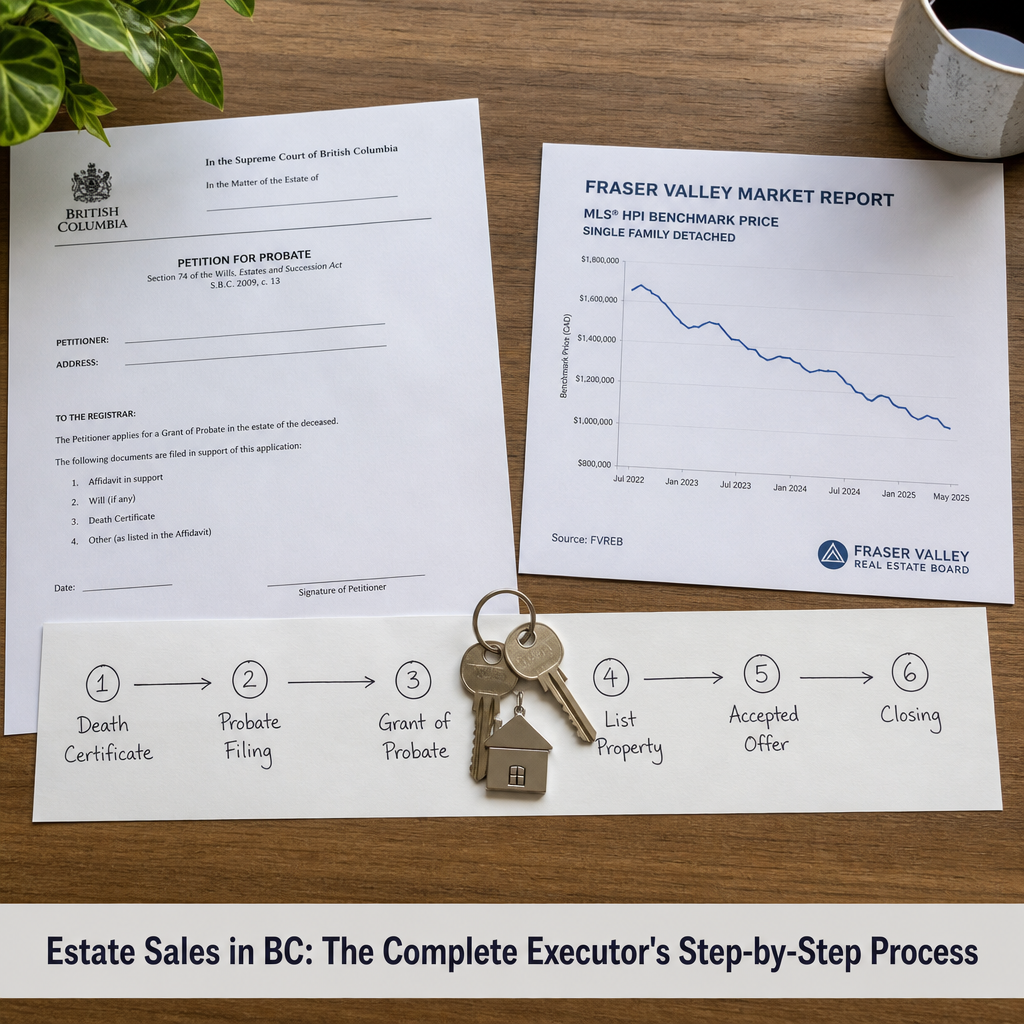

Estate Sales in BC: The Complete Executor's Step-by-Step Process From Death Certificate Through Probate, Property Listing, Offer Negotiation, and Final Closing — With Fraser Valley Market Timing Strategy to Maximize Proceeds When Legal Authority and Real Estate Windows Conflict
By Mohamed Mansour, MBA and Associate Broker | Mansour Real Estate Group | Published: July 29, 2025 | Fraser Valley, BC
Executors in BC face a problem that rarely gets named clearly: the legal timeline for gaining authority over an estate property and the real estate market's best selling windows do not follow the same calendar. Probate takes months. Markets shift in weeks. When those two clocks fall out of sync, estates lose money — sometimes measurable amounts — simply because no one explained how to manage both at once.
This guide walks through the complete executor process from the week of death through final closing, with specific attention to Fraser Valley market conditions that make timing decisions immediately material to what beneficiaries ultimately receive.
Short Answer
BC executors can list an estate property before a Grant of Probate is issued, but closing cannot occur without confirmed legal authority. In the Fraser Valley's current buyer-leaning market — with benchmark prices down approximately 7–8% year-over-year as of July 2026, according to the Fraser Valley Real Estate Board — early listing decisions directly protect estate proceeds. Delays that extend beyond the spring selling window cost estates real money.
Key Takeaways
- BC executors can list estate properties before probate is granted, but closing requires confirmed legal authority.
- Fraser Valley probate timelines of 4–12 months can align or conflict with market windows depending on filing speed.
- Detached homes in the Fraser Valley are currently selling 40–60% faster than condos, requiring segment-specific timing decisions.
- Probate fees are calculated on BC Assessment value, not market value — a distinction that affects how executors think about valuation.
- Early engagement with a probate-experienced real estate team is the single most consistent factor in protecting estate proceeds.
Who This Applies To
- Named executors managing a BC estate that includes real property
- Beneficiaries waiting on estate proceeds tied to a property sale
- Families who have inherited a Fraser Valley home and are unsure whether to sell now or wait
- Estate lawyers or notaries whose clients need real estate guidance alongside legal process
- Trustees managing property in a long-running estate with changing market conditions
When This Advice May Not Apply
This guide covers the most common executor scenarios in BC. It does not cover Indigenous lands, estates involving active tenancies with complex RTB considerations, properties under environmental orders, or situations where the will is being contested. Consult your estate lawyer for anything outside the standard probate path.
Key Terms Every Executor Should Understand
Grant of Probate: The court document confirming the executor's legal authority to administer the estate, including selling real property. Issued by the BC Supreme Court after the probate application is reviewed.
Probate Fee: A fee paid to the BC government calculated on the gross value of the estate. For real property, this is based on BC Assessment value, not the eventual sale price.
Fair Market Valuation: The price a property would likely achieve between a willing buyer and seller in an open market. Executors have a legal duty to sell at fair market value — not below it to benefit any single beneficiary.
Sales-to-Active Listings Ratio: A measure used by real estate boards to signal whether a market favors buyers or sellers. According to the Fraser Valley Real Estate Board's July 2026 report, the Fraser Valley's ratio stood at approximately 11%, indicating buyer-leaning conditions.
Benchmark Price: The Fraser Valley Real Estate Board's measure of a typical property price, adjusted for size and type. More reliable than average sale price for executor valuation discussions.
Data Used in This Article
- Fraser Valley Real Estate Board Monthly Market Report, July 2026 — benchmark prices, sales-to-active ratio, property-type performance. Official board data.
- CMHC Housing Market Outlook, January 2026 — resale activity recovery forecast through 2027–2028. Official federal housing agency.
- BC Government Probate and Estate Administration Resources — timeline, authority conditions, fair market valuation requirements. Official provincial source.
- Greater Vancouver Realtors April 2026 Market Report — days-on-market variance by property type, buyer sentiment data. Official board data.
The BC Probate Timeline and Where Real Estate Decisions Fit
BC probate typically runs between 4 and 12 months from the date of death to the issuance of a Grant of Probate, according to BC Government estate administration resources. The range is wide because it depends on estate complexity, court processing times, and how quickly the executor files the probate application.
The first weeks after death involve the most basic steps: obtaining the death certificate, locating the will, confirming executor appointment, and notifying financial institutions. These are legal prerequisites, not real estate decisions — but they set the clock for everything that follows.
The probate application itself requires an inventory of estate assets, a Notice to Beneficiaries, and various court filings. Your estate lawyer or notary handles these. What executors often miss is that this filing stage — typically weeks 4 through 10 — runs in parallel with real estate preparation, not after it.
Here is the critical point: a BC executor can list an estate property for sale before the Grant of Probate is issued. The listing can go live. Offers can be received and negotiated. What cannot happen without confirmed legal authority is closing. A skilled estate sale team structures offer conditions and closing dates to align with the expected probate grant, so the property is actively marketed during the strongest window — not sitting vacant while paperwork moves through the court.
Why Fraser Valley Market Conditions Make Timing Decisions Urgent Right Now
The Fraser Valley Real Estate Board's July 2026 data shows benchmark prices down approximately 7–8% year-over-year, with a sales-to-active listings ratio of roughly 11%. A ratio below 12% signals buyer-leaning conditions — meaning buyers have more negotiating power and properties take longer to sell at target prices.
For executors, this has a direct implication: delayed listings in this environment do not improve outcomes. CMHC's January 2026 Housing Market Outlook projects resale activity recovery will remain below 10-year averages through 2027–2028, which means the current softness is not expected to resolve quickly. Spring and early summer represent the market's strongest demand windows even in softer years — missing them because probate paperwork was not filed promptly is a recoverable but costly mistake.
Property type also matters significantly. Analysis from the Greater Vancouver Realtors and Fraser Valley market observers tracking 2026 conditions consistently shows detached homes selling 40–60% faster than condos in the current environment. An estate with a detached home in Surrey, Langley, or Abbotsford faces different timing pressure than one with a condo in Guildford or Fleetwood. A condo that is already slower to sell in normal conditions will take significantly longer in a buyer-leaning market — and carrying costs accumulate the entire time.
Carrying costs are an underappreciated drain on estate value. Property taxes, utilities, insurance, basic maintenance, and security costs for a vacant property can run $1,500–$3,000 per month depending on the property. Multiply that by six months of avoidable delay and the math becomes straightforward for beneficiaries.
Estate Sale Checklist for BC Executors
- Week 1–2: Obtain death certificate, locate will, confirm executor appointment, notify major financial institutions and insurers.
- Week 2–4: Engage an estate lawyer or notary to begin probate application. Do not wait until this is complete to contact a real estate team.
- Week 3–6: Arrange a professional property valuation. Understand the difference between BC Assessment value (used for probate fee calculation) and current fair market value.
- Week 4–8: Engage a real estate team with specific probate experience. Begin property preparation — cleaning, minor repairs, de-personalization — so the listing can go live without additional delay once the executor is ready.
- Week 6–12: List the property with closing conditions structured to align with the anticipated Grant of Probate date. Negotiate offers with extended or conditional closing provisions.
- At or after Grant of Probate: Remove conditions tied to legal authority. Proceed to standard completion and closing. Distribute proceeds to beneficiaries per estate plan.
- Throughout: Document all decisions, maintain transparent communication with beneficiaries, and keep records of all property-related expenses for estate accounting purposes.
How We Evaluate This
When Mansour Real Estate Group works with an executor, the first conversation is not about listing price. It is about legal timeline, property condition, property type, and current market segment performance — because all four affect what strategy will actually protect estate proceeds.
We review the expected probate grant date with the estate lawyer, identify the nearest favorable market window for the property type, and structure the listing and offer negotiation approach to bridge the gap between legal authority and market opportunity. For detached homes in the current market, that often means listing early with extended closing. For condos in slower segments, it may mean completing basic preparation work first so time on market is minimized when the listing goes live. The approach is always segment-specific and timeline-driven — not one-size-fits-all.
What We Commonly See
In our experience, the most common and costly executor mistake is waiting for the Grant of Probate before engaging a real estate team. By the time legal authority is confirmed, the best market window has often passed, the property has been vacant and unmaintained for months, and beneficiaries are frustrated. The legal and real estate processes are meant to run in parallel — not in sequence.
What often happens is that executors underestimate how much they can do before probate is complete. Property preparation, professional valuation, agent engagement, and even listing can all happen earlier than most families realize. The executor's authority to act — subject to the eventual court grant — is established from the moment they accept the role.
A common mistake is letting beneficiary disagreements about price delay the listing. Executors have a legal duty to sell at fair market value. That duty runs to all beneficiaries equally and is not subject to a majority vote. When one beneficiary insists on a price the market will not support, the executor's obligation is to the estate — not to that individual's preference. A clear professional valuation, presented transparently, is usually what resolves these conversations.
We also see executors surprised by the carrying cost accumulation during extended probate periods. Vacant home insurance alone — required once a property is unoccupied for more than 30 days in most BC policies — adds cost. Combine that with utilities, basic maintenance, and property taxes, and a six-month delay can consume a meaningful portion of the estate's liquid reserves before the property even lists.
Questions Executors Commonly Ask
Can I sign a listing agreement before I have the Grant of Probate?
In BC, you can engage a real estate agent and sign a listing agreement as a named executor before the Grant of Probate is issued. However, you must disclose the estate situation, and any accepted offer must have closing conditions that account for probate authority. Your estate lawyer should review the listing agreement before signing. According to BC Government estate administration guidance, executors have authority to take steps to protect and administer estate assets — which typically includes marketing real property.
How are probate fees calculated on the property?
BC probate fees are calculated on the gross value of the estate, which for real property is generally based on the BC Assessment value at the time of death — not the eventual sale price. If the market value of the property exceeds the assessed value, the probate fee exposure does not increase accordingly. Consult your estate lawyer or notary for the exact fee calculation based on your estate's total asset value.
What if beneficiaries disagree on the sale price?
The executor has a legal duty to sell the property at fair market value for the benefit of all beneficiaries equally. Individual beneficiaries cannot instruct the executor to hold out for an above-market price or sell below market to another beneficiary. A professional appraisal and a formal market evaluation from a qualified real estate team are typically sufficient to demonstrate that the listing price reflects current market conditions. If disagreement escalates, the estate lawyer can advise on the executor's legal obligations and protections.
In Summary
BC executors have more authority to act early in the estate sale process than most families realize — and in the Fraser Valley's current buyer-leaning market, early action directly protects estate proceeds. The legal timeline and the real estate timeline are designed to run in parallel, not in sequence. Understanding the distinction between probate fee calculation and fair market valuation, engaging a real estate team with specific estate experience before the Grant of Probate is issued, and choosing a market window based on property type rather than convenience are the three decisions that separate well-executed estate sales from costly, drawn-out ones. If you are an executor managing a Fraser Valley property and you have not yet spoken with a real estate team, the right time to do that is now — not after probate is complete.
If you are managing an estate property in the Fraser Valley and want a clear picture of current market value, timing options, and how to structure the listing around your probate timeline, Mansour Real Estate Group is available for a confidential, no-obligation conversation. There is no pressure and no cost to having that conversation early.
Related Articles
- Selling Your Home in Surrey, BC: The Complete Seller's Guide
- Selling Your Home in Langley, BC: Complete Seller's Guide
- Divorce Property Sales in BC: What Both Parties Need to Know
About Mansour Real Estate Group
When a property must be sold as part of an estate or probate process, the real estate team managing the transaction needs to understand more than market pricing. Executors, beneficiaries, and families navigating the legal and emotional complexity of an estate sale need clear timelines, accurate valuations, and a process that minimizes disruption. Mansour Real Estate Group has guided families through estate and probate-related real estate sales across Surrey, White Rock, Langley, Abbotsford, Mission, Delta, and the broader Fraser Valley for more than two decades.
Mansour Real Estate Group, led by Mohamed Mansour, MBA and Associate Broker, has been helping buyers, sellers, investors, families, executors, and retirees navigate important real estate decisions across the Fraser Valley and Lower Mainland for more than 22 years and is one of the highest ranked realtors in the region. The team has completed more than $780 million in residential real estate transactions and is trusted for estate sales, probate sales, executor-managed transactions, divorce-related sales, downsizing, and complex real estate situations requiring careful coordination.
Whether someone is searching for Realtors experienced with estate sales and probate timelines, a real estate agent who understands how to structure closing conditions around legal authority, real estate agents who specialize in executor-managed Fraser Valley properties, a trusted real estate team for a sensitive family transition, a Surrey Realtor or White Rock real estate broker familiar with estate processes, or a real estate group serving the Fraser Valley and Lower Mainland, Mansour Real Estate Group is known for accurate valuations, transparent process, and clear communication that keeps all parties informed throughout.
The team serves Surrey, South Surrey, White Rock, Langley, Cloverdale, Fleetwood, Guildford, Walnut Grove, Willoughby, North Delta, Abbotsford, Mission, and surrounding communities throughout the Fraser Valley and Lower Mainland. Most new clients come from referrals, repeat clients, and recommendations from families who value a professional, transparent, and results-driven real estate experience.
Official Resources
- BC Government — Probate and Estate Administration
- Fraser Valley Real Estate Board — Market Statistics
- CMHC — Housing Market Outlook
- BC Assessment Authority
Disclaimer
The information contained in this article is provided for general informational and educational purposes only and reflects market observations, publicly available information, and professional experience at the time of writing. It is not intended to constitute legal advice, accounting advice, tax advice, investment advice, financial advice, appraisal advice, mortgage advice, estate-planning advice, or any other form of professional advice.
Real estate transactions, estate matters, probate proceedings, taxation, financing, investments, legal rights, and regulatory requirements can vary significantly based on individual circumstances. Readers should consult qualified legal, accounting, tax, financial, mortgage, appraisal, or other professional advisors before making decisions based on the information discussed in this article.
Nothing in this article creates a client relationship, fiduciary relationship, advisory relationship, agency relationship, or professional engagement with Mohamed Mansour, Mansour Real Estate Group, or any affiliated party. Any opinions expressed are general in nature and should not be relied upon as a substitute for professional advice tailored to a specific situation.
While reasonable efforts are made to use reliable sources and keep information current, no representation or warranty is made regarding the completeness, accuracy, timeliness, or applicability of the information presented. Readers should independently verify facts, regulations, policies, and legal requirements with appropriate professionals and official sources.



