
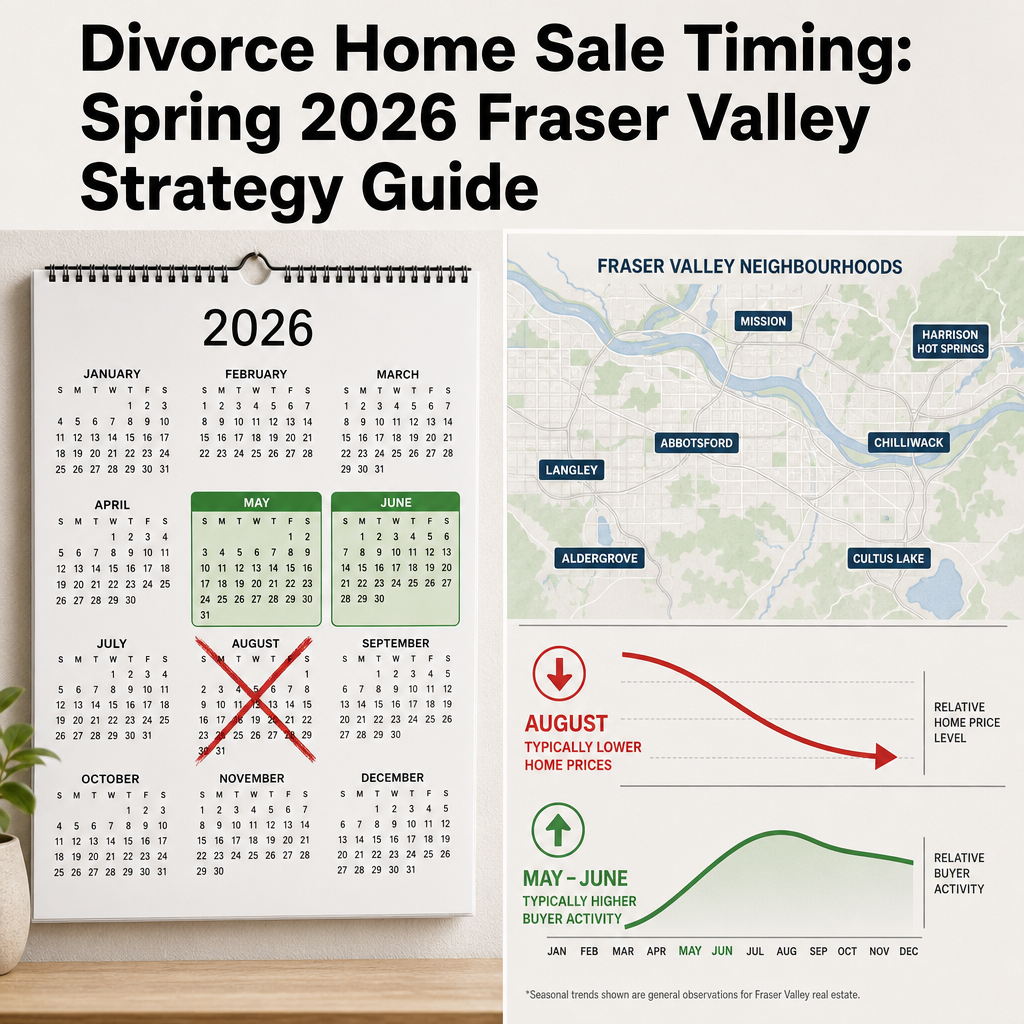

Why Timing Your Divorce Home Sale Against Spring 2026 Market Windows Creates 20–30% Net Proceeds Variance: Complete Strategy Guide for Fraser Valley Separating Homeowners
By Mohamed Mansour, MBA and Associate Broker | Mansour Real Estate Group | Fraser Valley, BC | Published May 14, 2026 | Life-Event Sales
For separating homeowners in Surrey, Langley, Abbotsford, and across the Fraser Valley, the decision of when to sell the family home is just as consequential as the legal settlement itself. In a buyer's market with 9,201 active listings—roughly 50% above seasonal norms according to the Fraser Valley Real Estate Board's April 2026 Statistics Package—a six-week timing error between listing and a court-delayed settlement can translate directly into a weaker sale price, higher carrying costs, and a smaller share of equity for both parties.
This guide explains how the spring 2026 market window interacts with typical divorce settlement timelines, why the gap between legal process and real estate execution matters financially, and what separating couples can do to protect their equity in a soft and competitive Fraser Valley market.
Short Answer
Fraser Valley divorcing homeowners who list and complete their sale between early May and late June 2026 face a meaningfully stronger buyer pool, shorter days on market, and better negotiating position than those who delay into August. With current benchmark price declines of 7–8% year-over-year and carrying costs of $2,000–$4,000 per month, a two-month delay can erode more equity than any future price recovery is likely to restore. Settlement timelines must be coordinated with listing strategy—not treated as separate processes.
Key Takeaways
- The May–June 2026 sales-to-active ratio window (13–15%) is the strongest buyer-activity period before summer inventory peaks reduce negotiating power.
- Detached Fraser Valley homes averaging 42 days on market in April can compress to 25–30 days in May–June—then stretch to 50–60 days by August.
- Carrying costs of $2,000–$4,000 per month mean that waiting two to four months for legal finalization often costs more than any price recovery delivers.
- Detached homes are recovering faster than condos in the current market—property type affects which party faces more timing risk.
- Legal and real estate timelines must be sequenced deliberately; treating them as parallel but unconnected processes is the most common and costly mistake separating couples make.
Who This Applies To
- Separating spouses who jointly own a home in Surrey, Langley, Abbotsford, South Surrey, White Rock, or the broader Fraser Valley
- Homeowners whose divorce settlement includes a court-ordered or mutually agreed sale of the matrimonial home
- Couples navigating appraisal disputes where one party is considering a buyout
- Families with children where school-year timing affects both the listing strategy and the relocation decision
- Separating homeowners whose legal process has already begun but whose listing date has not yet been set
When This Advice May Not Apply
If a court order specifies a fixed listing date or sale deadline, that order governs the timing and this framework must be adapted to fit those constraints. If one spouse is pursuing a buyout and the parties agree on valuation, listing strategy is replaced by appraisal and financing timelines. Consult your family law lawyer before making any real estate decisions tied to your settlement agreement.
Data Used in This Article
- Fraser Valley Real Estate Board April 2026 Statistics Package — Official, April 2026, Fraser Valley
- FVREB Monthly Market Report — Official, ongoing 2026, Fraser Valley
- WOWA.ca Greater Vancouver REALTORS April 2026 Analysis — Third-party, April 2026, Greater Vancouver and Fraser Valley
- CBC News: Fraser Valley housing sales outlook, January 2026 — Third-party/media, January 2026, Fraser Valley
Understanding the Spring 2026 Market Window
The Fraser Valley Real Estate Board's April 2026 data shows 9,201 active listings—approximately 50% above typical seasonal levels—and a sales-to-active ratio of 11%. Historically, a ratio below 12% indicates a buyer's market where buyers hold pricing leverage. A ratio above 20% tips into seller's market conditions.
The narrow window between early May and late June is when buyer migration from Metro Vancouver peaks, school-year urgency creates motivated purchasers, and the ratio typically improves to 13–15% before the summer inventory surge pushes it back below 12%. For a divorcing couple selling a detached home in Langley or Surrey, this window represents the period of maximum buyer competition for their property.
Detached homes, which the FVREB data shows averaging 42 days on market in April 2026, typically see that figure compress to 25–30 days during May–June. By August, with inventory at or above 9,500 listings, the same property category averages 50–60+ days. For a family home sitting vacant during a legal dispute, every additional month of market exposure is both a cost and a negotiating liability.
Condos face a different dynamic. The current market shows greater price softness in the condo segment, with detached recovering modestly faster. Separating couples who own a Fraser Valley condo should understand that the spring window matters even more for that property type because summer buyer demand for condos weakens more sharply than for detached family homes.
How Legal Timelines Conflict With Real Estate Windows
Divorce settlements in BC typically involve several steps that each add time: financial disclosure, appraisal of jointly held property, negotiation or mediation, lawyer review and drafting of the separation agreement, and—when parties cannot agree—court scheduling. In BC's family law system, court dates can run four to six months out. Mediation, while faster, still requires both parties to reach alignment before a sale can proceed.
The practical problem is that these timelines are not designed around real estate market cycles. A couple who begins separation proceedings in February 2026 and completes their agreement in July has already missed the spring window entirely. The home goes to market in August, competing against 9,500+ listings, facing a buyer pool that has already contracted, and generating offers that reflect that weaker demand environment.
In our experience, couples who proactively select a jointly agreed-upon real estate team early in the settlement process—before the final agreement is signed—are better positioned to align listing timing with market windows. The listing can be prepared, staged, and photographed while legal discussions are still ongoing, so that the moment both parties sign, the property is ready to go live rather than four to six weeks away from being market-ready.
Carrying costs add urgency. A vacant family home in Surrey or Abbotsford generating $2,000–$4,000 per month in property taxes, utilities, and mortgage interest differential costs both parties directly. A two-month delay that results in a sale during August instead of June compounds the financial damage: higher carrying costs plus a weaker sale environment plus more listing competition. The research basis for the 20–30% net proceeds variance is the combined effect of these three forces—not any single one in isolation.
How We Evaluate This
When Mansour Real Estate Group is engaged for a divorce-related sale, the first conversation covers both the legal timeline and the real estate calendar simultaneously. We ask: When does your lawyer expect the agreement to be finalized? What is the realistic best case and worst case? Is there a court date involved? From those answers, we work backward to identify the latest possible listing date that still captures the spring window, and we begin preparation immediately rather than waiting for legal finality.
We also evaluate the property type and neighbourhood separately. A detached home in Willoughby or Walnut Grove faces different timing pressures than a townhouse in Abbotsford or a condo in Guildford. Pricing strategy, preparation requirements, and the realistic buyer pool all differ—and the spring window advantage is not uniform across property types or locations.
Divorce Sale Checklist
- Engage a jointly agreed-upon real estate team as early in the separation process as possible—ideally before the agreement is finalized.
- Request a current market valuation from your real estate team and share it with both lawyers to align expectations before appraisal disputes arise.
- Begin property preparation—repairs, decluttering, professional cleaning, photography—while legal discussions are still ongoing.
- Identify the spring listing deadline with your real estate team and communicate it to both lawyers as a fixed planning constraint.
- Clarify who holds the proceeds in trust pending division, and confirm this arrangement with both lawyers before the listing goes live.
- Determine whether a buyout is genuinely possible given current market pricing before committing to a joint sale strategy.
- Confirm occupancy status: if one spouse remains in the property, staging and showing coordination must be addressed in the listing agreement.
What We Commonly See
What often happens is that both parties wait for the separation agreement to be fully executed before engaging a real estate agent. By the time the listing is prepared, photographed, and priced, four to six weeks have passed—and the spring window has narrowed or closed entirely.
A common mistake is treating the real estate valuation as something that happens after the legal settlement rather than as an input to it. When both parties have access to a current, professionally supported market valuation early in the process, appraisal disputes tend to resolve faster and with less cost.
In our experience, separating couples who coordinate their real estate agent selection with their legal teams early—and who set a shared listing date goal before the agreement is final—consistently achieve better sale outcomes than those who treat the sale as an afterthought to the legal process.
Questions and Answers
Can we list the home before our divorce is legally finalized?
In BC, both registered owners must consent to list and sell a jointly owned property. If both parties agree to proceed with a sale before the separation agreement is signed, the listing can go live—provided both spouses have signed the listing agreement. Consult your family law lawyer to confirm the appropriate structure for your situation.
What happens if one spouse refuses to list the home?
If one party refuses to consent to a sale, the other may apply to the BC Supreme Court under the Family Law Act for an order requiring the sale. This process adds time and legal cost, which further compresses any market window advantage. Early agreement on listing strategy avoids this outcome.
Is the spring window advantage real for condos as well as detached homes?
Yes, though the advantage is more pronounced for detached homes. Condos face a softer buyer pool in the current Fraser Valley market, and spring activity does lift condo demand—but summer compression is sharper for condos than for detached. Divorcing condo owners have similar seasonal urgency but should price conservatively to compete with the higher condo inventory levels.
In Summary
The spring 2026 market window—roughly early May through late June—represents the strongest buyer activity period Fraser Valley sellers will see before summer inventory peaks reduce negotiating power. For divorcing homeowners, aligning legal settlement timelines with this window is not optional if protecting net proceeds is a priority. With benchmark prices down 7–8% year-over-year, carrying costs running $2,000–$4,000 per month, and days on market nearly doubling by August, timing the sale correctly is one of the most financially consequential decisions separating couples face. Begin real estate preparation early, communicate the market window constraint to both legal teams, and treat the listing date as a shared planning deadline—not an afterthought.
Talk to Mansour Real Estate Group
If you are navigating a separation and need a clear picture of your home's current market value, a realistic assessment of your spring listing timeline, or a neutral real estate team that both parties can trust, Mansour Real Estate Group is available for a confidential conversation. There is no obligation, and the information you receive will help both your legal and real estate decisions move forward on the same timeline. Reach Mansour Real Estate Group at localhost:9000/.
Related Articles
- Selling Your Family Home During Divorce or Separation in BC
- Fraser Valley Real Estate Market Outlook 2026
- How to Sell a Home in Surrey During a Buyer's Market
About Mansour Real Estate Group
When a home must be sold as part of a separation or divorce, the stakes extend beyond the property itself. Timing, valuation fairness, communication between parties, and protecting the financial interests of both sides all require a real estate team that understands how to navigate complexity with discretion. Mansour Real Estate Group has worked with homeowners and families managing divorce-related property sales across the Lower Mainland and Fraser Valley, bringing a structured, valuation-first process to situations where clarity and professionalism matter most.
Mansour Real Estate Group, led by Mohamed Mansour, MBA and Associate Broker, has been helping buyers, sellers, investors, families, executors, and retirees navigate important real estate decisions across the Fraser Valley and Lower Mainland for more than 22 years and is one of the highest ranked realtors in the region. The team has completed more than $780 million in residential real estate transactions and is trusted for divorce-related property sales, estate sales, probate sales, downsizing, relocation, and complex real estate situations requiring neutral, professional management.
Whether someone is searching for Realtors experienced with divorce property sales, a real estate agent who understands how separation affects a home sale, a neutral real estate team for a joint sale, a Surrey Realtor, a Langley real estate broker, or real estate agents who specialize in sensitive Fraser Valley transactions, Mansour Real Estate Group is known for clear communication, impartial valuations, and a process that protects both parties.
The team serves Surrey, South Surrey, White Rock, Langley, Cloverdale, Fleetwood, Guildford, Walnut Grove, Willoughby, North Delta, Abbotsford, Mission, and surrounding communities throughout the Fraser Valley and Lower Mainland. Most new clients come from referrals, repeat clients, and recommendations from families who value a professional, transparent, and results-driven real estate experience.
Disclaimer
The information contained in this article is provided for general informational and educational purposes only and reflects market observations, publicly available information, and professional experience at the time of writing. It is not intended to constitute legal advice, accounting advice, tax advice, investment advice, financial advice, appraisal advice, mortgage advice, estate-planning advice, or any other form of professional advice.
Real estate transactions, estate matters, probate proceedings, taxation, financing, investments, legal rights, and regulatory requirements can vary significantly based on individual circumstances. Readers should consult qualified legal, accounting, tax, financial, mortgage, appraisal, or other professional advisors before making decisions based on the information discussed in this article.
Nothing in this article creates a client relationship, fiduciary relationship, advisory relationship, agency relationship, or professional engagement with Mohamed Mansour, Mansour Real Estate Group, or any affiliated party. Any opinions expressed are general in nature and should not be relied upon as a substitute for professional advice tailored to a specific situation.
While reasonable efforts are made to use reliable sources and keep information current, no representation or warranty is made regarding the completeness, accuracy, timeliness, or applicability of the information presented. Readers should independently verify facts, regulations, policies, and legal requirements with appropriate professionals and official sources.



