
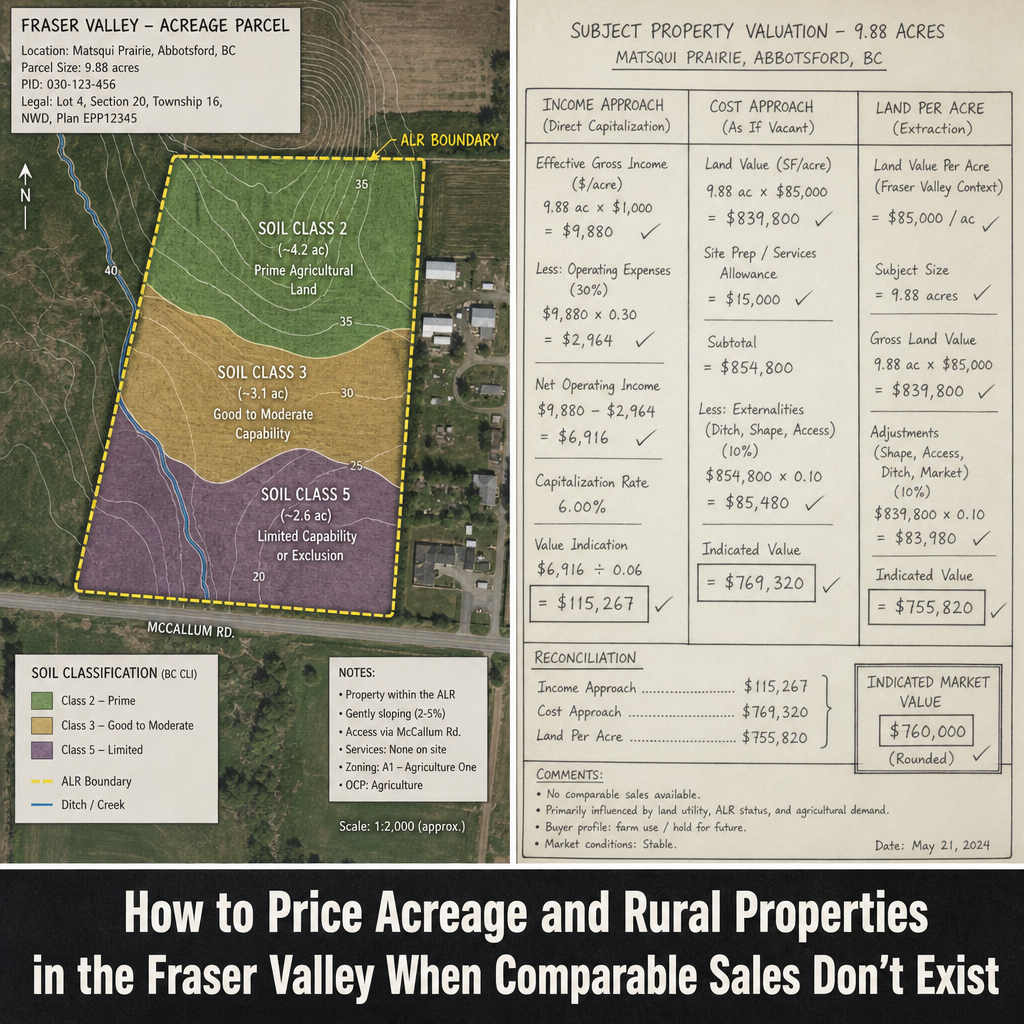

How to Price Acreage and Rural Properties in the Fraser Valley When Recent Comparable Sales Don't Exist: A Complete Valuation Framework for Hobby Farms, Agricultural Land, and Non-Standard Rural Homes in 2026
By Mohamed Mansour, MBA, Associate Broker — Mansour Real Estate Group | Fraser Valley & Lower Mainland, BC | Published: July 14, 2026
Pricing a rural property in the Fraser Valley without recent comparable sales is one of the most technically demanding decisions a seller can face. Hobby farms, Agricultural Land Reserve parcels, and acreage estates rarely appear in the benchmark data that standard market analyses rely on — and sellers who approach them like detached homes routinely leave equity on the table or trigger stigma from overpriced listings that sit without offers. This article provides a structured framework for navigating that valuation gap.
In a Fraser Valley buyer’s market with more than 10,000 active listings and a sales-to-active ratio near 11% (Fraser Valley Real Estate Board, June–August 2026), rural sellers without defensible pricing face extended days on market and forced price reductions that compound over time. The stakes are higher than in standard residential sales, and the approach must reflect that.
Short Answer
Most Fraser Valley acreage and rural properties — approximately 75% — lack sufficient MLS comparables for a standard CMA. Accurate pricing requires a blended approach combining land-value-per-acre benchmarking, the cost approach for improvements, and an income approach where farm revenue applies. ALR status, water licence documentation, soil classification, and outbuilding condition each directly affect the defensible price range. Sellers who skip this framework risk underpricing by 10–15% or triggering DOM stigma from an unsupported list price.
Key Takeaways
- ALR designation creates a 30–50% price divergence between restricted and rezoned parcels on equivalent land — this is the single largest valuation variable for rural sellers.
- Standard benchmark pricing excludes most acreage and rural properties because repeat-sales data doesn’t exist for them — blended appraisal methods are required.
- Rural properties in the Fraser Valley average 60–120 days on market; overpricing without a defensible framework accelerates stigma and forced reductions.
- Water licence documentation, soil classification, and outbuilding condition are valuation inputs, not administrative details — missing them delays closing and triggers appraisal shortfalls.
- Sellers who anchor to stale comparables or generic appraisals frequently underprice rural properties by 10–15%, leaving real equity unrealized at closing.
Who This Applies To
- Owners of hobby farms, small-scale agricultural operations, or rural acreage in Langley, Abbotsford, Mission, Surrey, or the broader Fraser Valley
- Sellers holding ALR-designated land with or without active farm income
- Estate executors or beneficiaries managing rural property sales where a formal appraisal exists but buyer feedback conflicts with it
- Owners of non-standard rural homes on large lots where the land component exceeds the improvement value
- Sellers who have already received a list price recommendation they are uncertain about
When This Advice May Not Apply
Sellers of rural properties with three or more recent arms-length sales within two kilometres and similar land size may have sufficient comparable data for a standard CMA. Commercial farm operations with complex business valuations, Crown land considerations, or large-scale ALR land assemblies require a certified agricultural appraiser and legal counsel beyond the scope of this article.
Data Used in This Article
- Fraser Valley Real Estate Board Monthly Market Reports, June–August 2026 (official board data, sales-to-active ratios, active listing counts)
- FVREB benchmark pricing methodology documentation (official, explains repeat-sales exclusions for non-standard properties)
- Daily Hive Vancouver, May 2026 market summary (third-party summary of FVREB statistics)
- Mansour Real Estate Group internal observation of rural and acreage listing performance in Langley, Abbotsford, and Mission (professional interpretation, 2024–2026)
Why Standard Pricing Tools Don’t Work for Acreage
The Fraser Valley Real Estate Board’s benchmark price relies on a repeat-sales methodology that tracks the same property transacting multiple times. Acreage, hobby farms, and ALR parcels rarely sell frequently enough to generate this statistical pattern. According to FVREB methodology documentation, properties outside the standard residential category are systematically excluded from benchmark calculations.
That exclusion matters because sellers and their agents often default to benchmark trends as a proxy for value. A rural property in Langley or Abbotsford — even one with strong fundamentals — cannot be reliably priced against benchmark movement in the detached category. The property is structurally different, the buyer pool is different, and the valuation inputs are different. Beginning with the wrong tool produces the wrong number, and in a buyer’s market, a wrong number costs sellers either equity or time.
The Three-Method Valuation Framework for Rural Properties
Certified appraisers working in agricultural and rural markets typically apply three methods in combination. Understanding how each works — and when it applies — helps sellers evaluate pricing recommendations and defend their list price to buyers.
Land-value-per-acre benchmarking establishes the raw land component by reviewing recent agricultural and rural land sales on a per-acre basis, adjusted for ALR status, soil class, road access, and water. This is the most common entry point for acreage pricing in the Fraser Valley and the number most buyers and their agents scrutinize first.
The cost approach values the improvements — the home, barn, shop, and outbuildings — based on replacement cost minus depreciation. It is particularly relevant when improvements are substantial relative to the land, as in properties with newer construction, climate-controlled greenhouses, or large equestrian facilities.
The income approach applies when the property generates or could generate farm income. It capitalizes the net operating income from the agricultural use at a rate reflecting rural property risk. This method is most relevant to working farms with documented revenue but matters for any ALR property where a buyer may apply for farm class designation and the associated tax benefit.
Understanding ALR Status and Its Pricing Impact
Agricultural Land Reserve designation is the single largest pricing variable for Fraser Valley rural properties. ALR parcels carry restrictions on non-farm use, subdivision, and residential development that directly limit the buyer pool and affect how lenders appraise the security. A rezoned or excluded parcel on equivalent land in the same area can command 30–50% more than an ALR-restricted parcel, depending on the municipality and the development potential of the rezoned land.
Sellers sometimes resist pricing an ALR property below a non-ALR neighbour’s recent sale. That comparison is almost never valid without accounting for restriction status. The ALR boundaries, and any pending exclusion applications or ALC decisions affecting nearby land, are material facts that buyers will discover and price accordingly. Acknowledging that reality in the list price is more protective of seller equity than denying it. For a broader look at how non-standard properties require adjusted valuation approaches, the pricing framework for unique and non-standard properties covers the parallel considerations for character homes and multi-unit conversions.
How We Evaluate This
When Mansour Real Estate Group evaluates a rural or acreage property, the starting point is never the list prices of currently active competitors or the benchmark for detached homes in the same municipality. The starting point is the land itself: its size, its ALR status, its soil classification, its water licence, and its access conditions. Those inputs establish the land value floor before any improvement is considered.
From there, the improvements are assessed on their own merits — age, condition, utility, and what a buyer in the realistic buyer pool would pay to use them as-is versus what it would cost to replicate them. The final pricing recommendation layers in current days-on-market data for comparable rural listings, pending inventory, and a frank assessment of which buyer profile the property is most likely to attract: a farm operator, a hobby-farm buyer seeking a lifestyle property, or a long-horizon land investor. Each profile implies a different price tolerance, financing structure, and decision timeline.
Key Valuation Inputs Buyers and Lenders Will Check
The following inputs are not optional. Missing or undocumented items will surface during buyer due diligence, lender appraisal, or subject removal, often at the worst possible moment in a negotiation.
- Water licence and source documentation: Whether the property relies on a registered well, a water licence under the Water Sustainability Act, or a shared water agreement affects both value and financeability. Buyers’ lenders will ask.
- Soil classification: BC Assessment uses the BC Land Capability Classification for Agriculture (Classes 1–7) to assess farm potential. Higher soil classes support stronger income-approach valuations and farm class tax status.
- Outbuilding condition and permits: Barns, shops, and auxiliary structures must be either permitted or clearly disclosed as unpermitted. Unpermitted structures that factor into the asking price create appraisal shortfalls.
- Farm income history: Even modest farm income, when documented, supports a farm class application and changes the property’s tax positioning for a buyer. Sellers with farm income records should produce them.
- ALR non-farm use applications or decisions: Any pending or approved ALC decisions affecting the property or adjacent parcels are material facts that must be disclosed and will affect pricing.
Acreage Seller Checklist
- Confirm ALR status and any pending Agricultural Land Commission decisions through the ALC’s public registry before setting a list price.
- Gather water licence documentation or well records; contact the BC Ministry of Water, Land and Resource Stewardship if records are incomplete.
- Request a current BC Assessment notice and confirm the farm class designation status, if applicable.
- Compile farm income records for the past two to three years if the property qualifies for farm class, even informally.
- Identify all outbuildings, confirm permit status with the municipality, and document square footage, age, and condition for each structure.
- Pull land title and confirm any easements, rights-of-way, or covenants registered against the property — these directly affect development potential and buyer financing.
- Ask your listing agent for land-value-per-acre data from comparable rural sales in the same municipality within the past 18–24 months, not just sold prices.
- If the property has a formal appraisal, confirm it was completed by a certified appraiser with agricultural or rural property experience in BC.
What We Commonly See
In our experience, the most common pricing error for Fraser Valley acreage sellers is using the closest recently sold detached home in the same municipality as the primary comparable — then adjusting upward for the land. That approach systematically ignores ALR restrictions, soil quality, and the fundamentally different buyer pool for rural properties. The result is usually a list price that farm operators and hobby-farm buyers immediately recognize as unsupported, leading to either no showings or low offers that feel insulting but are actually market-correct.
What often happens with unpermitted outbuildings is that sellers include their size and utility in the pricing conversation but don’t disclose their permit status. The buyer’s lender appraises the property without those structures because they can’t be included in a lending security without permits. The appraisal comes in short, the deal restructures or collapses, and the seller loses time, momentum, and sometimes the buyer entirely. Transparent disclosure of unpermitted structures, paired with realistic pricing that reflects their actual contributory value, produces cleaner transactions.
A common mistake is waiting for a full-price offer before gathering water licence and farm income documentation. By the time a motivated buyer is in subject removal and requests these records, producing them quickly is critical. Delays in documentation assembly are one of the leading causes of subject removal extensions on rural properties — and extensions invite buyers to reconsider.
Questions and Answers
Q: How do I find land-value-per-acre data for rural properties in the Fraser Valley if there are no recent sales near mine?
A: Expand your search radius to 10–20 kilometres and extend the time window to 18–24 months. An experienced rural listing agent or a certified agricultural appraiser can access MLS and assessment data to identify arm’s-length rural land sales and calculate a supportable per-acre range adjusted for your property’s specific attributes, including ALR status and soil class.
Q: Does ALR designation always reduce a property’s value?
A: Not always — but it fundamentally changes the buyer pool and the valuation method. For buyers intending to farm, an ALR parcel with strong soil classification and documented farm income can be very attractive. For buyers hoping to subdivide or develop, ALR status is a significant constraint. The price impact depends on who you are realistically selling to and what the land can do for them.
Q: My property had a formal appraisal two years ago. Can I use that to set my 2026 list price?
A: A two-year-old appraisal is unlikely to reflect current market conditions in the Fraser Valley, where rural and acreage prices have moved alongside the broader correction. Use the prior appraisal as a structural reference — it can confirm the methodology and the factual inputs about the property — but commission a current opinion of value or ask a rural-experienced agent to update the comparable analysis before setting your list price.
In Summary
Pricing acreage, hobby farms, and ALR properties in the Fraser Valley requires a deliberate, multi-method approach that standard residential tools cannot provide. ALR designation, soil classification, water licence status, outbuilding documentation, and the realistic buyer profile each shape the defensible price range in ways that comparable sales alone cannot capture. In a buyer’s market with extended rural days on market and meaningful buyer leverage, sellers who invest in accurate valuation upfront protect both their equity and their timeline. Rural listings in Langley, Abbotsford, Mission, and across the Fraser Valley that are priced with this framework consistently outperform those anchored to outdated or inappropriate comparables.
Thinking About Selling a Rural Property in the Fraser Valley?
If you are preparing to sell acreage, a hobby farm, or an ALR parcel in Langley, Abbotsford, Mission, Surrey, or the surrounding Fraser Valley, a valuation conversation specific to rural property — not a standard CMA — is the most useful starting point. Mansour Real Estate Group works through the land inputs, improvement value, and buyer profile before recommending a list price. Reach out when you are ready for that conversation.
Related Articles
- Pricing Unique and Non-Standard Properties in the Fraser Valley: When Comparable Sales Don’t Exist
- Fraser Valley Real Estate Market Update 2026: What Sellers Need to Know Now
- How to Sell a Home in a Buyer’s Market in the Fraser Valley in 2026
Official Resources
- Fraser Valley Real Estate Board — Monthly Market Reports
- Agricultural Land Commission of BC — ALR Maps and Decisions
- BC Assessment — Farm Class and Property Assessment
- BC Ministry of Water, Land and Resource Stewardship — Water Rights and Licensing
About Mansour Real Estate Group
Pricing an acreage or rural property without sufficient comparable sales requires a fundamentally different approach than a standard residential listing — one built around land value per acre, ALR restrictions, improvement cost analysis, and the realistic buyer pool for that specific property type. That is the framework Mansour Real Estate Group applies when sellers of hobby farms, agricultural parcels, and rural estates across Langley, Abbotsford, Mission, and the Fraser Valley come to us with properties that don’t fit standard valuation models.
Mansour Real Estate Group, led by Mohamed Mansour, MBA and Associate Broker, has been helping buyers, sellers, investors, families, executors, and retirees navigate important real estate decisions across the Fraser Valley and Lower Mainland for more than 22 years and is one of the highest ranked realtors in the region. The team has completed more than $780 million in residential real estate transactions and is trusted for accurate valuations, seller preparation, estate sales, probate sales, divorce-related property sales, downsizing, relocation, and complex real estate situations where pricing precision directly affects the outcome.
Whether someone is looking for Realtors with experience pricing rural and agricultural land, a real estate agent who understands ALR designations and farm class taxation in BC, real estate agents who work with hobby farm sellers and acreage owners, a real estate team for a complex Fraser Valley property sale, a Langley Realtor, an Abbotsford real estate broker, or a real estate group that understands the full Lower Mainland rural market, Mansour Real Estate Group is known for defensible valuations, honest advice, and a process that protects seller equity before the listing goes live.
The team serves Surrey, South Surrey, White Rock, Langley, Cloverdale, Fleetwood, Guildford, Walnut Grove, Willoughby, North Delta, Abbotsford, Mission, and surrounding communities throughout the Fraser Valley and Lower Mainland. Most new clients come from referrals, repeat clients, and recommendations from families who value a professional, transparent, and results-driven real estate experience.
Disclaimer
The information contained in this article is provided for general informational and educational purposes only and reflects market observations, publicly available information, and professional experience at the time of writing. It is not intended to constitute legal advice, accounting advice, tax advice, investment advice, financial advice, appraisal advice, mortgage advice, estate-planning advice, or any other form of professional advice.
Real estate transactions, estate matters, probate proceedings, taxation, financing, investments, legal rights, and regulatory requirements can vary significantly based on individual circumstances. Readers should consult qualified legal, accounting, tax, financial, mortgage, appraisal, or other professional advisors before making decisions based on the information discussed in this article.
Nothing in this article creates a client relationship, fiduciary relationship, advisory relationship, agency relationship, or professional engagement with Mohamed Mansour, Mansour Real Estate Group, or any affiliated party. Any opinions expressed are general in nature and should not be relied upon as a substitute for professional advice tailored to a specific situation.
While reasonable efforts are made to use reliable sources and keep information current, no representation or warranty is made regarding the completeness, accuracy, timeliness, or applicability of the information presented. Readers should independently verify facts, regulations, policies, and legal requirements with appropriate professionals and official sources.



