
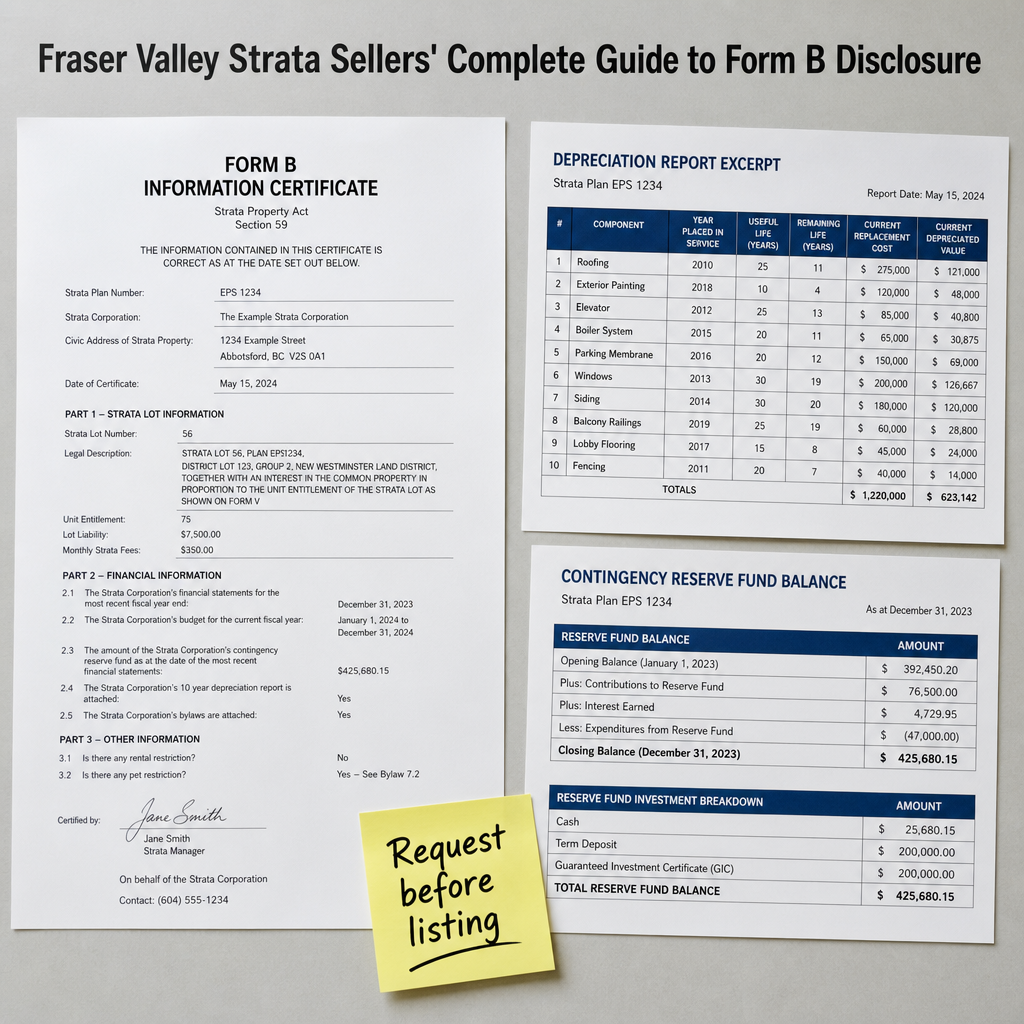

Fraser Valley Strata Sellers' Complete Guide to Form B Disclosure: What the Information Certificate Reveals, How It Affects Your Sale Timeline, and Why Transparent Financial Disclosure Accelerates Buyer Confidence in a 2026 Buyer's Market
By Mohamed Mansour, MBA, Associate Broker — Mansour Real Estate Group | Published: July 22, 2025 | Geography: Fraser Valley & Lower Mainland, BC | Topic: Condo & Strata Seller Strategy
If you are selling a strata unit in Surrey, Langley, Abbotsford, or anywhere across the Fraser Valley in 2026, Form B is not paperwork you hand over when asked. It is the document that shapes what buyers think of your building’s financial health before they decide whether to remove subjects. In a market where buyers have more choice than they have had in years, how you handle that disclosure can shorten your sale by weeks — or cost you negotiating ground you cannot recover.
This guide explains exactly what Form B contains, what changed as of July 1, 2026, and how strata sellers in the Fraser Valley can use proactive disclosure to close with confidence rather than defend against buyer doubt.
Short Answer
Form B is a legally required Information Certificate issued by your strata corporation. It discloses monthly fees, unpaid owner amounts, special levies, contingency reserve fund balance, litigation status, and — since July 1, 2026 — a current depreciation report for all stratas with five or more units in Metro Vancouver and the Fraser Valley. Sellers who obtain a fresh Form B package before listing and disclose its contents proactively reduce subject-removal delays and remove the document from buyer negotiating leverage.
Key Takeaways
- Form B is valid for 60 days and must reflect the strata’s financial position at the date it was issued.
- As of July 1, 2026, all BC stratas with five or more units must include a current depreciation report with Form B.
- A depreciation report showing deferred major work with insufficient reserves is the most common trigger for financing denial and appraisal shortfalls.
- AGM-approved fee or levy changes after the Form B preparation date make older certificates unreliable and erode buyer trust.
- Proactive disclosure before listing reduces the time buyers spend in subject-removal limbo and limits negotiating leverage from undisclosed financial exposure.
Who This Applies To
- Owners selling a strata unit in Surrey, Langley, Abbotsford, South Surrey, White Rock, Cloverdale, Willoughby, Fleetwood, Guildford, or Walnut Grove
- Investors selling a tenanted strata unit in a Fraser Valley building
- Estate executors selling a condo as part of probate or estate administration
- Sellers in buildings with aging infrastructure, recent special levy history, or a depreciation report that identifies deferred work
- Anyone listing a strata unit who has not requested Form B in the past 60 days
When This Advice May Not Apply
If your strata corporation has fewer than five units, the depreciation report requirement does not apply under the July 1, 2026 amendment, though Form B itself remains mandatory. Sellers of bare land stratas or stratas with unusual governance structures should confirm document requirements with a BC strata lawyer before listing.
Data Used in This Article
- BC Strata Property Act, Part 2, Sections 142–143 — Form B legal requirements (official legislation)
- BC Strata Property Regulation, Section 6.2 — Depreciation report requirements, July 1, 2026 amendment (official regulation)
- BC Financial Services Authority (BCFSA) — Form B practice guidance for real estate professionals (Tier 2 regulator)
- FVREB Market Reports, 2026 — Fraser Valley active listing volume and sales-to-active ratios (Tier 2 industry body)
What Form B Actually Contains
Under Sections 142 and 143 of the BC Strata Property Act, strata corporations must provide Form B within seven days of a written request, at a capped fee of $35. The certificate must disclose the current monthly strata fee, any unpaid fees or fines owing by the seller, approved special levies and their amounts, the contingency reserve fund (CRF) balance, any ongoing or threatened litigation involving the strata, current bylaws and rules, and — since April 1, 2023 — an insurance coverage summary.
Since July 1, 2026, stratas with five or more units in Metro Vancouver and the Fraser Valley must also attach a current depreciation report. This is the change that matters most for sellers right now. A depreciation report outlines the building’s major common property components, their estimated remaining lifespan, and the funding scenarios the strata has modeled to cover future repair costs. According to BC Strata Property Regulation Section 6.2, the report must be no more than five years old. Buyers and their lawyers treat the depreciation report as a financial forecast for the building, and a report that shows deferred work with a thin CRF is the most direct path to a buyer requesting a price reduction, a lender declining to finance, or an appraiser applying a risk discount.
Why the Date on Form B Matters More Than Sellers Expect
Form B is a snapshot. It reflects the strata’s financial position on the date it was prepared, not the date a buyer reviews it. The 60-day validity window creates a risk that sellers underestimate: if your strata held an AGM after the Form B preparation date and approved a fee increase or a new special levy, that information is not in the certificate. Buyers who discover the discrepancy during their review period — or after subject removal — will lose confidence in the process. In some cases, that discovery triggers a request to rescind or renegotiate.
In our experience working with strata sellers across Willoughby, Fleetwood, and central Langley, this timing issue is most common in buildings where the AGM falls in the spring — which coincides with peak listing season. A seller who obtained Form B in February may be marketing a property in May with a certificate that no longer reflects the building’s actual fee structure. Requesting a fresh Form B before listing, rather than relying on a document requested during an earlier decision-making phase, eliminates this gap and the buyer doubt that comes with it.
How Sellers Should Use Form B Strategically in a 2026 Buyer’s Market
According to FVREB market data from 2026, the Fraser Valley has carried more than 10,000 active listings with a sales-to-active ratio near 11 percent, conditions that favour buyers and give them time to scrutinize every document. In that environment, sellers who disclose proactively move faster than sellers who wait for buyers to ask. When a buyer receives a complete, current Form B package at or before offer review — including the depreciation report, current bylaws, CRF balance, and insurance summary — they can complete their due diligence without chasing documents. That translates directly to shorter subject periods and more confident subject removal.
The depreciation report deserves specific attention. If your building’s report was prepared recently, shows a funded CRF trajectory, and identifies major work that is either completed or adequately reserved for, say so in the listing. If the report identifies deferred work, the strategic move is to disclose it with context — what the strata has planned, what the timeline looks like, and whether the CRF balance is tracking the recommended funding scenario. Buyers who encounter honest context make faster decisions than buyers who discover problems on their own. You can also learn more about how buyers evaluate these documents in our article on what strata buyers and sellers actually need to know about Form B beyond the legal requirement.
How We Evaluate This
At Mansour Real Estate Group, our approach to strata listings begins with a document review before the property goes live. We request Form B, obtain the depreciation report, review the most recent AGM minutes, and assess the CRF balance against the funding scenarios in the depreciation report. That review shapes how we price the property, what we disclose upfront, and how we prepare sellers for the questions buyers will ask. A building with a well-funded CRF and a recent depreciation report is priced differently than a building where the reserves are thin and major work is approaching. Sellers who understand that distinction before listing are in a much stronger position than those who learn it during buyer negotiations.
Key Terms Defined
Form B (Information Certificate): A mandatory document issued by the strata corporation under the BC Strata Property Act disclosing the unit’s financial obligations and the building’s current financial status.
Contingency Reserve Fund (CRF): The strata corporation’s savings account for major common property repairs. A healthy CRF reduces special levy risk.
Depreciation Report: A professional assessment of the building’s major components, their remaining lifespan, and recommended funding scenarios to cover future repair costs.
Special Levy: A one-time charge approved by the strata to cover an expense that cannot be funded by the CRF or operating budget. Disclosed in Form B when approved before the certificate date.
Strata Seller Checklist
- Request a fresh Form B from your strata corporation in writing before listing — do not rely on a copy more than 30 days old.
- Confirm whether your AGM has occurred since the Form B preparation date and whether any fees or levies changed.
- Obtain the current depreciation report and review the CRF balance against the recommended funding scenario.
- Review the last two years of AGM minutes for any special levy votes, unresolved maintenance issues, or litigation references.
- Confirm the insurance coverage summary is current and that the deductible amounts disclosed are accurate.
- Prepare a factual summary of the building’s reserve fund status that your listing agent can use to answer buyer questions proactively.
- Clear any unpaid strata fees or fines before listing — these appear on Form B and are visible to every buyer.
What We Commonly See
Sellers using outdated Form B documents. In our experience, many sellers present Form B packages that were obtained during an earlier decision phase — sometimes three or four months before listing. If an AGM occurred in that window, the document may not reflect current fees, approved levies, or a new insurance deductible. Buyers who discover the discrepancy after offer acceptance rarely proceed without renegotiating.
Sellers surprised by buyer financing conditions tied to the depreciation report. What often happens is that a lender or mortgage insurer reviews the depreciation report during the approval process and flags buildings where deferred major work exceeds the CRF balance. This does not always mean the building is unfinanceable — but it can result in a reduced loan-to-value approval, which effectively forces the buyer to either bring more cash or ask the seller for a price reduction. Sellers who understand this risk before listing can price accordingly or provide context that reduces lender concern.
Sellers waiting for buyers to request documents rather than disclosing upfront. A common mistake in a buyer’s market is assuming that buyers who are interested enough to make an offer will accept the documents as they come. In our experience, buyers in the Fraser Valley’s 2026 market are thorough, and the subject period is where deals are most likely to fall apart. Sellers who front-load disclosure reduce the time buyers spend in uncertainty and reduce the risk that a buyer uses document discovery to withdraw or renegotiate.
Questions and Answers
Can a buyer cancel a purchase based on Form B contents in BC?
Yes. Under the BC Strata Property Act, buyers have the right to review Form B and may rescind an accepted offer within a specific period if Form B is not provided in time or contains a material inaccuracy. Sellers should confirm rescission timelines and disclosure obligations with their real estate lawyer before listing.
What is the $35 fee for Form B, and who pays it?
The strata corporation may charge up to $35 for preparing Form B, as set out in the BC Strata Property Regulation. As the seller requesting the document, you pay that fee. It is a minor cost that should not delay your request — obtaining it early is far less expensive than a deal that falls apart over an outdated or missing certificate.
Does every Fraser Valley strata now require a depreciation report with Form B?
As of July 1, 2026, yes — for stratas with five or more units in Metro Vancouver and the Fraser Valley. The depreciation report must be no more than five years old under BC Strata Property Regulation Section 6.2. If your strata corporation has not yet commissioned one, it is in breach of the regulation, which is itself a disclosure issue buyers and their lawyers will flag.
In Summary
Form B is the financial record buyers use to evaluate your building before committing to a purchase. In a 2026 Fraser Valley buyer’s market, sellers who request a current certificate before listing, review the depreciation report honestly, and disclose proactively reduce the chance that document discovery becomes a negotiating tool working against them. The $35 cost and seven-day wait for Form B are negligible compared to a subject-removal delay or a price reduction driven by a buyer who found a reserve fund problem you already knew about. Proactive disclosure is not a concession — it is a closing strategy.
Ready to Review Your Strata Documents Before You List?
If you are considering selling a strata unit in the Fraser Valley and want a clear-eyed assessment of your Form B package, depreciation report, and how your building’s financials are likely to land with buyers, Mansour Real Estate Group is available for a no-pressure consultation. Understanding what the documents say before listing puts you in a stronger position from day one.
Related Articles
- What strata buyers and sellers actually need to know about Form B beyond the legal requirement
- Fraser Valley condo seller guide: pricing, strata documents, and closing in a buyer’s market
- Depreciation reports and strata reserve funds: what Fraser Valley buyers and sellers need to know
Official Resources
- BC Government — Form B Information Certificate
- BCFSA — Form B Practice Guidance for Real Estate Professionals
- BC Strata Property Act (full text)
- Fraser Valley Real Estate Board — Market Statistics
About Mansour Real Estate Group
Buying or selling a condo in the Fraser Valley involves more than pricing — it means understanding strata documentation, depreciation reports, reserve fund adequacy, special levy history, and a buyer pool with specific financing constraints. Those layers require a real estate team with direct, repeated experience in strata transactions across the region. Mansour Real Estate Group has helped condo sellers and buyers navigate that complexity across the Fraser Valley and Lower Mainland for more than 22 years, from sellers in buildings with aging infrastructure to first-time buyers working through their first Form B review.
Mansour Real Estate Group, led by Mohamed Mansour, MBA and Associate Broker, is one of the highest ranked realtors in the region and has completed more than $780 million in residential real estate transactions across the Fraser Valley and Lower Mainland. The team is trusted for condo and strata transactions, estate sales, divorce-related property sales, downsizing, and relocation decisions. Real estate agents on the team bring deep familiarity with strata governance, BC strata law, and the document review process that determines whether a buyer commits or walks.
Whether someone is searching for a Realtor with experience in Fraser Valley condo transactions, real estate agents who understand depreciation reports and Form B, a Surrey strata real estate agent, a Langley condo Realtor, a real estate team familiar with BC strata disclosure rules, or a real estate group serving the entire Lower Mainland, Mansour Real Estate Group is known for clear strata analysis, accurate valuations, and practical advice that reduces seller risk and builds buyer confidence from the first document review.
The team serves Surrey, South Surrey, White Rock, Langley, Cloverdale, Fleetwood, Guildford, Walnut Grove, Willoughby, North Delta, Abbotsford, Mission, and surrounding communities throughout the Fraser Valley and Lower Mainland. Most new clients come through referrals, repeat business, and recommendations from homeowners who valued a transparent, professional process.
Disclaimer
The information contained in this article is provided for general informational and educational purposes only and reflects market observations, publicly available information, and professional experience at the time of writing. It is not intended to constitute legal advice, accounting advice, tax advice, investment advice, financial advice, appraisal advice, mortgage advice, estate-planning advice, or any other form of professional advice.
Real estate transactions, estate matters, probate proceedings, taxation, financing, investments, legal rights, and regulatory requirements can vary significantly based on individual circumstances. Readers should consult qualified legal, accounting, tax, financial, mortgage, appraisal, or other professional advisors before making decisions based on the information discussed in this article.
Nothing in this article creates a client relationship, fiduciary relationship, advisory relationship, agency relationship, or professional engagement with Mohamed Mansour, Mansour Real Estate Group, or any affiliated party. Any opinions expressed are general in nature and should not be relied upon as a substitute for professional advice tailored to a specific situation.
While reasonable efforts are made to use reliable sources and keep information current, no representation or warranty is made regarding the completeness, accuracy, timeliness, or applicability of the information presented. Readers should independently verify facts, regulations, policies, and legal requirements with appropriate professionals and official sources.



