
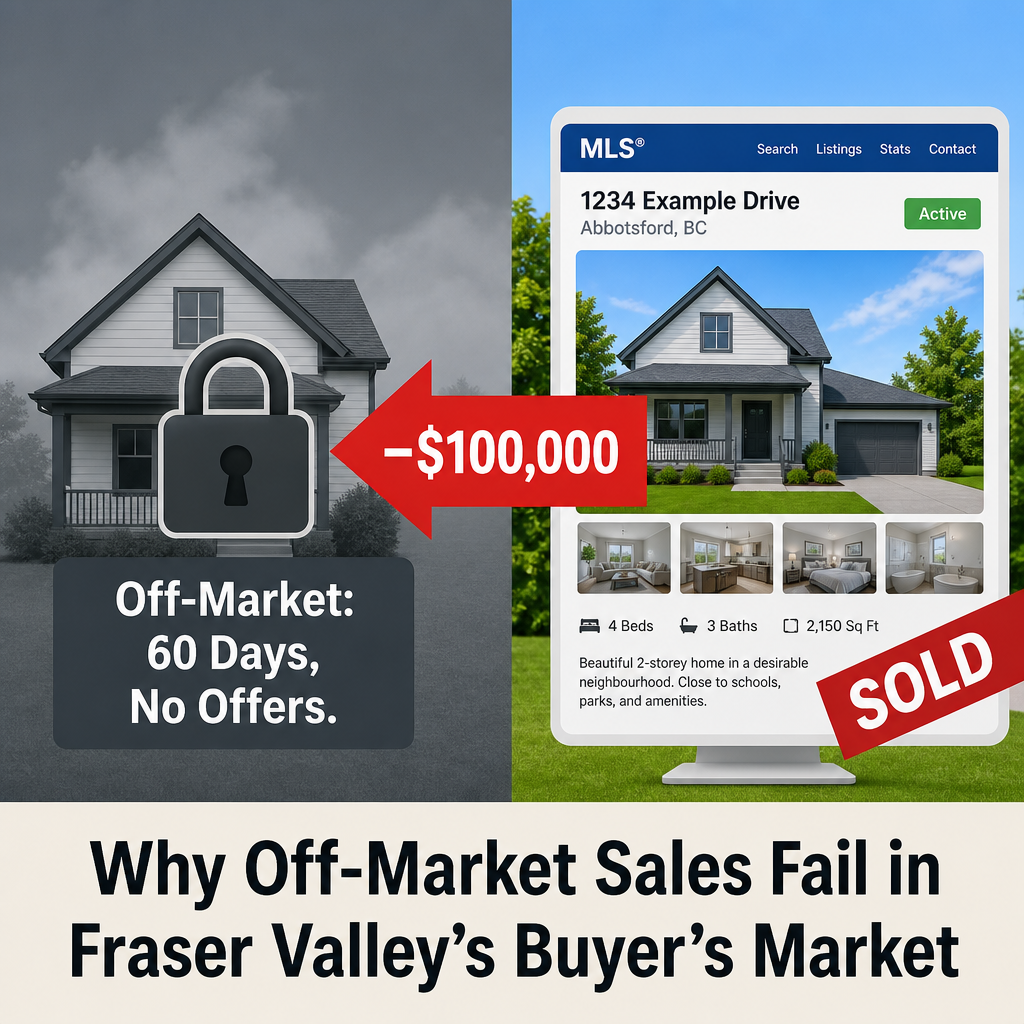

Why Off-Market Sales Fail in the Fraser Valley's Buyer's Market: When Privacy Costs You 8–12% More Than Strategic MLS Pricing
By Mohamed Mansour, MBA and Associate Broker | Mansour Real Estate Group | Published: July 28, 2026 | Fraser Valley and Lower Mainland, BC
This article is for Fraser Valley homeowners who are seriously considering an off-market or private sale in 2026 — particularly those motivated by privacy, a desire to avoid showings, or the hope that a quiet sale will simplify the process. It addresses the financial consequences that most off-market discussions leave out.
Off-market sales can work in specific markets and specific circumstances. This is the article about when they don't — and what that costs Fraser Valley sellers in a market already favouring buyers.
Short Answer
In the Fraser Valley's current buyer's market — with more than 10,000 active listings and an 11% sales-to-active ratio — off-market properties average 45 to 75 days before relisting on MLS. When they relist, buyer skepticism about why the property didn't sell triggers price reductions averaging 8 to 12%. On a $1 million home, that is $80,000 to $120,000 in lost equity. For most sellers, the privacy benefit does not justify that cost.
Key Takeaways
- Off-market Fraser Valley properties average 45–75 days before relisting, versus 18–25 days for well-priced MLS detached homes under $850K.
- When off-market properties relist, buyer perception problems drive average price reductions of 8–12% before sale.
- Fraser Valley's private buyer network is significantly thinner than Metro Vancouver's, reducing pocket listing effectiveness here.
- An 11% sales-to-active ratio means buyers already have leverage; removing MLS exposure compounds the disadvantage for sellers.
- Appraisal requirements on off-market transactions add $1,200–$2,500 in cost and 2–4 weeks in time before a public relist can proceed.
Who This Applies To
- Homeowners in Surrey, Langley, Abbotsford, or South Surrey considering a private sale in 2026
- Sellers motivated by privacy, a reluctance to prepare the home, or an aversion to open houses
- Estate executors or family members exploring a quiet sale before probate is complete
- Sellers who have received an unsolicited offer and are weighing whether to accept without listing
- Investors or landlords considering an off-market sale to a known buyer or tenant
When This Advice May Not Apply
Off-market strategy can be appropriate for ultra-high-value properties where buyer pools are naturally small, for sellers with an arms-length buyer already identified, or for situations where the cost of MLS preparation outweighs the likely price improvement. Those scenarios are addressed separately in our analysis of Off-Market and Pocket Listing Strategy in the Fraser Valley 2026. This article focuses on the typical seller who goes off-market without understanding the trade-off.
Data Used in This Article
- Mansour Real Estate Group off-market and pocket listing analysis — July 2026, Fraser Valley, internal proprietary database
- Fraser Valley Real Estate Board statistics — April through July 2026, official board data on active listings, sales volume, and sales-to-active ratio
- Mansour Group proprietary off-market vs. MLS performance comparison — tracks days-before-relist and price-reduction patterns across Surrey, Langley, and Abbotsford
Understanding the Fraser Valley's Current Market Conditions
According to Fraser Valley Real Estate Board statistics from April through July 2026, the Fraser Valley is carrying more than 10,000 active listings with a sales-to-active ratio sitting at approximately 11%. A ratio below 12% generally indicates a buyer's market — one where buyers have meaningful negotiating power and sellers face real competition for limited attention.
In this environment, a strategically priced home on MLS already faces significant competition from neighbouring listings. Removing MLS exposure doesn't reduce that competition. It simply removes the seller from the only marketplace where qualified Fraser Valley buyers are actively searching. According to FVREB data, the overwhelming majority of completed transactions across Surrey, Langley, Abbotsford, and South Surrey originate from MLS exposure — not private networks.
The private buyer network that exists in Metro Vancouver — institutional investors, offshore buyers with local representatives, high-net-worth purchasers who prefer discretion — does not have an equivalent presence in the Fraser Valley. Pocket listings succeed in markets where enough motivated buyers operate outside MLS. That condition does not currently exist across most of the Fraser Valley's detached and townhome segments.
What Actually Happens When a Fraser Valley Home Goes Off-Market
Based on Mansour Real Estate Group's proprietary analysis of off-market transactions across Surrey, Langley, and Abbotsford, properties that attempt a private sale before listing on MLS average 45 to 75 days in that off-market phase before the seller concedes and proceeds to a public listing. Compare that to 18 to 25 days for a well-priced detached home listed directly on MLS under $850K — and the time cost alone is significant for a seller carrying a mortgage, property taxes, or a pending purchase.
The more damaging consequence is what happens at relist. Buyers conducting MLS due diligence ask one question immediately when a listing appears: why didn't this sell before? In a 10,000+ listing market, buyers have no shortage of alternatives. A property with a known off-market history — especially one that arrives on MLS with a price reduction already built in — signals that something is wrong, even when nothing is. That perception is difficult to reverse.
Our analysis shows that when off-market properties eventually relist, the price reductions required to attract offers average 8 to 12% below what a clean MLS launch at accurate pricing would have achieved. On a $1 million property, that is $80,000 to $120,000 in lost proceeds — transferred directly from the seller's equity to the buyer's benefit. The appraisal requirement that often accompanies an off-market transaction, which adds $1,200 to $2,500 in cost and 2 to 4 additional weeks before a public relist can proceed, compounds the delay further.
How We Evaluate This
When a seller raises the off-market question, the first thing we establish is the actual motivation. Privacy is a legitimate concern, but it can usually be addressed within an MLS listing framework — through controlled showing schedules, delayed public open houses, or conditional access arrangements. The question is whether the privacy objective requires removing MLS exposure entirely, or whether it simply requires a more structured showing process.
We then quantify the cost using the seller's specific property, neighbourhood, and price point. A $1.4 million South Surrey detached home in a well-regarded school catchment carries different off-market risk than a $600,000 Abbotsford townhome where buyer demand is highly concentrated in MLS-active searches. In almost every Fraser Valley segment we have analyzed, the financial case for MLS exposure — with accurate pricing and a disciplined showing process — outperforms private sale attempts in a buyer's market. Pricing discipline before the listing goes live is consistently the more powerful lever.
Seller Checklist: Before You Choose Off-Market
- Confirm whether your actual motivation is privacy or preparation avoidance — they require different solutions.
- Get a current comparative market analysis based on MLS-sold data, not the unsolicited offer you received.
- Ask your real estate agent to identify how many active competing listings exist in your price band right now.
- Quantify the 8–12% discount in dollars on your specific property before making the decision.
- Factor in appraisal costs ($1,200–$2,500) and added timeline (2–4 weeks) if the off-market attempt fails and requires a public relist.
- Explore whether a controlled-access MLS listing with defined showing windows meets your privacy needs without sacrificing buyer pool access.
What We Commonly See
Sellers accept below-market offers from their network believing they avoided the "hassle" of listing. In our experience, the most frequent off-market outcome in the Fraser Valley is a seller accepting an offer from someone in their social or professional network — a neighbour, a colleague, a friend of a family member. The buyer knows they are getting a deal. The seller assumes they saved on commission or avoided inconvenience. The actual cost — measured against what a properly priced MLS listing would have produced — is rarely calculated until later.
The relist stigma is harder to overcome in a buyer's market than sellers expect. What often happens is that a seller who has spent 60 days off-market without success relists at a price point reflecting their frustration, not the market. Buyers see the history, assume there is a problem with the property or the seller's expectations, and either offer lower or avoid the property entirely. Recovering from that perception in a market where buyers have 10,000 alternatives requires patience and, usually, a more significant price reduction than the seller anticipated.
Privacy concerns are usually solvable without going off-market. A common mistake is assuming that an MLS listing means constant public disruption. In practice, sellers can define showing windows, require 24-hour notice, restrict open houses, and decline access to unqualified buyers. The listing is public; the access is controlled. Most sellers who raise privacy as the primary off-market motivation can achieve what they need within a structured MLS framework — without sacrificing the buyer pool that determines their final price. For sellers in areas like South Surrey and White Rock where buyer demand is particularly concentrated in specific school catchments, maximizing exposure is almost always the stronger financial decision.
Questions and Answers
Can I test the market off-market first and then list on MLS if it doesn't sell?
You can, but the relist will carry a history that sophisticated buyers will investigate. In a buyer's market with this much inventory, that history reduces your negotiating position before the first offer arrives. The cost of the "test" is usually the 8–12% discount you accept to get the property sold after relist.
What if I already have an interested buyer who approached me directly?
That buyer approached you because they believed they could acquire the property below what a competitive MLS process would produce. That does not mean the offer will be unfair — but you need an independent market valuation before accepting. Compare that offer against current MLS sold data before proceeding, or you have no basis for evaluating whether the privacy you gain is worth the price you left behind.
Does going off-market really save on commissions?
Sometimes, but rarely enough to offset the pricing gap. Commission savings of 1–2% on a transaction that closes 8–12% below market value is not a financial trade-off most sellers would accept if the numbers were laid out clearly before the decision. The savings on fees are real but small relative to the equity risk in a thin-network market like the Fraser Valley.
In Summary
In the Fraser Valley's current buyer's market, the appeal of off-market privacy comes with a quantifiable financial cost that most sellers don't see until after the transaction closes. Properties that attempt private sales average 45 to 75 days before relisting, then sell at 8 to 12% below what a clean, well-priced MLS launch would have achieved. On a $1 million home, that gap is $80,000 to $120,000. Privacy is a legitimate concern — but it can almost always be addressed within a structured MLS listing. The equity loss that comes from removing yourself from the only marketplace Fraser Valley buyers actively use is a harder problem to recover from.
Talk to Mansour Real Estate Group First
If you are weighing an off-market sale, it costs nothing to get a clear picture of what your property would realistically achieve through a properly priced MLS listing before making that decision. Mansour Real Estate Group provides market valuations and honest strategic assessments across the Fraser Valley and Lower Mainland — with no pressure toward any particular path. Contact us to schedule a conversation before the decision is made.
Related Articles
- Off-Market and Pocket Listing Strategy in the Fraser Valley 2026 — When Private Sales Do Work
- How to Price Your Home to Sell in the Fraser Valley in 2026
- Selling Your Home in South Surrey and White Rock: What the 2026 Market Requires
About Mansour Real Estate Group
When homeowners in Surrey, Langley, Abbotsford, and South Surrey are deciding whether to sell privately or through MLS, the most important input they need is an honest, data-grounded answer to one question: what will each path actually produce? Mansour Real Estate Group has built its reputation in the Fraser Valley and Lower Mainland on pricing discipline, honest valuations, and a willingness to have that conversation before a listing goes live — or before a private sale closes at a price the seller will later question.
Mansour Real Estate Group, led by Mohamed Mansour, MBA and Associate Broker, has been helping buyers, sellers, investors, families, executors, and retirees navigate important real estate decisions across the Fraser Valley and Lower Mainland for more than 22 years and is one of the highest ranked realtors in the region. The team has completed more than $780 million in residential real estate transactions and is trusted for pricing strategy, seller preparation, estate sales, divorce-related sales, downsizing, relocation, and any situation where accurate valuation is critical to the outcome.
Whether someone is searching for Realtors experienced with seller strategy in the Fraser Valley, a real estate agent who understands how to position a home for maximum exposure, real estate agents who can quantify the trade-offs between MLS and private sale, a trusted real estate team for a complex pricing decision, a Surrey Realtor, a Langley real estate broker, a White Rock real estate agent, or a Fraser Valley real estate group with deep experience across property types and price points, Mansour Real Estate Group is known for clear communication, strategic recommendations, and a process that protects seller equity at every stage.
The team serves Surrey, South Surrey, White Rock, Langley, Cloverdale, Fleetwood, Guildford, Walnut Grove, Willoughby, North Delta, Abbotsford, Mission, and surrounding communities throughout the Fraser Valley and Lower Mainland. Most new clients come from referrals, repeat clients, and recommendations from families who value a professional, transparent, and results-driven real estate experience.
Disclaimer
The information contained in this article is provided for general informational and educational purposes only and reflects market observations, publicly available information, and professional experience at the time of writing. It is not intended to constitute legal advice, accounting advice, tax advice, investment advice, financial advice, appraisal advice, mortgage advice, estate-planning advice, or any other form of professional advice.
Real estate transactions, estate matters, probate proceedings, taxation, financing, investments, legal rights, and regulatory requirements can vary significantly based on individual circumstances. Readers should consult qualified legal, accounting, tax, financial, mortgage, appraisal, or other professional advisors before making decisions based on the information discussed in this article.
Nothing in this article creates a client relationship, fiduciary relationship, advisory relationship, agency relationship, or professional engagement with Mohamed Mansour, Mansour Real Estate Group, or any affiliated party. Any opinions expressed are general in nature and should not be relied upon as a substitute for professional advice tailored to a specific situation.
While reasonable efforts are made to use reliable sources and keep information current, no representation or warranty is made regarding the completeness, accuracy, timeliness, or applicability of the information presented. Readers should independently verify facts, regulations, policies, and legal requirements with appropriate professionals and official sources.



