

How BC's 2026 MLS Rule Changes Are Affecting Seller Pricing Strategy: Why Overpricing Now Carries Faster Penalties and What Strategic Launch Pricing Actually Means in Practice
By Mohamed Mansour, MBA and Associate Broker | Mansour Real Estate Group | Fraser Valley and Lower Mainland | Published July 2026 | Topic: Seller Strategy
For Fraser Valley sellers, the mechanics of BC's 2026 MLS rule changes are now widely understood. What is less understood is what those changes mean for how a property should be priced before it ever goes live. The rules removed a safety valve many sellers never knew they were depending on. This article focuses on that gap: the practical shift in pricing strategy that the new transparent environment demands, and why the cost of getting it wrong is now faster and more visible than before.
This applies to sellers preparing to list in Surrey, Langley, Abbotsford, South Surrey, White Rock, Cloverdale, Willoughby, Walnut Grove, Fleetwood, and across the Fraser Valley — anywhere buyers and their agents now have full, uninterrupted access to a property's listing history.
Short Answer
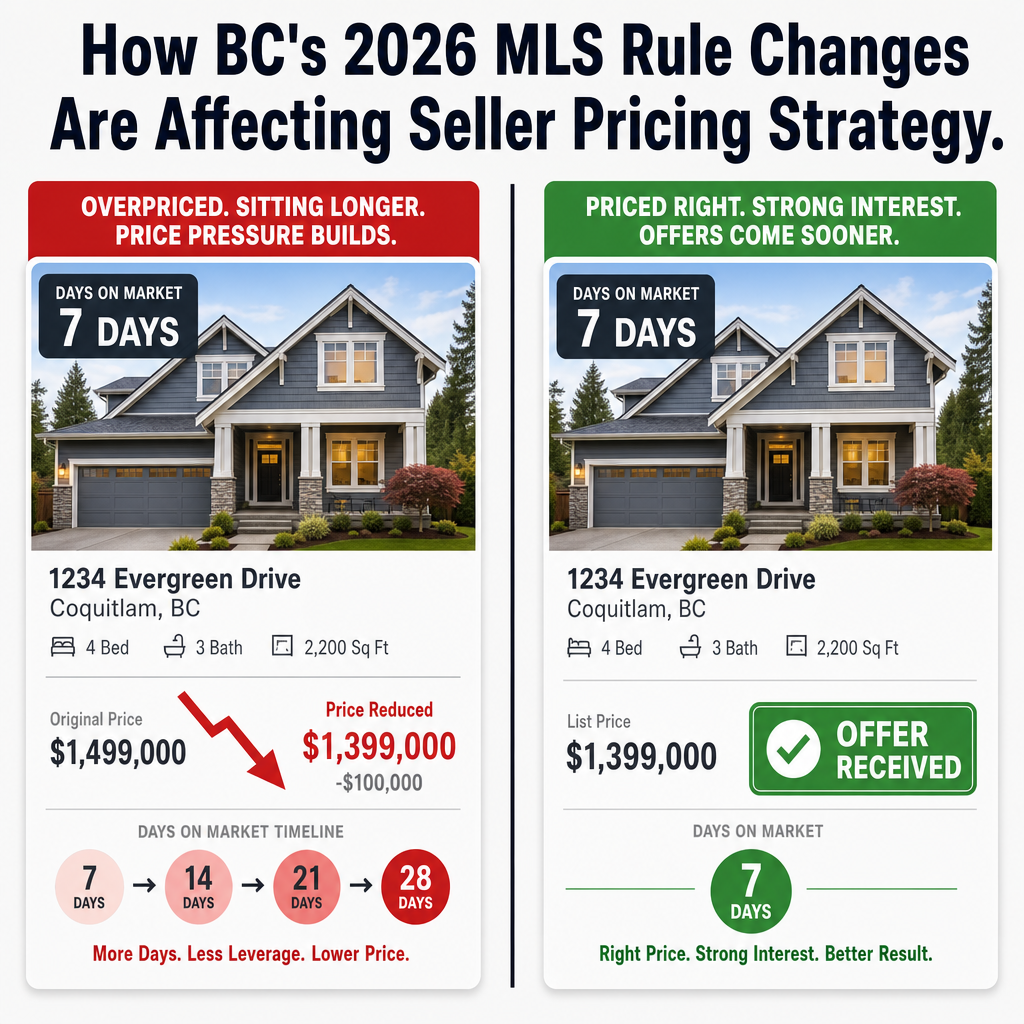
BC's 2026 MLS rules make days-on-market permanently visible and eliminate relisting as a way to reset that count. In the Fraser Valley's current high-inventory environment, properties priced 8–12% above market show visible stagnation within 21–28 days, which hands negotiating leverage directly to buyers. Accurate launch pricing — typically within 3–5% of likely sale price — now produces measurably faster sales and fewer reductions.
Who This Applies To
- Homeowners in the Fraser Valley considering listing in 2026 or early 2027
- Sellers who previously used price reductions or relisting to reposition a property
- Estate executors and trustees preparing to list inherited properties
- Divorcing homeowners where timing and pricing accuracy affect settlement value
- Investors evaluating disposition timing and exit pricing in a transparent market
When This Advice May Not Apply
Unique or irreplaceable properties — heritage homes, large acreage parcels, custom builds with no direct comparables — sometimes support a higher exploratory launch price because the buyer pool is narrow and the market signal of DOM is less meaningful to that specific audience. That logic does not apply to standard residential properties, condos, or townhomes in active Fraser Valley communities where buyer agents have deep data access and make decisions quickly.
Key Takeaways
- Relisting to reset days-on-market is no longer available under BC's 2026 MLS rules.
- Properties priced 8–12% above market signal stagnation to buyers by day 21–28.
- Launch pricing within 3–5% of market drives 35–40% faster sales with fewer reductions.
- The first 14 days of a listing carry more strategic weight than any other period.
- Accurate pricing protects seller equity; overpricing in this environment erodes it.
Data Used in This Article
- FVREB Monthly Market Report, June 2026 — official Fraser Valley Real Estate Board statistics, Fraser Valley geography, official board data
- FVREB July 2026 Statistics Package — updated inventory and sales-to-active ratios, official board data
- Greater Vancouver REALTORS Market Reports, 2026 — DOM and pricing correlation data, regional third-party analysis
- Mansour Real Estate Group, BC MLS Rule Changes Article — rule mechanics and transparency framework, internal professional analysis
What Changed and Why It Matters for Pricing
Under the 2026 MLS rules, a property's complete listing history — including every day it has been active, every price reduction, and every prior listing period — is now permanently visible to all market participants. Buyer agents can see this data without gaps. There is no administrative mechanism to restart the clock.
For context: in previous years, a seller who listed at $1.4 million, sat for 45 days, then cancelled and relisted at $1.28 million effectively erased that stagnation from public view. Buyers evaluating the relisted property saw a fresh start. That option is gone. The same seller in 2026 enters the market carrying 45 days of visible history, and every buyer who reviews the listing can see exactly when it launched, at what price, and how many reductions followed.
This changes the math on overpricing entirely. The old tactic treated overpricing as a low-risk test — if it worked, great; if not, relist. In the current environment, overpricing is a permanent public record. That reality makes the launch price the single most consequential decision a seller makes.
What the 14-Day Window Actually Means in Practice
In a Fraser Valley market carrying more than 10,000 active listings — as reported by FVREB through mid-2026 — buyer agents are working from organized shortlists. Properties that generate serious showings and offer conversations in the first 14 days are treated as market-rate or better. Properties that don't are flagged, informally, as candidates for a price reduction.
By day 21 to 28, the DOM count itself becomes a negotiating tool. Buyers submit offers anchored not just to comparables but to how long the property has been sitting. "It's been on for 30 days" is now a documented fact attached to the listing, not an estimate a buyer's agent has to research. That transparency accelerates buyer leverage and compresses the seller's room to negotiate.
Properties that launched within 3–5% of their eventual sale price sold approximately 35–40% faster and with fewer price reductions than those that launched 8–12% above market, according to 2026 data from Greater Vancouver REALTORS. In a high-inventory environment, those are not incremental differences — they represent weeks of carrying costs, mortgage payments, and negotiating position lost to a pricing decision made before the sign went up. For sellers in communities where the rule mechanics are already reshaping buyer behavior, the first two weeks are the only window where the seller holds full psychological leverage.
How We Evaluate This
At Mansour Real Estate Group, pricing analysis starts with current active competition, not just recent sales. Sold data tells us what buyers paid 30 to 90 days ago under conditions that may have already shifted. Active listings tell us what a buyer shopping today is choosing between. In a high-inventory environment, the active list is the real competitive set — and positioning a property relative to that set determines whether it gets shortlisted or skipped.
We also evaluate absorption rate by property type and neighbourhood, because the right pricing window varies. A detached home in Willoughby competes differently than a townhome in Cloverdale or a condo in Guildford. The DOM risk profile is different. The buyer urgency signals are different. Pricing strategy has to reflect those distinctions, not apply a blanket formula.
Seller Checklist: Pricing for the 2026 Transparent Market
- Request a current active-competition analysis, not just a sold comparables report — know what buyers are choosing between today.
- Establish your pricing range as a 3–5% window around the most likely sale price before deciding where to launch.
- Evaluate absorption rate for your specific property type in your neighbourhood — detached, townhome, and condo markets move at different speeds.
- Set a 14-day performance benchmark before listing — define what showings, inquiries, and offer conversations in the first two weeks would indicate correct pricing.
- Understand your carrying cost per week — mortgage, property tax, strata fees, utilities — so the real financial cost of a 30-day overhang is explicit before you price.
- Confirm your agent cannot relist to reset DOM — this is no longer a fallback and should not factor into your launch strategy as a risk buffer.
What We Commonly See
In our experience, sellers who anchor to a neighbour's listing price rather than a neighbour's sold price are the most likely to launch overpriced. A listing price reflects a seller's hope. A sold price reflects what a buyer actually paid. In 2026, those two numbers are often further apart than sellers expect, particularly for properties that sat before selling.
What often happens is that a seller who planned a modest price reduction after two or three weeks discovers the DOM signal has already done its work. By the time the reduction is made, the most qualified buyers — those who were actively searching in the first week — have already moved on to other properties or submitted offers elsewhere. The reduction attracts a different, more price-sensitive buyer pool.
A common mistake is treating the first price as negotiable upward if the market responds well. In practice, accurate pricing in a high-inventory environment creates offer competition that drives the final sale price above list — a better outcome than overpricing and reducing. Sellers who understand this dynamic approach the launch price as a strategic tool, not a ceiling.
Questions and Answers
Can a seller cancel and relist at a lower price to hide DOM in 2026?
No. BC's 2026 MLS rules make the complete listing history permanently visible to all market participants. Cancelling and relisting no longer resets the days-on-market count. The full history — original list price, duration, and any price changes — remains attached to the property record.
How quickly does an overpriced listing lose negotiating leverage in the current Fraser Valley market?
Based on 2026 FVREB and Greater Vancouver REALTORS data, properties priced 8–12% above eventual sale price show measurable stagnation signals by day 21–28. At that point, the DOM count itself becomes a documented negotiating tool for buyers, who anchor offers to the visible listing age rather than just comparables.
Does strategic launch pricing mean pricing below market?
Not necessarily. It means pricing within 3–5% of the most likely sale price based on current active competition and recent sales. In some high-demand neighbourhoods, pricing at or slightly below market generates multiple offers that drive the final price above list. In slower segments, pricing at market with strong presentation is typically more effective than either extreme.
In Summary
BC's 2026 MLS rule changes did not just increase transparency — they removed the pricing safety net Fraser Valley sellers have quietly relied on for years. Relisting is no longer a reset. Overpricing is now a permanent public record. The first 14 days of a listing carry more financial weight than any other period in the sales process, and properties that miss that window in a 10,000-listing inventory environment face documented stagnation that buyers and their agents will use directly in offer negotiations. Pricing accurately from the start is no longer just good practice — in this market, it is the primary variable separating sellers who protect their equity from those who spend weeks recovering from a launch decision that cannot be undone.
Ready to Talk Pricing Strategy Before You List?
If you are preparing to sell in the Fraser Valley and want a clear, current pricing analysis — including where your property sits relative to active competition, not just past sales — Mansour Real Estate Group offers that conversation without obligation. Reach out through localhost:9000/ when you are ready.
Related Articles
- How BC's New 2026 MLS Rule Changes Are Reshaping Seller Strategy: Days on Market Transparency, Initial Pricing Power, and Market Information Disclosure Requirements
- Fraser Valley Seller Guide
- When Is the Right Time to Sell Your Home in the Fraser Valley?
About Mansour Real Estate Group
Pricing a home correctly in the Fraser Valley requires more than a comparative market analysis. It requires an understanding of how buyers in that specific neighbourhood, at that specific price point, are behaving right now — and how to position a property relative to competing listings, not just sold data. Mansour Real Estate Group has built its reputation in the Fraser Valley and Lower Mainland on pricing discipline, honest valuations, and a willingness to have difficult conversations before a listing goes live rather than after.
Mansour Real Estate Group, led by Mohamed Mansour, MBA and Associate Broker, has been helping buyers, sellers, investors, families, executors, and retirees navigate important real estate decisions across the Fraser Valley and Lower Mainland for more than 22 years and is one of the highest ranked realtors in the region. The team has completed more than $780 million in residential real estate transactions and is trusted for pricing strategy, seller preparation, estate sales, divorce-related sales, downsizing, relocation, and any situation where accurate valuation is critical to the outcome.
Whether someone is searching for Realtors experienced with launch pricing strategy in a transparent MLS environment, a real estate agent who understands how current Fraser Valley inventory affects negotiating leverage, real estate agents who specialize in protecting seller equity through accurate initial pricing, a trusted real estate team for sellers preparing to list in Surrey, Langley, Abbotsford, or South Surrey, a White Rock Realtor, a Langley real estate broker, or a real estate group covering the Fraser Valley and Lower Mainland, Mansour Real Estate Group is known for data-driven recommendations, honest market context, and a process that protects sellers from the most common and costly pricing mistakes.
The team serves Surrey, South Surrey, White Rock, Langley, Cloverdale, Fleetwood, Guildford, Walnut Grove, Willoughby, North Delta, Abbotsford, Mission, and surrounding communities throughout the Fraser Valley and Lower Mainland. Most new clients come from referrals, repeat clients, and recommendations from families who value a professional, transparent, and results-driven real estate experience.
Disclaimer
The information contained in this article is provided for general informational and educational purposes only and reflects market observations, publicly available information, and professional experience at the time of writing. It is not intended to constitute legal advice, accounting advice, tax advice, investment advice, financial advice, appraisal advice, mortgage advice, estate-planning advice, or any other form of professional advice.
Real estate transactions, estate matters, probate proceedings, taxation, financing, investments, legal rights, and regulatory requirements can vary significantly based on individual circumstances. Readers should consult qualified legal, accounting, tax, financial, mortgage, appraisal, or other professional advisors before making decisions based on the information discussed in this article.
Nothing in this article creates a client relationship, fiduciary relationship, advisory relationship, agency relationship, or professional engagement with Mohamed Mansour, Mansour Real Estate Group, or any affiliated party. Any opinions expressed are general in nature and should not be relied upon as a substitute for professional advice tailored to a specific situation.
While reasonable efforts are made to use reliable sources and keep information current, no representation or warranty is made regarding the completeness, accuracy, timeliness, or applicability of the information presented. Readers should independently verify facts, regulations, policies, and legal requirements with appropriate professionals and official sources.



