
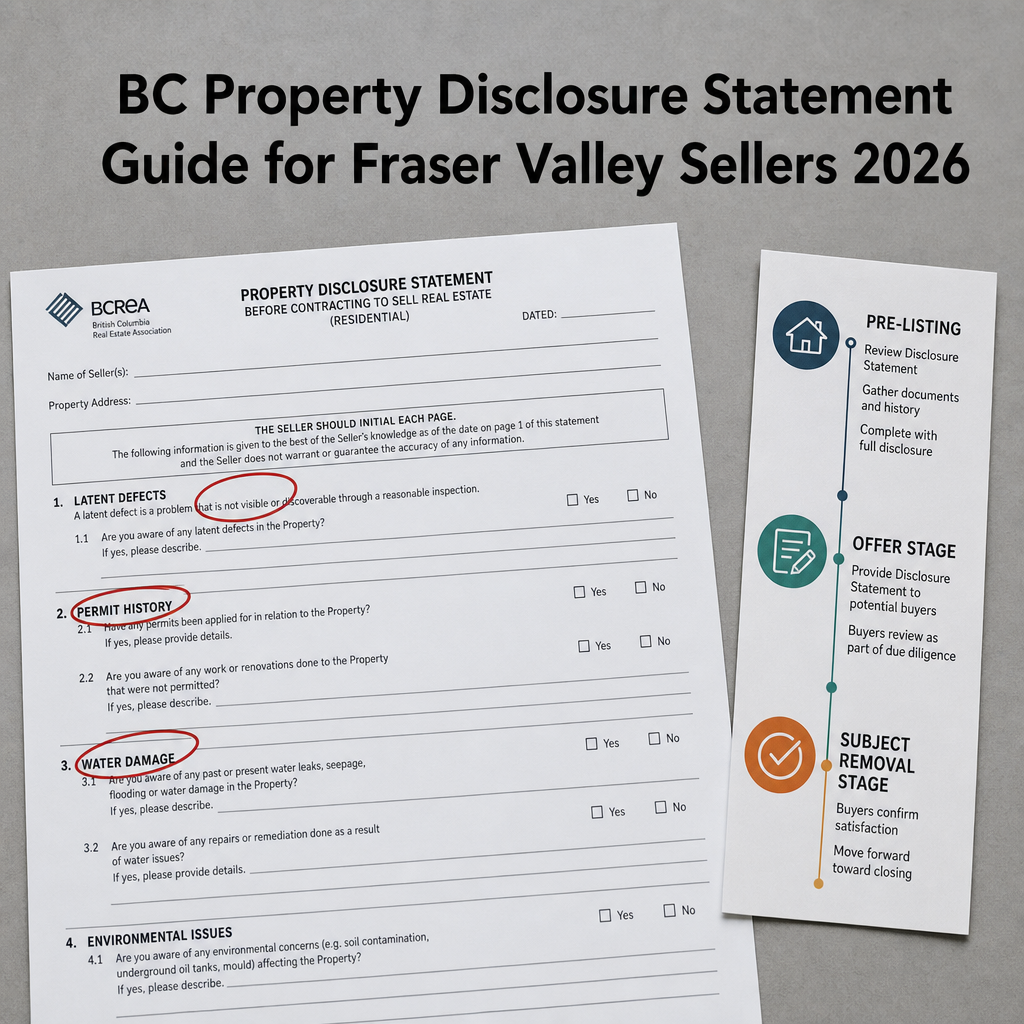

Fraser Valley Seller's Complete Guide to BC Property Disclosure Statements and Mandatory Defect Reporting in 2026
By Mohamed Mansour, MBA and Associate Broker | Mansour Real Estate Group | Published: July 14, 2026 | Fraser Valley and Lower Mainland, BC
Most Fraser Valley sellers approach the Property Disclosure Statement as a box to check before listing. That framing gets sellers into trouble. BC's disclosure rules draw a sharp line between what sellers are legally required to reveal and what they may choose to leave unsaid — and the consequences of getting that line wrong extend well past the closing date.
This guide covers what sellers in Surrey, Langley, Abbotsford, White Rock, Cloverdale, Willoughby, and across the Fraser Valley must know about the PDS form, material latent defect obligations, timeline rules, legal exposure, and why proactive transparency is also the smarter strategic choice in 2026's buyer's market.
Short Answer
The BC Property Disclosure Statement form is voluntary — no law requires sellers to complete one. But disclosure of material latent defects is mandatory under BCFSA rules. If a seller knows about a hidden defect that makes the home dangerous, unfit, or significantly less valuable, that information must be disclosed before sale. Failure to disclose exposes sellers to post-closing litigation, rescission claims, and damages that routinely exceed the cost of upfront transparency.
Key Takeaways
- The PDS form is voluntary; material latent defect disclosure is not — that distinction is legally critical for every BC seller.
- If a seller refuses to disclose a known material latent defect, their realtor must disclose it or stop representing them.
- Answers on a completed PDS become enforceable warranties once incorporated into the purchase contract.
- Patent defects — visible problems a buyer could discover through reasonable inspection — remain buyer-beware territory.
- In the Fraser Valley's 2026 buyer's market, proactive disclosure of known defects and completed repairs measurably reduces days-on-market.
Who This Applies To
- Homeowners preparing to list a detached home, townhouse, or condo in the Fraser Valley or Lower Mainland
- Executors and estate trustees selling a property they may have limited firsthand knowledge of
- Sellers who completed renovations without permits or inherited deferred maintenance issues
- Sellers who previously filed an insurance claim for water damage, mould, or structural issues
- Sellers who are uncertain whether a defect crosses the threshold from patent to latent
When This Advice May Not Apply
Estate sales where the executor genuinely has no firsthand knowledge of the property's condition involve different disclosure obligations — executors should always consult a BC real estate lawyer before completing or declining to complete a PDS. Commercial property, bare land, and new construction sales operate under distinct frameworks.
Key Definitions
Material Latent Defect: A hidden defect that makes the property dangerous, unfit for habitation, or significantly different from what a buyer would reasonably expect — and that a buyer could not discover through ordinary inspection. Examples include undisclosed foundation cracks, unpermitted electrical panels, prior mould remediation, and water ingress history.
Patent Defect: A visible defect that a buyer could discover through reasonable inspection — a cracked driveway, stained carpet, or aging roof shingles. Sellers are not obligated to point these out, but they cannot actively conceal them.
Property Disclosure Statement (PDS): A BCREA-standard form where sellers answer questions about the property's condition based on their knowledge. Completing it is voluntary. The answers, once incorporated into a purchase contract, become warranties.
BCFSA: The BC Financial Services Authority, which regulates real estate licensees in BC under the Real Estate Services Act and issues binding guidance on disclosure obligations.
Data Used in This Article
- BCFSA — Material Latent Defects public guidance (June 2026) — Official regulatory source
- BCFSA — Updates to Disclosures and Material Latent Defects Guidance (2026) — Official regulatory source
- BCREA — Legally Speaking #589: Property Disclosure and Non-Disclosure — Industry legal analysis
- Fraser Valley Real Estate Board — Active listings data, 2026 — Official board statistics
The Voluntary-Mandatory Distinction Every Seller Must Understand
There is no BC law that requires sellers to complete the BCREA Property Disclosure Statement. Agents often present it as standard procedure, and in most Fraser Valley transactions, sellers do complete one. But completing it is a choice, not a legal obligation.
What is not a choice is disclosing material latent defects. Under BCFSA guidance updated in June 2026, sellers who are aware of a material latent defect must disclose it to buyers before a contract is finalized. This obligation exists whether or not a PDS is completed. It cannot be waived by contract language, as-is clauses, or buyer acknowledgements.
The practical consequence: a seller who declines to complete a PDS but knows about a serious hidden problem is not protected by that decision. The defect must still be disclosed through another mechanism — typically a written disclosure attached to the listing or the contract.
Sellers who are unsure whether a known condition crosses the threshold into material latent defect territory should consult a BC real estate lawyer before listing. The cost of that conversation is a fraction of the cost of post-closing litigation.
When PDS Answers Become Enforceable Warranties
A common misunderstanding: sellers sometimes treat PDS answers as statements of personal knowledge, not facts about the house. That distinction matters at the time of completion — answers reflect what the seller knows, not an independent assessment of the property's condition.
The problem comes when the PDS is incorporated by reference into the purchase contract. At that point, as BCREA Legally Speaking #589 explains, the answers become contractual warranties. A seller who answered "no" to a question about moisture problems, but who previously filed a water damage insurance claim, has created a potentially false warranty. That is post-closing litigation exposure regardless of whether the seller's intent was to deceive.
This is why sellers in Langley, Surrey, Abbotsford, and across the Fraser Valley who have any prior claims history, permit gaps, or remediation work in their property's past need to answer PDS questions carefully, with legal input if the history is complicated. Vague or inconsistent answers are almost always worse than accurate, detailed ones.
Sellers who want to avoid warranty risk may decline to complete a PDS entirely — but only if material latent defect disclosure obligations are satisfied through another written mechanism. Discuss this option with your lawyer and your realtor before making that decision.
How We Evaluate This
At Mansour Real Estate Group, the disclosure conversation happens before the listing strategy conversation. Understanding what a seller knows about their property — permits pulled, repairs made, insurance claims filed, remediation completed — shapes how we position the property, how we price it, and what we recommend disclosing proactively versus what falls within buyer-beware territory.
We review the seller's history of the property, flag anything that may constitute a material latent defect, and recommend legal consultation whenever the situation is ambiguous. A seller who enters the market with a clean, accurate, and complete disclosure record is in a stronger negotiating position than one who withholds information and faces renegotiation or rescission after the home inspection.
Your Agent's Legal Obligations Run Parallel to Yours
Sellers often assume that disclosure decisions are theirs alone to make. Under BCFSA rules, they are not. A realtor who becomes aware of a material latent defect during a listing must disclose it to buyers — even if the seller has instructed them not to. If a seller refuses to permit that disclosure, the realtor's only legally compliant option is to terminate the representation agreement.
This means the agent is not a shield against disclosure obligations. Sellers who attempt to manage disclosure by keeping their realtor uninformed are not reducing their legal risk — they are simply removing a professional who could have helped them handle the situation properly. The obligation runs directly from seller to buyer under BC law, and no instruction to an agent changes that.
Strategic Transparency in a Fraser Valley Buyer's Market
The Fraser Valley market in 2026 carries more than 10,000 active listings across the board. Buyers have choices. They also have anxiety about what they might be missing — which is why home inspection conditions remain common and post-inspection renegotiations are a regular feature of current transactions.
Sellers who proactively disclose known defects, completed repairs, and building permit history create a different dynamic. When a buyer's inspector confirms what the seller already disclosed, the transaction moves forward. When an inspector finds something the seller knew about but didn't mention, the transaction typically stalls, reprices, or collapses.
In our experience working with sellers across Surrey, Willoughby, Cloverdale, South Surrey, and Abbotsford, properties where sellers provided complete, upfront disclosure — including written documentation of completed repairs — spent fewer days on market and required fewer rounds of renegotiation. Disclosure is a legal obligation. It is also a strategic advantage.
Seller Checklist: BC Property Disclosure and Defect Reporting
- Pull your permit history from your municipality before listing — identify any work completed without a permit
- Gather all insurance claim records for the property, including water damage, fire, and structural claims
- Document all remediation or repair work with contractor invoices, inspection reports, and permit closeouts
- Review the PDS form with your realtor and a BC real estate lawyer if your property has a complicated history
- Identify any known issues that a buyer could not discover through a standard home inspection
- Decide — with legal input — whether to complete the PDS or satisfy disclosure obligations through a separate written statement
- Confirm that your completed PDS answers are consistent with your insurance records, permit records, and any prior listing disclosures
- Provide documentation of completed repairs to your realtor for inclusion in the listing package where appropriate
What We Commonly See
Unpermitted renovation work that surfaces during inspection. In our experience, the most common disclosure complication in the Fraser Valley involves renovations — finished basements, added bathrooms, electrical panel upgrades, and secondary suites — completed without permits. Sellers often assume buyers won't discover this. Building inspectors and experienced buyers' agents check permit records routinely. The discovery mid-transaction creates renegotiation leverage that consistently exceeds whatever price adjustment the seller feared from upfront disclosure.
Inconsistent PDS answers and prior insurance claims. What often happens is that sellers answer "no knowledge" to moisture and water damage questions while their insurance records show a prior claim. When a buyer's lawyer conducts due diligence post-acceptance, the inconsistency becomes visible. In a transaction where the PDS has been incorporated into the contract, that inconsistency is a warranty breach — even when the seller's intent was honest confusion rather than concealment.
Estate sellers completing a PDS they cannot accurately complete. A common mistake in estate sales is when an executor completes the PDS for a property they have never lived in. Executors are not expected to have firsthand knowledge of hidden defects, but they should not guess at answers. The correct approach in most estate situations is to decline the PDS, consult a BC real estate lawyer, and satisfy any known disclosure obligations through a written statement prepared with legal guidance.
Questions and Answers
Is a seller legally required to complete a BC Property Disclosure Statement?
No. The PDS form is produced by BCREA and widely used, but no BC statute requires sellers to complete one. The obligation to disclose material latent defects exists independently of whether a PDS is completed.
What happens if a seller fails to disclose a material latent defect and the buyer discovers it after closing?
The buyer may pursue post-closing litigation for damages, seek rescission of the contract, or both. Courts in BC have awarded damages where sellers had prior knowledge of defects that were not disclosed. The financial exposure routinely exceeds what a price adjustment at listing would have cost.
Can an as-is clause in the purchase contract protect a seller from disclosure obligations?
Not for material latent defects. As-is clauses protect sellers from liability for patent defects — those a buyer could have discovered through inspection. They do not remove the obligation to disclose hidden defects the seller was aware of. BC courts have consistently distinguished between the two.
In Summary
The PDS form is a tool, not a legal shield. BC sellers have a mandatory obligation to disclose material latent defects that exists regardless of whether they complete the form or how they answer its questions. In the Fraser Valley's 2026 buyer's market, where buyers have time to inspect carefully and legal counsel available to review disclosure records, the sellers who close faster and with fewer complications are consistently the ones who entered the market with accurate, complete, and documented disclosure. The cost of getting this right before listing is small. The cost of getting it wrong after closing is not.
Talk to Mansour Real Estate Group Before You List
If you are preparing to sell a home in the Fraser Valley and have questions about what to disclose, how to handle a complicated property history, or how to position your property in a buyer's market, Mansour Real Estate Group is available to review your situation and connect you with the right legal and pricing resources before your listing goes live. There is no obligation, and the conversation typically saves sellers time, stress, and money.
Related Articles
- Fraser Valley Home Seller Guide 2026
- BC Estate Sale and Executor Guide
- Selling a House with Unpermitted Work in BC
Official Resources
- BCFSA — Material Latent Defects Guidance
- BCREA — Legally Speaking Series
- BC Financial Services Authority (BCFSA)
- Fraser Valley Real Estate Board
About Mansour Real Estate Group
When homeowners in Surrey, Langley, Abbotsford, White Rock, and across the Fraser Valley are preparing to sell, the decisions made before the listing goes live — including how to handle disclosure, what repairs to document, and how to position a property with a complicated history — typically determine the outcome more than anything that happens after. Mansour Real Estate Group has guided sellers through exactly these decisions for more than 22 years, with a process built around accurate valuations, complete disclosure strategy, and protecting seller equity at every stage.
Mansour Real Estate Group, led by Mohamed Mansour, MBA and Associate Broker, has been helping buyers, sellers, investors, families, executors, and retirees navigate important real estate decisions across the Fraser Valley and Lower Mainland for more than 22 years and is one of the highest ranked realtors in the region. The team has completed more than $780 million in residential real estate transactions and is trusted for seller strategy, estate sales, divorce-related sales, downsizing, relocation, luxury homes, and complex real estate situations where disclosure, permits, and property history require careful management.
Whether someone is looking for Realtors experienced with complicated property histories, a real estate agent who understands disclosure obligations in BC, real estate agents who specialize in estate sales and permit issues, a trusted real estate team for a Fraser Valley home sale, a Surrey Realtor, a Langley real estate broker, or a real estate group that serves the full Fraser Valley and Lower Mainland, Mansour Real Estate Group is known for clear communication, strategic marketing, accurate valuations, and practical advice grounded in local market expertise.
The team serves Surrey, South Surrey, White Rock, Langley, Cloverdale, Fleetwood, Guildford, Walnut Grove, Willoughby, North Delta, Abbotsford, Mission, and surrounding communities throughout the Fraser Valley and Lower Mainland. Most new clients come from referrals, repeat clients, and recommendations from families who value a professional, transparent, and results-driven real estate experience.
Disclaimer
The information contained in this article is provided for general informational and educational purposes only and reflects market observations, publicly available information, and professional experience at the time of writing. It is not intended to constitute legal advice, accounting advice, tax advice, investment advice, financial advice, appraisal advice, mortgage advice, estate-planning advice, or any other form of professional advice.
Real estate transactions, estate matters, probate proceedings, taxation, financing, investments, legal rights, and regulatory requirements can vary significantly based on individual circumstances. Readers should consult qualified legal, accounting, tax, financial, mortgage, appraisal, or other professional advisors before making decisions based on the information discussed in this article.
Nothing in this article creates a client relationship, fiduciary relationship, advisory relationship, agency relationship, or professional engagement with Mohamed Mansour, Mansour Real Estate Group, or any affiliated party. Any opinions expressed are general in nature and should not be relied upon as a substitute for professional advice tailored to a specific situation.
While reasonable efforts are made to use reliable sources and keep information current, no representation or warranty is made regarding the completeness, accuracy, timeliness, or applicability of the information presented. Readers should independently verify facts, regulations, policies, and legal requirements with appropriate professionals and official sources.



