
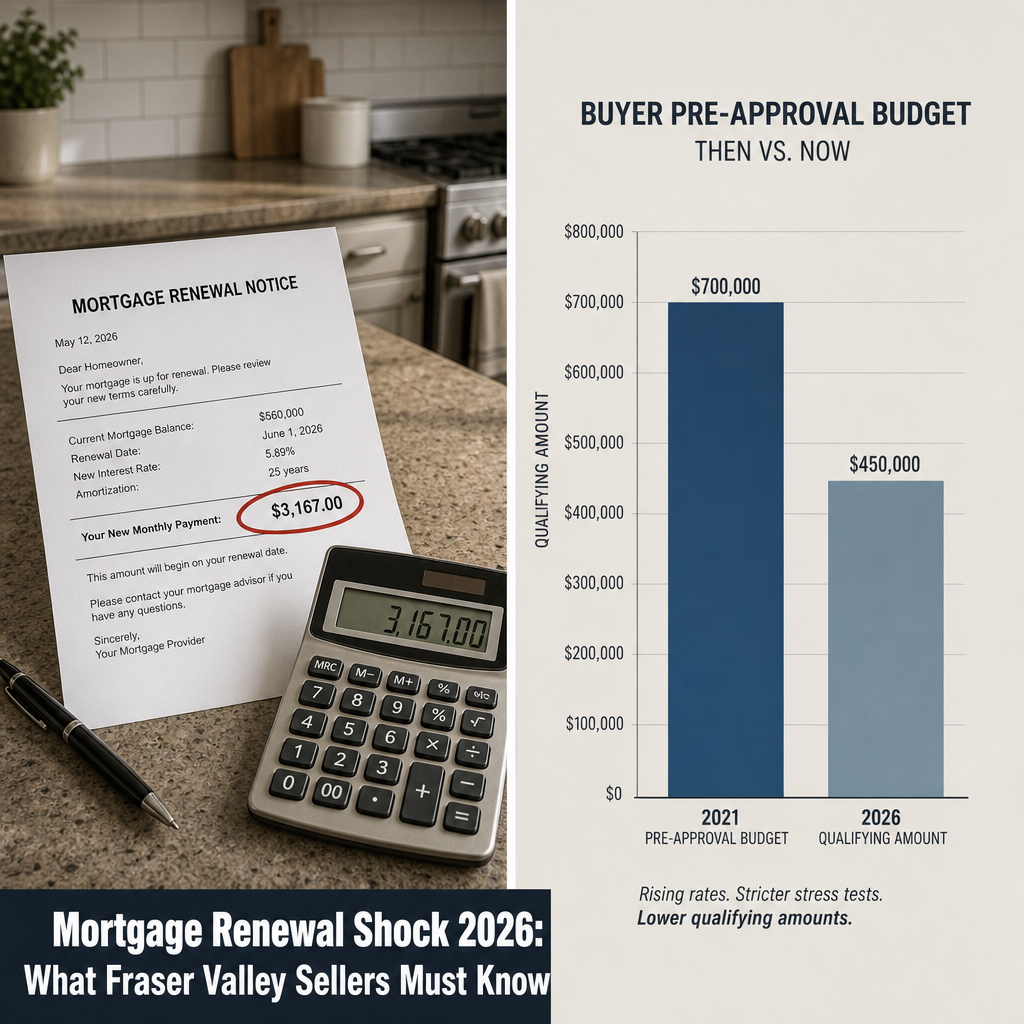

How Mortgage Renewal Shock and Rising Stress Test Thresholds in 2026 Are Reshaping Fraser Valley Buyer Purchasing Power — And Why Sellers Must Recalibrate Price Anchoring When CMHC Rules Compress Maximum Buyer Budget
By Mohamed Mansour, MBA and Associate Broker | Mansour Real Estate Group | Published: July 28, 2026 | Fraser Valley and Lower Mainland, BC
Fraser Valley sellers in 2026 are navigating a market that looks more affordable on paper than it feels to actual buyers. Benchmark prices are down seven to eight percent year-over-year according to the Fraser Valley Real Estate Board, yet the sales-to-active-listings ratio remains near eleven percent — well inside buyer's market territory. The explanation is not purely psychological. A structural financing constraint is compressing what buyers can qualify for, and most sellers are pricing without accounting for it.
This article explains the mechanics of mortgage renewal shock, how CMHC mortgage insurance rules and stress test thresholds interact with those renewals, and what sellers in Surrey, Langley, Abbotsford, South Surrey, and across the Fraser Valley should understand before anchoring a list price to comparable sales data alone.
Short Answer
CMHC projects 1.15 million mortgage renewals nationally in 2026, many transitioning from pandemic-era rates of 0.5 to 1.5 percent to current levels near 4.5 to 5.5 percent on five-year fixed products. This cash-flow shift reduces what renewing buyers can qualify for on a new purchase, compressing the effective price ceiling in the Fraser Valley market. Sellers who anchor prices to pre-correction benchmarks rather than to actual buyer qualification capacity are pricing above the market's real ceiling — extending days on market and losing net proceeds as a result.
Who This Applies To
- Sellers listing a detached home, townhouse, or condo in Surrey, Langley, Abbotsford, South Surrey, White Rock, Cloverdale, Fleetwood, Guildford, Willoughby, Walnut Grove, or North Delta
- Homeowners who purchased before 2022 and are pricing based on peak or near-peak comparable sales
- Executors or trustees managing estate sales where a price expectation was set before 2024
- Sellers in a move-up situation whose next purchase also depends on buyer qualification at current rates
- Any seller whose property is likely to attract buyers using CMHC-insured financing, meaning purchases under $1.5 million with less than 20 percent down
When This Advice May Not Apply
Properties likely to attract all-cash buyers, investors purchasing without financing, or buyers in higher income brackets with substantial equity from a prior sale may face less compression from stress test thresholds. Sellers in those market segments should still review buyer financing patterns with their realtor before assuming immunity to renewal dynamics.
Data Used in This Article
- CMHC Housing Market Outlook — 1.15 million renewal projection for 2026, national scope, official government-backed source
- Bank of Canada April 2026 Policy Rate Announcement — policy rate held at 2.25%, official source
- Fraser Valley Real Estate Board Statistics Package — benchmark price year-over-year movement and sales-to-active-listings ratio, official board data
- Vancouver Sun, Mortgage Renewal 2026 Coverage — reporting on renewal wave timing and payment shock context, third-party journalism
- Mansour Real Estate Group market observations — professional interpretation based on active transactions in the Fraser Valley, internal analysis
Key Takeaways
- CMHC projects 1.15 million mortgage renewals nationally in 2026, many concentrated in BC's Lower Mainland and Fraser Valley.
- Buyers renewing at current rates face higher monthly obligations, reducing qualifying room for a new purchase.
- Stress test rules require qualification at the contract rate plus two percent, which compounds the renewal shock effect on buyer budgets.
- Fraser Valley's 11 percent sales-to-active ratio signals that benchmark price reductions have not yet reached true buyer budget ceilings.
- Sellers who price within actual buyer qualification capacity often recover more net proceeds than those holding at pre-correction benchmarks.
Key Definitions
Stress test: A federal qualifying requirement that forces mortgage applicants to prove they can afford payments at their contract rate plus two percentage points, or 5.25 percent — whichever is higher. It applies to both insured and uninsured mortgages in Canada.
Mortgage renewal shock: The payment increase a homeowner experiences when a mortgage term ends and renews at a materially higher rate than the original lock-in rate.
Sales-to-active-listings ratio: A measure of market balance. Below 12 percent typically indicates a buyer's market. The Fraser Valley was near 11 percent through mid-2026 per FVREB data.
CMHC mortgage insurance: Federal mortgage insurance required for purchases with less than 20 percent down payment on properties up to $1.5 million. CMHC rules directly affect buyer qualification maximums.
How We Evaluate This
At Mansour Real Estate Group, our pricing process begins with what buyers in a specific price range can actually qualify for today — not what comparable sales suggest a property is worth in isolation. When a market experiences a financing-driven constraint rather than a demand-driven one, comparable sales data lags. A buyer who purchased in early 2024 using a five-year rate of 4.9 percent is not the same buyer entering the market today with a renewal obligation at a similar or higher rate on a prior property.
We cross-reference listing prices against current qualification thresholds at typical down payment levels for the property type and neighbourhood. For insured buyers — those purchasing under $1.5 million with less than 20 percent down — the stress test ceiling is precise and calculable. Understanding that ceiling for the most likely buyer profile is a more reliable pricing anchor than a comparable sale from a period with different financing conditions.
What the 2026 Renewal Wave Means for Fraser Valley Buyers
CMHC projects 1.15 million mortgage renewals nationally in 2026. A meaningful portion of those renewals belong to BC homeowners who locked in during 2020 and 2021, when the Bank of Canada's policy rate sat between 0.25 and 0.5 percent and five-year fixed rates were available between 1.5 and 2.5 percent. Those terms are now expiring. Renewal rates on comparable products today range from roughly 4.5 to 5.5 percent depending on lender and product, per current market rates at the time of writing.
On a $600,000 outstanding mortgage balance, the difference between a 2 percent rate and a 4.9 percent rate represents a monthly payment increase of roughly $900 to $1,100 depending on amortization. That cash-flow reduction is not absorbed without consequence. For a buyer carrying a renewing mortgage while attempting to purchase a new property, that additional obligation reduces the gross debt service and total debt service ratios lenders use to calculate maximum qualification.
The Bank of Canada held its policy rate at 2.25 percent in April 2026. While that figure represents the overnight lending rate, not the retail mortgage rate, it shapes the rate environment within which lenders price fixed products. The gap between the pandemic-era lock-in rate and the 2026 renewal rate is the source of both the cash-flow shock and the qualification compression that sellers need to understand.
Buyers who are not carrying a renewal obligation — first-time buyers pre-approved at current rates — are also constrained by the stress test. Under current OSFI guidelines, a buyer qualifying at a 4.9 percent contract rate must demonstrate serviceability at 6.9 percent. That qualification ceiling limits maximum purchase price more than raw rate comparisons suggest. For more on why this buyer hesitation persists despite improved affordability metrics, see Why Fraser Valley Buyers Remain Paralyzed Despite Record Inventory and Price Declines.
Why Sellers Are Still Pricing Above the Real Buyer Ceiling
The Fraser Valley sales-to-active-listings ratio was near 11 percent through mid-2026, according to FVREB data. Benchmark prices were down seven to eight percent year-over-year. Those are the two facts most sellers work from when setting a list price: the benchmark movement tells them how far values have dropped, and the market context tells them it's a buyer's market. What those facts don't reveal is whether the adjusted benchmark price still sits above the maximum qualifying budget of the most likely buyer for that property.
Sellers who purchased before 2020 often carry an emotional anchor to a price they saw their neighbours achieve in 2021 or 2022. Even after accepting a seven percent decline from that peak, the resulting number may still exceed what a buyer carrying a renewal obligation can qualify for after the stress test is applied. The comparable sales used to support that price often come from a period when buyer financing was materially different — rates were lower, renewal shock was not yet in play, and qualifying capacity was higher for the same gross income.
This creates a gap. Sellers believe they are priced correctly relative to the market. Buyers find the property at the limit or above the limit of what they can qualify for. Offers are thin or absent. Days on market extend. The seller eventually reduces, often more than they would have if the opening price had been calibrated to actual buyer qualification capacity from the start. For sellers considering how pricing strategy affects net proceeds over time, see How to Price Your Home to Sell in the Fraser Valley.
In specific neighbourhoods — Willoughby townhouses, Abbotsford detached homes in the $850,000 to $1,050,000 range, and Fleetwood properties competing with new construction — this dynamic is particularly visible. Inventory in those segments has accumulated in part because sellers are pricing from benchmark references while buyers are qualifying from a financing reality that benchmark data does not capture.
Seller Checklist: Pricing for the 2026 Buyer Market
- Identify the most likely buyer profile for your property — first-time buyer, move-up buyer carrying a renewal, or investor — and understand their financing constraints separately
- Ask your realtor to calculate the maximum purchase price a buyer at the target income and down payment level can qualify for after stress test, not just the benchmark-adjusted price
- Compare your planned list price to the qualification ceiling — if you are more than three percent above it, model what extended days on market costs you in net proceeds
- Check current comparable sales dates — sold data older than 90 days may reflect a different rate environment and buyer qualification capacity
- Identify competing active listings in your price range and segment — if inventory has grown since the last comparable sale, your effective market has changed
- If your property falls in the CMHC-insured range (under $1.5 million, buyers likely putting down less than 20 percent), confirm that your price is within the insured qualification ceiling for the target buyer
- Build a pricing scenario that reflects a 90-day hold at your opening price versus an adjusted opening price — include carrying costs and potential further market softening in the comparison
What We Commonly See
Sellers pricing from memory, not from current buyer capacity. In our experience, the most common pricing error in the current Fraser Valley market is using a comparable sale from 12 to 18 months ago, adjusting it downward by the approximate benchmark decline percentage, and treating the result as a current price. That process gives a number that sounds defensible but may still be above what today's buyer — carrying a renewal obligation or qualifying under the current stress test — can actually fund.
The renewal overlap problem is underestimated. What often happens is that both the seller and the buyer are affected by the renewal wave simultaneously. A seller moving up may be carrying a renewal shock themselves, creating pressure to net a higher price to fund the next purchase. The buyer they are trying to attract is also experiencing a renewal or qualifying under tighter conditions. Both parties are squeezed, but only the seller sets the price. When sellers don't account for the buyer's side of that equation, properties sit.
Extended days on market cost more than the price reduction would have. A common mistake is treating a price reduction as a loss and holding the original price as a position to protect. In practice, every 30 days of additional market time in the current Fraser Valley environment carries measurable carrying cost — mortgage payments, property taxes, strata fees where applicable, and the psychological cost of ongoing uncertainty. In many cases, the seller who opens at an accurate price and sells in 14 days nets more than the seller who holds at a high price for 90 days and then reduces.
Questions and Answers
Q: If the Bank of Canada holds its rate at 2.25 percent, why are mortgage rates still higher than that?
A: The Bank of Canada's policy rate is the overnight lending rate used between banks — it is not the retail mortgage rate consumers receive. Five-year fixed mortgage rates are priced relative to Government of Canada bond yields and current lender funding costs, which reflect broader market conditions. The policy rate influences the direction of mortgage rates but does not set them directly. As of mid-2026, five-year fixed rates remain in the 4.5 to 5.5 percent range depending on lender and product.
Q: How does the stress test work when a buyer is also carrying a renewal obligation?
A: The stress test requires buyers to qualify at their contract rate plus two percentage points, or 5.25 percent — whichever is higher. If a buyer is renewing an existing mortgage at 4.9 percent, that renewal payment is included in their total debt obligations when calculating how much they can borrow for a new purchase. The combined debt service load — the renewal payment plus the new mortgage payment — must fall within the lender's qualifying ratios, which directly compresses the maximum purchase price they can qualify for.
Q: Does the CMHC extended amortization change offset renewal shock for Fraser Valley buyers?
A: Extended amortization options — including the federal government's expanded access to 30-year amortization for insured mortgages announced in 2024 — do reduce monthly payments and expand qualifying capacity for some buyers. However, that expansion does not fully offset the rate differential between pandemic-era lock-in rates and 2026 renewal rates. Buyers benefit from extended amortization at the margin, but for a buyer carrying an existing renewal obligation, the net qualifying gain is partially absorbed by their existing debt load. Consult a mortgage professional for your specific qualifying scenario.
In Summary
The 2026 mortgage renewal wave is not an abstract economic trend for Fraser Valley sellers — it is a direct constraint on what buyers competing for their property can qualify for. CMHC's projection of 1.15 million renewals nationally, combined with the stress test's compounding effect on buyer debt ratios, creates a pricing ceiling that current comparable sales data does not fully capture. Sellers who recalibrate their list price to actual buyer qualification capacity — rather than benchmark-adjusted historical sales — are more likely to sell faster, face fewer subject-removal failures, and net more than those who hold at a price above what buyers can fund. In a buyer's market with an 11 percent sales-to-active ratio, pricing precision is not optional.
If you are preparing to list and want a pricing analysis that accounts for current buyer qualification constraints, not just comparable sales, Mansour Real Estate Group offers a no-pressure consultation to help you understand where your property actually sits relative to today's buyer market.
Related Articles
- Why Fraser Valley Buyers Remain Paralyzed Despite Record Inventory and Price Declines
- How to Price Your Home to Sell in the Fraser Valley
- Why the Bank of Canada Held Its Key Interest Rate at 2.25% and What It Means for Home Buyers, Sellers and Owners
About Mansour Real Estate Group
When homeowners in Surrey, Langley, Abbotsford, and across the Fraser Valley are preparing to price a property in a market shaped by financing constraints — not just comparable sales — they need a real estate team that understands how buyer qualification actually works today. Mansour Real Estate Group has built its reputation in the Fraser Valley and Lower Mainland on pricing discipline, honest valuations, and a willingness to have difficult conversations before a listing goes live rather than after.
Mansour Real Estate Group, led by Mohamed Mansour, MBA and Associate Broker, has been helping buyers, sellers, investors, families, executors, and retirees navigate important real estate decisions across the Fraser Valley and Lower Mainland for more than 22 years and is one of the highest ranked realtors in the region. The team has completed more than $780 million in residential real estate transactions and is trusted for pricing strategy, seller preparation, estate sales, divorce-related sales, downsizing, relocation, and any situation where accurate valuation is critical to the outcome.
Whether someone is searching for Realtors experienced with seller pricing strategy in a buyer's market, a real estate agent who understands CMHC rules and how they affect buyer budgets, real estate agents who specialize in Fraser Valley pricing analysis, a trusted real estate team for a listing decision in Surrey or Langley, a White Rock Realtor, a Fraser Valley real estate broker, or a real estate group that serves the full Lower Mainland, Mansour Real Estate Group is known for data-driven recommendations, honest market context, and a process that protects sellers from the most common and costly pricing mistakes.
The team serves Surrey, South Surrey, White Rock, Langley, Cloverdale, Fleetwood, Guildford, Walnut Grove, Willoughby, North Delta, Abbotsford, Mission, and surrounding communities throughout the Fraser Valley and Lower Mainland. Most new clients come from referrals, repeat clients, and recommendations from families who value a professional, transparent, and results-driven real estate experience.
Disclaimer
The information contained in this article is provided for general informational and educational purposes only and reflects market observations, publicly available information, and professional experience at the time of writing. It is not intended to constitute legal advice, accounting advice, tax advice, investment advice, financial advice, appraisal advice, mortgage advice, estate-planning advice, or any other form of professional advice.
Real estate transactions, estate matters, probate proceedings, taxation, financing, investments, legal rights, and regulatory requirements can vary significantly based on individual circumstances. Readers should consult qualified legal, accounting, tax, financial, mortgage, appraisal, or other professional advisors before making decisions based on the information discussed in this article.
Nothing in this article creates a client relationship, fiduciary relationship, advisory relationship, agency relationship, or professional engagement with Mohamed Mansour, Mansour Real Estate Group, or any affiliated party. Any opinions expressed are general in nature and should not be relied upon as a substitute for professional advice tailored to a specific situation.
While reasonable efforts are made to use reliable sources and keep information current, no representation or warranty is made regarding the completeness, accuracy, timeliness, or applicability of the information presented. Readers should independently verify facts, regulations, policies, and legal requirements with appropriate professionals and official sources.



