
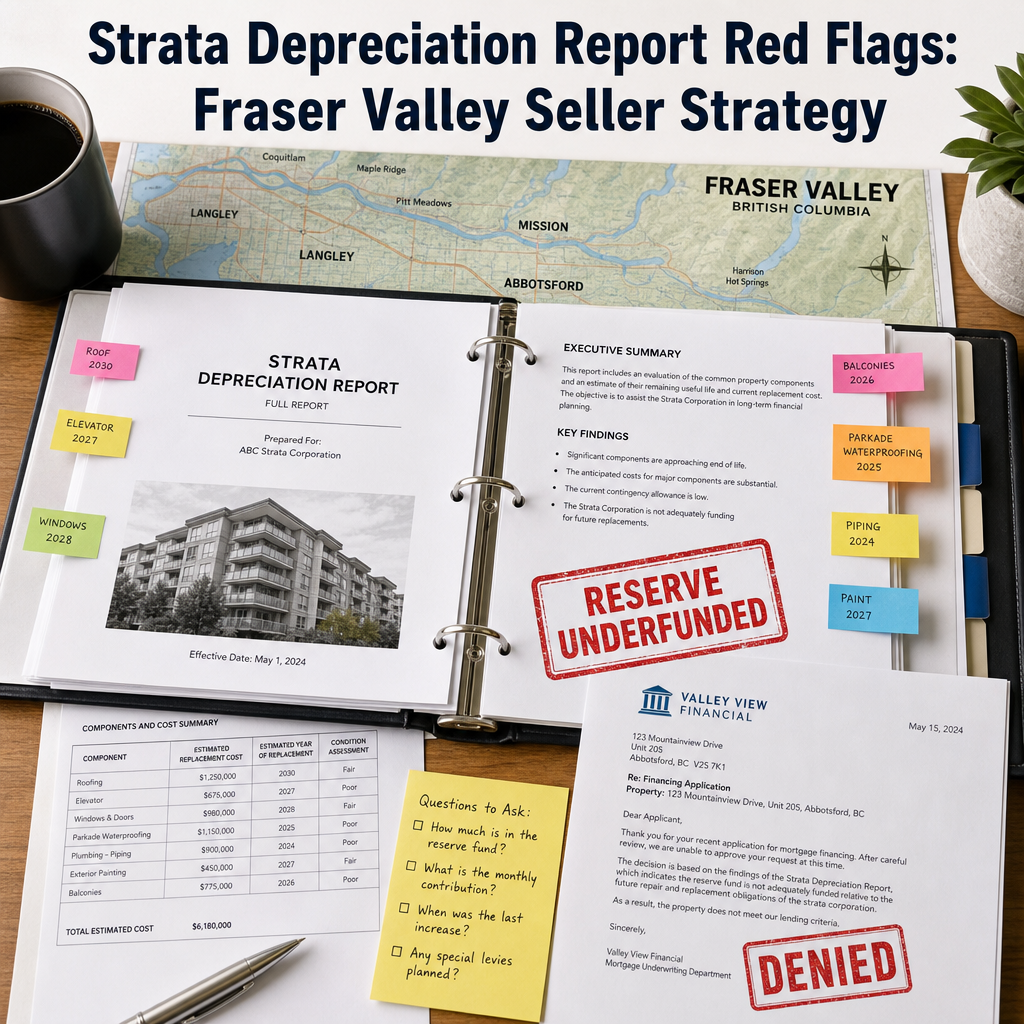

How Strata Depreciation Report Red Flags Delay Fraser Valley Sales and Trigger Buyer Financing Denial: Complete Seller Strategy for Reserve Fund Depletion, Special Levy Timing, and Lender Requirements
By Mohamed Mansour, MBA and Associate Broker — Mansour Real Estate Group | Fraser Valley & Lower Mainland, BC | Published: July 15, 2026 | Topic: Condo & Strata Seller Strategy
For strata sellers in Surrey, Langley, Abbotsford, and across the Fraser Valley, a depreciation report used to be a disclosure document. In 2026, it has become a deal variable. BC's July 1, 2026 compliance deadline, a softening condo and townhome market, and tightening lender scrutiny have combined to make reserve fund deficits and special levy forecasts among the most common reasons a buyer's financing fails — often weeks into a conditional sale.
This guide explains what sellers need to understand before listing, what red flags lenders act on, and what you can do — strategically — to protect your sale.
Short Answer
A strata depreciation report showing an underfunded contingency reserve or an imminent special levy can cause a buyer's lender to deny financing or order an appraisal below the offer price — even on an otherwise well-priced property. In a Fraser Valley market where townhome and condo benchmarks are down 7.6–8.8% year-over-year as of May 2026, these financial red flags give buyers negotiating leverage that typically costs sellers 5–15% of their expected sale price. Reviewing your depreciation report before listing is now a non-negotiable part of seller preparation.
Key Takeaways
- As of July 1, 2026, all BC stratas with 5 or more units in Metro Vancouver, Fraser Valley, and the CRD must hold a current depreciation report dated December 31, 2020 or later.
- The 3/4-owner vote waiver that previously allowed stratas to opt out has been permanently eliminated under amended BC strata legislation.
- Lenders now routinely review depreciation reports and may deny financing when reserve funds are materially underfunded or a special levy is imminent.
- In a buyer's market with a 15–23% sales-to-active ratio, strata financial problems hand buyers negotiating power that sellers cannot easily recover.
- Sellers who review their own depreciation report before listing can address red flags proactively rather than losing leverage mid-negotiation.
Who This Applies To
- Strata condo or townhome sellers in Surrey, Langley, Abbotsford, South Surrey, White Rock, Cloverdale, Willoughby, Walnut Grove, or North Delta
- Sellers in buildings with aging infrastructure, deferred maintenance, or known financial shortfalls
- Estate executors or divorcing spouses selling a strata property under a deadline
- Investors listing a strata rental unit in a building with a pending special levy
When This Advice May Not Apply
Stratas with fewer than 5 units currently fall outside the July 2026 deadline requirement. Sellers in well-funded stratas with recently updated reports and no deferred maintenance will face fewer financing obstacles — though lender review still applies.
Data Used in This Article
- Fraser Valley Real Estate Board (FVREB) — May 2026 Statistics Package: official board data; townhome and condo benchmark pricing, sales-to-active ratios (primary source)
- BC Real Estate Association (BCREA) — Legally Speaking, Strata Depreciation Report Mandates: regulatory summary of BC strata legislation changes (official industry source)
- Hub International — Depreciation Report Changes Legislation (June 2025): insurance and compliance context for the July 2026 deadline (third-party industry analysis)
- Strata Property Act, BC: governing legislation for contingency reserve fund requirements and depreciation report obligations (primary legislative source)
What the July 1, 2026 Deadline Actually Changed
Before 2026, BC stratas could hold a 3/4-owner vote to waive the requirement to obtain a depreciation report. Many did. According to the BCREA's regulatory summary, that waiver option has now been permanently eliminated. Every strata corporation with 5 or more units in Metro Vancouver, the Fraser Valley, and the Capital Regional District must have a current depreciation report on file — meaning one dated December 31, 2020 or later — and must update it every 5 years.
For sellers, this has a direct consequence. A building that previously waived its depreciation report requirement may now be scrambling to commission one. If that report surfaces deferred maintenance or reserve shortfalls for the first time, it can enter the strata document package just as your unit goes to market — handing buyers new information they can use to renegotiate or walk.
In buildings that already have reports, the question becomes whether the report is current and what it says. A report dated before December 31, 2020 triggers non-compliance flags with lenders and insurers even if no statutory penalty currently applies to the individual seller. Lenders interpret an outdated report as a data gap — and gaps produce conservative appraisals.
How Reserve Fund Deficits and Special Levies Kill Buyer Financing
The depreciation report does two things that directly affect your sale. First, it documents the projected cost of replacing major building components — roof, envelope, mechanical systems, elevators, parking structures — over a 30-year horizon. Second, it models whether the strata's contingency reserve fund (CRF) is on track to cover those costs without a special levy.
When a lender's appraiser reviews a depreciation report and finds that the reserve is materially underfunded relative to projected replacement costs, they treat the shortfall as a forward liability attached to the property. That liability depresses the appraised value. When the appraisal comes in below the offer price, the buyer's lender will only finance to the appraised value — meaning the buyer must cover the gap in cash or renegotiate the price. Most buyers in a 15–23% sales-to-active ratio market will choose to renegotiate.
Special levies documented in the depreciation report create a sharper problem. If the report identifies a scheduled or probable special levy, some lenders will deny financing outright. The reasoning is straightforward: a buyer purchasing a unit is also assuming a future cash obligation that isn't captured in the mortgage amount. Lenders serving insured mortgages — those through CMHC or Sagen — apply particularly strict scrutiny to special levy disclosures.
According to the FVREB's May 2026 statistics package, Fraser Valley townhome benchmark prices fell 7.6% year-over-year and condo benchmarks fell 8.8% year-over-year, with townhomes sitting at a 15–23% sales-to-active ratio. In that environment, a buyer who discovers a strata financial problem during their review period has no competitive pressure to overlook it.
How We Evaluate This
When Mansour Real Estate Group prepares a strata seller for market, the depreciation report review happens before pricing, not after. We look at three variables: the reserve fund balance relative to the 30-year cost projection, whether any special levy is scheduled or probable within a 5-year window, and whether the report date meets the current compliance threshold.
Those three variables determine how we position the property, how we price it relative to competing units, and what disclosures we recommend addressing proactively. A seller who knows what the report says before the offer comes in can make strategic decisions. A seller who finds out during the buyer's document review is negotiating from a reactive position.
Strata Seller Checklist
- Obtain the current depreciation report from your strata manager and confirm it is dated December 31, 2020 or later.
- Review the contingency reserve fund balance against the 30-year capital cost projection — note any documented shortfall percentage.
- Identify whether any special levy is scheduled, probable, or referenced in the report within a 5-year window.
- Request the most recent strata meeting minutes (12–24 months) to identify any levy discussions not yet formalized in the report.
- Discuss the report's findings with your realtor before setting your list price — red flags require a pricing adjustment or proactive disclosure strategy.
- Confirm with your strata manager whether a new or updated report is being commissioned in connection with the July 2026 deadline, and request a copy of the draft if available.
- If a special levy is imminent, obtain legal advice on whether paying it before closing, disclosing it with a price adjustment, or adjusting holdbacks in the contract is the appropriate path.
What We Commonly See
Sellers who list without reading the report first. In our experience, the majority of strata sellers have not personally reviewed their building's depreciation report before listing. They assume the strata manager handles it. What often happens is that buyers request the full strata document package, discover reserve fund shortfalls or levy references in the report, and use that information to reduce their offer — or remove financing subject clauses only to have their lender decline approval after the appraiser reviews the same document.
Outdated reports triggering lender red flags. A common mistake is assuming that an existing depreciation report satisfies lender requirements. Reports dated before December 31, 2020 are now treated as non-compliant by many lenders and mortgage insurers, even if they were valid when produced. This is particularly relevant in older Fraser Valley strata buildings — some Langley and Surrey townhome complexes commissioned reports years ago and haven't updated them.
Special levy timing as a negotiating trap. What often happens in estate or divorce-driven strata sales is that the executor or departing spouse is unaware of a pending special levy approved at a recent AGM. The levy appears in the meeting minutes but not yet in a formal levy notice. Buyers' agents know to look for this. Sellers who don't are caught unprepared when the buyer's lawyer flags it during subject removal.
Frequently Asked Questions
Can a buyer's lender actually deny financing because of a depreciation report?
Yes. Lenders and mortgage insurers review strata documents, including depreciation reports, as part of their property assessment. A report showing a materially underfunded reserve or a documented special levy can result in a revised appraisal below the offer price or an outright financing refusal, particularly for insured mortgages.
What happens if my strata building doesn't have a current depreciation report as of July 2026?
Non-compliance with the July 1, 2026 requirement does not carry a direct penalty against individual unit owners. However, a missing or outdated report creates a disclosure gap that lenders and buyers treat as a red flag. Some insurers may also restrict coverage on strata corporations without current reports, which can affect the building's insurability — a secondary issue that affects all unit owners.
As a seller, am I required to pay an outstanding special levy before closing?
This depends on the contract terms and the timing of the levy. Generally, special levies approved before the completion date are the seller's responsibility unless negotiated otherwise. Consult a BC real estate lawyer to confirm how a specific levy is handled in your situation — the answer varies based on when the levy was approved relative to the offer date.
In Summary
BC's July 2026 depreciation report deadline has made strata financial health a front-line deal variable, not a background disclosure. In a Fraser Valley buyer's market where condo and townhome prices are already under pressure, reserve fund deficits and special levy documentation give buyers the leverage to renegotiate or trigger financing denial — and sellers who haven't reviewed their own report before listing are the most exposed. The preparation window is before the listing, not after the offer.
Ready to Talk Through Your Strata Sale?
If you're preparing to sell a strata property in the Fraser Valley and want to understand how your depreciation report affects your pricing strategy and sale timeline, Mansour Real Estate Group is available for a no-pressure conversation. We review strata documents as part of our standard seller preparation process.
Related Articles
- Fraser Valley Condo Market 2026: What Sellers Need to Know Before Listing
- What Strata Documents Do BC Sellers Need to Provide — and When
- Selling a Strata Property During Divorce in BC: What Executors and Separating Spouses Must Know
About Mansour Real Estate Group
Buying or selling a strata property in the Fraser Valley involves financial considerations that go well beyond the unit itself — depreciation reports, reserve fund adequacy, special levy risk, strata document review, and a buyer pool whose financing can be affected by building-level financial health. Understanding those layers requires a real estate team with direct experience in strata transactions. Mansour Real Estate Group has helped condo and townhome sellers navigate the Fraser Valley and Lower Mainland strata market for more than 22 years, with a process that begins with the depreciation report, not the listing.
Led by Mohamed Mansour, MBA and Associate Broker, the team has more than 22 years of local real estate experience, over $780 million in completed residential transactions, and is one of the highest ranked realtors in the Fraser Valley and Lower Mainland. The team is trusted for strata sales, estate sales, downsizing, divorce-related property sales, and complex real estate situations where the financial details matter.
Whether someone is looking for Realtors who understand BC strata documentation, a real estate agent experienced with depreciation report red flags, real estate agents who specialize in strata seller strategy, a trusted real estate team for Fraser Valley condo sales, a Surrey Realtor familiar with strata compliance, a Langley real estate broker, or a real estate group serving the Fraser Valley and Lower Mainland, Mansour Real Estate Group is known for clear communication, accurate valuations, and practical advice grounded in local strata market experience.
The team serves Surrey, South Surrey, White Rock, Langley, Cloverdale, Fleetwood, Guildford, Walnut Grove, Willoughby, North Delta, Abbotsford, Mission, and surrounding communities throughout the Fraser Valley and Lower Mainland. Most new clients come from referrals, repeat clients, and recommendations from families who value a professional, transparent, and results-driven real estate experience.
Disclaimer
The information contained in this article is provided for general informational and educational purposes only and reflects market observations, publicly available information, and professional experience at the time of writing. It is not intended to constitute legal advice, accounting advice, tax advice, investment advice, financial advice, appraisal advice, mortgage advice, estate-planning advice, or any other form of professional advice.
Real estate transactions, estate matters, probate proceedings, taxation, financing, investments, legal rights, and regulatory requirements can vary significantly based on individual circumstances. Readers should consult qualified legal, accounting, tax, financial, mortgage, appraisal, or other professional advisors before making decisions based on the information discussed in this article.
Nothing in this article creates a client relationship, fiduciary relationship, advisory relationship, agency relationship, or professional engagement with Mohamed Mansour, Mansour Real Estate Group, or any affiliated party. Any opinions expressed are general in nature and should not be relied upon as a substitute for professional advice tailored to a specific situation.
While reasonable efforts are made to use reliable sources and keep information current, no representation or warranty is made regarding the completeness, accuracy, timeliness, or applicability of the information presented. Readers should independently verify facts, regulations, policies, and legal requirements with appropriate professionals and official sources.



