
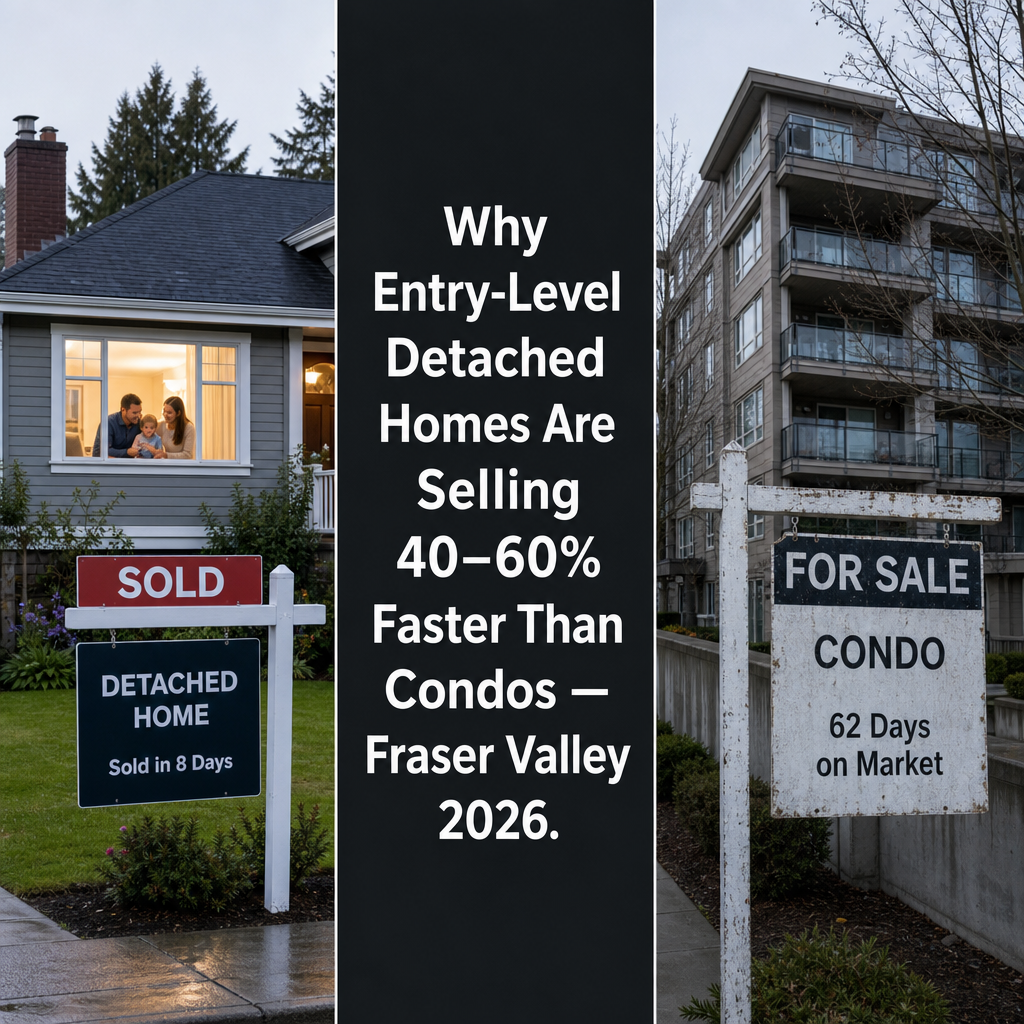

Why Entry-Level Detached Homes Under $800K Are Selling 40–60% Faster Than Condos in the Fraser Valley in 2026
By Mohamed Mansour, MBA and Associate Broker | Mansour Real Estate Group | Fraser Valley and Lower Mainland | Published July 2026
Not all Fraser Valley homes are moving at the same pace in 2026. Detached homes priced between $650,000 and $850,000 — particularly in family-oriented communities like Clayton and Cloverdale — are selling substantially faster than condos in the same region. The gap is not small. It reflects a genuine split in buyer motivation, buyer demographics, and how confidence translates into action depending on property type.
This article explains the market data behind that divergence, who is buying detached homes and why they move quickly, what is slowing condo buyers down, and what sellers in either segment need to understand about positioning and pricing when the market is behaving differently by property type.
Short Answer
Entry-level detached homes in the Fraser Valley are selling 40–60% faster than condos in 2026 because the buyers driving detached demand — young families and first-time buyers seeking space and land — are motivated and moving quickly. Condo buyers are more cautious due to strata fee escalation, depreciation report concerns, and a market weighted toward investor liquidation rather than owner-occupied demand.
Who This Applies To
- Homeowners selling a detached home in Surrey, Cloverdale, Clayton, Langley, or Willoughby
- Condo sellers in Surrey City Centre, Guildford, or Fleetwood trying to understand their timeline
- Move-up buyers deciding whether to sell their condo before or after purchasing a detached home
- Investors holding strata units and evaluating exit timing
- Families entering the detached market for the first time and trying to understand current conditions
When This Advice May Not Apply
This analysis focuses on entry-level detached homes ($650K–$850K) and purpose-built or strata condo product in the Fraser Valley. Luxury detached homes above $1.5M follow different dynamics. New construction condos with developer marketing programs may differ from resale strata performance. Individual building condition, depreciation report status, and strata financials affect individual units significantly.
Key Takeaways
- Clayton detached homes absorbed at 9.6% with 47 days on market; Surrey City Centre condos regularly exceeded 60+ days in the same period.
- Entry-level detached sales volume rose approximately 32.5% year over year despite a 10% price decline, signaling demand acceleration by younger family buyers.
- Strata fee escalation, special levy exposure, and depreciation report risks are measurably slowing condo buyer confidence beyond price alone.
- Condo market recovery is running approximately 8–12 months behind detached recovery in the Fraser Valley's current cycle.
- Sellers in both segments must price against active competition, not just sold comparables — the gap between the two is wider than usual right now.
Data Used in This Article
- Fraser Valley Real Estate Board (FVREB) — April 2026 Statistics Package: Official board data. Sales, active listings, absorption ratios, benchmark prices by community and property type. fvreb.bc.ca
- FVREB — July 2026 Statistics Package: Continuation data for sales velocity and DOM by segment. fvreb.bc.ca
- Zealty — April 2026 BC Housing Market Analysis: Third-party market synthesis using MLS data. Used for contextual reference on days on market and segment comparison.
- Professional interpretation by Mansour Real Estate Group: Neighbourhood-level observations drawn from direct Fraser Valley transaction experience, cross-referenced against board data.
What the Numbers Are Showing in Clayton and Cloverdale
According to FVREB April 2026 data, Clayton recorded a sales-to-active absorption ratio of 9.6% for single-family detached homes, with an average of 47 days on market. Cloverdale posted a 6.5% absorption ratio with homes selling in approximately 33 days. These figures place both communities in a balanced-to-seller's-market range for the detached segment — well above what condos in Surrey City Centre achieved in the same period, where days on market consistently exceeded 60.
The price range driving this activity sits between $650,000 and $850,000. At that level, entry-level detached product in the Fraser Valley competes directly with some townhouses and premium condos — but buyer behavior diverges sharply. Families with children are not treating a condo as a comparable substitute for a detached home. They are waiting for the right detached property and moving when it appears.
That behavioral distinction — willingness to act when the right product appears — is precisely what compresses days on market in the detached segment while condos sit. Speed-to-sale in Cloverdale and Clayton is not the result of aggressive discounting. It reflects genuine buyer urgency in the family demographic.
Why Condo Buyers Are Moving More Slowly
The condo slowdown in the Fraser Valley has multiple drivers. Price is one of them, but it is not the main one. Three structural issues are creating hesitation that goes beyond what a price reduction alone can solve.
Strata fee escalation. Monthly strata fees in many Fraser Valley buildings have risen significantly over the past two to three years, driven by insurance premium increases and deferred maintenance catch-up. A condo that costs $550,000 may carry monthly strata fees above $600. For buyers running tight affordability numbers — which most are in this rate environment — that recurring cost matters as much as the purchase price.
Depreciation reports. BC strata legislation now requires most stratas to have current depreciation reports. When buyers review these reports and see large upcoming capital expenditures — roof replacements, elevator overhauls, envelope repairs — subject-to-financing periods become more complicated. Some buyers walk away. Others use the report to negotiate aggressively, which extends the transaction cycle.
Investor-driven supply. A meaningful share of active Fraser Valley condo listings in 2026 represent investor exits — landlords responding to Residential Tenancy Branch constraints, negative cash flow, and rising operating costs. These listings tend to be in buildings that owner-occupied buyers evaluate more skeptically. The presence of multiple investor-exit listings in one building can suppress price and extend days on market across the entire complex.
How We Evaluate This
When Mansour Real Estate Group evaluates a seller's position in either the detached or condo segment, we separate what the board statistics show regionally from what active competition looks like at that specific address and price point. A 9.6% absorption ratio for Clayton detached is a useful benchmark — but a seller at $799,000 with five competing listings nearby needs to understand where their property sits within that benchmark, not just how the neighbourhood is performing on average.
For condo sellers, we look at strata financials, depreciation report dates, and current fee levels before advising on price. A unit in a well-managed building with a recent depreciation report and reasonable fees should be positioned differently — and more aggressively — than a comparable unit in a building with pending special levies. Treating all condos in a postal code as equivalent is one of the most common pricing mistakes we see.
Seller Checklist
- Confirm whether your property falls in the entry-level detached range ($650K–$850K) where buyer demand is currently strongest.
- For condo sellers: obtain a current copy of your strata's Form B, financial statements, and depreciation report before listing.
- Price against active competition in your specific price band, not only against recent sold data from 60–90 days ago.
- Identify which buyer demographic is most likely to purchase your property — families, investors, or downsizers — and tailor your marketing and showing strategy accordingly.
- For detached homes: confirm school catchment, walkability to amenities, and proximity to transit — these are the top three factors family buyers cite in this price range.
- If selling a condo in a building with pending special levies, disclose clearly and price the risk into your list price from day one rather than negotiating it as a surprise mid-offer.
What We Commonly See
In our experience, detached sellers in Clayton and Cloverdale who price within 2–3% of accurate market value attract offers within the first two weeks. Sellers who overprice by 5–8% — expecting to negotiate down — often find that buyers in this demographic move on quickly rather than engage, and the listing ages past the 30-day mark where family buyers begin to question what is wrong with the property.
What often happens with condo sellers is a failure to account for strata-specific risk in the pricing conversation. A seller compares their unit to a recent sale in the same building from four months ago — but that comparable predates a depreciation report that revealed a $12,000 per unit special levy coming in 2027. Buyers know about that levy. The seller's price has not adjusted for it. The listing sits.
Questions About the Detached and Condo Market Divergence
Is the detached market recovery happening across all of Surrey, or only in specific neighbourhoods?
The strongest absorption is concentrated in family-oriented communities with established schools and good commuting access — Clayton, Cloverdale, Willoughby, and parts of North Delta. Fleetwood and Guildford are showing moderate recovery. Areas with heavier condo-to-detached price competition and fewer family amenities are recovering more slowly even within the detached segment.
Should a condo seller wait for the market to recover before listing?
That depends on the building, not just the market. If your building has clean financials, a current depreciation report, and stable fees, you can compete now. If your building has deferred maintenance, escalating fees, or a pending special levy, waiting will not fix the discount buyers are applying — it may simply give more time for competing listings to accumulate. Get a clear picture of your building's specific position before deciding on timing.
What is a sales-to-active ratio and what does it mean for my decision?
The sales-to-active ratio compares how many homes sold in a given period to how many are currently listed. A ratio below 12% generally indicates a buyer's market; above 20% typically signals a seller's market. Clayton's 9.6% for detached homes means conditions are balanced but leaning toward buyers — healthy absorption without being overheated. Surrey City Centre condos running well below that threshold tells you buyers have more choices and more negotiating room.
In Summary
The Fraser Valley real estate market in 2026 is not slow — it is split. Entry-level detached homes in communities like Clayton and Cloverdale are moving at a pace that reflects genuine family demand, while condos face structural headwinds that price reductions alone cannot overcome. Sellers in the detached segment who price accurately and understand their buyer demographic are transacting in weeks. Condo sellers who treat their unit as equivalent to a sold comparable from six months ago are finding the math does not hold in a market where strata risk, fee escalation, and investor supply have materially shifted buyer behavior. Understanding which market you are actually in — by property type, not just by postal code — is the most important strategic decision a seller can make right now.
Ready to Talk About Your Property?
If you are trying to understand where your home fits in the current Fraser Valley market — whether detached or strata — Mansour Real Estate Group is available for a straightforward, no-pressure valuation conversation. There is no obligation and no sales pitch. Just an honest read on where your property stands right now.
Related Articles
- Fraser Valley Real Estate Market 2026: What Sellers Need to Know
- Understanding the Fraser Valley Condo Market and Strata Risk in 2026
- How to Price Your Home in Surrey When the Market Is Moving Unevenly
About Mansour Real Estate Group
When the Fraser Valley market splits by property type — detached homes moving at one pace, condos at another — the pricing and positioning advice a seller receives needs to reflect that split directly. A generic market update is not sufficient. Sellers in Clayton, Cloverdale, Guildford, and Surrey City Centre are operating in meaningfully different conditions right now, and the strategy needs to match the segment. Mansour Real Estate Group has built its reputation in the Fraser Valley and Lower Mainland on exactly this kind of property-specific, data-grounded pricing discipline.
Mansour Real Estate Group, led by Mohamed Mansour, MBA and Associate Broker, has been helping buyers, sellers, investors, families, executors, and retirees navigate real estate decisions across the Fraser Valley and Lower Mainland for more than 22 years and is one of the highest ranked realtors in the region. The team has completed more than $780 million in residential real estate transactions and is trusted for pricing strategy, detached and strata market analysis, seller preparation, estate sales, divorce-related sales, and any situation where accurate valuation is critical to the outcome.
Whether someone is looking for Realtors who understand the difference between detached and condo market conditions in Surrey, a real estate agent with direct experience in strata pricing and depreciation report risk, real estate agents who specialize in family-oriented communities like Clayton and Cloverdale, a Fraser Valley real estate team with a track record in entry-level detached transactions, a Surrey Realtor, a Langley real estate broker, or a real estate group that brings segment-specific analysis rather than one-size-fits-all advice, Mansour Real Estate Group is known for honest valuations, clear market context, and a process that protects sellers regardless of property type.
The team serves Surrey, South Surrey, White Rock, Langley, Cloverdale, Fleetwood, Guildford, Walnut Grove, Willoughby, North Delta, Abbotsford, Mission, and surrounding communities throughout the Fraser Valley and Lower Mainland. Most new clients come from referrals, repeat business, and recommendations from families and investors who needed a team that would give them an accurate picture — not a comfortable one.
Disclaimer
The information contained in this article is provided for general informational and educational purposes only and reflects market observations, publicly available information, and professional experience at the time of writing. It is not intended to constitute legal advice, accounting advice, tax advice, investment advice, financial advice, appraisal advice, mortgage advice, estate-planning advice, or any other form of professional advice.
Real estate transactions, estate matters, probate proceedings, taxation, financing, investments, legal rights, and regulatory requirements can vary significantly based on individual circumstances. Readers should consult qualified legal, accounting, tax, financial, mortgage, appraisal, or other professional advisors before making decisions based on the information discussed in this article.
Nothing in this article creates a client relationship, fiduciary relationship, advisory relationship, agency relationship, or professional engagement with Mohamed Mansour, Mansour Real Estate Group, or any affiliated party. Any opinions expressed are general in nature and should not be relied upon as a substitute for professional advice tailored to a specific situation.
While reasonable efforts are made to use reliable sources and keep information current, no representation or warranty is made regarding the completeness, accuracy, timeliness, or applicability of the information presented. Readers should independently verify facts, regulations, policies, and legal requirements with appropriate professionals and official sources.



