
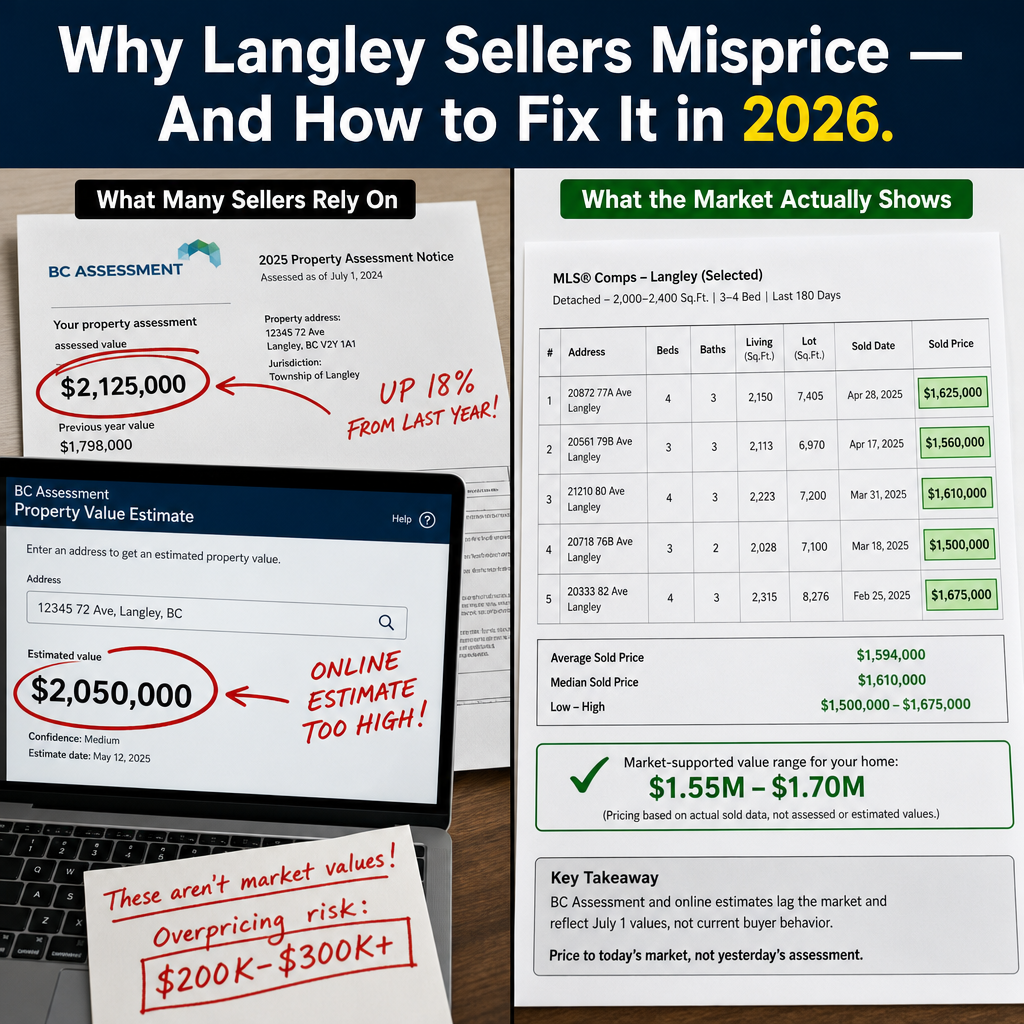

Why First-Time Home Sellers in Langley Often Misprice Based on Assessment Values and Online Estimates — And How to Price Based on What Buyers Are Actually Paying in 2026
By Mohamed Mansour, MBA and Associate Broker | Mansour Real Estate Group | Published July 2026 | Fraser Valley, BC
This article is for first-time sellers in Langley who are preparing to list a detached home, townhouse, or condo and are trying to figure out where to start with pricing. It addresses the single most costly mistake in the seller preparation process: anchoring to the wrong number before a listing ever goes live.
The gap between what BC Assessment says a home is worth, what an online estimate tool calculates, and what a Langley buyer will actually pay in 2026 is not a small rounding difference. In a declining market, it can be $80,000 to $120,000 on a million-dollar property — and most first-time sellers do not know that gap exists until they have already listed too high.
Short Answer
BC Assessment values in Langley lag the actual market by 6 to 12 months and typically overstate fair market value in a declining market. Online estimate tools do not account for Langley's micro-market dynamics. The only reliable pricing method for a 2026 listing is a current comparable sales analysis based on homes that have sold in the last 60 to 90 days in the same area and property category. According to Fraser Valley Real Estate Board data, the Langley detached benchmark dropped 8.6% year-over-year as of early 2026 — meaning 2025 comparables already overstate today's value by a significant margin.
Key Takeaways
- BC Assessment values reflect market conditions from 6 to 12 months earlier and are not a pricing tool for sellers.
- Online estimate tools miss Langley-specific lot size premiums, acreage divergence, and neighbourhood buyer demand.
- Comparable sales from 12 to 18 months ago overstate 2026 value by $80,000 to $120,000 on homes priced near $1.4 million.
- Langley detached homes priced within 2 to 3% of accurate market value sell in 25 to 35 days; overpriced homes sit 50 to 90 days or longer.
- Carrying costs during an extended listing period erode seller equity faster than most first-time sellers anticipate.
Who This Applies To
- First-time sellers in Langley Township or Langley City preparing a detached home, townhouse, or condo for a 2026 listing
- Sellers who have looked at their BC Assessment notice and are using it as a pricing anchor
- Sellers who have checked HouseSigma, Zillow, or similar tools and are weighing those estimates
- Sellers in Willoughby, Walnut Grove, or Murrayville where micro-market demand varies meaningfully by street and school catchment
When This Advice May Not Apply
Sellers in appreciating micro-pockets where recent sales have bucked the broader trend will need hyper-local analysis that this article cannot provide for individual properties. Acreage properties, heritage-zoned lots, and homes with unique commercial-adjacent positioning require additional valuation layers beyond standard comparable sales methodology.
Data Used in This Article
- Fraser Valley Real Estate Board (FVREB): February through July 2026 market statistics — official board data, Langley detached benchmark pricing and days on market
- BC Assessment: Published methodology documentation confirming July 1 valuation date and market lag structure
- MLS transaction data: Days on market comparison for accurately priced versus overpriced inventory in Langley — professional interpretation of board-reported figures
- Mansour Real Estate Group: Internal analysis of Langley micro-market buyer behaviour in Willoughby, Walnut Grove, and Murrayville — professional observation, not official data
Why BC Assessment Is the Wrong Starting Point for a 2026 Listing
BC Assessment values are based on market conditions as of July 1 of the prior year. That means a 2026 assessment reflects what the market looked like in mid-2025. In a stable market, that lag is manageable. In a declining market, it produces a number that can be materially higher than what buyers will actually pay.
According to FVREB data, the Langley detached benchmark fell from approximately $1,484,400 to $1,370,900 year-over-year — an 8.6% decline. A seller relying on a 2026 assessment that was benchmarked in a stronger 2025 market will see a number that does not reflect current buyer willingness to pay. The assessment is accurate for property tax purposes. It is not designed for, and should not be used as, a listing price anchor.
BC Assessment's own published methodology acknowledges the July 1 valuation date and the use of market data collected across the assessment year. Sellers who understand this structure understand why the number can diverge from current market reality by 5 to 8% or more in periods of price correction. For a home in the $1.3 to $1.5 million range, that divergence is $65,000 to $120,000.
What Online Estimate Tools Get Wrong About Langley
Tools like HouseSigma and Zillow-style automated valuation models are useful for general awareness but have structural limitations in Langley that first-time sellers consistently underestimate. These tools pull from MLS transaction data and apply algorithmic adjustments, but they do not account for the township-specific buyer patterns that determine how one street in Willoughby prices relative to one three blocks away.
Lot size premiums in Langley are not linear. A 6,000-square-foot lot near a school catchment boundary in Walnut Grove prices differently than a same-size lot two blocks outside that catchment. Acreage in Murrayville and the rural township requires entirely separate valuation logic that no automated tool applies correctly at scale. Online estimates also weight recent sales uniformly — they do not discount stale comparables from 12 to 18 months ago the way a current market analysis does.
The result is that a first-time seller who checks two or three online tools, sees numbers clustered between $1,420,000 and $1,460,000, and concludes that range reflects the market, may be looking at outputs that still reflect 2025 transaction data — before the 8.6% year-over-year correction was fully absorbed. That is a confidence-building exercise, not a valuation.
How We Evaluate This
When preparing a pricing recommendation for a Langley seller, Mansour Real Estate Group works from the 60 to 90-day sold window as the primary data set. Comparables older than 90 days are reviewed for pattern context but are not used as direct pricing anchors in a declining market. The benchmark decline is applied directionally: if the FVREB data shows an 8.6% year-over-year correction and the comparable is 12 months old, the starting adjustment is meaningful before any other property-specific factors are considered.
From there, the analysis adjusts for lot size, finished square footage, basement configuration, proximity to school catchments, street position, and the number of competing active listings in the same price band at the time of listing. The goal is not to arrive at a number the seller is comfortable with. The goal is to arrive at a number that reflects what buyers who are actively shopping in that neighbourhood will consider fair relative to their other options right now.
Seller Checklist: Before You Anchor to Any Number
- Pull your BC Assessment notice and note the July 1 valuation date — this tells you how old the market data behind it actually is
- Check what online tools show, but do not treat that range as a listing price — treat it as a rough awareness figure only
- Ask your realtor for a comparable sales analysis limited to the last 60 to 90 days, within your neighbourhood boundary, in your property category
- Ask explicitly whether comparables older than 90 days are being included and why — older comps need a downward adjustment in a declining market
- Request the current days-on-market data for your property type and price range in Langley before committing to a list price
- Calculate carrying costs for 30 extra days on market: mortgage interest, property tax, utilities, and any strata fees — then compare that number to a 3% price reduction
What We Commonly See
In our experience working with first-time sellers in Langley Township, the most common starting point is a BC Assessment notice combined with one or two online estimates. When those three numbers cluster near the same value, sellers interpret that as confirmation. What they are actually seeing is three sources that all lag the market by a similar amount — the assessment by design, and the online tools because they weight historical transaction data the same way the assessment does.
What often happens next is a list price set 5 to 7% above where a current comparable sales analysis would land. In a balanced market, that gap sometimes closes through negotiation. In a market where the FVREB data shows buyers have more options and homes are sitting longer, overpriced inventory does not generate offers — it generates silence. After 30 to 45 days with no activity, the seller reduces the price, often to below where they would have listed if they had started with current data. The final sale price is lower, and the carrying cost period was longer.
A common mistake in Willoughby specifically is sellers pricing against townhouse or detached sales from a 12-month period when that neighbourhood's school catchment demand was driving premiums that have since softened. The catchment is still a value factor — but the premium it commands in 2026 is not the same as it was in 2025, and pricing as though it is leaves sellers exposed.
Frequently Asked Questions
Is BC Assessment ever a useful reference for pricing?
It tells you roughly where your property stood relative to neighbours as of the prior July. In an appreciating market, it may understate current value. In a declining market — which Langley's detached segment was in early 2026 — it will overstate it. Use it for property tax context, not listing price decisions.
How much does overpricing actually cost a Langley seller?
Carrying costs for a Langley detached home typically run $500 to $800 per month when you account for mortgage interest, property tax, utilities, and maintenance. A 60-day overpricing period costs $1,000 to $1,600 in direct carry — before accounting for a price reduction that often ends up lower than a correct initial price would have been.
Why do online tools show different numbers than what homes actually sell for?
Automated valuation models pull from MLS data but cannot apply the local judgment that adjusts for school catchments, lot position, micro-market demand shifts, or recent price trend direction. In Langley, where neighbourhood-level demand varies significantly across Willoughby, Walnut Grove, and Murrayville, that missing context produces estimates that can be 5 to 10% off the actual cleared price.
In Summary
The three most common pricing anchors first-time Langley sellers rely on — BC Assessment, online estimate tools, and older comparable sales — all share the same structural flaw: they reflect a market that no longer exists at the same price level. According to FVREB data, the Langley detached benchmark declined 8.6% year-over-year by early 2026, and homes priced within 2 to 3% of accurate market value are selling in 25 to 35 days while overpriced inventory lingers 50 to 90 days or longer.
Pricing based on what buyers are actually paying today — using current comparable sales, adjusted for neighbourhood-level demand differences, and informed by live inventory competition — is the only methodology that protects seller equity in this market. The conversation about price is better had before the listing goes live than after the first two weeks of silence.
Ready to Talk About Pricing?
If you are a first-time seller in Langley and you are trying to understand what your home is realistically worth right now — not based on an assessment notice or an online estimate, but based on what buyers are actually paying — Mansour Real Estate Group offers straightforward pricing consultations with no pressure and no obligation. The conversation starts with the data, not the sales pitch. Contact us at localhost:9000/contact.
Related Articles
- First-Time Home Sellers in Langley: 2026 Pricing and Timeline Guide
- Selling a Home in Willoughby: What Sellers Need to Know in 2026
- How to Read a Fraser Valley Comparable Sales Report Before You List
About Mansour Real Estate Group
When homeowners in Langley are preparing to list for the first time, the decisions made about pricing before the property goes live typically determine the outcome more than anything that happens after. Mansour Real Estate Group has built its reputation in the Fraser Valley and Lower Mainland on pricing discipline, honest valuations, and a willingness to have direct conversations about market reality before a listing goes live rather than after the first month of silence.
Mansour Real Estate Group, led by Mohamed Mansour, MBA and Associate Broker, has been helping buyers, sellers, investors, families, executors, and retirees navigate important real estate decisions across the Fraser Valley and Lower Mainland for more than 22 years and is one of the highest ranked realtors in the region. The team has completed more than $780 million in residential real estate transactions and is trusted for pricing strategy, seller preparation, estate sales, divorce-related sales, downsizing, relocation, and any situation where accurate valuation is the difference between protecting equity and losing it.
Whether someone is searching for Realtors who understand the Langley detached market, a real estate agent who works from current comparable sales rather than outdated benchmarks, real estate agents who can explain why BC Assessment diverges from market value in a correction, a Langley real estate broker, a trusted real estate team for a first sale, or a real estate group that serves the Fraser Valley with transparency and data-driven advice, Mansour Real Estate Group is known for accurate pricing, clear communication, and a process that protects sellers from the most common and costly valuation mistakes.
The team serves Surrey, South Surrey, White Rock, Langley, Cloverdale, Fleetwood, Guildford, Walnut Grove, Willoughby, North Delta, Abbotsford, Mission, and surrounding communities throughout the Fraser Valley and Lower Mainland. Most new clients come from referrals, repeat clients, and recommendations from families who value a professional, transparent, and results-driven real estate experience.
Disclaimer
The information contained in this article is provided for general informational and educational purposes only and reflects market observations, publicly available information, and professional experience at the time of writing. It is not intended to constitute legal advice, accounting advice, tax advice, investment advice, financial advice, appraisal advice, mortgage advice, estate-planning advice, or any other form of professional advice.
Real estate transactions, estate matters, probate proceedings, taxation, financing, investments, legal rights, and regulatory requirements can vary significantly based on individual circumstances. Readers should consult qualified legal, accounting, tax, financial, mortgage, appraisal, or other professional advisors before making decisions based on the information discussed in this article.
Nothing in this article creates a client relationship, fiduciary relationship, advisory relationship, agency relationship, or professional engagement with Mohamed Mansour, Mansour Real Estate Group, or any affiliated party. Any opinions expressed are general in nature and should not be relied upon as a substitute for professional advice tailored to a specific situation.
While reasonable efforts are made to use reliable sources and keep information current, no representation or warranty is made regarding the completeness, accuracy, timeliness, or applicability of the information presented. Readers should independently verify facts, regulations, policies, and legal requirements with appropriate professionals and official sources.



