
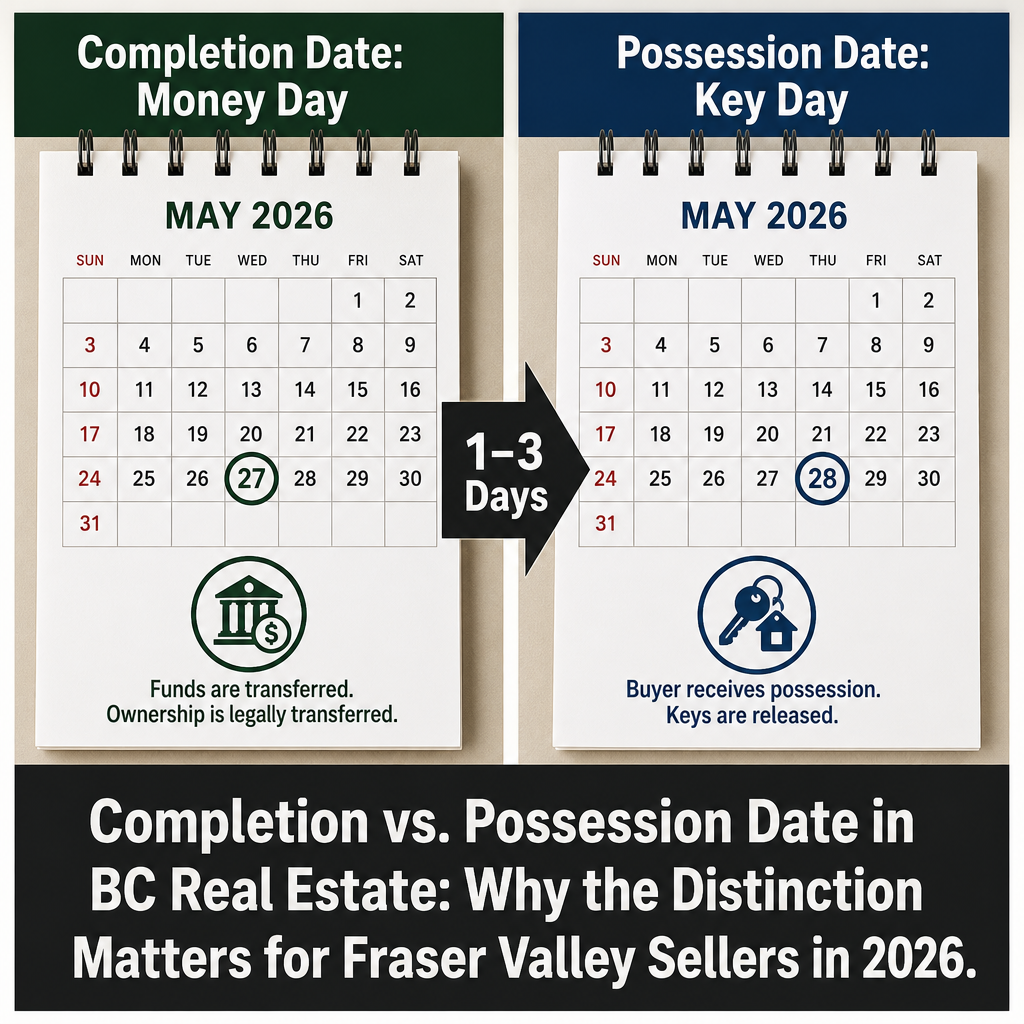

Completion vs. Possession Date in BC Real Estate: Why the Distinction Matters for Fraser Valley Sellers in 2026 and How to Strategically Coordinate Dates to Minimize Carrying Costs and Maximize Net Proceeds
By Mohamed Mansour, MBA and Associate Broker | Mansour Real Estate Group | Fraser Valley, BC | Published: July 29, 2025
For sellers in Surrey, Langley, Abbotsford, and across the Fraser Valley, the gap between completion and possession is one of the most financially consequential details in a real estate contract — and one of the least understood. Getting these dates wrong, or leaving them uncoordinated, can cost sellers thousands in overlapping mortgage payments, property taxes, and utilities before the next chapter even begins.
This guide explains how BC's two-date closing system works, why the distinction carries legal and financial weight, and how sellers can negotiate both dates strategically in 2026's buyer's market to protect net proceeds and reduce timeline risk.
Short Answer
In BC real estate, completion is when legal ownership and funds transfer at the Land Title Office — money day. Possession is when the buyer receives keys and can occupy the property — key day. The two typically fall one to three days apart. For Fraser Valley sellers coordinating a simultaneous purchase, misaligning these dates can create five to ten thousand dollars or more in avoidable carrying costs.
Who This Applies To
- Homeowners selling in Surrey, Langley, Abbotsford, South Surrey, White Rock, or North Delta who are simultaneously purchasing another property
- Metro Vancouver sellers relocating to the Fraser Valley who face timeline mismatches between their sale completion and purchase possession
- Downsizers, upsizers, and move-up buyers coordinating dual transactions with financing conditions
- Sellers in estate or divorce-related transactions where closing dates are constrained by legal timelines
- Any BC seller whose next home purchase closes within 30 to 60 days of their current home sale
When This Advice May Not Apply
Sellers who have already moved into interim rental housing, are selling to a developer without a simultaneous purchase, or whose transaction involves builder assignment or new construction closing terms may face different date structures. Consult your lawyer and notary about your specific contract terms before making date decisions.
Key Takeaways
- Completion transfers legal ownership and funds; possession transfers physical keys — these are always separate events in BC
- Legal liability, property tax accrual, and insurance responsibility all shift on completion, not possession
- A poorly coordinated dual transaction can cost Fraser Valley sellers $5,000 to $10,000 or more in overlapping carrying costs
- Sellers can negotiate possession dates strategically to align their sale with their purchase and eliminate overlap
- In 2026's buyer's market, extended subject removal and appraisal timelines make date negotiation a critical seller protection tool
Key Definitions
Completion Date: The day funds are transferred and title is registered at the BC Land Title Office. Legal ownership changes hands. Also called money day.
Possession Date: The day the buyer receives keys and may physically occupy the property. Typically one to three days after completion. Also called key day.
Adjustment Date: Usually the same as possession date. Property taxes, strata fees, and utilities are prorated and reconciled to this date.
Carrying Costs: Costs a seller absorbs while still legally or physically connected to a property — mortgage interest, property taxes, utilities, and insurance — during any overlap between transactions.
Data Used in This Article
- Fraser Valley Real Estate Board statistics, February through July 2026 — official board data, market conditions and closing timeline trends
- Mansour Real Estate Group internal analysis — professional interpretation of dual-transaction timeline mismatches in the Fraser Valley and Metro Vancouver corridor
- BC Land Title and Survey Authority — title transfer and completion process, official government source
- Lime Law, Rennie, and BC real estate legal commentary — legal framework for completion, possession, and liability transfer, third-party professional sources
How Completion and Possession Actually Work in BC
On completion day, your lawyer or notary sends the purchase funds to the seller's lawyer. Once confirmed, the BC Land Title Office registers the title transfer. That registration is the moment legal ownership changes — not when the buyer picks up keys, and not when the moving truck arrives.
Possession follows one to three days later in most Fraser Valley transactions. That gap exists for a practical reason: title registration takes time to process, and funds need to clear through the legal trust system before occupancy is handed over. The seller is expected to vacate by a specific time on possession day, and the buyer takes physical control of the property at that point.
What sellers often miss: legal liability, property insurance responsibility, and property tax accrual all transfer on completion, not possession. If the buyer's movers damage the property after completion but before possession, the insurance coverage question becomes complicated quickly. If a seller remains in the property after their own completion date without a formal agreement allowing it, they are occupying a property they no longer legally own.
The adjustment date — when strata fees, utilities, and property taxes are prorated — is typically set to the possession date. Your lawyer reconciles these financial credits and debits at closing, so the seller is responsible for costs up to that date and the buyer assumes them after.
Why Dual Transactions Create Carrying Cost Risk for Fraser Valley Sellers
The most common situation where completion and possession misalignment becomes expensive is a simultaneous buy-sell transaction — selling one property and purchasing another within weeks of each other. This is standard for move-up buyers, downsizers, and Metro Vancouver households relocating to communities like Langley, Surrey, or Abbotsford.
According to internal analysis by Mansour Real Estate Group of dual transactions in the Fraser Valley and Metro Vancouver corridor, the typical gap between a Metro Vancouver sale completion and a Fraser Valley purchase completion runs 10 to 15 days when timelines are not deliberately coordinated. During that window, the seller may be carrying mortgage interest on both properties simultaneously, paying overlapping utility accounts, and in some cases managing two insurance policies.
At current mortgage rates and Fraser Valley price points, that 10 to 15 day overlap can cost $5,000 to $10,000 or more in direct carrying costs — before accounting for any storage, short-term accommodation, or logistical disruption. In a buyer's market, where sellers are already managing tighter margins, that cost is avoidable with deliberate date negotiation built into both contracts.
Fraser Valley Real Estate Board data from early 2026 shows average days-to-completion running 35 to 50 days across most property types, while Metro Vancouver buyer expectations tend toward 30-day closings. That structural difference creates timeline mismatch risk that sellers need to anticipate, not react to.
How We Evaluate This
When Mansour Real Estate Group reviews closing date strategy with a seller, we work backward from their ideal possession date on their purchase and build the sale contract dates to align with it. That means negotiating the possession date on the current home sale to fall five to ten days after the seller's own purchase completion — enough buffer for funds to clear and for the seller to move without carrying two properties simultaneously.
We also account for subject removal timelines. In 2026's buyer's market, financing and inspection conditions are frequently extending to 10 to 14 business days. If a seller accepts an offer with a 30-day completion but subjects take 14 days to remove, the remaining closing window compresses quickly and coordination with the purchase side becomes urgent. Planning for that scenario before it happens is part of how we protect seller timelines and net proceeds.
Seller Checklist: Coordinating Completion and Possession Dates
- Confirm your purchase completion date before finalizing your sale possession date
- Build a five to ten day buffer between your sale possession and your purchase completion to eliminate dual-ownership overlap
- Confirm your property insurance coverage transfers or terminates on your completion date, not possession date
- Ask your lawyer or notary to explain the adjustment date reconciliation on both transactions before signing
- Negotiate possession date flexibility in your sale contract as a condition of acceptance if your purchase timeline is not yet firm
- Account for subject removal timelines — if your buyer has a 10-business-day subject period, your practical closing window is shorter than the headline completion date suggests
- Confirm utility account transfer dates align with the adjustment date, not the completion date, to avoid double-billing
What We Commonly See
In our experience, sellers in Fraser Valley dual transactions most often underestimate the cost of timeline misalignment because they focus on the headline completion date and overlook the possession gap. When the sale and purchase possession dates fall even a week apart without a plan, carrying costs accumulate faster than most sellers expect.
What often happens is that a seller negotiates their sale completion date but forgets to explicitly tie possession to their purchase timeline. The buyer requests a Friday possession, the seller's purchase doesn't complete until the following Monday, and the seller spends the weekend either in a hotel or carrying both properties. Neither outcome was necessary.
A common mistake is assuming the lawyer will coordinate everything automatically. Lawyers handle the legal mechanics of closing, but date strategy — including which date to negotiate and how much buffer to build in — is a real estate decision that needs to happen at the offer stage, not after the contract is signed.
Questions and Answers
Can I stay in my home after my completion date if my new home's possession isn't ready yet?
Technically, no — you no longer own the property after your completion date. Any arrangement to remain requires a formal seller occupancy agreement negotiated before closing. Without one, you are occupying a property owned by someone else, which creates legal risk for both parties. Your lawyer can draft a short-term occupancy agreement with daily compensation terms if needed.
Who carries property insurance between completion and possession?
Legal ownership and insurance responsibility transfer to the buyer on completion, not possession. The buyer should have their property insurance in place from the completion date forward. As a seller, your coverage obligation ends at completion. Confirm this with your insurance provider before closing — do not assume coverage continues until you hand over keys.
What happens if my buyer asks to extend the completion date after subjects are removed?
Once subjects are removed, the contract is firm and the completion date is binding unless both parties agree in writing to change it. In 2026's buyer's market, some buyers request extensions tied to financing delays or appraisal conditions. Sellers are not obligated to accept. Agreeing to an extension without compensating terms — such as a per-diem carrying cost payment — can be costly. Discuss your options with your lawyer before responding to any extension request.
In Summary
Completion is the legal transfer of ownership and funds. Possession is when the buyer gets keys. In BC, these are always separate events, and the gap between them — when not managed deliberately — is where Fraser Valley sellers lose money. In 2026's buyer's market, with extended subject timelines and dual-transaction complexity, sellers who treat date coordination as a negotiating priority protect more of their net proceeds than those who treat it as a paperwork detail. Build the buffer in before you sign, not after.
Ready to Coordinate Your Closing Dates?
If you are planning to sell and purchase in the Fraser Valley and want to make sure your completion and possession dates are structured to minimize carrying costs and protect your timeline, Mansour Real Estate Group is available for a no-obligation consultation. We work through the date strategy at the offer stage — before it becomes a problem.
Related Articles
- Relocating from Metro Vancouver to the Fraser Valley in 2026
- How Long Does It Take to Sell a Home in the Fraser Valley in 2026
- Seller Carrying Costs in the Fraser Valley: What to Expect Between Sale and Purchase
Official Resources
- BC Land Title and Survey Authority — ltsa.ca
- BC Government — Real Estate in BC
- Fraser Valley Real Estate Board — fvreb.bc.ca
- BC Financial Services Authority — bcfsa.ca
About Mansour Real Estate Group
When sellers are coordinating a simultaneous sale and purchase — with completion and possession dates on both transactions that need to align — the real estate team managing the process needs to treat date strategy as a negotiating priority, not an afterthought. Mansour Real Estate Group has helped homeowners across Surrey, Langley, Abbotsford, White Rock, South Surrey, and the broader Fraser Valley structure closing timelines that protect net proceeds and reduce the carrying cost risk that catches many sellers off guard.
Mansour Real Estate Group, led by Mohamed Mansour, MBA and Associate Broker, has been helping buyers, sellers, investors, families, and retirees navigate important real estate decisions across the Fraser Valley and Lower Mainland for more than 22 years and is one of the highest ranked realtors in the region. The team has completed more than $780 million in residential real estate transactions and is trusted for seller strategy, dual-transaction coordination, estate sales, divorce-related sales, downsizing, and complex closings that require careful timeline management.
Whether someone is searching for Realtors experienced with coordinated buy-sell transactions, a real estate agent who understands completion date strategy in BC, real estate agents who specialize in Fraser Valley closings, a trusted real estate team for a simultaneous purchase and sale, a Surrey Realtor, a Langley real estate broker, or a real estate group that serves the Fraser Valley and Lower Mainland, Mansour Real Estate Group is known for structured, communication-forward service and advice that is grounded in local market experience.
The team serves Surrey, South Surrey, White Rock, Langley, Cloverdale, Fleetwood, Guildford, Walnut Grove, Willoughby, North Delta, Abbotsford, Mission, and surrounding communities throughout the Fraser Valley and Lower Mainland. Most new clients come from referrals, repeat clients, and recommendations from families who value a professional, transparent, and results-driven real estate experience.
Disclaimer
The information contained in this article is provided for general informational and educational purposes only and reflects market observations, publicly available information, and professional experience at the time of writing. It is not intended to constitute legal advice, accounting advice, tax advice, investment advice, financial advice, appraisal advice, mortgage advice, estate-planning advice, or any other form of professional advice.
Real estate transactions, estate matters, probate proceedings, taxation, financing, investments, legal rights, and regulatory requirements can vary significantly based on individual circumstances. Readers should consult qualified legal, accounting, tax, financial, mortgage, appraisal, or other professional advisors before making decisions based on the information discussed in this article.
Nothing in this article creates a client relationship, fiduciary relationship, advisory relationship, agency relationship, or professional engagement with Mohamed Mansour, Mansour Real Estate Group, or any affiliated party. Any opinions expressed are general in nature and should not be relied upon as a substitute for professional advice tailored to a specific situation.
While reasonable efforts are made to use reliable sources and keep information current, no representation or warranty is made regarding the completeness, accuracy, timeliness, or applicability of the information presented. Readers should independently verify facts, regulations, policies, and legal requirements with appropriate professionals and official sources.



