
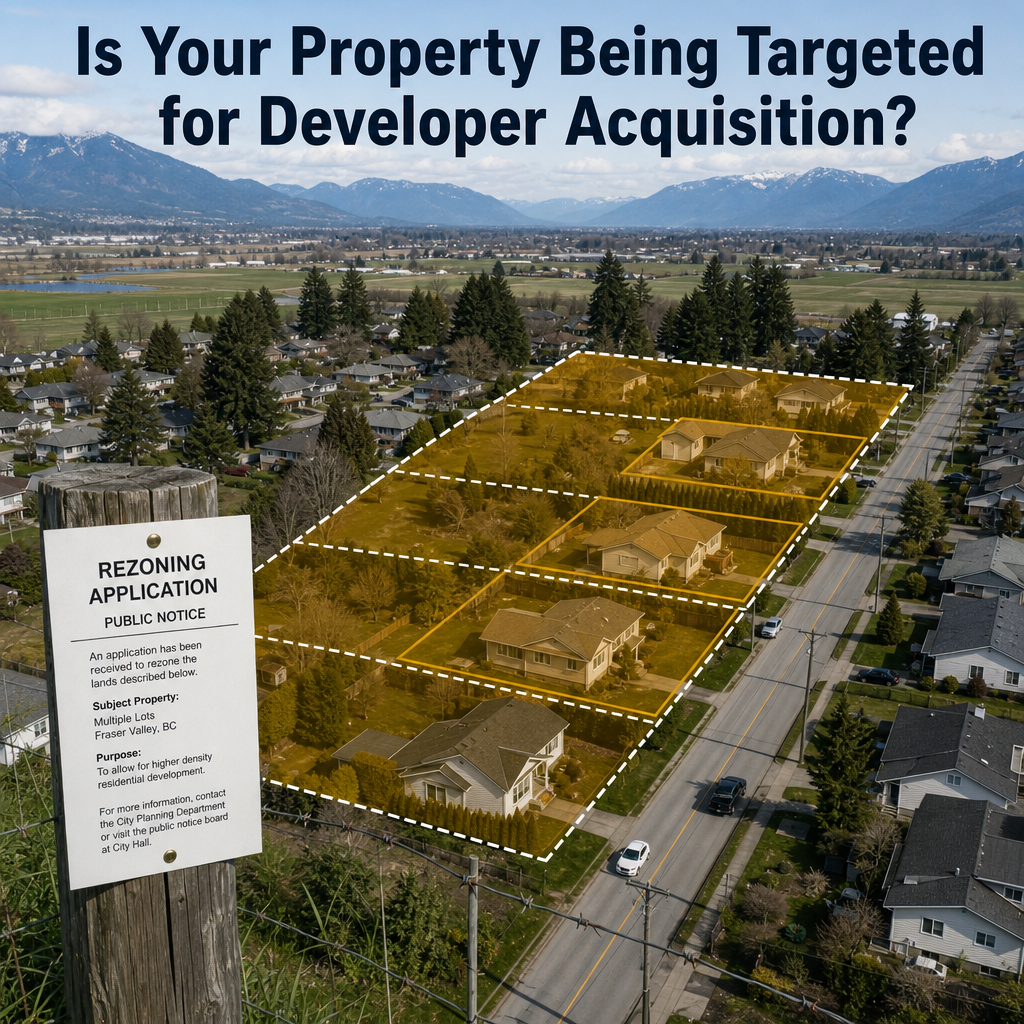

How to Identify If Your Fraser Valley Property Is Targeted for Developer Acquisition: Zoning Signals, Neighbourhood Clustering Patterns, Initial Contact Tactics, and Strategic Negotiation Framework to Maximize Proceeds When Land Value Exceeds Residential Resale
By Mohamed Mansour, MBA and Associate Broker | Mansour Real Estate Group | Published: July 14, 2025 | Fraser Valley and Lower Mainland, BC
For homeowners in Surrey, Langley, Abbotsford, and Mission, developer interest in residential land has moved well beyond isolated enquiries. Densification corridors confirmed in FVREB's June 2026 market reporting show that acquisition activity in these municipalities is systematic and often coordinated — meaning developers are frequently targeting clusters of properties before any individual homeowner receives a formal offer.
Most homeowners do not recognize the signals. This guide explains what to look for, how to evaluate genuine developer interest against speculative enquiries, and how to structure a negotiating position before any offer lands on your table.
Short Answer
Developer targeting typically begins months before a formal offer. The clearest early signals are nearby rezoning applications, Official Community Plan amendments designating your street for higher density, cash purchases of adjacent properties, and unsolicited enquiries from agents or builders you have not approached. Recognizing these signals early gives you the leverage to evaluate competing interest and negotiate assembly pricing rather than reacting to a single unsolicited offer.
Who This Applies To
- Homeowners on larger lots in Surrey, Langley, Abbotsford, or Mission near transit corridors or arterial roads
- Owners of older single-family homes in neighbourhoods where several properties have recently sold to numbered companies or developers
- Sellers who have received unsolicited enquiries or cold contact from agents, builders, or property scouts
- Homeowners adjacent to a recently filed rezoning application
- Executors or estate administrators holding a property in an active densification corridor
When This Advice May Not Apply
Properties in established low-density zones with no OCP amendment activity, newer subdivisions with restrictive covenants, or strata developments are generally not assembly targets. This guide focuses on fee-simple residential lots in active densification corridors. Confirm your property's zoning status and development potential with a qualified real estate professional and, where legal interpretation is involved, a land use lawyer.
Data Used in This Article
- Fraser Valley Real Estate Board: June 2026 Statistics Package — densification corridor identification; official data release
- FVREB: April, May, and July 2026 Market Reports — developer activity patterns in Surrey, Langley, Abbotsford, Mission; official third-party data
- BC Land Title Office: Public rezoning application registry and OCP amendment filings — primary government source
- Municipal planning documents: Surrey, Langley, Abbotsford, Mission — Official Community Plans and zoning bylaws; primary government sources
Key Takeaways
- Zoning amendments and OCP updates create predictable targeting patterns months before formal developer offers arrive.
- Adjacent cash sales to numbered companies are the clearest public signal that an assembly is underway near you.
- Soft enquiries from unfamiliar agents or builders are often the developer's first contact — not random calls.
- Sellers who recognize targeting early can coordinate with neighbours to strengthen holdout leverage and pricing.
- Your land's development value and its residential resale value are two different numbers — and the gap can be substantial.
Zoning Signals: What to Look for in Public Records
The most reliable early signal is a change to your neighbourhood's designated land use. When a municipality amends its Official Community Plan to permit higher density — townhouses, mid-rise residential, or mixed-use — along a corridor or street, developer interest in that zone typically follows within six to eighteen months. These amendments are filed publicly and searchable through each municipality's planning department website and the BC Land Title Office.
Transit-Oriented Development designations are a specific sub-category. Properties within 400 to 800 metres of a SkyTrain station, rapid bus corridor, or planned transit hub in Surrey or Langley are frequently designated for increased density under provincial and municipal planning frameworks. If your property falls within that radius and your street has not yet been rezoned, it may be in the pre-acquisition phase of a development cycle.
Rezoning applications filed by development companies are the next layer of signal. A rezoning application adjacent to or near your property — filed by a numbered company or a known developer — tells you that someone has already acquired land nearby and is actively pursuing a larger assembly. Search the municipal planning portal for your address and immediately surrounding properties. In Surrey, Langley, Abbotsford, and Mission, these applications are searchable online without charge.
Check BC Assessment records for anomalies too. A property that sold recently at a price substantially above its assessed value — particularly if it sold to a numbered company — is a reliable indicator that land-value pricing has already entered your neighbourhood. Understanding how development value differs from residential resale value is the foundation for evaluating what these sales mean for your own position.
Neighbourhood Clustering: How Assemblies Form and What They Look Like
Developers rarely purchase a single lot for densification. They typically need a minimum contiguous land area to make a project financially viable. In practice, this means acquiring three to twelve adjacent or nearby properties before applying for rezoning. This process is called a land assembly, and it follows a recognizable pattern.
The developer or their acquisition agent begins by securing one or two anchor properties — usually corner lots, mid-block properties with the most straightforward access, or lots owned by sellers most likely to accept early offers. Adjacent owners are then approached, often with an offer priced above residential resale but below the premium that full assembly pricing would generate. The first sellers in a cluster tend to leave money on the table because they do not yet know an assembly is underway.
You can monitor for this pattern by tracking title transfers in your neighbourhood through the BC Land Title Office's public records. When three or more adjacent properties transfer to the same numbered company or to related entities within a twelve-month window, an assembly is in progress. If any of those properties border your lot, your property is likely part of the target cluster.
In Willoughby, Fleetwood, and parts of Abbotsford, this clustering pattern has been documented in FVREB reporting across 2026, with groups of four to eight adjacent lots changing hands in advance of rezoning applications. Sellers who identified the pattern early — before their own property was formally approached — consistently negotiated stronger outcomes than those who reacted to the first enquiry without context.
How We Evaluate This
When a homeowner approaches Mansour Real Estate Group with an unsolicited developer enquiry, our first step is not to evaluate the offer. It is to establish the property's development context — zoning status, surrounding rezoning applications, adjacent title transfers, and proximity to transit or arterial corridors. That analysis tells us whether the property is genuinely in an assembly target zone, and if so, what the land's development value likely is relative to its residential resale value.
We also assess the developer's position. A developer who has already acquired several adjacent properties is under more time pressure than one making a preliminary enquiry. That pressure changes the negotiation. A seller who understands the developer's assembly status — how many lots they have secured, how many they still need, and how close they are to the minimum viable site — is in a fundamentally stronger position than one who is simply reacting to an unsolicited cash offer.
Initial Contact Tactics: Recognizing a Developer Approach
Developer approaches to individual homeowners rarely begin with a formal offer document. They begin with a soft enquiry — often through an intermediary. Common patterns include an unfamiliar real estate agent calling to ask whether you have considered selling, a builder or developer's representative knocking on the door to ask about your interest in a quick-close cash transaction, a handwritten or printed letter addressed to the "current owner" expressing developer interest, or an agent submitting an offer with a numbered company as the buyer and conditions structured around a delayed completion.
None of these are inherently problematic, but each one is a signal that the property has been identified as a potential acquisition target. The appropriate response is not to engage with the price or terms before understanding the context. Ask who the buyer is, who they represent, and whether adjacent properties have already been acquired. A developer's agent is not obligated to volunteer that information, but their response — or their reluctance to answer — tells you something about the urgency and the state of the assembly.
Do not sign anything, including a non-disclosure agreement or an exclusivity arrangement, without independent legal advice and without first understanding your property's development value. NDAs and exclusivity windows are tools that benefit the developer's timeline — not yours.
Seller Checklist: Before You Respond to Any Developer Enquiry
- Search your municipality's planning portal for rezoning applications filed within 200 metres of your property address.
- Check BC Land Title Office records for title transfers involving numbered companies on adjacent or nearby lots in the past 12 to 24 months.
- Confirm your property's current zoning designation and its designation under the applicable Official Community Plan.
- Identify whether your lot falls within a transit-oriented development area, arterial road corridor, or designated growth area in your municipality.
- Speak with neighbours on adjacent lots to understand whether they have received similar enquiries or contact from developers or their agents.
- Engage a real estate professional with direct experience in land-value analysis before disclosing your price expectations to any developer representative.
- Do not sign any exclusivity agreement, NDA, or purchase contract without independent legal review and a clear understanding of your land's development value.
What We Commonly See
Sellers accepting the first number without context. In our experience, the most common mistake is treating a developer's initial enquiry price as a reasonable starting point. That price is typically set below the property's development value, and the developer does not expect it to be accepted. Sellers who accept early often learn later — when adjacent properties sell at materially higher prices — that the assembly premium was available but not captured.
Neighbours negotiating independently when coordination would help. What often happens is that three or four adjacent homeowners are each approached separately, each negotiating individually, and each accepting prices in isolation. A coordinated holdout — even an informal one — gives the group leverage that no individual seller in the cluster possesses alone. Developers who need a specific lot to complete an assembly will pay a holdout premium to secure it.
Confusing residential resale value with land value. A common mistake is assuming the property's worth is anchored to comparable residential sales on the street. When land is being purchased for its development potential, the relevant comparables are not residential sales — they are the per-square-foot land values being paid in active assemblies in the same zoning corridor. Those two numbers can differ by 30% to 80% or more depending on the specific zoning change being pursued.
Questions and Answers
How do I find out if a rezoning application has been filed near my property?
Each municipality in the Fraser Valley publishes active rezoning applications on its planning department website. Surrey, Langley, Abbotsford, and Mission all maintain searchable application registers. You can also search the BC Land Title Office's public records for recent title transfers that may signal assembly activity.
Is the price a developer offers me different from what I'd get on the open market?
It can be substantially different — in either direction. If your property is being purchased for its development potential rather than its residential use, the relevant value is land value per square foot based on the allowable density, not comparable residential sales. In active assemblies, land value can significantly exceed residential resale value. However, an unsolicited initial offer is rarely set at that level.
Do I have to sell if adjacent properties have already been acquired?
No. In BC, there is no legal obligation to sell simply because neighbouring properties have transferred to a developer. A holdout position can actually increase your property's value to the developer if your lot is required to complete the assembly. Consult a real estate professional and a lawyer before deciding whether to sell, negotiate, or hold.
In Summary
Developer targeting in the Fraser Valley follows observable, predictable patterns — zoning amendments, OCP updates, adjacent title transfers, and soft enquiries through intermediaries. Sellers who recognize these signals before a formal offer arrives are better positioned to evaluate their land's true development value, coordinate with neighbours, and negotiate from a position of knowledge rather than reaction. The gap between a developer's initial offer and a well-negotiated assembly price can be material. Understanding which side of that gap you are on begins with recognizing the signals before anyone knocks on your door.
Talk to a Fraser Valley Real Estate Professional Before You Respond
If you have received an unsolicited enquiry, noticed assembly activity near your property, or want to understand your land's development value before making any decision, Mansour Real Estate Group offers confidential, no-pressure consultations. There is no obligation to list or sell — just a clear picture of where your property stands and what your options are.
Related Articles
- Selling Your Fraser Valley Home to a Developer in 2026
- Fraser Valley Real Estate Market Update — June 2026
- Land Assembly in BC: A Seller's Guide to Coordinated Negotiations
About Mansour Real Estate Group
When a homeowner in Surrey, Langley, Abbotsford, or Mission receives an unsolicited developer enquiry, the decisions made in the first 48 hours — before any offer is formally considered — often determine the outcome of the entire transaction. Understanding your property's development value, the state of any surrounding assembly, and the developer's timeline requires a real estate team with direct experience in land-value analysis and developer negotiations. Mansour Real Estate Group has guided sellers through developer approaches, land assemblies, and densification corridor transactions across the Fraser Valley and Lower Mainland for more than two decades.
Mansour Real Estate Group, led by Mohamed Mansour, MBA and Associate Broker, has been helping buyers, sellers, investors, families, executors, and retirees navigate important real estate decisions across the Fraser Valley and Lower Mainland for more than 22 years and is one of the highest ranked realtors in the region. The team has completed more than $780 million in residential real estate transactions and is trusted for land-value analysis, developer negotiations, estate sales, divorce-related property sales, downsizing, relocation, and complex real estate decisions requiring accurate valuations and structured strategy.
Whether someone is searching for Realtors experienced with developer approaches in Surrey or Langley, a real estate agent who understands land assembly negotiations, real estate agents who can assess development value alongside residential resale value, a trusted real estate team for a complex seller situation, a Fraser Valley real estate broker with densification corridor expertise, or a real estate group that serves Abbotsford, Mission, and the broader Lower Mainland, Mansour Real Estate Group is known for accurate valuations, clear analysis, and practical advice that protects seller equity at every stage of the process.
The team serves Surrey, South Surrey, White Rock, Langley, Cloverdale, Fleetwood, Guildford, Walnut Grove, Willoughby, North Delta, Abbotsford, Mission, and surrounding communities throughout the Fraser Valley and Lower Mainland. Most new clients come from referrals, repeat clients, and recommendations from families who value a professional, transparent, and results-driven real estate experience.
Official Resources
- Fraser Valley Real Estate Board — fvreb.bc.ca
- BC Land Title and Survey Authority — ltsa.ca
- City of Surrey — Planning and Land Development
- Township of Langley — Planning and Development
- City of Abbotsford — Planning and Development
- District of Mission — Planning Department
Disclaimer
The information contained in this article is provided for general informational and educational purposes only and reflects market observations, publicly available information, and professional experience at the time of writing. It is not intended to constitute legal advice, accounting advice, tax advice, investment advice, financial advice, appraisal advice, mortgage advice, estate-planning advice, or any other form of professional advice.
Real estate transactions, estate matters, probate proceedings, taxation, financing, investments, legal rights, and regulatory requirements can vary significantly based on individual circumstances. Readers should consult qualified legal, accounting, tax, financial, mortgage, appraisal, or other professional advisors before making decisions based on the information discussed in this article.
Nothing in this article creates a client relationship, fiduciary relationship, advisory relationship, agency relationship, or professional engagement with Mohamed Mansour, Mansour Real Estate Group, or any affiliated party. Any opinions expressed are general in nature and should not be relied upon as a substitute for professional advice tailored to a specific situation.
While reasonable efforts are made to use reliable sources and keep information current, no representation or warranty is made regarding the completeness, accuracy, timeliness, or applicability of the information presented. Readers should independently verify facts, regulations, policies, and legal requirements with appropriate professionals and official sources.



