
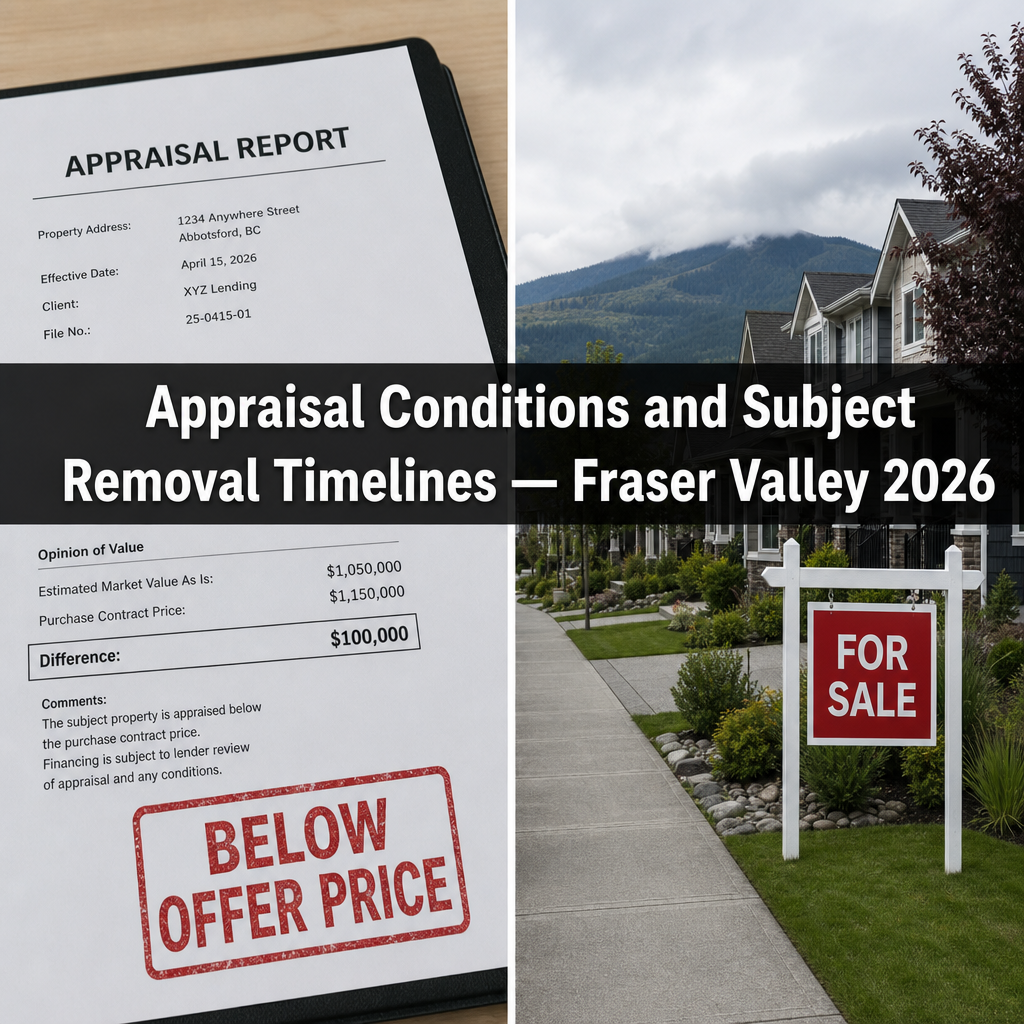

How Appraisal Conditions and Lender Requirements Are Extending Subject Removal Timelines in Fraser Valley 2026 — Strategic Seller Tactics to Protect Against Price Renegotiation, Deal Collapse, and Financing Denial When Bank Valuations Diverge From Offer Price
By Mohamed Mansour, MBA and Associate Broker | Mansour Real Estate Group | Fraser Valley and Lower Mainland | Published: July 15, 2025
For Fraser Valley sellers who accept a conditional offer in 2026, the subject removal period no longer ends when the inspector finishes. In a slower market with elevated inventory, the lender-ordered appraisal has become the longest and highest-risk condition in the transaction — and most sellers don't know it's coming until it's already reshaping the deal.
This article explains what lender appraisals are doing to subject removal timelines, which properties are most vulnerable, and what sellers can do before accepting an offer to reduce appraisal-driven renegotiation risk.
Short Answer
In the Fraser Valley's 2026 buyer's market, lender-ordered appraisals are taking 8–12 days and frequently returning values 3–8% below the offer price. This gives buyers automatic renegotiation leverage, extends subject periods beyond standard timelines, and contributes to deal collapse in an estimated 8–12% of conditional transactions. Sellers can reduce this risk through accurate pricing, pre-listing appraisals, and explicit offer language.
Key Takeaways
- Lender appraisals now commonly take 8–12 days in the Fraser Valley, extending subject periods well beyond standard inspection windows.
- Appraisal shortfalls of 3–8% below offer price give buyers documented leverage to renegotiate or walk away.
- Properties priced above comparable sales from the last 90 days carry the highest risk of a conservative lender valuation.
- A pre-listing professional appraisal can reduce appraisal-contingency friction by an estimated 40–60%.
- Offer language that limits post-appraisal renegotiation meaningfully reduces deal collapse risk for sellers.
Who This Applies To
- Sellers in Surrey, Langley, Abbotsford, White Rock, South Surrey, North Delta, or anywhere in the Fraser Valley listing in 2026
- Sellers who have received or are expecting conditional offers with financing subjects
- Sellers pricing near or above current benchmark prices in their area
- Estate and divorce-related sellers who cannot afford deal collapse or extended timelines
- Sellers who have already had one deal fall apart during the subject period
When This Advice May Not Apply
Cash offers without financing conditions eliminate lender appraisal risk entirely. Sellers with significant equity who are pricing conservatively relative to recent comparable sales will face lower shortfall risk. If your property type and price point are well-supported by multiple recent sales within a short radius, standard financing conditions may resolve without appraisal complications.
Data Used in This Article
- CMHC appraisal process and lender valuation standards — Official guidance, current regulatory period
- BC Financial Services Authority lending guidelines — Official, appraisal and lender requirements in BC
- Fraser Valley Real Estate Board transaction data — Subject removal delays and deal collapse rates, 2024–2026
- Third-party appraisal industry analysis — Shortfall frequency and renegotiation patterns in buyer's markets
Why Appraisals Are Now the Longest Condition in the Fraser Valley
Most sellers and many buyers think of the subject period as being driven by the home inspection. Inspections typically take one to two days to schedule and one to two days to report, meaning inspection-based subject conditions usually resolve within five to seven business days. Financing conditions have historically followed a similar timeline.
In 2026, that pattern has changed. According to CMHC guidance and BC Financial Services Authority lending standards, lenders are required to obtain independent appraisals when the loan-to-value ratio exceeds certain thresholds, when the property type carries elevated risk, or when the purchase price is not clearly supported by recent comparable sales. In the Fraser Valley's current buyer's market — where benchmark prices in segments like Surrey detached homes and Langley townhomes have softened — lenders are applying more conservative valuation standards, and those appraisals are taking 8–12 business days to complete.
The result is that a subject period structured around a seven-day inspection window is often incompatible with the actual appraisal timeline. Buyers request extensions. Sellers wait. And the appraisal result — when it arrives — frequently becomes a new negotiation rather than a straightforward confirmation of the deal.
What Happens When the Appraisal Comes in Below the Offer Price
When a lender's appraisal values a property below the accepted offer price, the buyer's financing approval is based on the appraised value, not the agreed price. If a buyer offered $950,000 and the appraisal returns $890,000, the lender will advance financing based on $890,000. The buyer must either cover the $60,000 gap from personal funds, renegotiate the price down, or walk away under the financing condition.
In practice, most buyers in this situation renegotiate. According to analysis of Fraser Valley transaction patterns, appraisal-driven price reductions average 3–8% below the original offer price in buyer's markets with elevated inventory. For a $950,000 property, that translates to a reduction of $28,500 to $76,000 — after the seller has already taken the property off the market, declined other offers, and spent one to two weeks in a conditional period.
Sellers who understand this dynamic before accepting an offer are better positioned to price accurately, structure offer conditions deliberately, and avoid the specific characteristics that trigger conservative lender valuations. For sellers navigating estate or probate sales or divorce-related sales, where deal collapse is especially costly, this preparation is not optional.
Which Properties Face the Highest Appraisal Shortfall Risk
Not every property carries equal appraisal risk. Lenders and their contracted appraisers rely heavily on comparable sales within a defined radius and a defined time window — typically 90 days and within close proximity. Properties that diverge significantly from recent comparables face the greatest exposure.
Specific risk factors include: pricing above the most recent 90-day sold comparables in the same neighbourhood; unique property characteristics that limit the comparable pool (unusual lot size, non-standard layout, significant renovation without permits, age-condition mismatch); segments where benchmark prices have declined recently and sold data has not yet caught up to current asking prices; and strata properties in buildings with deferred maintenance or pending special levies that reduce appraised value. In Abbotsford, Willoughby, and parts of North Delta, where inventory has accumulated in specific price bands, these conditions are appearing in transactions consistently.
How We Evaluate This
At Mansour Real Estate Group, appraisal risk is part of the pre-listing conversation, not a post-offer problem. Before recommending a list price, the team evaluates the strength and recency of comparable sales, identifies gaps in the comparable pool that would concern a lender appraiser, assesses whether specific property characteristics are likely to produce a conservative valuation, and considers whether the offer price range the seller wants to achieve is genuinely supportable under current lender standards. This analysis shapes pricing recommendations, subject removal language in offer strategy, and whether a pre-listing appraisal makes sense for that specific property.
Seller Checklist: Reducing Appraisal-Driven Deal Risk
- Price within the range supported by comparable sales from the past 90 days — not six months or more
- Obtain a pre-listing professional appraisal if the comparable pool is thin or the property has unique characteristics
- Confirm all renovation work has appropriate permits — unpermitted work reduces appraised value and can stall financing
- When reviewing offers, factor in appraisal timing and request subject periods of at least 10–14 business days for financed buyers
- Work with your agent to include explicit offer language that limits the buyer's ability to renegotiate solely on the basis of an appraisal shortfall
- Keep documentation of recent improvements, upgrades, and material features that support value — appraisers can use this information when provided through the listing agent
What We Commonly See
In our experience, the most common seller mistake is pricing to last year's comparables rather than last quarter's. In a declining benchmark environment, six-month-old sold data can support a price point that a lender's current appraisal will not. The seller has done nothing wrong in their own eyes — but the appraisal comes in short, the buyer has a renegotiation tool, and the deal restructures under pressure.
What often happens is that sellers accept an offer with a seven-day subject period and then receive a request to extend by five to seven more days because the appraisal has not come back. Most sellers agree because they do not want the deal to fall apart. But extending the subject period without adjusting other terms puts the seller in a weaker position: the property is off the market, other buyers have moved on, and the seller is now negotiating from a place of exposure rather than competition.
A common mistake is treating the financing condition as equivalent to the inspection condition. They are not. Inspection conditions are largely within the buyer's control and resolve based on their own decision. Financing conditions depend on a third party — the lender — whose appraiser applies standards that are independent of the buyer's intent. Sellers who treat these conditions identically often do not structure adequate protection for the appraisal component.
Frequently Asked Questions
Can a seller refuse to renegotiate after an appraisal shortfall?
Yes. A seller is not obligated to reduce the price because of an appraisal shortfall. However, if the buyer's offer includes a financing condition and the buyer cannot arrange financing at the offer price due to the shortfall, the buyer can remove themselves from the deal without consequence. The seller's practical choices are to hold the price and risk deal collapse, or renegotiate. Offer language can narrow this window but cannot eliminate it if a financing condition exists.
Does a pre-listing appraisal eliminate the lender's appraisal requirement?
No. Lenders will typically order their own appraisal regardless of any appraisal the seller has obtained. However, a current, professionally prepared appraisal shared through the listing can influence the lender's appraiser by providing comparable data, documentation of improvements, and a defensible value basis — which reduces the likelihood of a significant divergence.
Which Fraser Valley areas are seeing the most appraisal shortfall issues in 2026?
Based on FVREB transaction data and market observation, segments with the most appraisal friction include Abbotsford detached homes priced above current benchmark levels, Willoughby and Walnut Grove townhomes where inventory has built up, and certain strata segments in Fleetwood and Guildford where building condition affects appraised value. Properties in South Surrey and White Rock at higher price points also face thinner comparable pools, which increases appraiser conservatism.
In Summary
In the Fraser Valley's 2026 market, lender appraisals have become the most consequential and least understood risk in the subject removal period. Appraisal shortfalls affect an estimated 8–12% of conditional offers, take 8–12 days to complete, and give buyers documented grounds to renegotiate at an average of 3–8% below the offer price. Sellers who price accurately relative to recent comparable sales, obtain pre-listing appraisals where appropriate, and structure subject periods and offer language to limit post-appraisal renegotiation can meaningfully reduce their exposure. The preparation happens before the offer is accepted — not after the appraisal returns short.
Talk to Mansour Real Estate Group Before You Accept an Offer
If you are selling in the Fraser Valley and concerned about appraisal risk, subject removal timelines, or deal structure, Mansour Real Estate Group can review your pricing position and offer strategy before the listing goes live. The conversation costs nothing and often changes the outcome.
Related Articles
- Subject Removal in BC: What Sellers Need to Know Before Accepting a Conditional Offer
- How Long Does It Take to Sell a Home in the Fraser Valley in 2026?
- Pricing Your Home in a Buyer's Market: A Fraser Valley Seller's Strategic Guide
About Mansour Real Estate Group
When a lender appraisal comes in below the offer price, sellers who have not prepared for that moment are left negotiating from a position of exposure. Understanding appraisal risk before the listing goes live — through accurate pricing, documentation of improvements, and deliberate offer structure — is one of the most important things a seller's real estate team can do to protect deal integrity in a buyer's market. Mansour Real Estate Group has built its approach around exactly that kind of preparation, working with sellers across the Fraser Valley and Lower Mainland who cannot afford the cost of a deal that collapses or reprices at the last moment.
Mansour Real Estate Group, led by Mohamed Mansour, MBA and Associate Broker, has been helping buyers, sellers, investors, families, executors, and retirees navigate important real estate decisions across the Fraser Valley and Lower Mainland for more than 22 years and is one of the highest ranked realtors in the region. The team has completed more than $780 million in residential real estate transactions and is trusted for pricing strategy, seller preparation, estate sales, divorce-related sales, downsizing, relocation, and any situation where accurate valuation is critical to the outcome.
Whether someone is searching for Realtors known for accurate pricing in the Fraser Valley, a real estate agent who understands how lender appraisals affect conditional offers, real estate agents who specialize in protecting seller equity through the subject period, a Surrey real estate team, a Langley Realtor, a White Rock real estate broker, or a real estate group with direct experience navigating appraisal-driven deal risk — Mansour Real Estate Group is known for data-driven recommendations, honest market context, and a process built to protect sellers from costly surprises.
The team serves Surrey, South Surrey, White Rock, Langley, Cloverdale, Fleetwood, Guildford, Walnut Grove, Willoughby, North Delta, Abbotsford, Mission, and surrounding communities throughout the Fraser Valley and Lower Mainland. Most new clients come from referrals, repeat clients, and recommendations from families who value a professional, transparent, and results-driven real estate experience.
Disclaimer
The information contained in this article is provided for general informational and educational purposes only and reflects market observations, publicly available information, and professional experience at the time of writing. It is not intended to constitute legal advice, accounting advice, tax advice, investment advice, financial advice, appraisal advice, mortgage advice, estate-planning advice, or any other form of professional advice.
Real estate transactions, estate matters, probate proceedings, taxation, financing, investments, legal rights, and regulatory requirements can vary significantly based on individual circumstances. Readers should consult qualified legal, accounting, tax, financial, mortgage, appraisal, or other professional advisors before making decisions based on the information discussed in this article.
Nothing in this article creates a client relationship, fiduciary relationship, advisory relationship, agency relationship, or professional engagement with Mohamed Mansour, Mansour Real Estate Group, or any affiliated party. Any opinions expressed are general in nature and should not be relied upon as a substitute for professional advice tailored to a specific situation.
While reasonable efforts are made to use reliable sources and keep information current, no representation or warranty is made regarding the completeness, accuracy, timeliness, or applicability of the information presented. Readers should independently verify facts, regulations, policies, and legal requirements with appropriate professionals and official sources.



