

Why Buyer Hesitation Persists Despite Record Affordability: The Complete Seller Playbook for Pricing, Marketing, and Timing Strategy in the Fraser Valley's 10,000+ Listing Surplus in 2026
By Mohamed Mansour, MBA and Associate Broker | Mansour Real Estate Group | Fraser Valley and Lower Mainland, BC | Published July 29, 2026
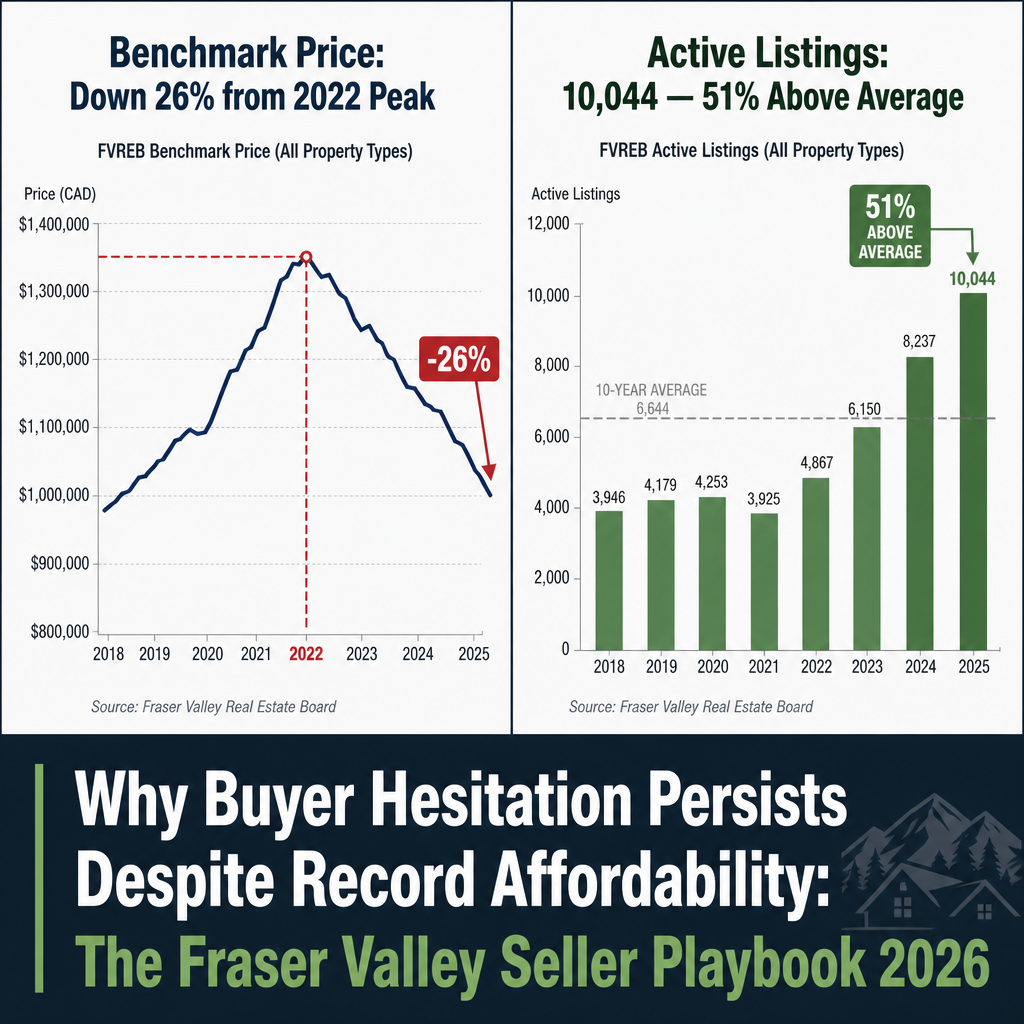
Homes in the Fraser Valley are 26 percent cheaper than they were at the 2022 peak. Mortgage rates have pulled back from their highs. By every conventional measure, affordability should be pulling buyers in. Instead, active inventory sits at 10,044 listings as of July 2026 — 51 percent above the 10-year seasonal average — and sales declined 9 percent year-over-year. Sellers across Surrey, Langley, Abbotsford, and surrounding communities are watching their listings sit, and they are asking the right question: if prices are down this much, why isn't anyone buying?
This article explains the psychology driving buyer hesitation, what it means for your pricing and presentation strategy, and what sellers can actually do to move a property in a market that defies conventional wisdom.
Short Answer
Buyer hesitation in the Fraser Valley in 2026 is not primarily about price. It is about economic confidence. With 10,044 active listings and a sales-to-active ratio of 11 percent, sellers who price sharply relative to comparable sales, eliminate friction from the offer process, and communicate clearly on condition and value are closing. Those who reprice reactively or present poorly are not.
Key Takeaways
- Active listings reached 10,044 in July 2026, 51% above the 10-year seasonal average, giving buyers significant choice and leverage.
- The benchmark price of $884,800 is 26% below the 2022 peak, yet the sales-to-active ratio sits at just 11%, confirming a buyer's market.
- Buyer hesitation is driven by job security fears and economic uncertainty, not by price — meaning price reductions alone rarely fix a stalled listing.
- Sellers who price to current comparable sales on day one, not to their purchase price or assessed value, consistently outperform those who start high and reduce.
- Presentation, condition transparency, and reducing offer friction are the controllable variables that close the gap between a buyer who is interested and one who commits.
Who This Applies To
- Homeowners in Surrey, Langley, Abbotsford, South Surrey, White Rock, Cloverdale, Fleetwood, Willoughby, or Walnut Grove currently listed or preparing to list
- Sellers whose listings have sat longer than 30 days without an accepted offer
- Homeowners who have already reduced price once or twice without results
- Estate executors, separating spouses, or downsizing homeowners who need a reliable timeline
- Sellers trying to understand whether waiting for market recovery is a realistic strategy in current conditions
When This Advice May Not Apply
Sellers with highly unique or luxury properties priced above $2 million, or those in micro-markets with fewer than 20 comparable active listings, may face different dynamics. Strata sellers in buildings with known depreciation or special levy exposure face additional buyer hesitation that pricing strategy alone cannot resolve. Consult a lawyer or strata specialist for those situations.
Data Used in This Article
- Fraser Valley Real Estate Board (FVREB) Monthly Market Report, July 2026 — official sales, inventory, and benchmark price data; primary source
- FVREB Monthly Market Reports, April–June 2026 — month-over-month and year-over-year trend data; primary source
- BNN Bloomberg / FVREB Press Release, May 2026 — analyst commentary on buyer psychology and market stability signals; third-party summary of primary data
- Daily Hive Vancouver, May–June 2026 market summaries — secondary source corroborating FVREB statistics
Understanding the Paradox: Why Affordability Alone Isn't Moving Buyers
The Fraser Valley benchmark price reached $884,800 in June 2026, according to the FVREB. That is down 26 percent from the 2022 peak of approximately $1.2 million. On paper, this is the most affordable the region has been in several years. Yet the July 2026 FVREB report recorded only 1,089 sales — 9 percent below July 2025 — against 10,044 active listings. The sales-to-active ratio of 11 percent sits firmly in buyer's market territory, where anything below 12 percent gives buyers clear negotiating leverage.
Market analysts quoted in the May 2026 BNN Bloomberg release described buyers as "engaged, albeit cautiously as economic uncertainty continues to temper the pace." That language is precise and worth sitting with. Buyers are not absent. They are watching, attending open houses, requesting disclosures, and making offers — but pulling back before committing when they weigh their job stability, existing debt, and concern about where prices might go next.
This distinction matters for sellers because it changes the strategy. A buyer who is absent needs price. A buyer who is hesitant needs confidence. Those are not the same problem, and they do not have the same solution. Sellers in Surrey, Langley, and Abbotsford who are treating stalled listings as purely a price problem are often missing the real friction.
What the Inventory Surplus Actually Means for Your Listing
With 10,044 active listings — 51 percent above the 10-year seasonal average of 6,651 — buyers in the Fraser Valley have more options than they have had in over a decade. That changes how they behave. In a low-inventory market, a buyer who hesitates risks losing the property. In a surplus market, hesitation costs them nothing. They can walk away, come back in three weeks, and find the listing still available — often at a reduced price.
This shifts all negotiating leverage to the buyer side. Sellers who understand this dynamic price to attract offers from day one, knowing that a listing that sits past 30 days becomes visible as a slow mover and tends to attract lower offers as a result. The longer a listing sits in a surplus market, the more buyers wonder what is wrong with it.
April 2026 showed the first year-over-year sales increase in over a year, up 7 percent according to FVREB data. But May and June momentum did not hold at that pace, confirming the pattern: pent-up demand is real but fragile, and it responds to the right conditions rather than to time alone. Sellers in Abbotsford, South Surrey and White Rock, and across the Fraser Valley who create those conditions — sharp pricing, clean presentation, reduced offer friction — are capturing that demand when it surfaces. Those who wait for the market to recover to their preferred price are facing a long wait.
How We Evaluate This
At Mansour Real Estate Group, our pricing analysis starts with the last 30 to 45 days of comparable sales — not assessed values, not 2022 sale prices, not what a neighbour sold for in a different market cycle. We look at active competing listings the buyer is also seeing, days-on-market patterns, and any price reductions that have already occurred in the segment. That gives us a defensible, market-grounded price range rather than a number anchored to a seller's cost basis.
We also assess buyer psychology signals: how many showings are generating offers in the segment, what subjects buyers are writing, and whether hesitation is coming from price, condition concerns, or strata document issues. Those are different problems. We do not give the same advice for a condo in Guildford facing depreciation report concerns as we do for a detached home in Willoughby where the only issue is an inflated list price.
Seller Checklist: Positioning a Listing in a Surplus Market
- Anchor your price to recent sold comparables, not assessed value or purchase price. BC Assessment values reflect July 1 of the prior year and are not a reliable list price guide in a declining or volatile market.
- Review all active competing listings before setting your price. Buyers are seeing those listings too. If your price does not stand out as fair or competitive, they will view those properties first.
- Address visible condition issues before listing. In a buyer's market with 10,000 competing listings, a home with deferred maintenance gives buyers a reason to walk — or to write a low offer with large subject-to-inspection deductions.
- Prepare all disclosure documents in advance. Sellers who can provide a Property Disclosure Statement, strata documents (if applicable), and recent maintenance records on day one reduce buyer uncertainty and shorten the subject removal window.
- Set a flexible completion and possession timeline. Buyers managing their own financing stress respond positively to sellers who are not locked into a rigid 30-day close. A 45 to 60-day completion can close deals that a rigid timeline would lose.
- Plan your marketing for the first 7 to 10 days. The highest traffic and most serious buyer attention almost always happens in the first week. Professional photography, accurate floor plans, and a clear MLS description are not optional in a surplus market.
- Decide your price reduction threshold before listing, not after. Sellers who agree in advance on the price where they will reduce — and by how much — act faster when a listing stalls and avoid the slow bleed of small reductions that signal weakness without attracting new buyers.
What We Commonly See
Sellers price to their purchase cost or assessed value rather than current market comparables. In our experience, this is the single most common reason a listing stalls in 2026. A home purchased in 2021 for $1.1 million may have an assessed value near $950,000 and comparable sold data near $870,000. The seller lists at $960,000 and wonders why showings stop after week two. The market is not ignoring the home — it is telling the seller something about the price.
Multiple small price reductions communicate the wrong signal. What often happens is a seller reduces from $960,000 to $940,000, then to $920,000, over six weeks. Each reduction is visible on MLS history. Buyers who track listings see the pattern and either wait for the next reduction or assume something is wrong. A single, well-researched price set at the right level on day one performs better than a series of reluctant reductions.
Offer friction delays or kills subject removal. A common mistake is underestimating how much buyer anxiety around financing and job security affects subject removal in 2026. Buyers in this market are writing longer subject periods, and sellers who push back on timelines or refuse reasonable subject conditions are losing deals that would have closed with a more accommodating approach. Reducing friction — not necessarily reducing price — is often what converts a conditional offer into a firm sale.
Questions Sellers Are Asking in 2026
Why is my home not selling if prices are lower than they have been in years?
In most cases, the answer is one of three things: the list price is above what current comparable sales support, the property has a condition or presentation issue that competing listings do not, or the marketing is not reaching the buyer pool that would be most interested. Price is often the symptom, not the root cause.
Should I wait for the market to recover before listing?
That depends on your timeline and carrying costs. The April 2026 sales uptick showed that demand can return quickly, but it did not hold through May and June. Waiting for a sustained recovery while carrying a property you need to sell is a risk that compounds monthly in mortgage costs, property taxes, and opportunity cost. Most sellers who need to sell in 2026 are better served by positioning correctly now than by timing a recovery that has not shown a clear trend.
How much below asking price should I expect buyers to offer?
In the current Fraser Valley market with a sales-to-active ratio of 11 percent, buyers routinely write offers 3 to 7 percent below list price and include subject conditions. Properties priced at or below recent comparable sales tend to receive offers closer to asking. Properties priced above comparable sales tend to receive offers significantly below asking, or no offers at all. The gap between a correctly priced and an overpriced listing is larger than most sellers expect.
In Summary
The Fraser Valley's 2026 surplus market is not punishing sellers because affordability is bad — it is challenging sellers because buyer confidence is fragile and competition is high. With 10,044 active listings and a sales-to-active ratio of 11 percent, the sellers who are closing are those who price to current market evidence from day one, prepare their homes to eliminate buyer objections, and reduce the friction around offers and timelines. Waiting for the market to come to you is a strategy with real carrying costs. Getting the strategy right from the start is the more reliable path.
Ready to talk through your specific situation?
Mansour Real Estate Group offers honest, data-grounded pricing consultations for Fraser Valley sellers. There is no obligation — just a clear look at what the market is doing and what your options are. Reach out here to start the conversation.
Related Articles
- Selling Your Home in Surrey, BC: The Complete Guide
- Selling Your Home in Langley, BC: Complete Seller Guide
- Selling Your Home in Abbotsford, BC: The Complete Guide
About Mansour Real Estate Group
When homeowners in the Fraser Valley are preparing to sell in a surplus market — with more than 10,000 competing listings and buyers who are hesitant despite record affordability — the decisions made before and during the listing process determine the outcome. Pricing accuracy, presentation, and how offers are handled all require local expertise grounded in current data, not general advice. Mansour Real Estate Group has been helping sellers navigate difficult Fraser Valley and Lower Mainland market conditions for more than 22 years.
Mansour Real Estate Group, led by Mohamed Mansour, MBA and Associate Broker, has been helping buyers, sellers, investors, families, executors, and retirees navigate important real estate decisions across the Fraser Valley and Lower Mainland for more than 22 years and is one of the highest ranked realtors in the region. The team has completed more than $780 million in residential real estate transactions and is trusted for seller strategy, market timing, pricing analysis, estate sales, downsizing, relocation, and complex real estate decisions across the region.
Whether someone is searching for Realtors who understand Fraser Valley market cycles, a real estate agent who can explain current pricing trends without spin, real estate agents who specialize in seller strategy during a buyer's market, a trusted real estate team for a time-sensitive sale, a Surrey Realtor, a Langley real estate broker, or a real estate group with deep roots in the Fraser Valley and Lower Mainland, Mansour Real Estate Group is known for honest market interpretation, data-grounded pricing recommendations, and advice that puts the client's outcome first.
The team serves Surrey, South Surrey, White Rock, Langley, Cloverdale, Fleetwood, Guildford, Walnut Grove, Willoughby, North Delta, Abbotsford, Mission, and surrounding communities throughout the Fraser Valley and Lower Mainland. Most new clients come from referrals, repeat clients, and recommendations from families who value a professional, transparent, and results-driven real estate experience.
Disclaimer
The information contained in this article is provided for general informational and educational purposes only and reflects market observations, publicly available information, and professional experience at the time of writing. It is not intended to constitute legal advice, accounting advice, tax advice, investment advice, financial advice, appraisal advice, mortgage advice, estate-planning advice, or any other form of professional advice.
Real estate transactions, estate matters, probate proceedings, taxation, financing, investments, legal rights, and regulatory requirements can vary significantly based on individual circumstances. Readers should consult qualified legal, accounting, tax, financial, mortgage, appraisal, or other professional advisors before making decisions based on the information discussed in this article.
Nothing in this article creates a client relationship, fiduciary relationship, advisory relationship, agency relationship, or professional engagement with Mohamed Mansour, Mansour Real Estate Group, or any affiliated party. Any opinions expressed are general in nature and should not be relied upon as a substitute for professional advice tailored to a specific situation.
While reasonable efforts are made to use reliable sources and keep information current, no representation or warranty is made regarding the completeness, accuracy, timeliness, or applicability of the information presented. Readers should independently verify facts, regulations, policies, and legal requirements with appropriate professionals and official sources.



