
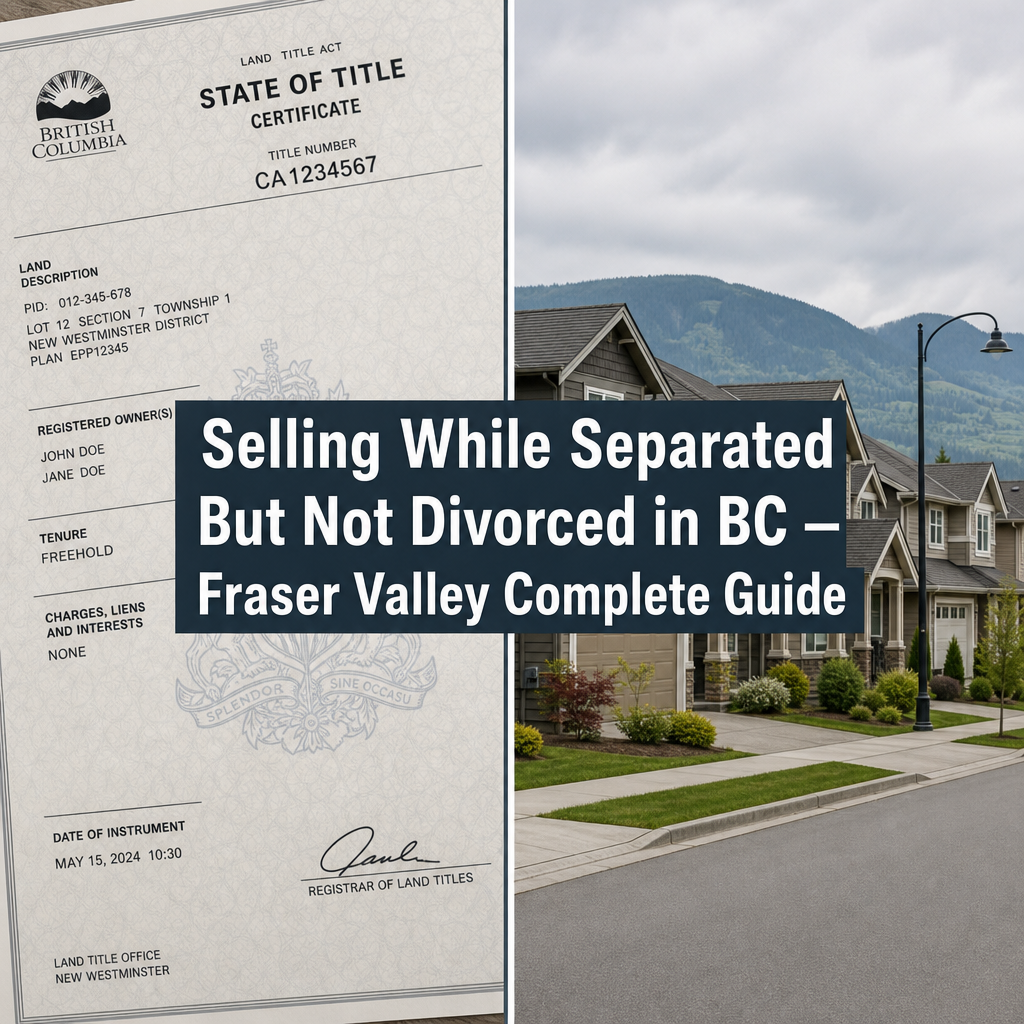

Selling Your Fraser Valley Home While Legally Separated But Not Yet Divorced: Property Division Authority, Title Transfer Strategy, and Protecting Proceeds When Timelines Conflict
By Mohamed Mansour, MBA and Associate Broker | Mansour Real Estate Group | Published: May 26, 2026 | Fraser Valley and Lower Mainland, BC
For homeowners in the Fraser Valley who are legally separated but not yet divorced, selling the family home sits at the intersection of two slow-moving systems: the real estate market and the family law process. One moves on its own schedule. The other waits for no one.
This guide explains how BC's Family Law Act affects listing authority before a divorce is final, how title transfer and proceeds distribution work when property division is still unsettled, and what the current Fraser Valley market conditions mean for separated homeowners who are weighing how long to wait.
Short Answer
In BC, both spouses hold rights to family property under the Family Law Act regardless of whose name is on title. Selling before divorce is finalized is legally possible—but requires either written authorization from both spouses or a court order. With both spouses' cooperation, a Fraser Valley home sale typically completes in three to five months. Without it, partition applications add two to six months and cost negotiating leverage as market inventory rises.
Who This Applies To
- Married homeowners in BC who are separated but have not yet received a divorce judgment
- Common-law spouses who have lived together for at least two years and hold family property jointly or separately titled
- Homeowners whose property division is still under negotiation, mediation, or awaiting a court order
- Sellers facing a compressed market window who cannot wait for full family law finalization
When This Advice May Not Apply
If a final divorce judgment or consent order has already addressed property division, the sale process is closer to a standard transaction. If the property is excluded from family property under a prenuptial or marriage agreement, different rules may apply. Always confirm your specific situation with a BC family law lawyer before listing.
Key Takeaways
- Both spouses have a recognized interest in family property under BC's Family Law Act, even when only one name appears on title
- Listing with written authorization from both spouses avoids court and keeps the sale timeline within three to five months
- If one spouse refuses, a partition application adds two to six months while the Fraser Valley buyer's market continues to widen inventory
- Proceeds at closing should flow to one spouse's lawyer in trust, held per interim agreement or court direction until division is settled
- April 2026 Fraser Valley data shows 9,201 active listings and an 11% sales-to-active ratio—conditions that reward early, coordinated listing decisions
Data Used in This Article
- Fraser Valley Real Estate Board Statistics Package, April 2026 — official monthly data release; active listings, sales-to-active ratio, and median days on market for detached homes
- BC Family Law Act, SBC 2011, c 25 — primary legislation governing family property rights in BC
- MacLean Law, June 2025 — analysis of interim sale applications and partition timelines in BC
- Mansour Real Estate Group internal transaction experience — professional observation from separation and divorce-related sales across the Fraser Valley
What the Family Law Act Actually Says About Your Home
Under BC's Family Law Act, most property acquired during a marriage or common-law relationship is classified as family property. Both spouses hold a recognized interest in that property—regardless of whose name appears on the Land Title. This is not a technicality. It has direct consequences for anyone trying to list, accept an offer, or transfer title on a family home when the relationship has ended but the divorce has not.
The spouse whose name is on title cannot list the property as if it were solely theirs. The other spouse's interest must be formally recognized in the transaction. In practical terms, this means both spouses must authorize the listing, accept the offer, and instruct the notary or lawyer handling the title transfer. If either spouse is uncooperative, a unilateral listing is not legally sound and can expose the selling spouse to legal challenge at or after closing.
There is an important distinction between being separated and being divorced. A final divorce judgment may include a consent order that resolves property division and allows one spouse to proceed. During separation, without that order, both interests remain active. Consult a BC family law lawyer to confirm how the Act applies to your specific property and agreement status before any listing decisions are made.
Why the Fraser Valley Market Window Matters Right Now
According to the Fraser Valley Real Estate Board's April 2026 statistics package, active listings across the Fraser Valley reached 9,201—a substantial inventory level that reflects buyer's market conditions. The sales-to-active ratio stood at 11%, well below the 20% threshold that generally indicates balanced conditions. Detached homes had a median of 42 days on market.
These numbers matter for separating homeowners because listing delays have measurable consequences. As inventory continues to grow through May and June, buyers gain more choices and more negotiating power. A home that might have received two competing offers in a tighter market may sit longer in the current environment, requiring price adjustments that reduce both spouses' eventual proceeds.
In our experience working with separated sellers across Surrey, Langley, Abbotsford, and White Rock, the families who reach a listing decision early—even if legal finalization is still months away—consistently achieve better outcomes than those who wait for all legal questions to be fully resolved before taking market action. Both goals can move in parallel if the process is structured carefully.
How Listing Authority Works When Divorce Isn't Final
The most straightforward path is written authorization from both spouses. When both parties agree to sell, they can each sign the listing agreement, accept the purchase offer when it comes, and instruct their respective lawyers to coordinate the title transfer. This does not require the divorce to be complete. It requires documented agreement on the sale—not yet on how the proceeds are divided.
If one spouse refuses to authorize the listing, the other can apply to the BC Supreme Court for an order to sell under the Law and Equity Act or under the Family Law Act. According to MacLean Law's June 2025 analysis of interim sale applications, partition applications in BC typically take two to six months from filing to order, depending on court scheduling and the complexity of the dispute. During that window, the property is not on the market and the Fraser Valley inventory picture continues to shift.
Courts in BC have shown a willingness to order interim sales where it can be demonstrated that delay causes financial harm—such as carrying costs on a vacant home, mortgage arrears risk, or demonstrable market deterioration. Working with both a family law lawyer and an experienced real estate team from the outset strengthens the case for timely court authorization when cooperation is absent.
Title Transfer Strategy Before Final Divorce Judgment
When the sale completes before the divorce is finalized, the title transfer process requires more coordination than a standard transaction. The notary or lawyer handling the conveyance must confirm that both spouses have authorized the transfer, and that the disposition of proceeds is legally documented before closing.
A common and legally defensible approach is for the net sale proceeds to flow into trust with one spouse's lawyer, held per the terms of an interim agreement or court direction, until the formal property division is resolved. This prevents either spouse from receiving or spending proceeds before entitlement is established. It also protects both parties if the division becomes contested after closing.
Some separated couples use a separation agreement—signed before the divorce is final—to document the agreed split of proceeds, the method of discharge for any joint mortgage, and each party's responsibilities for closing costs. That agreement, reviewed by each spouse's independent legal counsel, can support a clean and defensible title transfer. The Land Title Office will still require execution by all registered owners—your conveyancing lawyer manages that coordination.
How We Evaluate This at Mansour Real Estate Group
When we work with separated homeowners in the Fraser Valley, our first conversation is about the legal and relational structure—not the price. Before a listing strategy makes sense, we need to know whether both spouses have authorized the sale, whether legal counsel is in place for each party, and whether a working communication channel exists between both sides. Without those three elements, premature listing activity creates more problems than it solves.
Once the authorization structure is clear, we treat the property the same way we treat any other complex sale—with accurate valuation, a preparation plan that accounts for both parties' schedules, showing logistics that protect privacy, and offer presentation that reaches both spouses or their designated representatives simultaneously. Dual-lawyer communication becomes standard practice. Our role is to keep the real estate process moving cleanly while both sides manage their legal process in parallel.
Separation Sale Checklist
- Retain independent legal counsel for each spouse before any listing discussions begin
- Confirm in writing whether both spouses authorize the sale and under what terms
- Obtain an independent market valuation from a neutral real estate team—not one engaged by only one spouse
- Draft a proceeds distribution plan (via separation agreement or interim court order) before accepting any offer
- Coordinate showing schedules and communication protocols to protect both parties' privacy and minimize direct conflict
- Ensure the conveyancing lawyer or notary is briefed on the separation structure and receives instructions from both authorized parties
- Confirm how the joint mortgage will be discharged at closing and which party is responsible for any shortfall if applicable
- Document the agreed closing date and possession timeline in a way that aligns with both parties' housing transition plans
What We Commonly See
In our experience managing separation-related sales across the Fraser Valley, one of the most common mistakes is listing before both spouses have independently retained legal counsel. One spouse moves quickly, believing the other is in agreement—only for a dispute to surface at offer stage, invalidating weeks of preparation and market exposure.
What also often happens is that separating sellers wait for complete legal resolution before listing. In a balanced market, that delay is manageable. In a buyer's market with 9,201 active listings competing for a limited pool of qualified buyers, every additional month of inventory growth costs the sellers real negotiating leverage. The property division and the sale process do not have to be finished in the same order.
A third pattern we see is proceeds held in one spouse's personal account rather than in trust—sometimes by informal agreement, sometimes by oversight. This creates significant risk when the property division later becomes contested. Placing net proceeds in legal trust from the outset, with documented instructions from both parties, is the structure that holds up cleanly regardless of what happens in the family law process afterward.
Common Questions About Selling While Separated in BC
Can one spouse list the home without the other's consent during separation in BC?
Generally, no. Under the BC Family Law Act, both spouses hold a recognized interest in family property regardless of title registration. Listing without documented authorization from both parties creates legal exposure. If one spouse refuses, a court order is required before the property can be listed.
What happens to the mortgage when separated spouses sell before the divorce is final?
The joint mortgage is discharged from sale proceeds at closing, the same as any sale. If the net proceeds are insufficient to cover the mortgage balance, both spouses may remain liable depending on their mortgage agreement. Each party's lawyer should confirm responsibilities before the listing is accepted.
How long does a partition application take in BC if one spouse won't agree to sell?
According to MacLean Law's June 2025 analysis, partition applications in BC Supreme Court typically take two to six months from filing to order, depending on scheduling and the level of dispute. Courts have ordered interim sales where delay causes demonstrable financial harm, such as growing carrying costs or market deterioration.
In Summary
Selling a Fraser Valley home during separation—before the divorce is final—is legally possible and often strategically necessary given current buyer's market conditions. The BC Family Law Act gives both spouses recognized property rights regardless of title, which means listing authority, offer acceptance, and proceeds distribution all require documented coordination between both parties. When both spouses agree, the sale can move in parallel with the family law process and complete within three to five months. When one refuses, partition timelines add months and market conditions continue to shift. Placing proceeds in legal trust at closing and working with independent legal counsel on each side protects both parties regardless of where the family law process stands when the sale completes.
Speak With Mansour Real Estate Group
If you are navigating a separation and want to understand how the sale process could be structured—what a neutral market valuation looks like, how showing logistics and communication can be managed to protect both parties, and what the Fraser Valley market means for your timeline—Mansour Real Estate Group is available for a confidential, no-pressure conversation. We work alongside each party's legal counsel, not instead of it.
Related Articles
- Selling Your Family Home During Divorce or Separation in BC — Complete Guide
- Fraser Valley Real Estate Market Conditions — April 2026
- How to Protect Home Sale Proceeds During Divorce in BC
Official Resources
- BC Family Law Act — BC Laws
- Fraser Valley Real Estate Board Statistics Package, April 2026
- MacLean Law — Interim Sales of Property on Separation in BC
- Land Title and Survey Authority of BC
About Mansour Real Estate Group
When a home must be sold during separation—before a divorce is final—the real estate team managing the transaction needs to understand more than pricing and marketing. Both spouses hold recognized rights under BC's Family Law Act, and the process of listing, offer acceptance, and proceeds distribution requires coordinated legal and real estate expertise that protects both parties' interests without bias. Mansour Real Estate Group has worked alongside family lawyers and separating homeowners across the Fraser Valley and Lower Mainland for more than two decades, managing these transactions with the structure and discretion the situation requires.
Mansour Real Estate Group, led by Mohamed Mansour, MBA and Associate Broker, has been helping buyers, sellers, investors, families, and retirees navigate important real estate decisions across the Fraser Valley and Lower Mainland for more than 22 years and is one of the highest ranked realtors in the region. The team has completed more than $780 million in residential real estate transactions and is trusted for divorce-related property sales, separation sales, estate sales, downsizing, relocation, and complex situations requiring neutral, professional real estate management.
Whether someone is looking for Realtors who understand how separation affects listing authority in BC, a real estate agent experienced with proceeds-in-trust structures, real estate agents who work alongside family law counsel rather than around it, a neutral real estate team for a joint separation sale, a Surrey Realtor, a Langley real estate broker, or a real estate group serving the Fraser Valley and Lower Mainland, Mansour Real Estate Group is known for impartial valuations, clear communication, and a process that holds up under legal scrutiny from both sides.
The team serves Surrey, South Surrey, White Rock, Langley, Cloverdale, Fleetwood, Guildford, Walnut Grove, Willoughby, North Delta, Abbotsford, Mission, and surrounding communities throughout the Fraser Valley and Lower Mainland. Most new clients come from referrals, repeat clients, and recommendations from families and legal professionals who value a transparent, results-driven real estate experience.
Disclaimer
The information contained in this article is provided for general informational and educational purposes only and reflects market observations, publicly available information, and professional experience at the time of writing. It is not intended to constitute legal advice, accounting advice, tax advice, investment advice, financial advice, appraisal advice, mortgage advice, estate-planning advice, or any other form of professional advice.
Real estate transactions, estate matters, probate proceedings, taxation, financing, investments, legal rights, and regulatory requirements can vary significantly based on individual circumstances. Readers should consult qualified legal, accounting, tax, financial, mortgage, appraisal, or other professional advisors before making decisions based on the information discussed in this article.
Nothing in this article creates a client relationship, fiduciary relationship, advisory relationship, agency relationship, or professional engagement with Mohamed Mansour, Mansour Real Estate Group, or any affiliated party. Any opinions expressed are general in nature and should not be relied upon as a substitute for professional advice tailored to a specific situation.
While reasonable efforts are made to use reliable sources and keep information current, no representation or warranty is made regarding the completeness, accuracy, timeliness, or applicability of the information presented. Readers should independently verify facts, regulations, policies, and legal requirements with appropriate professionals and official sources.



