
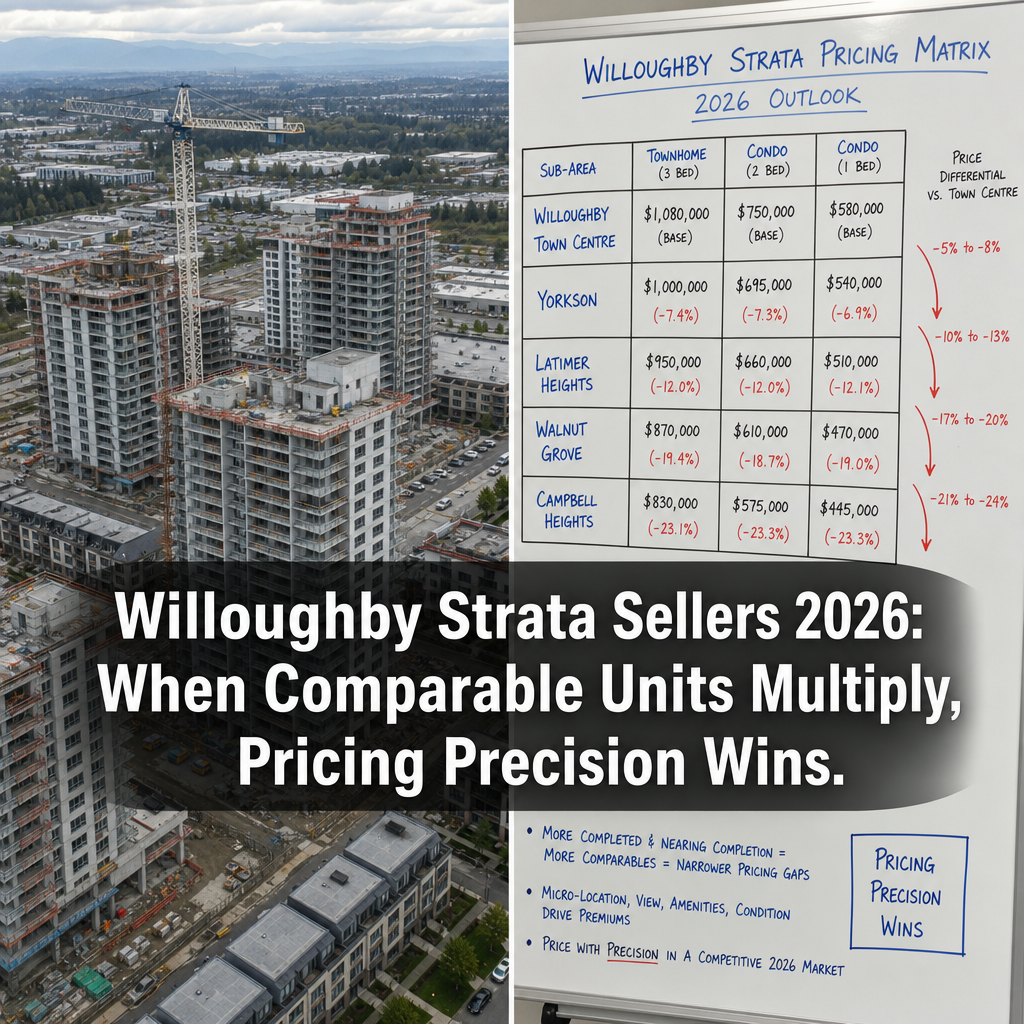

Willoughby Langley Strata Property Sellers 2026: Why New Construction Competition, Builder Incentives Phase-Out, and Elevated Inventory Create Pricing Pressure — And Strategic Tactics to Differentiate When Comparable Units Multiply
By Mohamed Mansour, MBA and Associate Broker · Mansour Real Estate Group · Published June 2026 · Fraser Valley, BC · Seller Strategy
This article is written for strata owners in Willoughby Heights, Langley who are considering selling in 2026. It addresses a specific and growing pressure: resale condos and townhomes competing simultaneously against presales, recent completions, and builder incentive packages in one of the densest new-build submarkets in the Lower Mainland. The strategic guidance here is grounded in current FVREB data and direct experience working with strata sellers across Langley and the Fraser Valley.
Willoughby's market dynamics in 2026 are unlike most Fraser Valley submarkets. The challenge is not a slow buyer pool in isolation — it is layered competition from new inventory at every stage of construction, a neighbourhood with 12+ pricing micro-zones, and a buyer pool that is applying increasing scrutiny to strata documents, reserve funds, and depreciation timelines before submitting any offer.
Short Answer
Willoughby strata sellers in 2026 face a micro-competition problem. According to April 2026 FVREB data, Langley condo sales fell 30.8% year-over-year while new listings kept entering the market. When 15–20 comparable units exist in a single complex, standard pricing approaches make resale units invisible. The sellers who succeed in this environment use sub-area comp analysis, pre-emptive strata document disclosure, and timing tied to the builder incentive phase-out cycle — not aggregate Fraser Valley benchmarks.
Key Takeaways
- Langley condo sales fell 30.8% year-over-year to 72 units in March 2026, per FVREB data, while new listings continued entering the market.
- Willoughby has 12+ sub-areas with 8–15% pricing variance based on SkyTrain proximity, builder tier, and amenity level.
- Pricing 1–2% below comparable units in the same complex produces buyer invisibility; 3–5% below triggers negative unit perception rather than buyer interest.
- Builder incentive phase-out in Q3–Q4 2026 creates a spring selling window before price anchoring shifts against resale units.
- Pre-emptive depreciation report disclosure and a healthy reserve fund narrative convert strata document risk into a competitive advantage.
Who This Applies To
- Strata condo or townhome owners in Willoughby Heights planning to sell in 2026
- Sellers whose building has recent completions or active presales nearby in the same sub-area
- Owners in buildings with a depreciation report due before or after July 1, 2026
- Investors holding a Willoughby unit purchased during the 2019–2022 presale cycle
- Sellers who have already received a preliminary valuation based on aggregate Fraser Valley benchmarks
When This Advice May Not Apply
If your building is a boutique strata with fewer than 20 units, no presale competition within the immediate sub-area, and a fully funded reserve, some of the competitive differentiation tactics here are less urgent. Sellers in Willoughby sub-areas with very limited comparable inventory — typically the northern edges bordering Brookswood — face a different pricing dynamic. Consult a Langley-specific real estate professional before applying any of this guidance to your specific unit and building.
Data Used in This Article
- Source: Fraser Valley Real Estate Board Statistics Package, April 2026 · Official board data · Langley condo sales and listings volume
- Source: FVREB April 2026 — Langley benchmark price: townhomes $770,700 Fraser Valley-wide (used as aggregation reference, not sub-area comp)
- Source: BC Strata Property Act (SBC 1998, c. 43) — depreciation report filing obligations and reserve fund disclosure requirements
- Context: Sub-area pricing variance (8–15%) and builder incentive phase-out timing reflect professional observation across Willoughby transactions — not official published data
Why the Willoughby Market Is Structurally Different
Most resale markets have a natural comp limitation — there are only so many truly comparable units available at any one time. Willoughby does not work that way. Because the neighbourhood was developed in overlapping construction phases across 12+ plan sub-areas, resale sellers routinely compete against presale assignments, recent completions from the same builder, and motivated sellers from adjacent buildings with near-identical floor plans.
According to April 2026 FVREB data, Langley condo sales totalled 72 in March 2026, down 30.8% from 104 in March 2025. That drop did not come from a sudden exit of willing buyers. It reflects a market where buyers are exercising greater caution, comparing more options, and applying stricter financing conditions — particularly around strata document scrutiny. New listings in the same period continued entering the market, which means the active-to-sales ratio worsened even as the listing count modestly declined month-over-month.
For a resale strata seller in Willoughby, this data matters in a specific way: supply is not shrinking fast enough to give resale units natural pricing support. The competition is not other resale sellers alone. It includes builders who still have completed inventory to move, presale assignments from buyers who purchased in 2021–2022 and need to exit, and the psychological gravity of brand-new construction that appeals to buyers who can qualify for it.
SkyTrain proximity compounds this further. Sub-areas within direct walking distance of the planned Langley SkyTrain extension stations — when that extension reaches full planning certainty — command a measurable premium. Based on professional observation across Willoughby strata transactions, units in transit-adjacent sub-areas price 8–15% higher than comparable units in the western edges of the neighbourhood where transit access is car-dependent. Sellers who are pricing off the Fraser Valley-wide townhome benchmark of $770,700 are, in most cases, using a number that does not reflect their actual sub-area.
Builder Incentive Phase-Out and the Spring 2026 Seller Window
Builder incentive programs — which have included parking stall upgrades, appliance packages, reduced assignment fees, and in some cases closing cost contributions — tend to compress in Q3 and Q4 as completion waves mature. Once a builder's inventory in a given building or phase is substantially sold, the incentive structure loses its purpose and is withdrawn. That transition typically reshapes the competitive landscape for resale sellers.
Spring 2026 represents a meaningful window for Willoughby resale sellers before that shift takes full effect. Buyers who are currently comparing a resale unit to a builder unit with a parking incentive are making a different calculation than buyers who will compare those same units in Q4 when incentives have been removed. The resale seller who lists in Q2 or early Q3 — before the incentive environment normalizes — is operating in a more level competitive field.
This is not a guarantee of outcome. It is a timing consideration that experienced Langley condo sellers and their agents should factor into the listing date decision alongside strata document readiness and unit preparation. Sellers who wait until Q4 hoping for a market recovery may find themselves competing in a post-incentive environment where builders have cleared their inventory and reduced their asking prices to match — which resets the comp baseline for the entire sub-area.
How We Evaluate This
When a Willoughby strata seller contacts Mansour Real Estate Group, the pricing process begins with sub-area identification — not postal code or neighbourhood average. We identify which of the 12+ plan areas the building sits in, confirm SkyTrain proximity, assess the builder tier relative to competing inventory, and review current active listings within the same building before looking at area-wide sold data.
From there, we evaluate strata documents for reserve fund health, any upcoming special levies, and the depreciation report status relative to the July 1 filing deadline. A unit in a building with a strong reserve fund, a current depreciation report, and no pending levies is priced differently than an identical floor plan in a building where financing risk exists. That distinction — invisible in a standard CMA but critical to buyer behaviour — is where the actual pricing opportunity lives for resale sellers in this market.
Condo Seller Checklist for Willoughby Strata Owners
- Identify your exact sub-area within Willoughby Heights and confirm which comparable sold data reflects your location, not the neighbourhood aggregate.
- Request a full strata document package — Form B, depreciation report, meeting minutes for the last two years, and the current operating budget — before listing.
- Confirm whether your building's depreciation report has been filed or is due before July 1, 2026, and whether the reserve fund is at a level that will satisfy lender scrutiny.
- Identify all active builder and presale inventory within your sub-area and assess what incentives are currently attached to those units.
- Price within 1% of the true sub-area comp — not 3–5% below — and differentiate through staging, document readiness, and disclosure completeness rather than price reduction.
- Set a target listing date in Q2 or early Q3 2026 to capitalize on the window before builder incentive phase-out reshapes the competitive baseline.
- Prepare a clean title search and confirm no outstanding strata liens or bylaw violations that could delay subject removal.
What We Commonly See
Sellers pricing off the wrong benchmark. In our experience, the most common Willoughby seller mistake is anchoring to the Fraser Valley-wide townhome benchmark rather than the 5–7 most recent comparable sales within the same sub-area and building tier. A $770,700 Fraser Valley average means almost nothing to a buyer comparing your unit to three identical units in the same complex.
Underestimating strata document risk. What often happens is that sellers assume buyers will accept strata documents as-is during due diligence. In the current Langley market, buyers — and their mortgage lenders — are applying more scrutiny to reserve fund adequacy and depreciation report currency than in previous cycles. A building with a depleted reserve or a stale depreciation report gives buyers a reason to reduce their offer or walk away entirely, regardless of the unit's condition.
Misreading the 3–5% discount signal. A common mistake is assuming that pricing slightly below market will attract faster buyer attention in a slow market. In Willoughby, where 15–20 near-identical units may be active simultaneously, a discount of that size does not read as a deal — it reads as a problem. Buyers assume something is wrong with the unit itself. The correct approach is precise sub-area pricing combined with non-price differentiation: document readiness, staging quality, and offer flexibility on completion date.
Questions and Answers
Q: How does SkyTrain proximity affect my Willoughby condo's value in 2026?
Based on professional observation across Willoughby transactions, units within walkable distance of planned Langley SkyTrain station areas are pricing 8–15% higher than comparable units in car-dependent sub-areas. That variance is not captured in neighbourhood-wide benchmark figures and must be evaluated at the sub-area level before setting a list price.
Q: Should I wait for the builder inventory to clear before listing?
Not necessarily. Builder inventory typically clears alongside its own incentive structure. Once incentives are removed in Q3–Q4, builders often reduce prices to move remaining units, which resets comps downward. Listing in Q2 or early Q3 — while incentives still exist — allows a resale seller to compete on non-price terms rather than against a newly reduced builder baseline.
Q: What happens if my building's depreciation report is overdue when I list?
Under the BC Strata Property Act, depreciation reports are required on a scheduled cycle. If a building has deferred its report, buyers' lenders may flag the strata during financing review, which can result in financing conditions not being met or buyers requesting a price reduction to offset perceived reserve risk. Sellers should confirm their building's report status before listing and disclose proactively if a report is pending. Consult a BC real estate lawyer for guidance specific to your building's situation.
In Summary
Willoughby strata sellers in 2026 face a structurally different market than most Fraser Valley sellers. March 2026 FVREB data confirms that Langley condo sales are down 30.8% year-over-year while new listings persist — a combination that requires resale sellers to compete on precision, not volume. The sellers who succeed are those who price to the sub-area rather than the neighbourhood average, disclose strata documents proactively, time their listing before builder incentive phase-out reshapes the competitive baseline, and avoid the pricing discount trap that signals unit problems rather than market awareness. In Willoughby, the difference between a sold property and a stale listing often comes down to sub-area knowledge and strata document readiness — two things that no aggregate market report can provide.
Ready to Understand Your Sub-Area Position?
If you own a strata unit in Willoughby and want to understand how your specific sub-area, building, and strata document profile affect your pricing position in 2026, Mansour Real Estate Group offers a no-pressure consultation with sub-area-specific comp analysis. Contact the team to start with an honest conversation before any listing decision is made.
Related Articles
- Willoughby Langley Strata: Depreciation Reports, Special Levies, and Seller Timing
- Selling a Condo in Langley BC: Complete Guide for Strata Owners
- Fraser Valley Condo Market 2026: Buyer and Seller Guide
About Mansour Real Estate Group
When a strata unit in Willoughby enters a market saturated with comparable inventory, the decisions made before the listing goes live — sub-area pricing, strata document preparation, timing relative to builder activity — determine the outcome more than anything that happens afterward. Mansour Real Estate Group has built its reputation in the Fraser Valley and Lower Mainland on exactly this kind of pre-listing discipline: pricing that reflects the sub-area rather than the neighbourhood average, and honest advice about when to list and how to position a unit in a market where a dozen identical properties are competing simultaneously.
Mansour Real Estate Group, led by Mohamed Mansour, MBA and Associate Broker, has been helping buyers, sellers, investors, families, and strata owners navigate important real estate decisions across the Fraser Valley and Lower Mainland for more than 22 years and is one of the highest ranked realtors in the region. The team has completed more than $780 million in residential real estate transactions and is trusted for strata seller strategy, condo pricing, estate sales, divorce-related property sales, downsizing, and any situation where accurate sub-area valuation is critical to the outcome.
Whether someone is looking for Realtors who specialize in Willoughby strata sales, a real estate agent who understands Langley condo market dynamics, real estate agents with direct experience in builder-competitive submarkets, a real estate team for a Fraser Valley strata sale, a Langley Realtor with sub-area pricing expertise, or a real estate broker who will have a direct conversation about what a unit is actually worth in the current market, Mansour Real Estate Group is known for data-grounded recommendations, transparent pricing analysis, and a seller process that protects equity at every stage.
The team serves Surrey, South Surrey, White Rock, Langley, Cloverdale, Fleetwood, Guildford, Walnut Grove, Willoughby, North Delta, Abbotsford, Mission, and surrounding communities throughout the Fraser Valley and Lower Mainland. Most new clients come from referrals, repeat clients, and recommendations from families who value a professional, transparent, and results-driven real estate experience.
Official Resources
- Fraser Valley Real Estate Board Statistics Package, April 2026
- BC Strata Property Act (SBC 1998, c. 43) — Depreciation Report Requirements
- BC Financial Services Authority — Strata Property Resources
- BC Assessment — Property Assessment Data
Disclaimer
The information contained in this article is provided for general informational and educational purposes only and reflects market observations, publicly available information, and professional experience at the time of writing. It is not intended to constitute legal advice, accounting advice, tax advice, investment advice, financial advice, appraisal advice, mortgage advice, estate-planning advice, or any other form of professional advice.
Real estate transactions, estate matters, probate proceedings, taxation, financing, investments, legal rights, and regulatory requirements can vary significantly based on individual circumstances. Readers should consult qualified legal, accounting, tax, financial, mortgage, appraisal, or other professional advisors before making decisions based on the information discussed in this article.
Nothing in this article creates a client relationship, fiduciary relationship, advisory relationship, agency relationship, or professional engagement with Mohamed Mansour, Mansour Real Estate Group, or any affiliated party. Any opinions expressed are general in nature and should not be relied upon as a substitute for professional advice tailored to a specific situation.
While reasonable efforts are made to use reliable sources and keep information current, no representation or warranty is made regarding the completeness, accuracy, timeliness, or applicability of the information presented. Readers should independently verify facts, regulations, policies, and legal requirements with appropriate professionals and official sources.



