
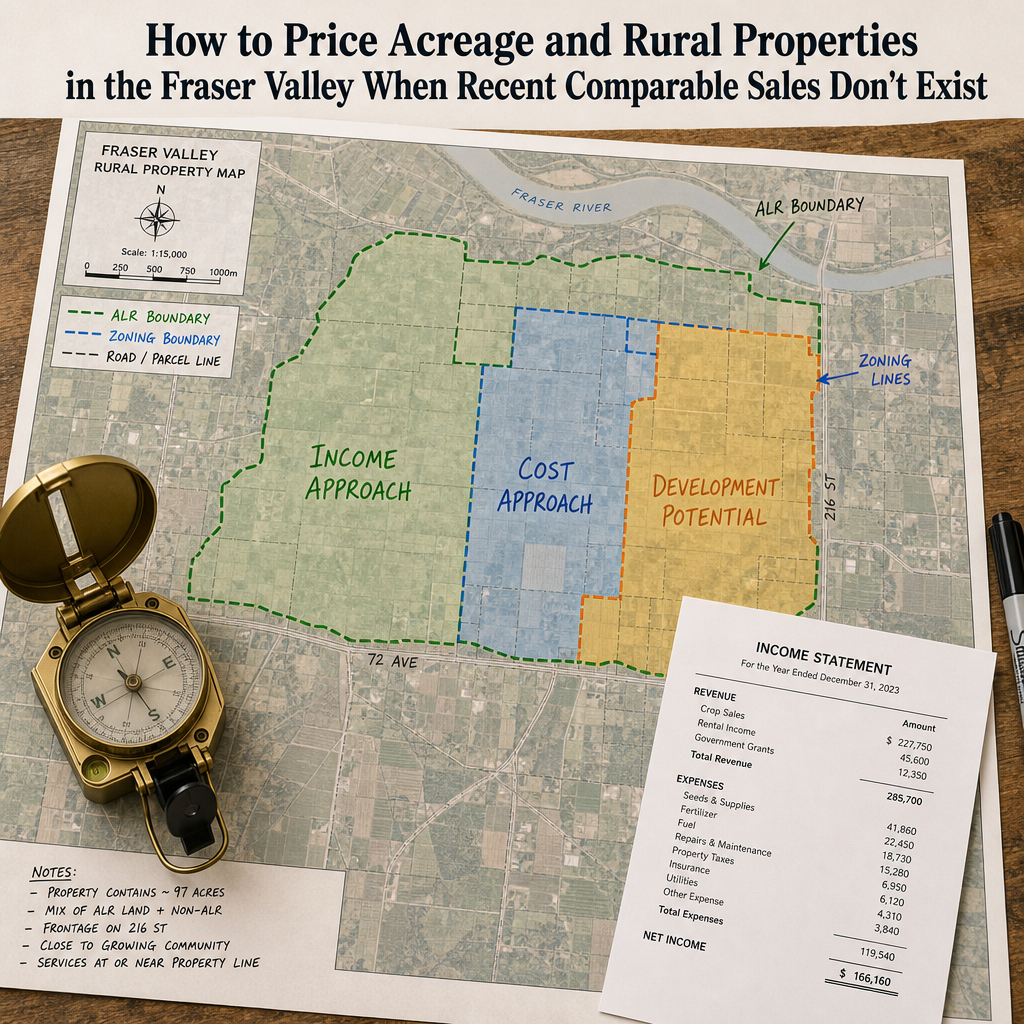

How to Price Acreage and Rural Properties in the Fraser Valley When Recent Comparable Sales Don't Exist
By Mohamed Mansour, MBA and Associate Broker | Mansour Real Estate Group | Fraser Valley and Lower Mainland | Published July 2026
Acreage and rural properties in the Fraser Valley are some of the hardest to price correctly — and the market data shows it. According to the Fraser Valley Real Estate Board's April and May 2026 statistics packages, agricultural and acreage listings are averaging 60 to 90 or more days on market, compared to 25 to 35 days for standard detached homes. That gap is not primarily a demand problem. It is a pricing problem.
Most sellers of rural properties in Langley, Abbotsford, Mission, and South Surrey arrive at their asking price one of two ways: they anchor to BC Assessment values that rarely reflect actual buyer intent, or they lean on emotional investment in a property they have spent years improving. Both paths lead to the same outcome — an overpriced listing that sits, weakens, and eventually sells at a larger discount than a well-priced launch would have required.
Short Answer
When recent comparable sales don't exist for acreage or rural properties in the Fraser Valley, pricing requires three separate analytical frameworks: the income approach (documented farm or rental revenue), the cost approach (land value plus replacement cost of improvements), and development potential analysis (ALR status, OCP zoning, rezoning probability). A certified pre-listing appraisal costing $800 to $1,500 is often the most defensible starting point, and three years of documented farm income is critical to supporting agricultural-use pricing.
Who This Applies To
- Owners of rural acreage, hobby farms, or agricultural properties in the Fraser Valley preparing to sell
- Executors managing estate sales that include rural land, farm buildings, or large lots
- Families who have held a rural property for 10 or more years with little comparable sale activity nearby
- Sellers whose properties are in the Agricultural Land Reserve, have mixed zoning, or sit near development boundaries
- Landowners trying to understand how BC Assessment diverges from actual market value for their property type
When This Advice May Not Apply
If your acreage is in a neighbourhood with active comparable sales from the past six months, standard CMA methodology may be sufficient. This framework is specifically for properties where the market is thin, ALR or zoning constraints are material, and buyer intent varies widely between agricultural use and development potential.
Key Takeaways
- Acreage in the Fraser Valley averages 60 to 90+ days on market — more than double detached homes — primarily because of pricing misalignment at launch.
- Three valuation frameworks apply when comps are absent: income approach, cost approach, and development potential analysis.
- ALR designation, OCP zoning, and rezoning probability can shift a property's value by 30 to 50 percent for otherwise identical parcels.
- Sellers without documented farm income or a pre-listing appraisal lose negotiating authority and face buyer-driven price reductions of 10 to 20 percent.
- BC Assessment values for agricultural and rural properties frequently diverge from buyer intent — they are a starting point, not a pricing anchor.
Data Used in This Article
- FVREB Statistics Package — April 2026: Fraser Valley Real Estate Board, official monthly release, Fraser Valley geography, days on market by property type (official data)
- FVREB Statistics Package — May 2026: Fraser Valley Real Estate Board, official monthly release, acreage and agricultural category (official data)
- FVREB Statistics Package — February 2026: Fraser Valley Real Estate Board, baseline period comparison (official data)
- Mansour Real Estate Group internal acreage transaction data, 2024–2026: internal analysis of acreage and rural property listings, price adjustments, and final sale outcomes in the Fraser Valley (professional experience)
Why Standard Comparable Sales Fail for Acreage
A comparable sales analysis works when you can find three to five recent sales with similar square footage, lot size, age, and condition within a reasonable geographic radius. For rural and agricultural properties in the Fraser Valley — particularly across Langley, Abbotsford, Mission, and parts of Surrey — that comparability almost never exists.
Two acreage parcels a kilometre apart can carry dramatically different values depending on ALR designation, water rights, soil classification, farm building infrastructure, access to municipal services, and what a buyer can realistically do with the land. A 10-acre hobby farm in Langley Township with a working well, a hay barn, and a secondary suite may have no recent sale within five kilometres that shares all of those variables. Using the closest available sale — even one from 18 months ago on a smaller parcel with no improvements — produces a price that is either too high or too low, both of which result in extended days on market and deteriorating negotiating position.
The April 2026 FVREB statistics package confirmed that agricultural and acreage listings were averaging 60 to 90 or more days on market across the Fraser Valley. Properties that launched at a price supported by documentation — certified appraisal, income records, or a formal cost analysis — moved faster. Properties launched on instinct or BC Assessment anchoring generally required one or more price reductions before selling.
The Three Valuation Frameworks That Replace Comparable Sales
1. Income Approach
The income approach values a property based on the revenue it generates or could generate. For agricultural land in the Fraser Valley, that means farm income — hay production, berry farming, greenhouse operations, equestrian boarding, and similar — as well as any rental income from tenant farmers, secondary suites, or outbuildings.
This approach requires three years of documented income, agricultural exemption records from BC Assessment, and any lease agreements in place. Without this documentation, the income approach cannot be applied defensibly. A buyer's appraiser or lender will ask for it, and if you cannot produce it, the valuation reverts to the buyer's interpretation — typically the most conservative number available.
For properties under ALR designation in Langley or Abbotsford where agricultural use is the primary purpose, income documentation is the single most powerful tool a seller has. It transforms the conversation from "what did similar properties sell for?" to "what does this land produce, and what is that income stream worth to a qualified buyer?"
2. Cost Approach
The cost approach estimates value as the sum of the land's base value plus the replacement cost of all permanent improvements, adjusted for depreciation. For rural properties, this includes farm buildings, barns, irrigation systems, fencing, wells, septic systems, and any residential structures on the lot.
The cost approach is most reliable when improvements are significant, relatively new, and would be expensive to replicate. A seller who invested $300,000 in a modern equestrian facility — arena, stalls, climate-controlled tack room — cannot expect that investment to transfer dollar-for-dollar into resale value. But it does establish a floor that a cost analysis can defend, particularly when buyers are active in equestrian or specialty agricultural segments.
Where the cost approach most frequently fails is when sellers conflate personal investment with market value. Improvements made for personal use — custom landscaping, oversized personal workshops, residential luxury finishes inside a farm house — may have cost significant money but may not correspond to what the active buyer pool for that acreage category values or is willing to pay for.
3. Development Potential Analysis
For acreage that sits near ALR boundaries, along growth corridors, or within municipalities actively updating their Official Community Plans, development potential is often the most material valuation variable. The same 20-acre parcel can be worth substantially more if there is a documented rezoning pathway than if ALR exclusion is unlikely or opposed by the municipality.
According to our internal transaction data from 2024 to 2026, ALR designation, OCP zoning alignment, and assessed rezoning probability produced valuation variance of 30 to 50 percent for otherwise similar parcels in the Fraser Valley. This variance cannot be estimated without reviewing the municipality's OCP, the ALC's recent application decisions in that area, and the infrastructure costs a developer would face to bring the land to its next use.
Sellers pricing on development potential without specialist analysis — a land economist, a planning consultant, or a realtor with direct acreage transaction experience — routinely either leave money on the table by ignoring real rezoning probability or damage their sale by pricing on speculative potential that active buyers do not yet see as credible.
How BC Assessment Values Mislead Rural Sellers
BC Assessment values for agricultural and rural properties are calculated using a mass appraisal model that prioritizes consistency across a large portfolio of properties. That model is not designed to reflect individual buyer intent, current market demand for a specific use, or the value of unique improvements.
For a hobby farm in Abbotsford with an active chicken operation, a newer barn, and a secondary suite, BC Assessment may be assessing land and improvements at values that bear little relationship to what a qualified hobby farm buyer would pay — or to what a developer researching exclusion applications along that corridor would consider. Using the assessment as a pricing anchor is a common and costly error. It is a useful reference point for property tax purposes, not a substitute for a valuation framework built around actual buyer intent.
How We Evaluate This
When Mansour Real Estate Group works with acreage sellers in the Fraser Valley, we begin with a structured pre-listing review that covers all three frameworks before any price is discussed. That means requesting income documentation, reviewing BC Assessment land and improvement breakdown, checking ALR status and OCP alignment for the specific parcel, and identifying what the active buyer pool for that property type looks like in the current market.
We also assess whether a certified pre-listing appraisal is warranted. For properties where comparable sales are absent and improvements are significant, a $800 to $1,500 appraisal is one of the highest-return investments a seller can make before listing. It provides a defensible anchor that protects the seller's negotiating position when buyers arrive with their own conservative appraisers. Sellers who skip this step tend to negotiate from a position of uncertainty — and buyers notice.
Acreage Seller Checklist
- Confirm ALR designation and OCP zoning classification with the municipality before setting price
- Gather three years of documented farm income, agricultural exemption records, and any CRA farm-use filings
- Obtain a certified pre-listing appraisal from a BC AACI-designated appraiser experienced in agricultural and rural properties
- Document all permanent improvements with receipts, permits, and professional assessments of condition and remaining useful life
- Review municipal permit history — unpermitted structures are a deal risk and must be disclosed or remedied before listing
- Confirm water source, well records, and septic compliance — buyers and lenders will require this documentation
- Establish whether the property will be positioned as agricultural income, development potential, or residential rural lifestyle — the buyer pool and pricing strategy differ for each
What We Commonly See
In our experience, the most common mistake acreage sellers make is conflating what they put into the land with what the market is prepared to pay. A seller who spent 15 years building a working berry farm has created real value — but that value must be documented through income records to be credible to a buyer's appraiser. Without income documentation, a buyer's lender treats the farming operation as incidental and the land as bare acreage. That shift in categorization alone can move the appraised value down by hundreds of thousands of dollars.
What often happens with development-adjacent acreage is that sellers price based on a neighbour's sale from three years ago under different OCP conditions, or on speculation about rezoning that has not yet moved through the ALC. Buyers experienced in development land acquisition are often better informed about current rezoning timelines and infrastructure costs than the seller. That information asymmetry consistently favours the buyer during offer negotiations — unless the seller has engaged specialist analysis before listing.
A common mistake we see with estate-held acreage is that executors assume BC Assessment provides a fair baseline for a sale price. For rural and agricultural properties, it rarely does. Estate sales involving acreage in Langley, Abbotsford, or Mission with no recent comparable sales are high-risk situations where a certified appraisal is not optional — it is the foundation of a defensible estate distribution and sale process.
Definitions
Agricultural Land Reserve (ALR): A provincial zone in BC where agricultural land is protected from non-farm use or subdivision. ALR designation significantly affects what a buyer can do with the land and is a primary driver of acreage valuation.
Official Community Plan (OCP): A municipal land-use planning document that designates how land can be used and developed. OCP alignment with a proposed rezoning is a key variable in development potential analysis.
AACI: Accredited Appraiser Canadian Institute — the professional designation for appraisers qualified to value agricultural, rural, and complex commercial properties in BC.
Income Approach: A valuation method that estimates property value based on the revenue the property generates or is capable of generating.
Cost Approach: A valuation method that estimates property value as land value plus the depreciated replacement cost of all permanent improvements.
Questions and Answers
Q: My acreage has no recent comparable sales nearby. Can I still list with confidence?
Yes — but only if you replace comparable sales with a documented valuation framework. A certified pre-listing appraisal, income records, and an analysis of ALR status and OCP zoning give you a defensible price that holds during buyer negotiations. A price set without documentation invites buyer appraisers to set the final number instead.
Q: How much does a pre-listing appraisal cost for rural acreage in BC, and is it worth it?
A certified appraisal from a BC AACI-designated appraiser for agricultural or rural acreage typically costs $800 to $1,500 depending on property complexity. For a property priced at $1.5 million or more, a 10 to 15 percent pricing error costs far more than the appraisal fee. It is one of the highest-return pre-listing investments available for this property type.
Q: Does ALR designation always reduce my property's value?
Not necessarily. ALR designation limits non-farm uses, but for buyers seeking working farms, hobby farms, or equestrian properties, ALR status can be a neutral or positive attribute. The impact on value depends entirely on the buyer pool for your specific property type and the income potential of the land as currently classified.
In Summary
Acreage and rural properties in the Fraser Valley require a fundamentally different pricing approach than standard residential sales. When comparable sales are absent, three frameworks replace them: income approach, cost approach, and development potential analysis. ALR designation, OCP zoning, and documented farm revenue are the primary variables — not BC Assessment. Sellers who invest in a certified pre-listing appraisal and organize their income documentation before listing hold the negotiating authority. Those who don't tend to negotiate from uncertainty, resulting in extended days on market and buyer-driven price reductions that exceed the cost of proper preparation many times over.
Talk to a Realtor Who Understands Acreage Pricing
If you own rural or agricultural land in the Fraser Valley and are considering a sale, a pre-listing conversation about valuation strategy costs nothing and can protect significant equity. Mansour Real Estate Group works with acreage and rural property sellers across Langley, Abbotsford, Mission, South Surrey, and the broader Fraser Valley. Reach out through localhost:9000/ when you are ready to talk through your specific situation.
Related Articles
- How to Price Your Home in the Fraser Valley in 2026
- Selling a Unique or Non-Standard Property in the Fraser Valley
- Estate Sales and Probate Property in the Fraser Valley
About Mansour Real Estate Group
Pricing acreage and rural properties in the Fraser Valley without comparable sales is one of the most technically demanding challenges in residential real estate — and one where the cost of getting it wrong is measured in months of carrying costs and negotiated price reductions that could have been avoided. Mansour Real Estate Group has worked directly with sellers of agricultural land, hobby farms, estate-held acreage, and development-adjacent rural properties across Langley, Abbotsford, Mission, South Surrey, and the broader Fraser Valley, bringing a structured, documentation-first approach to valuations where standard CMA methodology falls short.
Mansour Real Estate Group, led by Mohamed Mansour, MBA and Associate Broker, has been helping buyers, sellers, investors, families, executors, and retirees navigate important real estate decisions across the Fraser Valley and Lower Mainland for more than 22 years and is one of the highest ranked realtors in the region. The team has completed more than $780 million in residential real estate transactions and is trusted for acreage sales, estate sales, divorce-related property sales, pricing strategy on non-standard properties, and any situation where accurate valuation is critical to protecting seller equity. Realtors on the team bring direct experience with ALR-designated properties, farm income analysis, and development potential assessments — the variables that matter most when comparable sales don't exist.
Whether someone is looking for a Realtor who understands agricultural land pricing in the Fraser Valley, real estate agents experienced with ALR properties in Langley or Abbotsford, a real estate team that can navigate acreage valuation without comparable sales, a real estate broker familiar with OCP zoning and development potential analysis, or real estate agents who specialize in rural and farm property sales across the Lower Mainland, Mansour Real Estate Group is known for data-driven valuation frameworks, honest pre-listing conversations, and a process that keeps sellers in control of the negotiation.
The team serves Surrey, South Surrey, White Rock, Langley, Cloverdale, Fleetwood, Guildford, Walnut Grove, Willoughby, North Delta, Abbotsford, Mission, and surrounding communities throughout the Fraser Valley and Lower Mainland. Most new clients come from referrals, repeat clients, and families who value a professional, transparent, and results-driven real estate experience — including many who found the team specifically because they were navigating a property situation where standard advice wasn't enough.
Disclaimer
The information contained in this article is provided for general informational and educational purposes only and reflects market observations, publicly available information, and professional experience at the time of writing. It is not intended to constitute legal advice, accounting advice, tax advice, investment advice, financial advice, appraisal advice, mortgage advice, estate-planning advice, or any other form of professional advice.
Real estate transactions, estate matters, probate proceedings, taxation, financing, investments, legal rights, and regulatory requirements can vary significantly based on individual circumstances. Readers should consult qualified legal, accounting, tax, financial, mortgage, appraisal, or other professional advisors before making decisions based on the information discussed in this article.
Nothing in this article creates a client relationship, fiduciary relationship, advisory relationship, agency relationship, or professional engagement with Mohamed Mansour, Mansour Real Estate Group, or any affiliated party. Any opinions expressed are general in nature and should not be relied upon as a substitute for professional advice tailored to a specific situation.
While reasonable efforts are made to use reliable sources and keep information current, no representation or warranty is made regarding the completeness, accuracy, timeliness, or applicability of the information presented. Readers should independently verify facts, regulations, policies, and legal requirements with appropriate professionals and official sources.



