
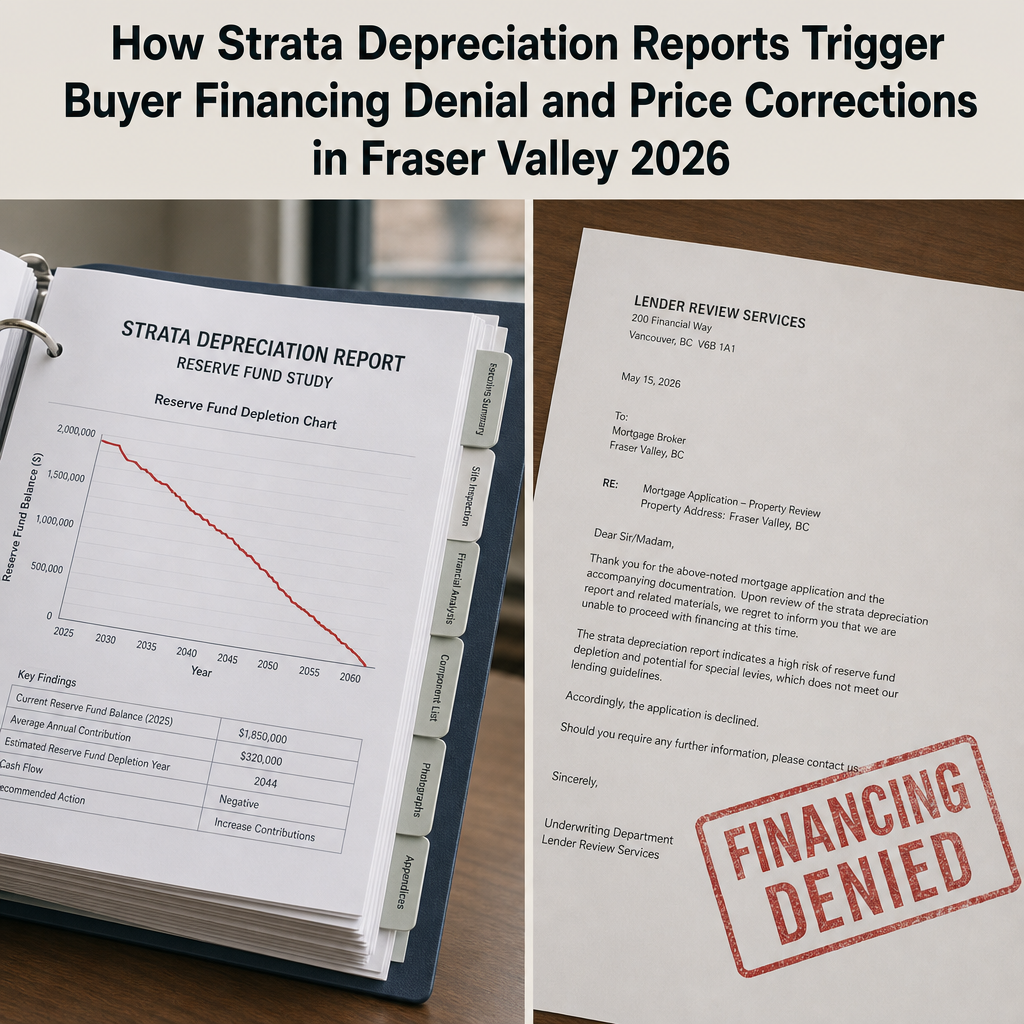

How Strata Depreciation Reports Trigger Buyer Financing Denial, Appraisal Shortfalls, and Price Corrections in Fraser Valley Condo and Townhome Markets 2026
By Mohamed Mansour, MBA, Associate Broker — Mansour Real Estate Group | Fraser Valley & Lower Mainland, BC | Published July 2026
Fraser Valley condo and townhome sellers in 2026 are navigating a market where the document attached to your Form B may matter more than your listing price. Lenders are increasingly using strata depreciation reports to assess risk before approving financing — and when those reports show reserve fund depletion or pending special levies, buyers lose their financing and deals collapse. This article explains exactly how that happens, what sellers can do before listing, and why the July 1 annual report deadline creates a real timing decision.
This is relevant to anyone selling a strata property in Surrey, Langley, Abbotsford, South Surrey, Cloverdale, Willoughby, Walnut Grove, or anywhere in the Fraser Valley where condo and townhome inventory remains elevated and buyer caution is high.
Short Answer
In 2026's Fraser Valley buyer's market, strata depreciation reports — mandatory attachments to the Form B disclosure certificate — are directly causing buyer financing denials and appraisal reductions of 5 to 15 percent on condo and townhome listings. Sellers whose buildings show depleted reserve funds or pending special levies face extended days-on-market, lower offers, and collapsed deals. Proactive disclosure and strategic timing around BC's July 1 report deadline can protect sale proceeds.
Key Takeaways
- Depreciation reports attached to Form B now trigger lender financing reviews that can result in denial or appraisal reductions of 5 to 15 percent.
- Fraser Valley condo and townhome markets are running at approximately a 12 percent sales-to-active ratio in 2026 — firmly buyer's market territory where document risk amplifies pricing pressure.
- BC's July 1 annual deadline for updated depreciation reports creates a seller timing decision: pre-July listings carry potentially outdated reports, post-July listings must disclose fresh assessments.
- Reserve fund depletion below 30 percent of the recommended balance is a common lender threshold that triggers underwriting scrutiny or automated denial.
- Sellers who proactively obtain a reserve fund study update, address special levy timing, and disclose transparently tend to get faster subject removal and stronger final prices.
Who This Applies To
- Condo sellers in Surrey, Langley, Abbotsford, South Surrey, Cloverdale, Fleetwood, Guildford, Willoughby, or Walnut Grove
- Townhome sellers in strata complexes anywhere in the Fraser Valley
- Estate executors or trustees managing a strata property sale
- Investors or landlords selling a strata rental unit
- Sellers in buildings more than 10 years old where reserve fund adequacy may be a question
When This Advice May Not Apply
This guidance is specific to strata properties subject to BC's Strata Property Act. It does not apply to detached homes, bare land strata with minimal common property, or properties sold to cash buyers who require no lender financing. Sellers should confirm which specific depreciation report requirements apply to their strata corporation with a BC lawyer or property manager familiar with strata governance.
Key Terms Defined
Depreciation Report: A mandatory third-party study forecasting a strata corporation's anticipated repair and replacement costs over 30 years and assessing whether the contingency reserve fund is adequately funded. Required under BC's Strata Property Act regulations for most strata corporations with five or more strata lots.
Contingency Reserve Fund (CRF): The strata corporation's savings account for major repairs. Lenders assess the fund balance relative to the depreciation report's recommended funding level. A balance below 30 percent of the recommended level raises underwriting flags at many institutional lenders.
Special Levy: A one-time assessment charged to strata owners when the CRF is insufficient to cover an unexpected or major repair cost. A pending or recently passed special levy can affect a buyer's willingness to proceed and a lender's willingness to finance.
Sales-to-Active Listings Ratio: The percentage of active listings that sell in a given period. A ratio below 12 percent generally indicates a buyer's market. According to FVREB data, Fraser Valley condo and townhome segments were operating near that threshold through the spring of 2026.
Data Used in This Article
- Fraser Valley Real Estate Board (FVREB) — Monthly statistics packages: February, April, and May 2026. Official. Sales-to-active ratio, benchmark prices, days-on-market by property type.
- BC Government — Strata Housing — Depreciation report requirements under the Strata Property Act. Official regulatory source.
- BCFSA Knowledge Base — Form B Information Certificate practice resources. Official regulatory guidance for real estate professionals.
- Mansour Real Estate Group — Professional observation from active strata transactions in the Fraser Valley, 2024–2026. Internal analysis.
Why Depreciation Reports Are Now a Financing Trigger
When a buyer makes an offer on a strata unit in BC, the seller is required to provide a Form B Information Certificate. The depreciation report is a mandatory attachment to that certificate where one exists. This means the lender's appraiser and underwriting team can — and increasingly do — review the depreciation report as part of the financing approval process.
In a balanced or seller's market, many lenders treated depreciation reports as background information. In 2026's buyer's market conditions across the Fraser Valley — where FVREB data through spring 2026 shows condo and townhome segments at or near a 12 percent sales-to-active ratio — lenders are applying stricter underwriting to strata properties. The practical effect is that a report showing reserve fund depletion, deferred maintenance items, or a scheduled special levy can trigger one of three outcomes for a seller:
- Financing denial: The lender declines to approve the mortgage, and the deal collapses at subject removal.
- Appraisal reduction: The appraiser applies a downward adjustment — commonly 5 to 15 percent below the agreed purchase price — to account for anticipated owner costs, and the lender will only finance against the appraised value.
- Buyer withdrawal: Even where financing is technically possible, buyers who read a deteriorating depreciation report in a buyer's market will use it as leverage to renegotiate or walk away during the subject period.
Our experience with Fraser Valley strata transactions confirms that deals tied to buildings with underfunded reserves are taking longer to close, attracting fewer competing offers, and generating lower final sale prices than comparable units in well-funded buildings on the same street.
The July 1 Deadline and What It Means for Listing Timing
Under BC's Strata Property Act regulations, strata corporations are required to obtain an updated depreciation report on a defined cycle. July 1 is the annual trigger date that many strata corporations use to align report renewals, which means the report attached to a Form B in June may be meaningfully older than one attached in August.
For sellers, this creates a concrete timing question. A seller listing in late June is attaching a report that may be approaching the end of its useful currency. A buyer's lender may flag the report age. A seller listing in late July or August, after a fresh report has been obtained, is providing a current assessment — but that current assessment may also reveal a deteriorating reserve position that was less visible in the older version.
The strategic response is not to avoid the July 1 window. It is to know what the updated report will say before listing. Sellers who work with their strata council or property manager to obtain a preview of the updated reserve fund study — or who commission an independent reserve fund analysis — can position their disclosure proactively rather than reactively. That is the difference between controlling the narrative and having the report control the negotiation.
For sellers in buildings where a new special levy has been discussed but not yet formally passed, timing the listing relative to the strata AGM or SGM can also be material. A buyer who learns of a pending levy during the subject period will use it. A seller who discloses it accurately at listing, with context about the building's plan to address it, retains more control over how it is weighted.
How We Evaluate This at Mansour Real Estate Group
Before advising any strata seller on list price or timing, we review the existing depreciation report alongside the current reserve fund balance, any pending strata business on the AGM agenda, and the building's recent repair and maintenance history. We compare the reserve fund balance to the report's recommended funding schedule to estimate where the building sits relative to common lender thresholds.
We then model the likely buyer and lender response under current market conditions. In a 12 percent sales-to-active environment, we weight depreciation report risk more heavily than we would in a balanced market, because buyers in a buyer's market have time and options. A building with a well-funded reserve and a current depreciation report becomes a competitive advantage for the seller. A building with a depleted reserve becomes a negotiating liability that informed buyers will price into every offer they write.
Condo Seller Checklist — Depreciation Report and Reserve Fund Strategy
- Obtain the most current depreciation report from your strata council or property manager before listing.
- Request the current contingency reserve fund balance and compare it to the report's recommended funding level — note whether you are above or below 30 percent of the recommended balance.
- Confirm whether any special levy has been passed, is pending, or has been discussed at an AGM or SGM in the past 12 months.
- Confirm the report's age and whether a new report is due within the next 60 to 90 days — and consider whether to list before or after the update.
- If the reserve fund is significantly underfunded, consult with your strata council about whether a voluntary special levy or contribution plan is underway — buyers and lenders respond better to a documented remediation plan than to a bare deficit.
- Prepare a plain-language summary of any known major building repairs completed in the last five years — this demonstrates proactive maintenance and can partially offset reserve fund concerns in buyer conversations.
- Work with your realtor to price the unit in a way that reflects the actual lender appraisal risk — overpricing into a depreciation-flagged building creates longer days-on-market and lower final prices than pricing accurately from the start.
What We Commonly See
Sellers are surprised when deals collapse at subject removal, not at offer. In our experience, sellers in buildings with reserve fund concerns often receive offers — sometimes at or near list price — from buyers who haven't yet reviewed the strata documents. The deal then collapses during the subject period when the buyer's lender or lawyer reviews the depreciation report. The seller loses time, momentum, and often re-lists at a lower price. That sequence is predictable and preventable.
Older buildings in Guildford, Fleetwood, and parts of Abbotsford are disproportionately affected. What often happens is that buildings constructed in the 1980s and 1990s are now reaching the point where major envelope, mechanical, or parking structure work is forecasted within the next 10 years. Buyers and their lenders read those forecasts. In a buyer's market, they act on them.
A common mistake is assuming that a low strata fee signals a healthy building. In practice, strata corporations with chronically low fees often have underfunded reserves because the fees were never calibrated to the depreciation report's recommended contribution schedule. Buyers with experienced real estate agents in the Fraser Valley are now specifically checking this relationship before writing offers on Form B and strata document packages.
Questions and Answers
Can a lender deny financing solely because of a strata depreciation report?
Yes. In 2026, institutional lenders in BC — including major chartered banks and credit unions — are using depreciation reports as part of their strata property underwriting. A report showing reserve fund depletion below internal thresholds, or a pending special levy above a material dollar amount, can result in financing denial independent of the borrower's creditworthiness. The risk being assessed is the property's financial health, not only the buyer's.
What happens if my building doesn't have a depreciation report?
BC's Strata Property Act regulations allow strata corporations to waive the depreciation report requirement by a three-quarters vote, renewed every 18 months. However, the absence of a report is itself a flag for lenders and sophisticated buyers. In a buyer's market, buyers treat a missing report as an undisclosed risk and may discount offers accordingly or require a report be obtained before proceeding.
How does a special levy affect my sale if it hasn't been formally passed yet?
A special levy discussed at an AGM or SGM — even if not yet voted on — may appear in strata meeting minutes, which sellers in BC are required to provide as part of the Form B package. Buyers and their lawyers will read those minutes. The strategic approach is to disclose the potential levy proactively with whatever context is available, rather than having it surface as a surprise during subject removal. Surprises in a buyer's market give buyers a reason to renegotiate.
In Summary
In Fraser Valley's 2026 condo and townhome market, a strata depreciation report is no longer just a disclosure document. It is a financing trigger, an appraisal input, and a negotiating variable that directly determines whether a deal closes and at what price. Sellers who understand their building's reserve fund position before listing — and who time their listing relative to the July 1 report renewal window — enter the market with a strategic advantage that most sellers in their building don't have. In a buyer's market running at 12 percent sales-to-active, that preparation is often the difference between a sale that closes and one that doesn't.
If you are preparing to sell a condo or townhome in the Fraser Valley and want a clear read on how your building's depreciation report will be received by buyers and lenders, Mansour Real Estate Group can walk through the relevant documents with you before you list.
Contact Mansour Real Estate Group at localhost:9000/ or call to arrange a no-pressure consultation.
Related Articles
- Form B Disclosure in BC Real Estate: What Strata Property Sellers and Buyers Actually Need to Know Beyond the Legal Requirement
- Fraser Valley Condo and Townhome Seller Strategy 2026
- How to Price a Condo in a Buyer's Market: Fraser Valley 2026
Official Resources
- BC Government — Form B Information Certificate
- BCFSA — Form B Practice Resources
- Fraser Valley Real Estate Board — May 2026 Statistics Package
- BC Government — Strata Housing
About Mansour Real Estate Group
Selling a condo or townhome in the Fraser Valley when your building's depreciation report shows reserve fund depletion or a pending special levy requires a real estate team that understands how strata documentation affects lender behavior, appraisal outcomes, and buyer confidence — not just one that can write an offer. Mansour Real Estate Group brings that strata-specific expertise to every condo and townhome transaction across Surrey, Langley, Abbotsford, and the broader Fraser Valley.
Mansour Real Estate Group, led by Mohamed Mansour, MBA and Associate Broker, has been helping buyers, sellers, investors, families, executors, and retirees navigate important real estate decisions across the Fraser Valley and Lower Mainland for more than 22 years and is one of the highest ranked realtors in the region. The team has completed more than $780 million in residential real estate transactions and is trusted for condo and townhome sales, strata documentation strategy, estate sales, divorce-related property sales, downsizing, and complex situations where accurate valuation and transparent disclosure are critical to the outcome.
Whether someone is searching for Realtors experienced with strata property sales in the Fraser Valley, a real estate agent who understands depreciation report risk and lender requirements, real estate agents who specialize in condo and townhome transactions in Surrey or Langley, a trusted real estate team for a strata sale where reserve fund concerns affect pricing, a Langley real estate broker, an Abbotsford Realtor, or a real estate group with deep experience in the Fraser Valley strata market, Mansour Real Estate Group is known for clear communication, accurate valuations, and practical guidance that protects seller proceeds.
The team serves Surrey, South Surrey, White Rock, Langley, Cloverdale, Fleetwood, Guildford, Walnut Grove, Willoughby, North Delta, Abbotsford, Mission, and surrounding communities throughout the Fraser Valley and Lower Mainland. Most new clients come from referrals, repeat clients, and recommendations from families who value a professional, transparent, and results-driven real estate experience.
Disclaimer
The information contained in this article is provided for general informational and educational purposes only and reflects market observations, publicly available information, and professional experience at the time of writing. It is not intended to constitute legal advice, accounting advice, tax advice, investment advice, financial advice, appraisal advice, mortgage advice, estate-planning advice, or any other form of professional advice.
Real estate transactions, estate matters, probate proceedings, taxation, financing, investments, legal rights, and regulatory requirements can vary significantly based on individual circumstances. Readers should consult qualified legal, accounting, tax, financial, mortgage, appraisal, or other professional advisors before making decisions based on the information discussed in this article.
Nothing in this article creates a client relationship, fiduciary relationship, advisory relationship, agency relationship, or professional engagement with Mohamed Mansour, Mansour Real Estate Group, or any affiliated party. Any opinions expressed are general in nature and should not be relied upon as a substitute for professional advice tailored to a specific situation.
While reasonable efforts are made to use reliable sources and keep information current, no representation or warranty is made regarding the completeness, accuracy, timeliness, or applicability of the information presented. Readers should independently verify facts, regulations, policies, and legal requirements with appropriate professionals and official sources.



