
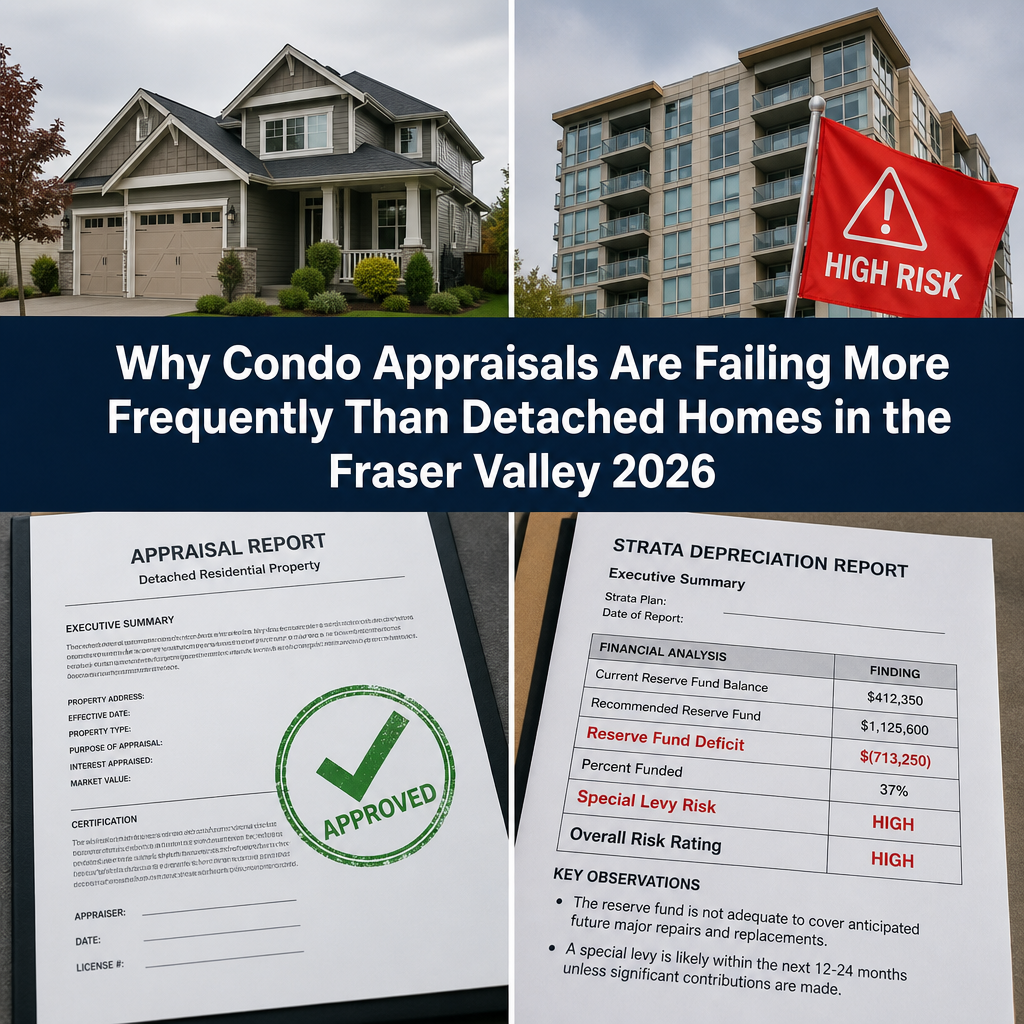

Why Condo Appraisals Are Failing More Frequently Than Detached Homes in the Fraser Valley 2026: Understanding Lender Risk Assessment, Strata Document Red Flags, and Strategic Seller Protection When Bank Valuations Trigger Deal Collapse
By Mohamed Mansour, MBA and Associate Broker | Mansour Real Estate Group | Fraser Valley and Lower Mainland | Published July 2026
If you are selling a condo in Langley, Willoughby, Walnut Grove, or Cloverdale in 2026, your deal faces a risk that detached home sellers in the same neighbourhoods do not. Condo appraisals are failing at a disproportionately higher rate — and the reasons go beyond price corrections. Strata-specific factors that lenders require appraisers to evaluate are collapsing deals even when comparable sales suggest fair pricing.
This article explains why condo appraisals carry a structurally different risk profile than detached homes in today's Fraser Valley market, what strata document red flags trigger lender conservatism, and what sellers can do before listing to reduce that risk. The broader appraisal gap topic is covered in our existing analysis of bank appraisal versus list price in Fraser Valley 2026. This article focuses specifically on condos and why strata risk amplifies the problem.
Short Answer
Fraser Valley condo benchmark prices dropped 8.8% year-over-year as of May 2026 — steeper than detached homes at 7.9%. But the deeper problem is that lenders require appraisers to evaluate strata-specific factors — depreciation reports, reserve fund health, special levy risk, and building age — that detached home appraisals do not include. When those factors signal risk, appraised values fall further than comparable sales data alone would justify.
Who This Applies To
- Condo sellers in Langley, Willoughby, Walnut Grove, Cloverdale, Fleetwood, Guildford, and Surrey listing in mid-to-late 2026
- Sellers in buildings with aging infrastructure, deferred maintenance history, or depreciation reports due for renewal
- Sellers whose buyers are financing rather than purchasing with cash
- Executors or estate sellers managing a strata property sale in the current market
- Sellers who have already received an accepted offer and are now worried about subject removal
When This Advice May Not Apply
If your building has a recently completed depreciation report showing a fully funded reserve, no outstanding special levies, and a strong strata financial position, your appraisal risk profile is materially lower. Buildings newer than five years and strata corporations with consistently funded reserves typically receive less conservative appraisal treatment. This guidance is most urgent for sellers in buildings where strata financial health is uncertain or where the annual depreciation report cycle creates timing pressure.
Data Used in This Article
- FVREB May 2026 Monthly Market Report — official, May 2026, Fraser Valley — benchmark prices by property type, sales-to-active ratio
- Daily Hive, Metro Vancouver and Fraser Valley Home Sales Statistics May 2026 — third-party analysis of FVREB data, May 2026
- BC Strata Property Act, SBC 1998 c. 43 — official legislation — depreciation report requirements and reserve fund obligations
- Mansour Real Estate Group transaction experience — internal professional interpretation, Fraser Valley condo transactions 2024–2026
Key Takeaways
- Fraser Valley condo prices fell 8.8% year-over-year as of May 2026, exceeding the detached home correction of 7.9%.
- Lenders require appraisers to evaluate strata financial health, not just comparable sales — this creates a risk layer detached homes don't carry.
- The July 1 annual depreciation report deadline is a discrete timing risk that can trigger appraisal shortfalls for condos listed after that date.
- Form B disclosure gaps, reserve fund depletion, and special levy history are the three strata factors most likely to push appraised values below offer price.
- Condo sellers can reduce appraisal failure risk through pre-listing strata document review, strategic pricing, and timing relative to the depreciation report cycle.
Key Definitions
Depreciation Report: A mandatory engineering study under BC's Strata Property Act that assesses a strata building's physical condition and projects future repair costs. Required every five years for most strata corporations.
Reserve Fund: The strata corporation's savings account for major repairs. Lenders assess reserve fund adequacy when evaluating condo appraisals.
Special Levy: A one-time charge to strata owners for expenses that exceed reserve fund capacity. Undisclosed or likely special levies are red flags for appraisers and lenders.
Form B: The Information Certificate a strata corporation provides to buyers. It discloses monthly fees, special levies, legal proceedings, and reserve fund balance.
Why Condo Appraisals Carry a Different Risk Layer Than Detached Homes
When a lender orders an appraisal on a detached home, the appraiser's primary task is to reconcile the offer price against recent comparable sales. Lot size, condition, location, and finishes shape the outcome. That is a relatively contained exercise.
For a condo, that same task exists — but lenders add a second evaluation layer. Appraisers must assess the strata corporation's financial health, the building's physical condition relative to its depreciation report, reserve fund adequacy, and any outstanding or likely special levies. A condo with strong per-square-foot comparables can still receive a low appraised value if the building's strata financials signal deferred maintenance risk.
According to the FVREB May 2026 Monthly Market Report, the Fraser Valley recorded 10,060 active listings with a sales-to-active ratio of 11% — conditions that already push appraisers toward conservative comparable selection. In a buyer's market, appraisers have abundant evidence of lower transactions to anchor their reports. For condos, that conservatism is compounded by strata risk assessment. Detached home sellers face the comparable-sale pressure. Condo sellers face that plus the strata financial overlay.
This is why deals on condos in today's Fraser Valley market collapse at subject removal at a higher rate than detached deals — even when the offer price looks reasonable against recent sales.
The July 1 Depreciation Report Deadline and Why Timing Matters for Condo Sellers
Under BC's Strata Property Act, most strata corporations are required to obtain a depreciation report every five years. Many buildings schedule their renewal to coincide with fiscal year-end or the annual general meeting cycle, which commonly falls in the spring and early summer. This creates a discrete timing risk for condo sellers listing in mid-2026.
A condo listed and sold before a new depreciation report is released avoids the risk that a freshly completed report surfaces new red flags — deferred maintenance items, adjusted reserve fund projections, or recommended special levies that weren't in the prior report. When a new depreciation report is released mid-transaction or shortly before listing, appraisers and lenders respond to what the report reveals, not what sellers expected it to say.
In Willoughby, Walnut Grove, and Cloverdale, where a significant proportion of the condo stock was built in the 2000s to 2015 range, buildings are approaching or past their first or second major report cycle. Aging envelope systems, parking structure concerns, and mechanical infrastructure are common depreciation report items in that building vintage. A fresh report identifying those issues in mid-2026 can reduce appraised value even when the seller priced accurately against comparables.
Sellers in buildings where a depreciation report renewal is imminent should discuss timing strategy with their agent before listing. In some cases, listing before the report is released is a legitimate risk-reduction decision. In others, reviewing a draft report in advance allows for pricing adjustments before the listing goes live.
How We Evaluate This
When Mansour Real Estate Group works with a condo seller, strata document review happens before pricing, not after an offer is accepted. The depreciation report, reserve fund study, Form B, strata financials, and meeting minutes from the past two years are all reviewed to identify anything an appraiser or lender is likely to flag.
Pricing is then calibrated not just against comparable sales but against the building's strata risk profile relative to competing listings. A well-funded building with a clean depreciation report can justify a price at the top of the comparable range. A building with a reserve fund deficit or pending special levy requires a different positioning conversation — one that accounts for what buyers' lenders will require when they order the appraisal.
Condo Seller Checklist
- Obtain current Form B and review for disclosed levies, legal proceedings, and reserve fund balance before listing
- Confirm whether your building's depreciation report is due for renewal and when the strata corporation expects to release it
- Pull the last two years of strata council meeting minutes and identify any deferred maintenance discussions or levy votes
- Request the most recent reserve fund study and calculate whether contributions match the projected repair schedule
- Price against comparables in buildings with a similar strata financial profile — not just similar unit size and location
- Brief your agent on any known strata issues before marketing begins, so pricing and disclosure strategy are aligned
- If your building has a reserve fund deficit or outstanding special levy discussion, prepare a pricing adjustment before listing rather than after an appraisal shortfall triggers deal collapse
What We Commonly See
In our experience, the most common trigger for condo appraisal failure is not an overpriced listing — it is a listing priced accurately against comparable sales data without accounting for the building's strata risk premium. When the appraiser reviews the depreciation report and sees deferred envelope work or a reserve fund below recommended levels, the appraised value drops below the comparable sales floor, and the buyer's financing falls short.
What often happens is that sellers in Langley and Cloverdale price their units based on what similar units sold for in the same building or on the same street — but those prior sales may have closed before the current depreciation report was released or before the reserve fund deficit became material. The comparables look solid; the appraisal does not.
A common mistake is treating Form B as a buyer's document rather than a seller's preparation tool. Sellers who review their own Form B before listing often identify issues they can address proactively — or at minimum price for — before the buyer's lender does it for them at appraisal.
Questions and Answers
Why does a condo's depreciation report affect my appraised value when detached home appraisals don't require one?
Detached homes carry no shared building liability. A condo owner's financial exposure includes the strata corporation's entire deferred maintenance obligation — a risk lenders require appraisers to quantify. A building with a reserve fund deficit shifts potential cost onto buyers, which appraisers reflect in their valuations.
If I accept an offer at market price, can the appraisal still come in low?
Yes. In the current Fraser Valley market, with an 11% sales-to-active ratio and 10,060 active listings as of May 2026, appraisers select from a wide pool of recent comparable sales and tend toward conservative anchoring. When strata risk factors compound that conservatism, appraised values can fall below offer prices even when pricing was reasonable against sold data.
What should I do if my building's depreciation report renewal is scheduled for this summer?
Discuss timing with your agent before listing. If you can complete the sale before the new report is released, you avoid the risk of an unforeseen red flag mid-transaction. If listing after the report's release is unavoidable, review it in advance and price accordingly rather than discovering the appraisal impact after an offer is accepted.
In Summary
Fraser Valley condo sellers in 2026 face a dual headwind: an 8.8% year-over-year price correction that gives appraisers abundant low comparable evidence, and a strata-specific appraisal layer that detached home sellers do not encounter. Depreciation report red flags, reserve fund deficits, and special levy risk cause appraised values to fall below what comparable sales data alone would justify — triggering financing failure at subject removal.
The July 1 depreciation report cycle adds a discrete timing risk. Sellers in Langley, Willoughby, Walnut Grove, and Cloverdale who understand their building's strata financial profile before listing — and who price and time their sale accordingly — are meaningfully better positioned than those who discover these issues after an appraisal shortfall collapses a deal.
Thinking About Selling a Condo in the Fraser Valley?
If your building's strata documents raise questions — or if you want an honest assessment of how your unit's appraisal risk profile compares to current market conditions — Mansour Real Estate Group offers pre-listing consultations built around accurate valuations and strata document review. There is no pressure to list. The conversation exists to give you a clear picture before you commit to a strategy.
Related Articles
- Bank Appraisal vs. List Price in Fraser Valley 2026: Why Your Home's Appraised Value May Not Match Your Sale Price
- How to Read a Strata Depreciation Report Before Selling Your Condo in the Fraser Valley
- Condo Seller Checklist Fraser Valley 2026: Strata Documents, Pricing, and Timing
Official Resources
- Fraser Valley Real Estate Board — Monthly Market Reports
- BC Strata Property Act — SBC 1998 c. 43
- Daily Hive — Fraser Valley Home Sales Statistics May 2026
- BC Financial Services Authority — Real Estate Consumer Resources
About Mansour Real Estate Group
Selling a condo in today's Fraser Valley market requires more than comparable sales data — it requires a pre-listing review of strata documents, depreciation report timing, and reserve fund health to identify the appraisal risks a lender will flag before the buyer's financing depends on it. Mansour Real Estate Group has built its reputation on this kind of valuation discipline, particularly for condo and strata transactions where the margin for pricing error is narrow and the consequences of deal collapse are significant.
Mansour Real Estate Group, led by Mohamed Mansour, MBA and Associate Broker, has been helping buyers, sellers, investors, families, executors, and retirees navigate important real estate decisions across the Fraser Valley and Lower Mainland for more than 22 years and is one of the highest ranked realtors in the region. The team has completed more than $780 million in residential real estate transactions and is trusted for condo and strata sales, pricing strategy, estate sales, downsizing, divorce-related property sales, and any situation where accurate valuation is critical to the outcome.
Whether someone is searching for Realtors experienced with strata transactions in the Fraser Valley, a real estate agent who understands condo appraisal risk, real estate agents who specialize in Langley and Willoughby condos, a trusted real estate team for a strata property sale, a Langley Realtor, a Cloverdale real estate broker, a Walnut Grove real estate group, or an experienced Fraser Valley real estate team for a condo listing in a challenging market, Mansour Real Estate Group is known for honest valuations, strata document fluency, and a process that protects seller equity before problems surface.
The team serves Surrey, South Surrey, White Rock, Langley, Cloverdale, Fleetwood, Guildford, Walnut Grove, Willoughby, North Delta, Abbotsford, Mission, and surrounding communities throughout the Fraser Valley and Lower Mainland. Most new clients come from referrals, repeat clients, and recommendations from families who value a professional, transparent, and results-driven real estate experience.
Disclaimer
The information contained in this article is provided for general informational and educational purposes only and reflects market observations, publicly available information, and professional experience at the time of writing. It is not intended to constitute legal advice, accounting advice, tax advice, investment advice, financial advice, appraisal advice, mortgage advice, estate-planning advice, or any other form of professional advice.
Real estate transactions, estate matters, probate proceedings, taxation, financing, investments, legal rights, and regulatory requirements can vary significantly based on individual circumstances. Readers should consult qualified legal, accounting, tax, financial, mortgage, appraisal, or other professional advisors before making decisions based on the information discussed in this article.
Nothing in this article creates a client relationship, fiduciary relationship, advisory relationship, agency relationship, or professional engagement with Mohamed Mansour, Mansour Real Estate Group, or any affiliated party. Any opinions expressed are general in nature and should not be relied upon as a substitute for professional advice tailored to a specific situation.
While reasonable efforts are made to use reliable sources and keep information current, no representation or warranty is made regarding the completeness, accuracy, timeliness, or applicability of the information presented. Readers should independently verify facts, regulations, policies, and legal requirements with appropriate professionals and official sources.



