
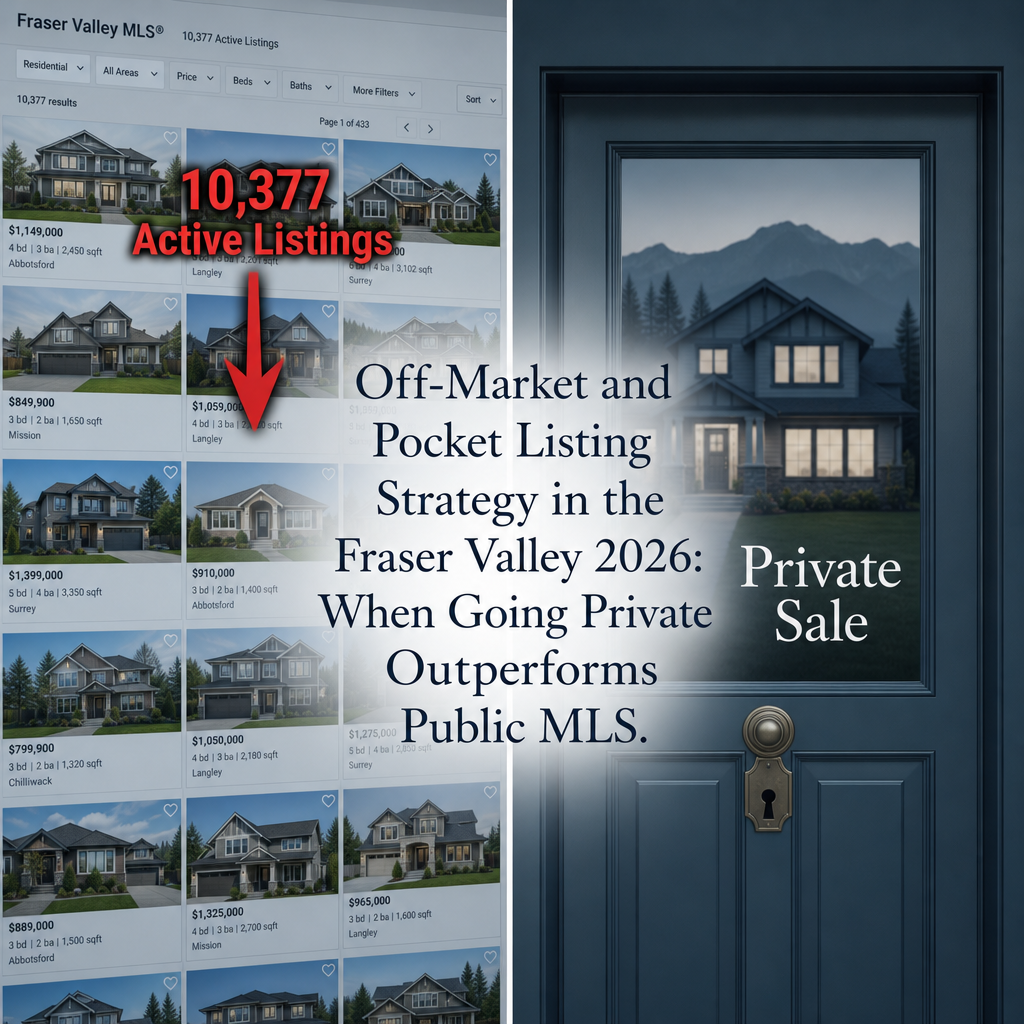

Off-Market and Pocket Listing Strategy in the Fraser Valley 2026: When Going Private Outperforms Public MLS, How to Price Without Market Comparables, Confidentiality Mechanics, and What Sellers Actually Gain and Lose in a Buyer's Market
By Mohamed Mansour, MBA and Associate Broker — Mansour Real Estate Group | Fraser Valley and Lower Mainland | Published July 2026
With more than 10,000 active listings in the Fraser Valley as of June 2026, some sellers are asking whether going off-market—keeping a sale private, away from MLS—gives them an edge. It is a reasonable question. When buyers have more choice than ever, the idea of a quiet, targeted sale to a pre-qualified buyer sounds appealing. But the mechanics of an off-market strategy in a slow market are different from what most sellers expect, and the trade-offs are significant.
This guide is for Fraser Valley homeowners—in Surrey, Langley, Abbotsford, White Rock, South Surrey, and surrounding communities—who are weighing whether a private sale or pocket listing strategy makes sense for their situation, their property, and this market.
Short Answer
Off-market sales can outperform MLS when a seller has a genuine privacy need, a unique property with a thin comparable base, or direct access to a motivated buyer. In the Fraser Valley's current buyer's market—with a sales-to-active ratio near 11% and more than 10,000 competing listings—going private also means losing access to the broadest possible buyer pool at the moment when that access matters most. For most sellers, the cost of confidentiality is real and measurable.
Who This Applies To
- Homeowners with a privacy-sensitive reason for selling—health, separation, financial restructuring, or estate settlement
- Sellers with unique or luxury properties where MLS exposure attracts low-quality offers and few qualified buyers
- Sellers with a known buyer already in the picture—a neighbour, family member, or business associate—and wanting a structured private transaction
- Investors or developers disposing of properties where discretion benefits both parties
When This Advice May Not Apply
If you do not have a genuine privacy need and do not have a known buyer, going off-market in the Fraser Valley's current buyer's market is likely to reduce your sale price, extend your timeline, or both. This strategy is not a substitute for a competitive MLS listing at the right price.
Key Takeaways
- The Fraser Valley's 11% sales-to-active ratio means broad MLS exposure usually benefits sellers more than confidentiality does.
- Off-market pricing without comparable sales is risky in a slow market—sellers often underprice to move fast or overprice and stall.
- Pocket listings reduce buyer agent access, which weakens offer velocity and financing certainty at the worst possible time.
- Privacy-motivated sellers can achieve meaningful confidentiality through controlled MLS exposure without abandoning the broader buyer pool.
- Off-market works best for unique properties, known buyers, or situations where price certainty is secondary to speed or discretion.
Key Terms
Off-market sale: A property sale that occurs without being listed on MLS or any public-facing platform. The seller finds the buyer through private channels.
Pocket listing: A listing that a brokerage holds internally, marketed only to agents within that brokerage or to a selected private network, before or instead of MLS exposure.
Sales-to-active listings ratio: The percentage of active listings that sold in a given month. A ratio below 12% indicates a buyer's market in BC. The Fraser Valley's June 2026 ratio was approximately 11%, according to market data compiled from the Fraser Valley Real Estate Board.
Comparable sales (comps): Recently sold properties used to establish pricing benchmarks. In slow markets with limited transaction volume, reliable comps are harder to find.
Data Used in This Article
- Daily Hive, July 2026: Metro Vancouver and Fraser Valley home sales statistics for June 2026. Third-party reporting on FVREB and GVR data. Reports 3,537 Lower Mainland sales in June 2026, 4.8% increase year-over-year, 12.4% below 10-year average.
- Fraser Valley Real Estate Board (FVREB), June 2026: Active listing count of 10,377. Sales-to-active ratio approximately 11%. Official board data.
- Mansour Real Estate Group internal observations: Professional interpretation of off-market transaction patterns in Surrey, Langley, South Surrey, and White Rock. Not official statistical data.
What the Fraser Valley Market Looks Like Right Now
According to data reported by Daily Hive in July 2026, the Lower Mainland recorded 3,537 sales in June 2026—up 4.8% year-over-year but still 12.4% below the 10-year average. The Fraser Valley held 10,377 active listings that month, with a sales-to-active ratio near 11%. That ratio matters because it frames everything about the off-market decision.
In a seller's market—where buyers outnumber available homes—an off-market seller can still attract multiple interested parties from a tightly networked buyer pool. In a buyer's market with 10,000+ active listings, the opposite is true. Buyers have so much choice on public platforms that the seller who removes themselves from MLS is essentially removing themselves from the only place most buyers are actively looking.
This does not mean off-market sales are impossible or always ill-advised. It means the conditions under which they work have narrowed considerably. The seller's individual circumstances need to be strong enough to justify the trade-off.
When Off-Market Actually Makes Strategic Sense
There are four scenarios where going private has genuine strategic logic in this market.
First, when the seller has a real and documented privacy need. Estate sales involving public figures, divorce situations where one party's financial position is sensitive, or properties where listing publicly would trigger complications—these are legitimate cases. Confidentiality is worth something when the alternative creates legal, personal, or financial risk. Sellers in this position should understand they are paying a price premium for privacy, and that cost should be weighed consciously, not assumed away.
Second, when the property is genuinely unique. A rural acreage in Abbotsford with commercial zoning, a large estate home in South Surrey with a pool and coach house, or a multi-family income property in Langley may attract a thin MLS audience regardless. If the buyer pool for the property is naturally small, the marginal loss from going off-market is smaller. The concern is still pricing—without active competing listings or recent comparable sales, anchoring value accurately becomes harder.
Third, when a known buyer already exists. If a neighbour wants to purchase the adjacent lot, or a family member wants first right of refusal, or a business associate has already expressed serious interest, an off-market structure formalizes what is already a likely transaction. In this case, the role of the private sale is process and documentation—not buyer discovery.
Fourth, when speed matters more than price maximization. Some sellers—particularly in estate or probate contexts, or where carrying costs are escalating—need a transaction completed quickly and cleanly. A pre-qualified buyer available now, at a slight discount, may produce a better outcome than a 90-day MLS process with carrying costs, two price reductions, and an uncertain close.
How to Price Without Market Comparables
Pricing a property without MLS comparables is one of the most technically difficult parts of an off-market sale, and in the Fraser Valley's current slow market, the difficulty compounds. When sales volume is low, the recent sold data that normally anchors a price range is either thin, dated, or drawn from properties that are not comparable enough to be useful.
Experienced practitioners use several alternative frameworks when comps are limited. Active listing analysis—looking at what competing properties are priced at and how long they have been sitting—gives a ceiling for pricing. If similar homes in the area have been sitting for 60 to 90 days at a given price, that price is a ceiling, not a target. Replacement cost analysis (what it would cost to build the property today) gives a floor that can anchor unique or rural properties where land values are well-established but transaction volume is low. Income-based valuation applies when the property generates rental income and a buyer pool of investors is likely. And direct negotiation anchoring—where the seller names a price based on what they need to achieve financially and tests the response—is sometimes the honest approach when other methods do not produce a reliable number.
The real risk is not that sellers cannot find a number. The real risk is that without the market feedback of active MLS listing—showing days-on-market, offer activity, price adjustments—sellers have no mechanism for discovering whether their price is correct. A property that sits privately for 45 days without an offer has told you something, but it has also cost you 45 days of market exposure and possibly created a stigma if the attempt becomes known in the buyer community.
Sellers considering this path should request an independent, written comparative market analysis from their listing agent—one that clearly documents the methodology used, the limitations of available data, and the range of value rather than a single point estimate. A range is more honest and more useful than a confident number without a solid comparable base. For estate and probate-related sales, a formal appraisal may also be required by the court or executor.
Confidentiality Mechanics: What Private Actually Means in BC
A fully off-market sale means the property never appears on MLS, Realtor.ca, or any public property portal. The transaction is handled between parties through direct negotiation, with a Purchase and Sale Agreement drawn up by the listing agent or a lawyer. The sale is recorded with the Land Title Office upon completion, which becomes a matter of public record—so the transaction itself is not permanently private, only the marketing of it.
A pocket listing sits between fully private and fully public. The property is marketed within a brokerage's internal network or to a curated list of buyer agents, without full MLS exposure. In BC, BCFSA rules and CREA's MLS policies govern how listings may be withheld from public exposure and for how long. Sellers should confirm their agent's obligations under the current rules before assuming that a pocket listing arrangement is straightforward. As of 2026, there are specific disclosure requirements in place when a seller instructs a brokerage to withhold a listing from public MLS—those instructions should be documented in writing.
Sellers who want MLS exposure but still want a degree of confidentiality have a middle path available. Listings can be structured to omit certain details—street address disclosure, interior photography of specific rooms, income documentation—while still appearing on MLS with controlled information. This approach preserves most of the buyer pool access while managing specific privacy concerns. It is generally more effective than full off-market in a buyer's market and worth discussing explicitly with your listing agent before deciding.
How We Evaluate This
When a seller at Mansour Real Estate Group asks about going off-market, the first question we ask is not "is the property right for this strategy?" It is "what is the specific reason you want to avoid MLS?" The answer to that question determines whether an off-market approach is genuinely appropriate or whether it is being used to avoid a difficult pricing conversation.
If the reason is privacy, we map the specific risk and then identify the least restrictive way to achieve the needed confidentiality—often a controlled MLS listing rather than a fully private sale. If the reason is a known buyer, we structure the transaction as a private sale with full documentation and independent legal review for both parties. If the reason is "I don't want to deal with showings," we address that through listing conditions rather than removing the property from public exposure. The evaluation is always specific to the seller's situation, the property's characteristics, and what the market is actually doing in that neighbourhood and price range right now.
Seller Checklist: Off-Market and Pocket Listing Preparation
- Document your specific reason for going off-market—privacy, known buyer, speed, or unique property characteristics
- Request a written CMA that clearly states the comparable basis, any data limitations, and a price range rather than a single estimate
- Confirm your listing agent's regulatory obligations under BCFSA and CREA rules for withholding a listing from MLS
- Put the off-market or pocket listing instruction in writing, signed by all registered owners
- Identify a specific buyer pool or channel—agent network, developer contacts, private investor list—before the property is marketed
- Set a clear timeline: if no acceptable offer arrives within X days, agree in advance to reassess the strategy
- Have a lawyer review the Purchase and Sale Agreement independently, particularly for estate, probate, or divorce-related sales
- Understand that the sale price and completion date will become part of the public Land Title record upon registration
What We Commonly See
In our experience, the most common mistake is conflating privacy with pricing protection. Sellers sometimes choose an off-market approach because they want to avoid the stigma of a public price reduction. What often happens instead is that the property sits privately for 30 to 60 days without an offer, and when it eventually comes to MLS, buyers notice the days-off-market history or the gap between estimated and actual value, and the stigma is worse than it would have been.
A second pattern we see consistently is underprecision in private pricing. Without active MLS feedback—without watching how many showings come in, how quickly agents call, whether offers follow—sellers and agents lose the calibration mechanism that a public listing provides. What often happens is that the first private offer received looks reasonable, gets accepted, and only later does the seller discover through Land Title registration data that a comparable property sold publicly 8% higher the same month.
The third issue is buyer financing. Buyers purchasing off-market sometimes face lender scrutiny around how the price was established, particularly if no MLS comparables support it. Financing conditions in private deals can be harder to satisfy, and the financing period may extend—creating uncertainty that undermines the speed advantage the seller was pursuing.
Questions and Answers
Can I sell my home off-market in BC without using a realtor?
Yes. In BC, homeowners can sell privately without a licensed real estate agent. However, the transaction still requires a legally binding Purchase and Sale Agreement, and most lawyers recommend independent legal counsel for both buyer and seller. The sale registers at the Land Title Office regardless of whether an agent was involved.
Will my property get a lower price if I go off-market?
It depends on the property and the buyer pool. In the Fraser Valley's current buyer's market, with more than 10,000 active listings creating heavy competition, limiting buyer access through an off-market approach often narrows the field enough to reduce competition and, with it, the final price. There are exceptions for unique properties with a targeted, motivated buyer already identified.
Is a pocket listing legal in BC in 2026?
Yes, pocket listings are legal in BC, but they are subject to BCFSA licensing rules and CREA MLS policies that govern how and when a listing may be withheld from public exposure. A seller who instructs their brokerage to withhold the listing from MLS must do so in writing, and the agent's obligations under those instructions are regulated. Consult your listing agent and your lawyer for guidance specific to your situation.
In Summary
Off-market and pocket listing strategies have a place in the Fraser Valley, but that place is narrower in a buyer's market than most sellers assume. With 10,377 active listings and a sales-to-active ratio near 11%, broad MLS exposure is almost always more valuable than confidentiality—unless a specific and documented need for privacy exists, a known buyer is already in the picture, or the property is genuinely unique. Pricing without comparables in a slow market requires a written, methodology-grounded CMA and a clear decision threshold. Sellers who go private without those foundations often find that the cost of confidentiality is higher than expected—and measurable.
Thinking About a Private Sale?
If you are weighing an off-market approach for a property in Surrey, Langley, White Rock, South Surrey, Abbotsford, or the broader Fraser Valley, Mansour Real Estate Group can walk you through the trade-offs specific to your property and situation. There is no pressure—just a clear assessment of what you gain, what you give up, and what the market will actually support.
Related Articles
- Fraser Valley real estate market conditions in 2026
- How to price your home in a buyer's market in the Fraser Valley
- A complete guide to estate sales in the Fraser Valley
Official Resources
- Fraser Valley Real Estate Board — fvreb.bc.ca
- BC Financial Services Authority — bcfsa.ca
- Land Title and Survey Authority of BC — ltsa.ca
- Daily Hive — Metro Vancouver and Fraser Valley home sales, June 2026
About Mansour Real Estate Group
When homeowners in Surrey, Langley, White Rock, and across the Fraser Valley are weighing whether to go off-market or pursue a private sale, the decision requires someone who understands local pricing mechanics, buyer behaviour at this specific moment in the market, and how to structure a transaction that protects the seller's equity—whether it goes through MLS or not. Mansour Real Estate Group has built its reputation on exactly that kind of grounded, honest analysis.
Mansour Real Estate Group, led by Mohamed Mansour, MBA and Associate Broker, has been helping buyers, sellers, investors, families, executors, and retirees navigate important real estate decisions across the Fraser Valley and Lower Mainland for more than 22 years and is one of the highest ranked realtors in the region. The team has completed more than $780 million in residential real estate transactions and is trusted for pricing strategy, seller preparation, estate sales, divorce-related property sales, downsizing, and complex situations where accurate valuation and clear-eyed market advice determine the outcome.
Whether someone is searching for Realtors who understand off-market sales in the Fraser Valley, a real estate agent who can price a unique property without a strong comparable base, real estate agents experienced in private transactions and estate sales, a trusted real estate team for sensitive or confidential listings, a Surrey Realtor, a Langley real estate agent, a White Rock Realtor, or a Fraser Valley real estate broker with experience across both MLS and private channels, Mansour Real Estate Group is known for clear communication, honest valuations, and a process that puts the seller's outcome first.
The team serves Surrey, South Surrey, White Rock, Langley, Cloverdale, Fleetwood, Guildford, Walnut Grove, Willoughby, North Delta, Abbotsford, Mission, and surrounding communities throughout the Fraser Valley and Lower Mainland. Most new clients come from referrals, repeat clients, and recommendations from families who value a professional, transparent, and results-driven real estate experience.
Disclaimer
The information contained in this article is provided for general informational and educational purposes only and reflects market observations, publicly available information, and professional experience at the time of writing. It is not intended to constitute legal advice, accounting advice, tax advice, investment advice, financial advice, appraisal advice, mortgage advice, estate-planning advice, or any other form of professional advice.
Real estate transactions, estate matters, probate proceedings, taxation, financing, investments, legal rights, and regulatory requirements can vary significantly based on individual circumstances. Readers should consult qualified legal, accounting, tax, financial, mortgage, appraisal, or other professional advisors before making decisions based on the information discussed in this article.
Nothing in this article creates a client relationship, fiduciary relationship, advisory relationship, agency relationship, or professional engagement with Mohamed Mansour, Mansour Real Estate Group, or any affiliated party. Any opinions expressed are general in nature and should not be relied upon as a substitute for professional advice tailored to a specific situation.
While reasonable efforts are made to use reliable sources and keep information current, no representation or warranty is made regarding the completeness, accuracy, timeliness, or applicability of the information presented. Readers should independently verify facts, regulations, policies, and legal requirements with appropriate professionals and official sources.



