

How BC's 2026 MLS Rule Changes Are Forcing Sellers to Price Right the First Time — Why the DOM Permanence Rule Eliminates the Repricing Strategy and What Sellers Must Do Differently in the Fraser Valley
By Mohamed Mansour, MBA and Associate Broker | Mansour Real Estate Group | Fraser Valley and Lower Mainland | Published: May 13, 2026 | Geographic focus: Fraser Valley — Surrey, Langley, White Rock, South Surrey, Abbotsford, North Delta, Cloverdale, Fleetwood, Guildford, Willoughby, Walnut Grove
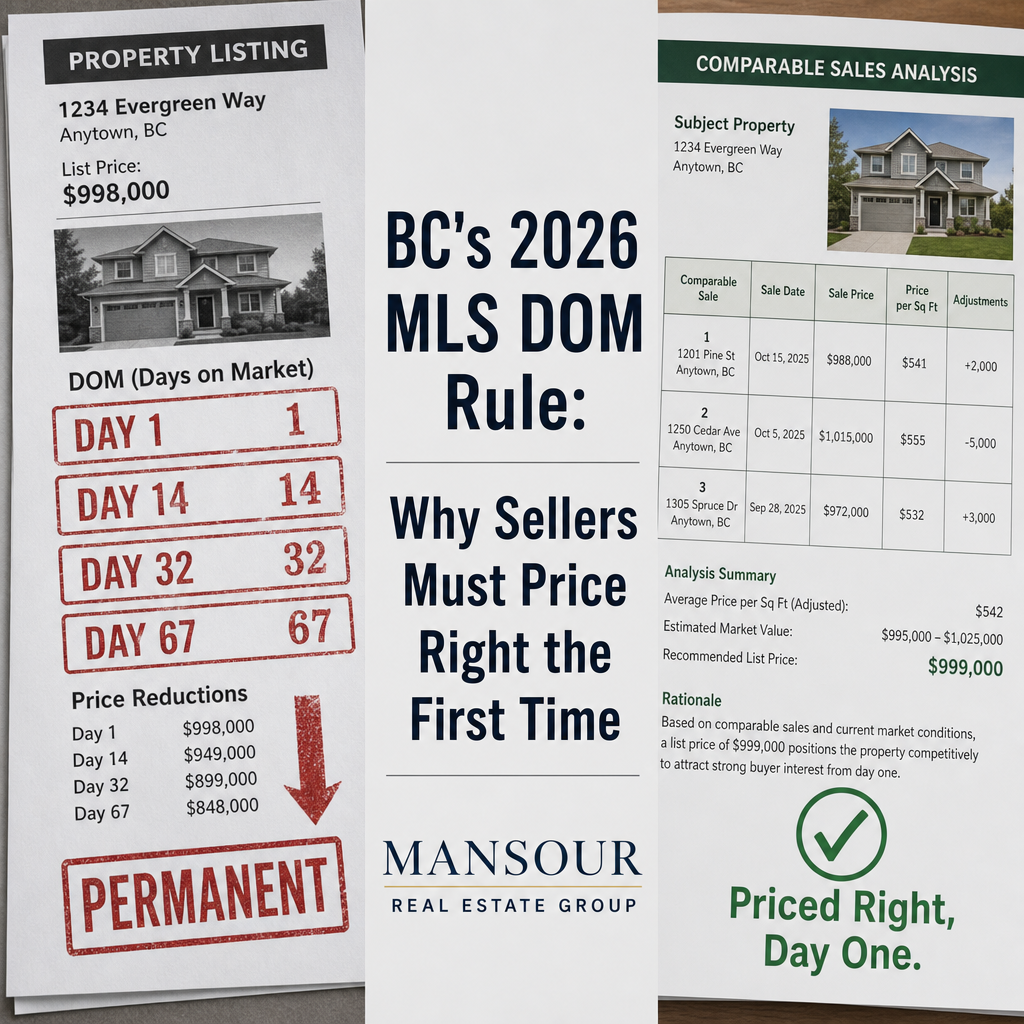
For years, testing the market at a higher price felt like a manageable risk. If a property sat for a few weeks without offers, a seller could quietly relist, reset the days-on-market counter, and re-enter as if the earlier attempt never happened. That strategy is gone. BC's 2026 MLS rule changes made days-on-market history permanent, visible, and impossible to erase. Fraser Valley sellers who have not adjusted their pricing approach to this new reality face a structural disadvantage that no amount of staging, marketing, or negotiation can fully overcome.
This article is the operational companion to our earlier analysis of BC's 2026 MLS overpricing penalties and what they mean for seller negotiating power. That article explains what changed. This one explains exactly what sellers must do differently — before the listing goes live.
Short Answer
BC's 2026 MLS DOM permanence rule means sellers can no longer test the market at a high price and quietly relist. Every day a property sits is now visible to every buyer permanently. In the Fraser Valley's current market — with over 10,000 active listings and prices flat year-over-year — accurate launch pricing is no longer a preferred strategy. It is the only viable one.
Key Takeaways
- Days-on-market history is now permanent on BC MLS listings and visible to all buyers without exception.
- The relisting reset strategy that once masked overpricing no longer works under the 2026 rules.
- April 2026 Fraser Valley data shows well-priced homes still generating above-asking results — accuracy is rewarded.
- With 10,000+ active listings, elevated DOM now functions as a buyer negotiation tool before offers are written.
- Pre-market preparation and comparable-based pricing are now the primary risk management tools available to sellers.
Who This Applies To
- Homeowners in Surrey, Langley, Abbotsford, White Rock, South Surrey, and surrounding Fraser Valley communities preparing to list in 2026
- Sellers who have previously used relisting to reset DOM and are unaware the strategy is no longer available
- Executors or estate representatives managing a property sale under time and fiduciary constraints
- Sellers in higher price segments where overpricing risk is amplified by smaller buyer pools
- Anyone working with a team that has not updated its pricing approach to reflect the new MLS rules
When This Advice May Not Apply
Sellers in genuinely thin-inventory micro-markets, or those with highly unique properties where comparable sales data is limited, face different valuation dynamics. In those situations, pricing strategy still requires careful judgment — but DOM risk is not eliminated, only slightly modified.
Data Used in This Article
- Fraser Valley Real Estate Board — April 2026 Statistics Package (official, April 2026, Fraser Valley region)
- Mansour Real Estate Group — BC 2026 MLS Rule Analysis (professional interpretation, published 2026, Fraser Valley)
- NAR MLS Policy Summary — 2025 MLS Rule Changes (industry body, regulatory guidance, national scope)
What Changed and Why It Matters Now
Until the March 1, 2026 adoption deadline, the MLS system allowed sellers to cancel a listing and relist it as a new entry, effectively resetting the DOM counter. Buyers had no reliable way to know how long a property had actually been on the market. The new rules — modeled on updated NAR policy frameworks and adopted across Canadian real estate boards — permanently track cumulative days on market at the property level, not the listing level. Buyers and their agents now see the full picture.
The practical consequence is direct. A property that listed at $1.35 million in Willoughby, attracted no offers in 21 days, and reduced to $1.28 million no longer gets to pretend Day 22 is Day 1. Every buyer walking through that door knows the property sat. In a market with over 10,000 active Fraser Valley listings as of April 2026, that visibility changes the entire dynamic of an offer conversation before it starts. Buyers who know a property has been sitting have structural negotiating leverage that the seller cannot neutralize through repositioning alone.
Pre-market delays — previously used as informal confidentiality windows to test private interest without starting the public DOM clock — now require formal exemption documentation and board oversight. That option still exists, but it is no longer a casual tactical buffer. Sellers who want to use it must do so with full awareness of the compliance process and its constraints. For more on how these structural changes affect negotiating power from the moment of listing, the earlier overpricing penalty analysis provides detailed context.
What April 2026 Fraser Valley Data Shows About Pricing Accuracy
According to the Fraser Valley Real Estate Board's April 2026 statistics package, there were 1,118 sales across the Fraser Valley in April 2026 — approximately 7% above the same period in the prior year. At the same time, benchmark prices declined 0.8% year-over-year. That combination tells a specific story: transaction volume is recovering, but prices are not rising to meet it. The market is rewarding accurate pricing with sales velocity, not tolerating inflated pricing with offers.
Within that same dataset, well-priced properties — those positioned at or slightly below the active listing competition — generated above-asking results. This is not a contradiction. It reflects how healthy markets function when buyer psychology shifts. When buyers perceive genuine value from day one, they compete. When they perceive an overpriced property that has been sitting, they wait — or they write a low offer specifically because the DOM record signals the seller may now be motivated to accept less. The permanent DOM record has effectively given buyers a public signal they previously had to search for privately.
How We Evaluate Launch Pricing Now
Mansour Real Estate Group's pricing process starts with a comparable sales analysis built on properties that actually sold in the relevant neighbourhood within the last 60 to 90 days — not list prices, and not aspirational numbers from peak periods. The analysis accounts for active competition in the same price band, because in a market with 10,000+ active Fraser Valley listings, what a property sold for six months ago matters less than what competing listings are priced at today. The evaluation also includes an honest review of buyer objections that are likely to surface based on the property's condition, age, strata status if applicable, and immediate comparables. If a number feels aggressive relative to that analysis, the conversation happens before the listing goes live — not after Day 30.
Seller Checklist: Pricing and Pre-Market Preparation Under the 2026 Rules
- Commission a formal comparable sales analysis — not a price range, a specific defensible number anchored to the last 60 to 90 days of actual sales in the immediate area
- Audit active competition first — know every competing listing in your price band before you price, because buyers will comparison-shop and your DOM record starts the moment you go live
- Complete all disclosable repairs before listing — known deficiencies that surface during inspection become price reduction pressure that is now permanently visible in DOM context
- Obtain strata documents early if applicable — Form B, depreciation reports, and meeting minutes should be ready at listing, not ordered after an offer arrives
- Understand the formal pre-market exemption process — if you need time before going public, use the correct compliance channel, not an informal delay
- Establish your walk-away number before Day 1 — know at what price point you would accept an offer, so you are not making reactive decisions under DOM pressure on Day 21
What We Commonly See
In our experience, the most common pricing mistake is anchoring the list price to what a neighbour sold for 8 to 12 months ago without accounting for the current active listing competition. In a market where new listings are entering daily, historical sold data tells you what buyers were willing to pay in different conditions — not what they will pay today.
What often happens is that sellers who resist an accurate launch price because it feels lower than expected spend the next 45 to 60 days watching their DOM count rise and their negotiating position weaken — and ultimately accept a number lower than the accurate launch price would have generated, because buyers now have public evidence that the property has been sitting.
A common mistake among sellers in the Cloverdale, Fleetwood, and Guildford markets is treating the list price as a negotiating opener rather than a value signal. In a high-inventory environment with permanent DOM tracking, that approach now consistently backfires. The properties generating above-asking results in these areas in April 2026 were priced within 1% to 2% of their actual comparable sales value on launch day.
Questions Fraser Valley Sellers Are Asking
Can I still cancel and relist to reset my DOM in BC?
No. The 2026 MLS rule changes track cumulative days on market at the property level. Cancelling and relisting no longer resets the counter. Buyers and their agents can see the full DOM history regardless of how many times the listing has been renewed or reposted.
Does higher DOM always mean a lower sale price in the Fraser Valley?
Not automatically, but elevated DOM shifts buyer psychology toward negotiation. In a market with 10,000+ active listings, buyers have alternatives. A high DOM record signals that other buyers passed, which consistently encourages lower offers. Properties with strong DOM records — meaning sold quickly — generate more competitive offer environments.
Is it still possible to get above asking in Surrey or Langley in 2026?
Yes — the April 2026 Fraser Valley data confirms it. But above-asking results in the current market are specific to accurately priced properties that signal genuine value from day one. Properties launched above market value are not generating above-asking results; they are generating extended DOM records and eventual price reductions.
In Summary
BC's 2026 MLS DOM permanence rule has closed the repricing loophole that allowed sellers to test the market without lasting consequence. In the Fraser Valley, where over 10,000 active listings give buyers real alternatives, an elevated DOM record now functions as a public signal that weakens seller leverage before the first offer is written. April 2026 data confirms that accurate launch pricing still generates strong results — including above-asking outcomes — while overpriced properties accumulate visible history that is difficult to recover from. The practical response is rigorous pre-market preparation, honest comparable sales analysis, and a pricing discipline that treats Day 1 as the most important decision of the entire transaction.
Thinking About Listing in the Fraser Valley?
If you are preparing to sell in Surrey, Langley, White Rock, Abbotsford, or anywhere in the Fraser Valley and want an honest, data-anchored pricing conversation before your listing goes live, Mansour Real Estate Group is available to help. There is no obligation — just a straightforward analysis of where your property sits relative to the current market.
Related Articles
- BC's 2026 MLS Overpricing Penalties and What They Mean for Seller Negotiating Power
- Fraser Valley Seller Guide: How to Prepare Your Home for Sale in Surrey, Langley, and Abbotsford
- How Long Does It Take to Sell a Home in the Fraser Valley and What Drives the Timeline
Official Resources
- Fraser Valley Real Estate Board — April 2026 Statistics Package
- NAR — Summary of 2025 MLS Rule Changes
- MLS Rule Change Overview — Agent Guidance Summary
- Mansour Real Estate Group — BC 2026 MLS Rule Analysis
About Mansour Real Estate Group
Pricing a home correctly in the Fraser Valley requires more than a comparative market analysis. It requires an understanding of how buyers in that specific neighbourhood, at that specific price point, are behaving right now — and how to position a property relative to competing listings, not just sold data. Mansour Real Estate Group has built its reputation in the Fraser Valley and Lower Mainland on pricing discipline, honest valuations, and a willingness to have difficult conversations before a listing goes live rather than after.
Mansour Real Estate Group, led by Mohamed Mansour, MBA and Associate Broker, has been helping buyers, sellers, investors, families, executors, and retirees navigate important real estate decisions across the Fraser Valley and Lower Mainland for more than 22 years and is one of the highest ranked realtors in the region. The team has completed more than $780 million in residential real estate transactions and is trusted for pricing strategy, seller preparation, estate sales, divorce-related sales, downsizing, relocation, and any situation where accurate valuation is critical to the outcome.
Whether someone is searching for Realtors known for accurate pricing in the Fraser Valley, a real estate agent who understands local market conditions, real estate agents who specialize in seller preparation, a trusted real estate team for pricing decisions, a Surrey Realtor, a Langley real estate broker, or a real estate group that serves the entire Fraser Valley and Lower Mainland, Mansour Real Estate Group is known for data-driven recommendations, honest market context, and a process that protects sellers from the most common and costly pricing mistakes.
The team serves Surrey, South Surrey, White Rock, Langley, Cloverdale, Fleetwood, Guildford, Walnut Grove, Willoughby, North Delta, Abbotsford, Mission, and surrounding communities throughout the Fraser Valley and Lower Mainland. Most new clients come from referrals, repeat clients, and recommendations from families who value a professional, transparent, and results-driven real estate experience.
Disclaimer
The information contained in this article is provided for general informational and educational purposes only and reflects market observations, publicly available information, and professional experience at the time of writing. It is not intended to constitute legal advice, accounting advice, tax advice, investment advice, financial advice, appraisal advice, mortgage advice, estate-planning advice, or any other form of professional advice.
Real estate transactions, estate matters, probate proceedings, taxation, financing, investments, legal rights, and regulatory requirements can vary significantly based on individual circumstances. Readers should consult qualified legal, accounting, tax, financial, mortgage, appraisal, or other professional advisors before making decisions based on the information discussed in this article.
Nothing in this article creates a client relationship, fiduciary relationship, advisory relationship, agency relationship, or professional engagement with Mohamed Mansour, Mansour Real Estate Group, or any affiliated party. Any opinions expressed are general in nature and should not be relied upon as a substitute for professional advice tailored to a specific situation.
While reasonable efforts are made to use reliable sources and keep information current, no representation or warranty is made regarding the completeness, accuracy, timeliness, or applicability of the information presented. Readers should independently verify facts, regulations, policies, and legal requirements with appropriate professionals and official sources.



