
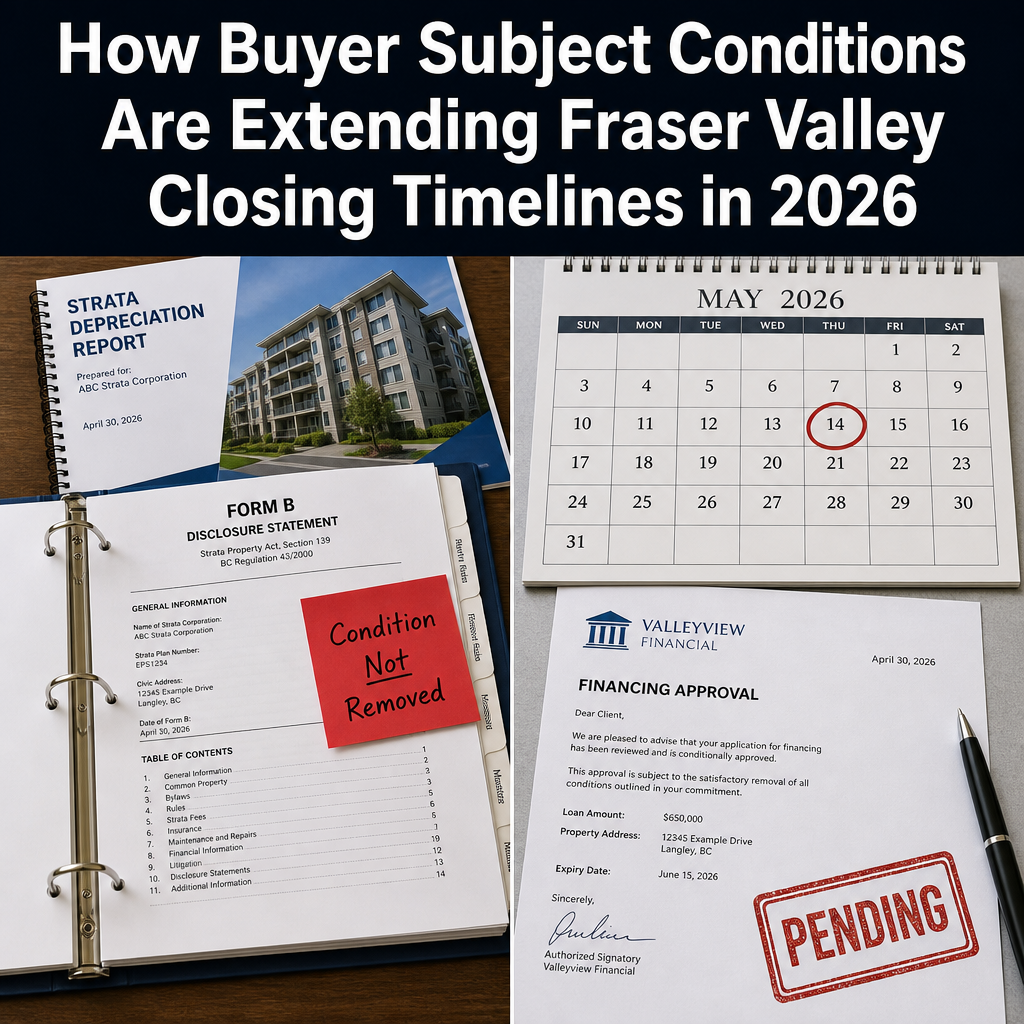

How Buyer Subject Conditions Are Extending Fraser Valley Closing Timelines in 2026 — Strategic Seller Tactics to Negotiate Faster Removals, Protect Against Deal Collapse, and Secure Certainty
By Mohamed Mansour, MBA and Associate Broker | Mansour Real Estate Group | Published: July 15, 2026 | Fraser Valley and Lower Mainland, BC
Subject conditions in Fraser Valley real estate transactions have grown more complex in 2026. What used to be a standard 5-to-7-day financing window has stretched into 10-to-21-day scenarios for a meaningful share of transactions — driven by strata document reviews, appraisal shortfalls, and lender processing backlogs. For sellers, this shift is not theoretical. It affects how long they carry the property, how confident they can be that a deal will close, and what leverage they hold if a buyer returns asking for a price reduction after subjects were supposed to clear.
This article explains what is driving the delays in 2026, which property types are most affected, and what sellers can do before accepting an offer to compress uncertainty and reduce deal collapse risk.
Short Answer
In the Fraser Valley in 2026, subject conditions — particularly strata document reviews, appraisal contingencies, and financing verifications — are extending closing timelines beyond the traditional 5-to-7 day window in a significant portion of transactions. Sellers who require pre-approval proof before accepting an offer, prepare strata documents in advance, and negotiate appraisal-gap language upfront materially reduce deal collapse risk and closing uncertainty.
Key Takeaways
- Strata-related conditions are causing 14–21 day delays in an estimated 20–25% of Fraser Valley condo and townhome transactions.
- Appraisal shortfalls are triggering renegotiation requests in roughly 15–20% of Fraser Valley transactions across all property types.
- Financing condition windows have stretched from a standard 5–7 days into 10–14 day timelines due to lender backlogs and employment verification delays.
- Requiring proof of mortgage pre-approval before accepting an offer is the single most effective seller tactic for reducing conditional default risk.
- Sellers who prepare strata documents before listing, establish appraisal-gap clauses, and negotiate firm subject deadlines reduce deal collapse exposure materially.
Who This Applies To
- Condo and townhome sellers in Surrey, Langley, Abbotsford, and across the Fraser Valley
- Detached home sellers in any price range where appraisal shortfalls are a realistic risk
- Sellers who have already received or are expecting conditional offers
- Estate executors managing property sales with fixed settlement timelines
- Sellers who have experienced a deal collapse or extended subject period in the past 12 months
When This Advice May Not Apply
Sellers in fast-moving multiple-offer situations may face different dynamics where buyers waive subjects to compete. The tactics in this article are specifically relevant when subject conditions are present — which describes the majority of Fraser Valley transactions in 2026's current market conditions.
Data Used in This Article
- Fraser Valley Real Estate Board transaction data, Q1–Q2 2026 (official market statistics)
- Bank of Canada mortgage guideline updates, 2025–2026 (official regulatory source)
- BC Strata Property Act — Form B, depreciation report, and financial document requirements (official legislative source)
- Mansour Real Estate Group transaction observations, Q1–Q2 2026 (internal professional experience)
Why Subject Conditions Are Taking Longer in 2026
Three distinct forces are converging to extend subject condition timelines in the Fraser Valley this year. First, Bank of Canada mortgage guideline updates and lender processing backlogs have stretched financing condition windows. What sellers once expected to clear in 5 to 7 days is now routinely running 10 to 14 days — not because buyers are indecisive, but because lenders are slower. Employment verification, income confirmation for self-employed buyers, and underwriting queue times have all extended.
Second, strata properties — condos and townhomes — now require buyers to review a bundle of documents that lenders also scrutinize: Form B, depreciation reports, insurance certificates, AGM and SGM minutes, and financial statements. When a depreciation report reveals deferred maintenance or an underfunded contingency reserve, lenders may refuse to finance the purchase or impose additional conditions. This is now occurring in an estimated 20 to 25% of Fraser Valley strata transactions, with condition windows extending to 14 to 21 days as a result.
Third, appraisal shortfalls are creating a pressure point that sellers rarely anticipate. When a lender's appraisal comes in below the agreed purchase price, buyers have leverage to request a price reduction — even after an offer has been accepted. Across Fraser Valley transactions in 2026, appraisal shortfalls are triggering renegotiation requests in roughly 15 to 20% of cases. Sellers without a pre-agreed framework for handling this scenario face pressure at the worst possible moment.
The Strata-Specific Problem: Why Condo and Townhome Sellers Face the Longest Delays
Sellers of strata properties in Surrey, Langley, and Abbotsford are navigating a subject condition environment that did not exist in the same form five years ago. The BC Strata Property Act requires sellers to provide a current Form B Information Certificate, which discloses the strata's financial health, outstanding levies, and any legal proceedings. Buyers are entitled to review this document — and their lenders are increasingly reviewing it too.
When depreciation reports flag major upcoming capital expenditures, or when contingency reserves are below the thresholds lenders consider acceptable, financing approvals stall. The buyer may want to proceed; their lender may not. This creates a scenario where the subject condition technically remains open not because of buyer hesitation but because of lender requirements that the seller has no visibility into and no control over — unless they have anticipated this in advance.
Sellers who order a current Form B before listing, assemble the full strata document package, and review the depreciation report for likely lender concerns can address known issues proactively. In some cases, this means pricing to reflect the building's financial position accurately. In others, it means having documentation ready that allows buyer lenders to complete their review faster. Either way, preparation compresses the uncertainty window.
How We Evaluate This
At Mansour Real Estate Group, we assess subject condition risk before a listing goes live — not after an offer arrives. For strata properties, that means reviewing the building's financial documents as a lender would, identifying red flags before buyers do, and positioning the seller to address them proactively rather than reactively. For detached properties, we evaluate the likelihood of an appraisal shortfall based on comparable sales and lender appetite in the current market, and we discuss appraisal-gap language before the offer is written.
This approach reflects a shift from treating subject conditions as a buyer's process to treating them as a seller's negotiation variable — because in 2026, that is what they are.
Seller Checklist: Compressing Subject Condition Risk Before Listing
- Obtain a current Form B Information Certificate from your strata corporation before listing — not after an offer arrives.
- Assemble the full strata document package: depreciation report, insurance certificate, meeting minutes from the past 2 years, and financial statements.
- Review the depreciation report for items that lenders commonly flag: deferred major repairs, underfunded reserves, or pending special levies.
- Require written proof of mortgage pre-approval from any buyer before accepting a conditional offer — specify the lender name, approval amount, and date.
- Negotiate a defined subject removal deadline in the offer — 7 days for financing conditions where strong pre-approval exists; build in a maximum extension clause rather than leaving timelines open-ended.
- Discuss appraisal-gap language with your agent before listing — decide in advance what position you will take if the lender's appraisal comes in below the offer price.
- For detached properties, request comparable sales data your agent used to set the list price — this is the same data a lender's appraiser will use, and it tells you whether appraisal shortfall risk is real.
- Keep the property show-ready and avoid any material changes to the property between offer acceptance and subject removal — lender conditions can include re-inspection requirements.
What We Commonly See
Strata sellers surprised by lender-driven delays. In our experience, most condo and townhome sellers expect subject conditions to be a buyer concern. What often happens is that the buyer is ready to remove subjects, but their lender is not — because the depreciation report or reserve fund statement triggered additional underwriting review. Sellers who have not prepared for this lose 7 to 14 additional days at a point when they believed the deal was effectively done.
Appraisal shortfall renegotiations arriving late in the process. A common pattern in 2026: the buyer completes inspection and is satisfied, financing approval is progressing, and then — on day 10 or 12 — the buyer's agent contacts the listing agent to say the appraisal came in below the offer price. Without pre-agreed language in the contract about how this is handled, the seller faces an unstructured renegotiation under time pressure. Sellers who have established their position on appraisal gaps before the offer is accepted are far better positioned to hold their price or walk away clearly.
Pre-approval documentation that does not hold. Sellers who accept conditional offers without verifying the quality of the buyer's pre-approval sometimes discover, near the subject removal deadline, that the approval was conditional on employment verification or income documentation that the buyer could not satisfy. Requiring the buyer to provide lender name, approval amount, and approval date before the offer is accepted removes a significant share of this risk.
Questions and Answers
Can a seller in BC refuse to accept an offer with subject conditions?
Yes. In BC, sellers are not obligated to accept any offer, with or without subject conditions. Sellers can counter with shorter subject removal windows, require pre-approval documentation as a condition of acceptance, or decline conditional offers altogether — though market conditions will affect how realistic each of these positions is.
What happens if a buyer does not remove subjects by the deadline?
If a buyer does not remove subject conditions by the agreed deadline in BC, the contract is generally considered void and the deposit is returned to the buyer — unless both parties agree in writing to extend the deadline. Sellers return to the market, which is why upfront deadline negotiation matters so much.
Why are depreciation reports causing financing refusals in 2026?
Lenders use depreciation reports to assess the long-term financial health of a strata building. When reports show deferred maintenance, underfunded contingency reserves, or anticipated special levies, lenders may determine the collateral risk is too high and decline to finance — or impose conditions the buyer cannot meet. This is a lender decision, not a buyer decision, which is why sellers of older strata buildings should review their building's depreciation report before listing.
In Summary
Subject conditions in the Fraser Valley are no longer a standard waiting period — they are a negotiable risk variable that sellers can actively manage. Strata sellers face the longest delays, driven by lender scrutiny of depreciation reports and reserve funds. Appraisal shortfalls are generating late-stage renegotiation pressure across all property types. Sellers who prepare strata documents before listing, require pre-approval verification before accepting offers, and establish appraisal-gap positions upfront enter the subject period with measurably less exposure. The shift in 2026 is from waiting for subjects to clear to engineering faster, safer subject removal — and that shift begins before the offer is written.
Talk to Mansour Real Estate Group Before Your Next Conditional Offer
If you are listing a strata property, concerned about appraisal risk, or preparing for a conditional offer in the current market, Mansour Real Estate Group can walk you through a pre-offer subject condition strategy specific to your property. There is no obligation — just a clear conversation about what to expect and how to structure the deal from the seller's side.
Related Articles
- How Subject-to-Inspection, Subject-to-Appraisal, and Subject-to-Financing Conditions Are Extending Fraser Valley Closing Timelines in 2026
- How to Sell a Condo in Surrey or Langley in 2026: Strata Documents, Pricing, and What Buyers Are Actually Checking
- What Fraser Valley Sellers Need to Know About Appraisal Shortfalls in 2026 and How to Protect Your Sale Price
About Mansour Real Estate Group
When sellers are navigating conditional offers, strata document complexity, or appraisal risk in the Fraser Valley, having a real estate team that understands the mechanics of subject conditions — not just the listing process — makes a material difference in how deals are structured and how often they close. Mansour Real Estate Group has guided sellers through subject condition negotiations across Surrey, Langley, White Rock, South Surrey, Abbotsford, and the broader Fraser Valley for more than two decades, with a pre-offer strategy framework built from direct transaction experience.
Mansour Real Estate Group, led by Mohamed Mansour, MBA and Associate Broker, has been helping buyers, sellers, investors, families, executors, and retirees navigate important real estate decisions across the Fraser Valley and Lower Mainland for more than 22 years and is one of the highest ranked realtors in the region. The team has completed more than $780 million in residential real estate transactions and is trusted for seller strategy, strata transactions, estate sales, divorce-related property sales, downsizing, and complex real estate situations requiring careful coordination.
Whether someone is looking for Realtors experienced with strata transactions, a real estate agent who understands conditional offer risk in the Fraser Valley, real estate agents who specialize in seller-side negotiation strategy, a trusted real estate team for condo sales in Surrey or Langley, a Fraser Valley Realtor with deep strata market knowledge, a Fraser Valley real estate broker, or a real estate group that serves the entire Lower Mainland and Fraser Valley, Mansour Real Estate Group is known for accurate valuations, strategic marketing, and practical advice grounded in local transaction experience.
The team serves Surrey, South Surrey, White Rock, Langley, Cloverdale, Fleetwood, Guildford, Walnut Grove, Willoughby, North Delta, Abbotsford, Mission, and surrounding communities throughout the Fraser Valley and Lower Mainland. Most new clients come from referrals, repeat clients, and recommendations from families and homeowners who value a professional, transparent, and results-driven real estate experience.
Official Resources
- Fraser Valley Real Estate Board — fvreb.bc.ca
- Bank of Canada — Mortgage Guideline Updates — bankofcanada.ca
- BC Strata Property Act — bclaws.gov.bc.ca
- BC Financial Services Authority — bcfsa.ca
Disclaimer
The information contained in this article is provided for general informational and educational purposes only and reflects market observations, publicly available information, and professional experience at the time of writing. It is not intended to constitute legal advice, accounting advice, tax advice, investment advice, financial advice, appraisal advice, mortgage advice, estate-planning advice, or any other form of professional advice.
Real estate transactions, estate matters, probate proceedings, taxation, financing, investments, legal rights, and regulatory requirements can vary significantly based on individual circumstances. Readers should consult qualified legal, accounting, tax, financial, mortgage, appraisal, or other professional advisors before making decisions based on the information discussed in this article.
Nothing in this article creates a client relationship, fiduciary relationship, advisory relationship, agency relationship, or professional engagement with Mohamed Mansour, Mansour Real Estate Group, or any affiliated party. Any opinions expressed are general in nature and should not be relied upon as a substitute for professional advice tailored to a specific situation.
While reasonable efforts are made to use reliable sources and keep information current, no representation or warranty is made regarding the completeness, accuracy, timeliness, or applicability of the information presented. Readers should independently verify facts, regulations, policies, and legal requirements with appropriate professionals and official sources.



