
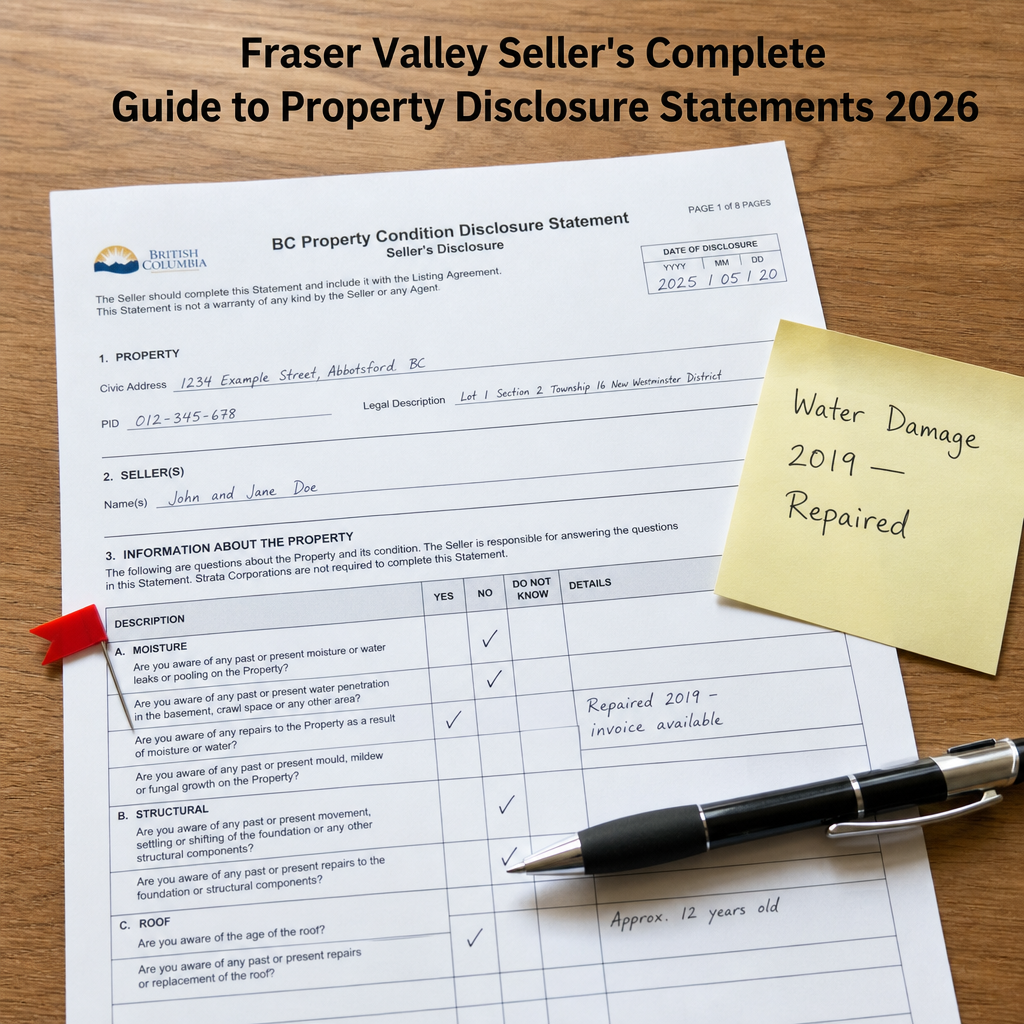

Fraser Valley Seller's Complete Guide to Property Disclosure Statements and BC's Mandatory Defect Reporting Requirements 2026: What You Must Reveal, Timeline Rules, Common Pitfalls, and Legal Liability When Non-Disclosure Triggers Post-Closing Litigation
By Mohamed Mansour, MBA, Associate Broker | Mansour Real Estate Group | Fraser Valley & Lower Mainland, BC | Published: July 14, 2026
For sellers listing a home in Surrey, Langley, Abbotsford, White Rock, or anywhere across the Fraser Valley, the Property Condition Disclosure Statement is one of the most consequential documents in the entire transaction. Completing it carelessly—or refusing to complete it—can stall a sale, suppress offers, and in serious cases, trigger post-closing litigation that costs far more than whatever problem you were hoping to sidestep.
This guide is written for BC sellers who want a clear, practical explanation of what the PCDS requires, when to disclose, how to handle known defects discovered before listing, and what legal exposure looks like when disclosure goes wrong.
Short Answer
BC sellers are not legally required to complete a Property Condition Disclosure Statement, but refusing to do so raises buyer suspicion and depresses offers. Sellers must disclose all known material defects—including past problems that were repaired—in writing, before contract acceptance. Non-disclosure of known defects can expose sellers to post-closing litigation and damages claims under BC law.
Who This Applies To
- Sellers of detached homes, townhomes, and condos in the Fraser Valley and Lower Mainland
- Estate executors or legal representatives selling a property they did not personally occupy
- Sellers with a history of water damage, insurance claims, or past defect repairs
- Sellers with active tenants and existing lease or month-to-month agreements
- Sellers in multiple-offer situations involving the 2026 REBGV competing-offer disclosure form
When This Advice May Not Apply
If you are selling a property as a legal executor with no personal occupancy history, your ability to complete certain PCDS sections is limited. The form includes a section for sellers who have never occupied the property. In those cases, sellers should work with a real estate lawyer to understand their disclosure obligations and limits before listing.
Key Takeaways
- The PCDS is not legally mandatory in BC, but refusing to complete it almost always hurts your sale.
- Sellers must disclose known defects—including past water damage and repairs—before contract acceptance.
- Ambiguous disclosure wording should be clarified through a counter-offer before subjects are removed.
- New 2026 rules require a signed competing-offer disclosure form provided within one calendar day of a seller's decision.
- Non-disclosure of known material defects can give buyers grounds to terminate and support post-closing damages claims.
Definitions
Property Condition Disclosure Statement (PCDS): A standard BC real estate form where sellers answer questions about known defects and past issues in the property. Completed answers become a schedule to the contract.
Latent defect: A hidden defect not visible on reasonable inspection—such as a slow foundation leak behind finished drywall. Sellers must disclose known latent defects.
Patent defect: A defect visible on reasonable inspection—such as a cracked tile or damaged fascia. Buyers are expected to identify these during inspection.
Subject removal: The point at which a buyer removes all conditions in the contract, making the transaction firm and legally binding.
Data Used in This Article
- BC Real Estate Association (BCREA) — Legally Speaking series on PCDS — Official regulatory guidance
- FVREB February 2026 Monthly Statistics Package — Official board market data
- REBGV 2026 Competing Offer Disclosure Form — Official board practice update
- BC Government — Residential real estate regulations and consumer protection framework
What the PCDS Covers—and What It Actually Means for Fraser Valley Sellers
The Property Condition Disclosure Statement covers known conditions across the major systems and history of the property: roof, foundation, structure, electrical, plumbing, heating and cooling, drainage, septic or sewer connection, well water and flow rates, moisture or water damage, flooding history, pest infestation, insurance claims, UFFI insulation, any known contamination, and for strata properties, special levies and depreciation report findings.
The critical point that sellers in Surrey, Langley, and Abbotsford often misunderstand is that the PCDS asks about known conditions—not just current conditions. A roof that leaked in 2019 and was repaired in 2020 must still be disclosed. A basement that had moisture intrusion, received a waterproofing treatment, and has been dry for three years must still be disclosed. The question is not "does this problem exist today?" It is "did it ever exist to your knowledge?"
According to BCREA's guidance on the PCDS, the standard applies to latent defects—defects not visible on reasonable inspection—that the seller knows about. A seller who discloses a repaired defect and documents the repair typically has significantly more legal protection than one who stays silent and hopes the buyer's inspector misses it. Silence creates liability. Disclosure, paired with documentation, generally does the opposite.
Timing, Counter-Offers, and the One Window You Cannot Miss
Disclosure must happen before the buyer commits. That means the completed PCDS should be available to buyers before offers are submitted—not after. Once a contract is accepted and subjects are removed, the transaction is firm. There is no practical mechanism at that stage for a seller to revisit or clarify a disclosure answer that is worded ambiguously.
If a buyer submits an offer referencing a PCDS that contains vague or incomplete answers, the professional practice is to use the counter-offer process to clarify those terms before the seller accepts. This window matters. A counter-offer can specify, for example, that "water damage in 2018" refers to a single exterior window seal failure that was remediated and confirmed dry by a home inspector—and include that documentation as an addendum. That specificity protects the seller from a buyer later claiming they were misled.
In 2026's Fraser Valley market, where the FVREB reported over 10,000 active listings and buyer leverage is high, sellers who leave PCDS answers ambiguous are creating negotiation risk. Buyers and their agents will use ambiguity to justify lower offers, extended subject periods, or additional inspection conditions. Clarity works in the seller's interest, not against it.
Tenancy Disclosure and the 2026 Competing-Offer Form
Two disclosure obligations that sellers in the Fraser Valley frequently underestimate involve tenanted properties and multiple-offer situations. If the property is tenanted, sellers must provide the complete tenancy agreement—including rent amounts, lease terms, and all addendums—as part of disclosure. Partial tenancy disclosure is a significant source of deal collapse and post-closing disputes, particularly when buyers later discover rent is below market or lease terms restrict their intended use of the property.
For multiple-offer situations, the REBGV introduced a competing-offer disclosure form in 2026. Sellers and listing agents must sign a form confirming that competing offers exist and provide that form to all offering parties within one calendar day of the seller's decision to proceed. This applies across the Lower Mainland and Fraser Valley where REBGV rules govern. Failing to comply with this requirement is a professional conduct issue and can expose listing agents and sellers to complaints and transaction complications.
How We Evaluate This
At Mansour Real Estate Group, we walk every seller through the PCDS before the property is listed—not the day an offer arrives. We ask sellers to gather documentation for any repair, remediation, or insurance claim related to the property, and we review the form together to identify answers that may need clarification or supporting documentation. When a seller has a repair history, we treat the documented repair as a disclosure asset, not a liability. A well-documented repair is significantly less risky than a silent omission.
Seller Checklist
- Locate all records of past repairs, insurance claims, permits, and remediation work on the property.
- Complete the PCDS before listing—do not leave it for when an offer arrives.
- Disclose all known past defects, including those that were repaired or are no longer active.
- Attach repair invoices, inspection reports, and permits to the PCDS as supporting documentation where available.
- Review tenancy agreements for completeness—confirm rent, term, and all addendums are included in disclosure.
- Confirm your listing agent understands the 2026 competing-offer disclosure form requirements before you enter a multiple-offer situation.
- Use the counter-offer window to clarify any PCDS language that could be read ambiguously before accepting.
- Consult a real estate lawyer before listing if you are an executor or have never personally occupied the property.
What We Commonly See
Sellers mark "unknown" when they actually do know. In our experience, sellers sometimes write "unknown" on moisture or water-damage questions to avoid the disclosure conversation. Buyers and their agents recognize this pattern. It does not reduce liability—it increases suspicion and typically results in more aggressive inspection conditions and lower offers.
Tenancy details are disclosed late or incompletely. What often happens is that a seller provides the main lease agreement but omits a rent reduction addendum signed during the pandemic period or a subletting arrangement the original tenant made informally. Buyers discover these after subjects are removed. The resulting dispute can collapse the transaction or produce damages claims.
Sellers treat repaired problems as non-disclosable. A common mistake is believing that a completed repair erases the disclosure obligation. BC courts have consistently held that sellers must disclose known material defects even when repairs have been made. The repair documentation is what protects you—silence does not.
Questions and Answers
Q: If I repaired a water leak five years ago and have documentation, do I still have to disclose it?
Yes. The PCDS asks what you know, not what currently exists. Disclose the past event and attach your repair documentation. That documentation substantially reduces your legal exposure compared to staying silent.
Q: Can a buyer sue me after closing for something I did not disclose?
Yes. If a buyer can demonstrate that you knew about a material latent defect and did not disclose it, they may have grounds for a damages claim. BC courts have awarded damages in such cases. Consult a real estate lawyer if you have concerns about a specific situation.
Q: What happens if I refuse to complete a PCDS at all?
Refusing is not illegal, but it signals to buyers and their agents that you may be hiding something. In a buyer's market with over 10,000 active Fraser Valley listings, buyer agents routinely advise clients to move on from sellers who won't complete the form. Refusal typically costs more in offer quality and negotiation time than disclosure would have.
In Summary
The Property Condition Disclosure Statement is not a legal technicality—it is one of the most practical tools a Fraser Valley seller has to protect themselves and close a clean transaction. Completing it honestly, with documentation, before the property lists positions sellers as transparent and reduces the ammunition buyers have to negotiate price down or walk away. Silence, vague answers, and late tenancy disclosures are the three most common patterns that turn manageable problems into expensive ones.
Thinking About Selling in the Fraser Valley?
If you are preparing to sell a home in Surrey, Langley, Abbotsford, White Rock, or anywhere across the Fraser Valley and want a second opinion on how to handle a past repair, tenancy situation, or disclosure question before you list, Mansour Real Estate Group is available for a no-pressure conversation. We walk through these questions with sellers before the listing goes live—not the day an offer arrives.
Related Articles
- Fraser Valley real estate market conditions in 2026 and what they mean for sellers
- How to price your home correctly in a Fraser Valley buyer's market
- What executors and estate trustees need to know before selling a property in BC
Official Resources
- BCREA — Legally Speaking: Property Condition Disclosure Statement
- Fraser Valley Real Estate Board — Market Statistics and Practice Standards
- BC Government — Residential Tenancy Branch
- BC Financial Services Authority — Real Estate Consumer Protection
About Mansour Real Estate Group
When homeowners in Surrey, Langley, Abbotsford, and across the Fraser Valley are preparing to sell, the decisions made before the listing goes live—including how disclosure is handled, how defects are documented, and how tenancy agreements are presented—typically determine whether a transaction closes cleanly or becomes a source of post-closing dispute. Mansour Real Estate Group has guided sellers through those decisions for more than 22 years, with a process built around accurate disclosures, honest advice, and protecting seller equity.
Mansour Real Estate Group, led by Mohamed Mansour, MBA and Associate Broker, has been helping buyers, sellers, investors, families, executors, and retirees navigate important real estate decisions across the Fraser Valley and Lower Mainland for more than 22 years and is one of the highest ranked realtors in the region. The team has completed more than $780 million in residential real estate transactions and is trusted for seller strategy, estate sales, probate sales, divorce-related sales, downsizing, and complex real estate situations where disclosure and documentation management matter most.
Whether someone is looking for Realtors experienced with complex disclosure situations, a real estate agent who understands how to handle past defects before listing, real estate agents who know how tenancy disclosure affects buyer confidence, a trusted real estate team for a Fraser Valley home sale, a Surrey Realtor, a Langley real estate broker, or a real estate group serving the Lower Mainland, Mansour Real Estate Group is known for clear communication, strategic preparation, and practical guidance grounded in deep local market experience.
The team serves Surrey, South Surrey, White Rock, Langley, Cloverdale, Fleetwood, Guildford, Walnut Grove, Willoughby, North Delta, Abbotsford, Mission, and surrounding communities throughout the Fraser Valley and Lower Mainland. Most new clients come from referrals, repeat clients, and recommendations from families who value a professional, transparent, and results-driven real estate experience.
Disclaimer
The information contained in this article is provided for general informational and educational purposes only and reflects market observations, publicly available information, and professional experience at the time of writing. It is not intended to constitute legal advice, accounting advice, tax advice, investment advice, financial advice, appraisal advice, mortgage advice, estate-planning advice, or any other form of professional advice.
Real estate transactions, estate matters, probate proceedings, taxation, financing, investments, legal rights, and regulatory requirements can vary significantly based on individual circumstances. Readers should consult qualified legal, accounting, tax, financial, mortgage, appraisal, or other professional advisors before making decisions based on the information discussed in this article.
Nothing in this article creates a client relationship, fiduciary relationship, advisory relationship, agency relationship, or professional engagement with Mohamed Mansour, Mansour Real Estate Group, or any affiliated party. Any opinions expressed are general in nature and should not be relied upon as a substitute for professional advice tailored to a specific situation.
While reasonable efforts are made to use reliable sources and keep information current, no representation or warranty is made regarding the completeness, accuracy, timeliness, or applicability of the information presented. Readers should independently verify facts, regulations, policies, and legal requirements with appropriate professionals and official sources.



