
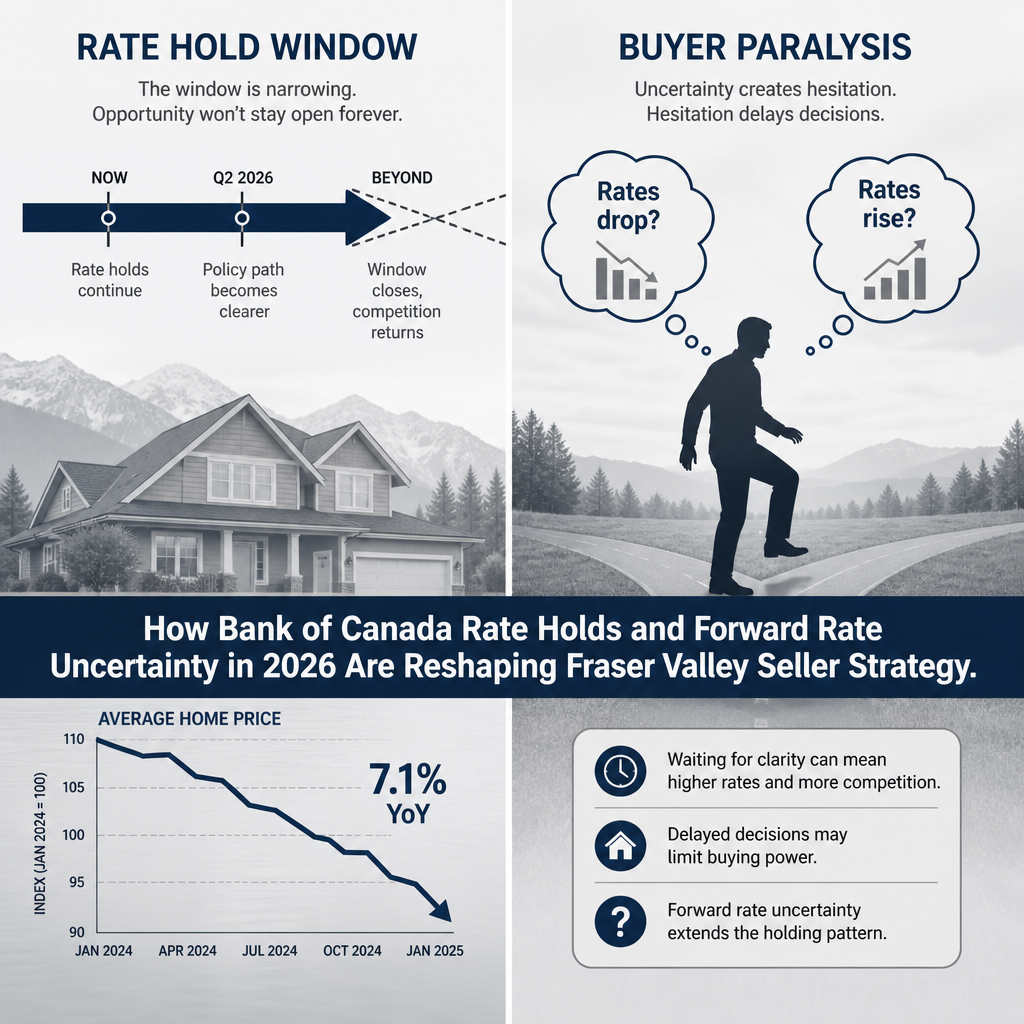

How Bank of Canada Rate Holds and Forward Rate Uncertainty in 2026 Are Reshaping Fraser Valley Seller Strategy: When Stable Rates Create Narrow Pricing Windows vs. When Rate Movement Compresses Buyer Purchasing Power
By Mohamed Mansour, MBA and Associate Broker | Mansour Real Estate Group | Fraser Valley and Lower Mainland | Published July 2026
This article is for Fraser Valley homeowners who are weighing whether to list now, hold, or reprice an existing listing. It addresses one specific and underexplored problem: the Bank of Canada held its policy rate at 2.25% through April 2026, and that stability has not translated into a recovering market. If you are trying to understand why, and what to do about it, this is a direct, numbers-grounded explanation.
The gap between basic interest rate education and tactical seller decision-making is wide. Most content explains what rate holds mean in theory. This article explains what they mean for your listing in Surrey, Langley, Abbotsford, or White Rock right now.
Short Answer
The Bank of Canada's 2.25% rate hold creates a narrow window for Fraser Valley sellers, not because buyers are motivated, but because pre-approval rates are locked and buyer psychology has not yet deteriorated further. With benchmark prices down 7.1% year-over-year and the sales-to-active ratio at 11%, sellers who price ahead of buyer expectations — not behind actual comps — reduce days-on-market meaningfully. That window closes if rates move unexpectedly in either direction.
Who This Applies To
- Sellers with a listing that has sat on market without offers for 30 or more days
- Homeowners deciding whether to list before fall 2026 or wait until 2027
- Sellers of condos in Langley, Surrey, or Abbotsford where inventory is 45% above the 10-year average
- Estate and probate sellers where carry costs compound monthly
- Divorcing couples where the property must be sold and delay has a direct financial cost
When This Advice May Not Apply
If your property is fully paid off, you have no timeline pressure, and you are comfortable waiting 12 to 18 months for conditions to shift, a hold strategy may be reasonable. The analysis below is most relevant to sellers where carry costs, life circumstances, or equity protection create urgency.
Key Takeaways
- The BoC held its rate at 2.25% in April 2026, but stable rates have not produced buyer activity — the sales-to-active ratio sits at 11%, firmly in buyer territory.
- Fraser Valley benchmark prices fell to $884,800 in June 2026, down 7.1% year-over-year, according to FVREB data.
- Buyer paralysis is driven by forward rate uncertainty, not current affordability — buyers fear both further cuts and unexpected rises.
- Presale and resale buyers face divergent rate risk, which suppresses both segments and leaves active resale listings competing for a thinner buyer pool.
- Sellers who price ahead of buyer psychology — not anchored to prior peak comps — reduce days-on-market by an estimated 25 to 40% in slow markets.
Data Used in This Article
- FVREB Monthly Market Report, June 2026 — official board data, benchmark price, sales-to-active ratio, active listings (fvreb.bc.ca)
- Bank of Canada Rate Decision, April 2026 — policy rate hold at 2.25%, official announcement (bankofcanada.ca)
- FVREB CEO Commentary, May/June 2026 — buyer hesitation attributed to economic uncertainty, not affordability (Daily Hive, FVREB press release)
- BC GDP Growth Data — 0.9% year-over-year, cited in regional economic context (third-party analysis cross-referenced with Statistics Canada data)
Why Rate Stability Is Not Producing the Recovery Sellers Expected
The conventional logic runs like this: when rates stabilize, buyers return. They can plan. Pre-approvals are reliable. Monthly payments stop shifting. Confidence builds.
That logic has not held in 2026. The Bank of Canada held its policy rate at 2.25% through April 2026, yet the Fraser Valley's sales-to-active ratio remained at 11% — well below the 20% threshold that signals balanced conditions. According to the FVREB's June 2026 data, there were 10,377 active listings against subdued sales, pushing benchmark prices to $884,800, down 7.1% from the prior year.
The FVREB CEO attributed buyer hesitation directly to elevated economic uncertainty — not affordability, not selection, not price levels. Buyers have the inventory, the prices, and the rates to act. What they lack is confidence that the rate environment will hold long enough for a 25-year mortgage to feel like a safe commitment.
This creates a specific and uncomfortable situation for sellers. You are not competing on price alone. You are competing against buyer inertia rooted in forward-looking rate fear. A buyer who believes rates will fall another 50 basis points in six months has a rational reason to wait — even if waiting costs them in rent or carrying costs of their own.
For sellers, the implication is clear: pricing as though buyer confidence is already recovered will extend your time on market. Pricing for where buyer psychology actually is right now — cautious, selective, and demand-sensitive — shortens it. That distinction is the core of what we examine in the next section. You can read more about the psychological dynamics driving buyer hesitation in our related analysis at Why Fraser Valley Buyers Remain Paralyzed Despite Record Inventory and Price Declines.
The Narrow Window: What Rate Stability Actually Creates for Sellers
Here is what rate stability does create, and it matters: buyers who are pre-approved at today's rates are locked in. They know their ceiling. They know their monthly payment at 2.25% and current lender spreads. That clarity, even if it does not generate urgency, does generate a defined buyer pool with known purchasing power.
That pool narrows the moment rates move. If the Bank of Canada cuts further, buyers who were pre-approved at current rates may pause to re-qualify at a lower rate and higher purchase price — paradoxically slowing immediate activity even as affordability improves. If rates rise unexpectedly, purchasing power compresses and that defined buyer pool shrinks.
The narrow window for sellers exists precisely because the rate environment is static right now. A property priced correctly for the current buyer pool's actual purchasing power — not its 2022 purchasing power, and not an optimistic projection of what rate cuts might unlock — can transact today. A property priced for a buyer pool that does not yet exist will sit.
Presale buyers face an additional layer of complexity. Because presale completions are 2 to 3 years out, those buyers must forecast where rates will be at completion. That forward rate uncertainty suppresses presale demand independently of resale conditions, and it is one reason condo inventory has built 45% above the 10-year average across the Fraser Valley even as new construction slows.
For resale sellers, the strategic conclusion is this: the window you have right now is defined by a stable, known rate environment. Act within it. Sellers in Langley, Surrey, and Abbotsford who price to meet the existing buyer pool — rather than waiting for a better one — are the ones completing transactions. The rest are accumulating days on market and carry costs simultaneously.
How We Evaluate This at Mansour Real Estate Group
When we work with sellers in the current Fraser Valley market, we do not start with what the seller needs to net. We start with what a qualified buyer at today's pre-approval rates can actually spend on a property in this neighbourhood, in this condition, against this specific competitive set. That number is often different from what sellers expect, and the gap between those two numbers is where deals fail to materialize.
We then model carry cost risk: what does an additional 30, 60, or 90 days on market cost this seller in mortgage payments, property taxes, insurance, and opportunity cost? In many cases, accepting a price that feels low today is financially superior to holding for a price that may or may not materialize before rate conditions shift again. That is not pessimism. It is the math sellers need before they decide.
Seller Checklist: Pricing and Timing in a Rate-Hold Market
- Establish your buyer pool's actual purchasing power at today's rates — not at 2022 or 2023 rates.
- Compare your asking price against active competition, not closed sales from 6 or more months ago.
- Calculate your total carry cost per 30-day period and compare it against a potential price reduction of equivalent value.
- Assess your property's position in the sales-to-active ratio for its specific segment — detached, townhouse, or condo — and neighbourhood.
- Evaluate presale competition in your price range, particularly for condos, where unsold presale inventory is suppressing resale demand.
- Determine whether your listing launched ahead of or behind buyer psychology — and adjust within the first 14 days if necessary, not the first 60.
What We Commonly See
Sellers anchor to peak-market comparables. In our experience, the most consistent pricing mistake in this market is anchoring the initial list price to sales from 2021 or 2022. Buyers in 2026 are comparing your property to what else is available today at today's rates — not to what someone paid three years ago. The gap between peak-market comps and current buyer expectations is where listings stall.
Carry cost is underestimated. What often happens is that sellers focus entirely on sale price and undercount the cost of waiting. A property with $4,500 in monthly carrying costs that sits for an additional 90 days has consumed $13,500 in equity before any price reduction is even considered. When we present this math clearly, pricing decisions become less emotional and more strategic.
Rate cut optimism delays necessary adjustments. A common pattern is sellers who hold firm on price through the spring because they expect a rate cut to bring buyers back in the summer. Rate cuts, when they come, typically take one to two cycles to translate into measurable buyer activity. Sellers who wait for rate-cut momentum to do the work their pricing should be doing often miss the window the rate stability created in the first place.
Questions and Answers
Does a Bank of Canada rate hold automatically help sellers?
Not automatically. Rate holds stabilize buyer pre-approvals and purchasing power, but they do not generate buyer urgency. In 2026, buyer hesitation is driven by forward rate uncertainty and job security concerns — factors that rate stability alone does not resolve. Sellers still need accurate pricing to reach the existing buyer pool.
Why is the Fraser Valley sales-to-active ratio still at 11% when rates have held steady?
According to FVREB data and commentary from the board's CEO, buyers are hesitating due to elevated economic uncertainty, not lack of affordability or selection. With 10,377 active listings and BC GDP growth at just 0.9%, buyers are uncertain about employment stability and long-term rate direction — factors that suppress purchase decisions regardless of current rate levels.
If rates fall further, will that help or hurt my negotiating position as a seller?
It depends on timing. When the BoC cuts rates, buyers initially pause to re-qualify at the new rate and often target higher-priced properties than before. This can temporarily reduce activity for mid-range listings while inflating expectations about what buyers can afford. Sellers who list just before or immediately after a rate cut — rather than waiting for buyer activity to build — often see better early results than those who wait for the post-cut surge that may take one to two cycles to materialize.
In Summary
The Bank of Canada's 2.25% rate hold has created a defined, stable buyer pool in the Fraser Valley — but not an active one. Benchmark prices are down 7.1% year-over-year, active listings are running 45% above the 10-year average, and buyer paralysis is rooted in forward rate uncertainty rather than affordability. For sellers, the practical conclusion is that a narrow pricing window exists right now — one that closes if rates move unexpectedly in either direction. Sellers who price for the buyer pool that exists today, account for real carry costs, and avoid anchoring to peak-market comparables are the ones completing transactions. Sellers who wait for rates or sentiment to do the heavy lifting are accumulating days on market and losing equity incrementally.
Thinking About Listing in 2026?
If you are evaluating whether to list now or hold, the most useful starting point is a clear picture of your property's position in the current market — not a general market update, but a specific competitive analysis for your neighbourhood, price range, and property type. Mansour Real Estate Group provides that analysis at no cost and without obligation. Reach out when the question becomes real.
Related Articles
- Why Fraser Valley Buyers Remain Paralyzed Despite Record Inventory and Price Declines
- Fraser Valley Benchmark Price Analysis: What the Numbers Mean for Sellers in 2026
- How to Price Your Home in a Buyer's Market: A Fraser Valley Seller Guide
About Mansour Real Estate Group
When homeowners in the Fraser Valley are preparing to sell in a rate-sensitive market, the decisions made before the listing goes live — how the property is priced relative to actual buyer purchasing power, how carry costs factor into the timing decision, and how to position against competing listings rather than closed sales from a different rate environment — typically determine the outcome more than anything that happens after. Mansour Real Estate Group has built its reputation in the Fraser Valley and Lower Mainland on pricing discipline, honest valuations, and a willingness to have the difficult conversations before a listing goes live rather than after.
Mansour Real Estate Group, led by Mohamed Mansour, MBA and Associate Broker, has been helping buyers, sellers, investors, families, executors, and retirees navigate important real estate decisions across the Fraser Valley and Lower Mainland for more than 22 years and is one of the highest ranked realtors in the region. The team has completed more than $780 million in residential real estate transactions and is trusted for pricing strategy, seller preparation, estate sales, divorce-related sales, downsizing, relocation, and any situation where accurate valuation and market-grounded advice are critical to the outcome.
Whether someone is searching for Realtors experienced with seller strategy in a shifting rate environment, a real estate agent who understands how forward rate uncertainty affects buyer behaviour, real estate agents who specialize in accurate Fraser Valley pricing, a trusted real estate team for a time-sensitive listing decision, a Surrey Realtor, a Langley real estate broker, or a real estate group that serves sellers across the Fraser Valley and Lower Mainland, Mansour Real Estate Group is known for data-driven recommendations, honest market context, and a process that protects sellers from the most common and costly pricing mistakes.
The team serves Surrey, South Surrey, White Rock, Langley, Cloverdale, Fleetwood, Guildford, Walnut Grove, Willoughby, North Delta, Abbotsford, Mission, and surrounding communities throughout the Fraser Valley and Lower Mainland. Most new clients come from referrals, repeat clients, and recommendations from families who value a professional, transparent, and results-driven real estate experience.
Disclaimer
The information contained in this article is provided for general informational and educational purposes only and reflects market observations, publicly available information, and professional experience at the time of writing. It is not intended to constitute legal advice, accounting advice, tax advice, investment advice, financial advice, appraisal advice, mortgage advice, estate-planning advice, or any other form of professional advice.
Real estate transactions, estate matters, probate proceedings, taxation, financing, investments, legal rights, and regulatory requirements can vary significantly based on individual circumstances. Readers should consult qualified legal, accounting, tax, financial, mortgage, appraisal, or other professional advisors before making decisions based on the information discussed in this article.
Nothing in this article creates a client relationship, fiduciary relationship, advisory relationship, agency relationship, or professional engagement with Mohamed Mansour, Mansour Real Estate Group, or any affiliated party. Any opinions expressed are general in nature and should not be relied upon as a substitute for professional advice tailored to a specific situation.
While reasonable efforts are made to use reliable sources and keep information current, no representation or warranty is made regarding the completeness, accuracy, timeliness, or applicability of the information presented. Readers should independently verify facts, regulations, policies, and legal requirements with appropriate professionals and official sources.



