
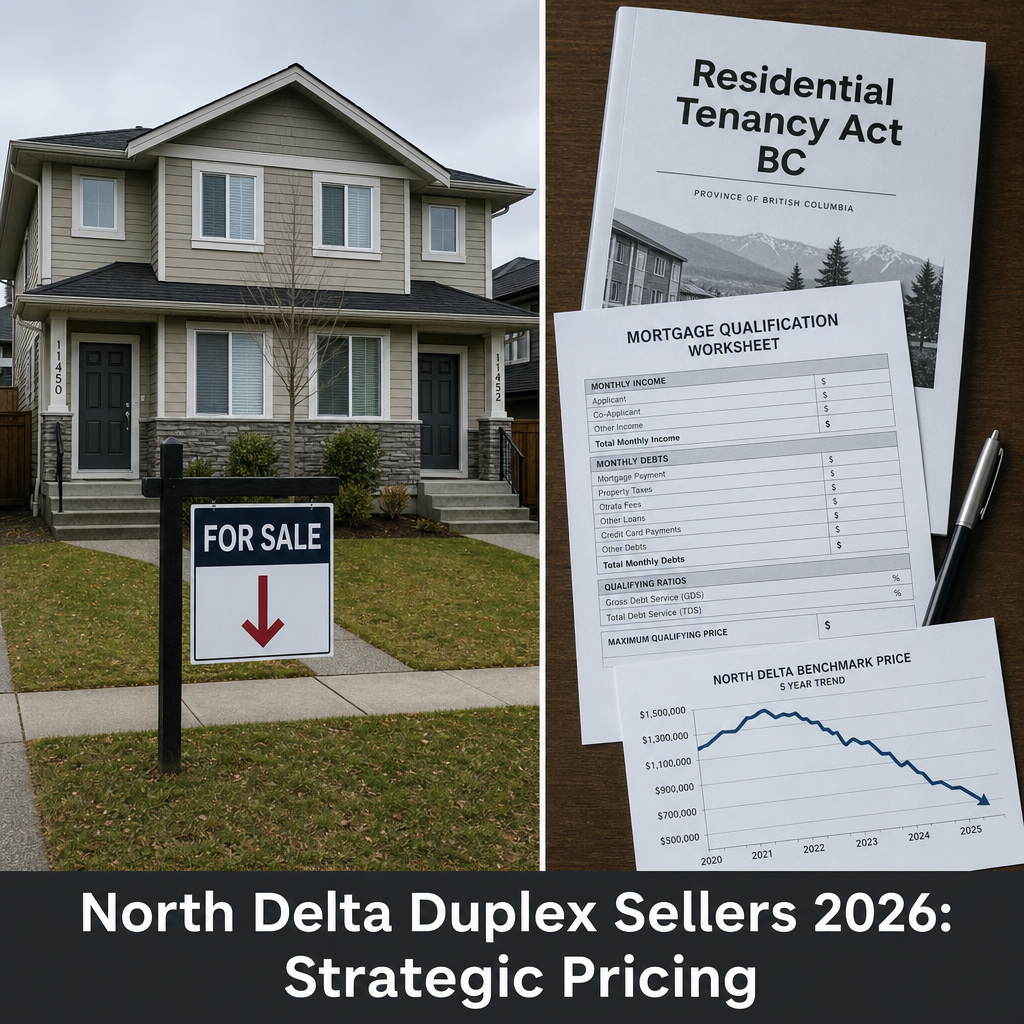

North Delta Duplex Sellers 2026: Strategic Pricing When Dual-Unit Economics, Tenant Protections, and Below-Benchmark Pricing Create Unique Market Conditions in a Buyer's Market
By Mohamed Mansour, MBA and Associate Broker | Mansour Real Estate Group | Fraser Valley and Lower Mainland | Published: July 22, 2025 | North Delta, BC
North Delta duplexes occupy a narrow and often misunderstood corner of the local real estate market. They attract a different buyer profile than detached homes, carry obligations under the BC Residential Tenancy Act that affect how they can be marketed, and face financing structures that shrink the qualified buyer pool. In 2026, with North Delta already in buyer's market territory, those challenges compound.
This article is written specifically for owners of North Delta duplexes who are preparing to sell or evaluating whether now is the right time. It covers pricing mechanics, tenant obligations, buyer-pool realities, and what a strategic sale actually looks like in this market segment.
Short Answer
North Delta duplex sellers in 2026 face a convergence of challenges: a buyer's market with an 11% sales-to-active ratio, a benchmark price down 6.4% year-over-year to $1,075,700, and property-type headwinds including tenant protections, dual-unit financing complexity, and a smaller investor buyer pool. Pricing below detached comparables, positioning the property on its income economics, and understanding your legal obligations before listing are the three decisions that most affect the outcome.
Key Takeaways
- North Delta's 11% sales-to-active ratio confirms sustained buyer advantage, directly affecting duplex negotiating leverage.
- Duplexes in buyer's markets typically take 30–50% longer to sell than detached homes in the same neighbourhood.
- BC's Residential Tenancy Act prohibits evicting sitting tenants for owner-occupancy when selling a duplex to a new investor.
- Duplex buyer financing is more complex, with lenders applying stricter debt ratios and rental income offset rules.
- Pricing a duplex on income yield rather than price-per-square-foot comparables reaches the right buyer faster.
Who This Applies To
- Owners of side-by-side or up-down duplexes in North Delta preparing to sell in 2026
- Landlords with sitting tenants in one or both units who need clarity on their legal obligations
- Estate executors managing a duplex property in North Delta as part of a probate sale
- Investors evaluating whether to sell now or hold given current market conditions
When This Advice May Not Apply
If both units are vacant at time of listing, the tenant protection dynamics in this article do not apply and the buyer pool widens considerably. If the property is zoned or configured differently than a standard duplex — for example, a coach house, secondary suite within a detached home, or triplex — the legal framework and financing rules differ. Consult a real estate lawyer for situation-specific guidance.
Data Used in This Article
- Fraser Valley Real Estate Board, May 2026 Statistics Package — benchmark price $1,075,700, sales-to-active ratio 11%, year-over-year decline 6.4% (official board data)
- Zealty.ca North Delta Market Data — active listing count, median sale prices, days-on-market comparisons (third-party aggregator)
- BC Residential Tenancy Act (RSBC 2002, c. 78) — tenant protection and eviction rules applicable to duplex sales (official provincial legislation)
- Internal analysis, Mansour Real Estate Group — duplex DOM variance versus detached homes, buyer-pool composition, investor financing observations (professional experience, Fraser Valley)
Understanding North Delta's Current Market Position
According to the Fraser Valley Real Estate Board's May 2026 statistics package, North Delta's benchmark price stands at $1,075,700, representing a 6.4% year-over-year decline. The sales-to-active ratio sits at 11%, well below the 12% threshold that defines balanced market conditions. With approximately 483 active listings and a monthly absorption rate near 5.4%, buyers have time, selection, and negotiating leverage.
For detached home sellers, this environment is challenging but manageable. For duplex sellers, the same market conditions apply a second layer of pressure. Detached homes in North Delta benefit from first-time buyer demand, mortgage default insurance availability on qualifying purchases, and emotional owner-occupier motivation. Duplex sales in North Delta take considerably longer to complete because none of those dynamics apply in the same way.
Buyers for duplexes are primarily investors seeking positive cash flow, or owner-occupiers who want to live in one unit and rent the other. In a rate-uncertain environment where gross rental yields must justify the purchase price, the investor buyer pool narrows when prices remain elevated relative to achievable rents. Sellers who understand this dynamic going in are positioned to price and market the property correctly from the first day on market — which matters more in a buyer's market than in any other condition.
What the BC Residential Tenancy Act Means for Duplex Sellers
The BC Residential Tenancy Act (RSBC 2002, c. 78) provides protections to sitting tenants that directly affect how a duplex can be sold and to whom. The key constraint for sellers with occupied units is this: a landlord cannot issue an eviction notice simply because the property is being sold. Tenants have the right to remain in the unit until the lease ends or until proper grounds for eviction are established under the Act.
If a buyer intends to occupy one unit personally, the Act does permit an eviction notice to be served — but only after the sale closes, the buyer is confirmed as the new landlord, and the required notice period (typically two months) has been properly given. Sellers of tenanted duplexes in BC cannot guarantee vacant possession to a buyer before closing unless the tenant voluntarily agrees to leave.
In practice, this means most duplex listings in North Delta must be marketed as tenant-in-place sales. That changes the buyer profile entirely. An owner-occupier who needs immediate access to both units cannot purchase a tenanted duplex without a long coordination timeline. Investors, on the other hand, buy tenant-in-place properties regularly — but they price those purchases on rental income economics, not on what vacant-possession comparables might suggest.
Understanding this before listing determines your pricing strategy, your subject-removal timeline, and how you write the offer conditions. Sellers who list a tenanted duplex at detached-home comparable prices, hoping buyers won't notice the tenancy constraints, consistently receive fewer offers and longer days on market than those who price accurately from the start.
How Duplex Financing Affects Your Buyer Pool
Mortgage qualification for duplex buyers is materially more complex than for single-family purchases. In Canada, lenders evaluate duplex purchases differently depending on whether the buyer intends to occupy one unit. Owner-occupier buyers can typically use a portion of the rental income from the second unit to offset debt ratios — but lenders apply a rental offset calculation (commonly 50–80% of market rent) rather than accepting the full rental income. This means the qualifying income calculation is more restrictive than many buyers expect.
Pure investor buyers face even stricter qualification. Rental properties that are not owner-occupied typically require a minimum 20% down payment, do not qualify for CMHC mortgage default insurance on a conventional basis, and are assessed on debt service ratios that may exclude or deeply discount projected rental income depending on the lender's internal policy.
For duplex sellers, this translates directly to subject-removal risk. A buyer who appears qualified at offer acceptance may encounter financing obstacles during the subject period — particularly if the appraisal comes in below the agreed purchase price, or if the lender reassesses the rental income calculation after reviewing the tenancy agreements. In North Delta's current market, where buyers have leverage, sellers who accept offers with tight financing subjects may find themselves back on market after a failed subject removal — which resets buyer perception of the property.
How We Evaluate This
When Mansour Real Estate Group evaluates a duplex listing in North Delta, we start with two separate pricing analyses. The first is a standard comparable sales analysis using nearby duplex sales and the FVREB benchmark data. The second is an income-based valuation using current achievable rents, a market cap rate derived from recent investor transactions, and a net operating income estimate that accounts for vacancy, maintenance, and management costs.
The lower of those two analyses sets the pricing ceiling for the first 30 days. In a buyer's market with 11% sales-to-active ratios, starting at the high end of a range and reducing later consistently produces worse outcomes than entering accurately. We also evaluate the tenancy structure early — understanding lease terms, current rents relative to market, and tenant cooperation with showings — because those factors affect both the marketing strategy and the offer conditions we recommend.
Pricing a North Delta Duplex on Income Economics
Investor buyers evaluate duplexes on gross yield and cap rate, not on price-per-square-foot comparisons to detached homes. If a North Delta duplex generates $5,200 per month in combined rental income ($62,400 annually), an investor targeting a 4.5% cap rate — a reasonable expectation in the current market — would value the property at approximately $1.38 million before applying a vacancy and expense adjustment. At a 5% cap rate, that same income stream suggests a value closer to $1.25 million.
Where rents are below market due to long-term tenants protected by rent control — BC's annual rent increase limit for 2026 is tied to the provincial allowable increase guideline — the achievable rent and the current rent may differ significantly. A buyer purchasing a duplex where one unit pays $1,400 per month when market rent is $2,100 is not paying for the income that exists today. They are pricing in the risk and timeline of eventually reaching market rent. That discount is real, and sellers should account for it before listing.
This is the core reason why duplex sellers in North Delta achieve prices below the neighbourhood benchmark. It is not simply a function of property type. It reflects the income calculation that rational investors perform before making an offer.
Duplex Seller Checklist
- Obtain current signed tenancy agreements for both units before meeting with your Realtor
- Document current rents paid and compare to current North Delta market rents for equivalent suites
- Confirm with a real estate lawyer what notice obligations apply to your specific tenancy situation before listing
- Prepare a rental income summary with gross annual income, known expenses, and vacancy history
- Establish a showing protocol with tenants early — cooperation during showings materially affects buyer experience
- Complete an income-based valuation alongside your CMA to set a realistic pricing ceiling
- Review strata status if the duplex is stratified — Form B and depreciation report may be required by buyers
- Budget for a longer marketing period than a comparable detached home sale in North Delta
What We Commonly See
In our experience working with North Delta duplex sellers, the most consistent mistake is pricing the property against detached single-family comparables without adjusting for the tenancy structure or the investor buyer's income requirements. Sellers see a neighbour's detached home sell for $1.35 million and list their duplex at $1.32 million, expecting similar interest. The buyer pools are almost entirely different, and the offer activity reflects that within days.
What often happens next is a price reduction two to three weeks into the listing — but by that point, the most motivated buyers have already passed. A repositioned price after an extended days-on-market period rarely generates the same buyer response as an accurate price on day one. In a buyer's market, the first two weeks of a listing are disproportionately important.
A common secondary mistake is failing to prepare tenancy documentation before the listing goes live. Buyers conducting due diligence on a tenanted duplex want to review lease agreements, current rent amounts, and any existing RTB decisions or notices. When that documentation isn't organized, subject periods extend, buyer confidence drops, and deals that should have closed don't. Preparation on the landlord side directly reduces transaction risk.
Frequently Asked Questions
Can I ask my tenants to leave so I can sell the duplex vacant?
Under BC's Residential Tenancy Act, you cannot evict tenants simply because you intend to sell the property. Tenants have the right to remain until their tenancy ends or until a new owner with personal-use grounds issues proper notice after the sale closes. Consult a real estate lawyer before taking any steps toward asking tenants to vacate.
Does a tenanted duplex always sell for less than a vacant one?
Generally, yes — particularly when current rents are below market due to rent control. Buyers pay for the income the property generates today, not the income it could eventually generate. When rents are at or near market, a tenant-in-place sale can price closer to vacant-possession value, especially for investor buyers who do not need to occupy the property.
Why does duplex financing affect the sale timeline?
Duplex buyers — particularly investor buyers — face stricter mortgage qualification rules than owner-occupiers purchasing detached homes. Lenders apply rental income offsets conservatively, require larger down payments for non-owner-occupied properties, and may request extended appraisal timelines. Sellers should expect longer subject periods and build that into their offer evaluation process.
In Summary
North Delta duplexes operate in a distinct market segment where neighbourhood conditions, property-type economics, and legal obligations all converge to affect the sale outcome. In 2026, with benchmark prices down 6.4% and the sales-to-active ratio confirming buyer advantage, the margin for pricing error is narrow. Sellers who understand the income-based logic investors apply, who prepare their tenancy documentation before listing, and who price the property accurately from day one consistently achieve better outcomes than those who discover these dynamics mid-campaign. A duplex sale in North Delta is manageable — but it requires a strategy built around what this property type actually is, not what a detached home nearby sold for.
Thinking About Selling Your North Delta Duplex?
If you own a duplex in North Delta and are weighing your options in the current market, a conversation before you list is worth the time. Mansour Real Estate Group provides income-based valuations alongside standard CMAs, reviews tenancy documentation, and walks through the realistic marketing timeline for your specific property. No pressure — just clear information so you can make a decision you're confident in. Reach out through localhost:9000/.
Related Articles
- North Delta Real Estate Market 2026: What Sellers Need to Know
- Selling a Tenanted Property in BC: What Landlords and Sellers Need to Know
- How Long Does It Take to Sell a Home in North Delta in 2026?
Official Resources
- Fraser Valley Real Estate Board — May 2026 Statistics Package
- BC Residential Tenancy Act (RSBC 2002, c. 78)
- BC Government — Residential Tenancies
- Zealty — North Delta Housing Market Data
About Mansour Real Estate Group
Selling a North Delta duplex in 2026 requires more than a standard listing approach. It requires an understanding of how investor buyers evaluate income properties, what BC tenancy law permits and prohibits, and how to position a dual-unit property accurately in a market where the buyer pool is smaller and the due diligence period is longer. Mansour Real Estate Group has built its reputation on exactly this kind of layered, property-specific analysis across the Fraser Valley and Lower Mainland.
Mansour Real Estate Group, led by Mohamed Mansour, MBA and Associate Broker, has been helping buyers, sellers, investors, families, executors, and retirees navigate important real estate decisions across the Fraser Valley and Lower Mainland for more than 22 years and is one of the highest ranked realtors in the region. The team has completed more than $780 million in residential real estate transactions and is trusted for pricing strategy, seller preparation, estate sales, divorce-related sales, downsizing, relocation, and complex multi-unit situations where accurate valuation and legal awareness are critical to the outcome.
Whether someone is looking for Realtors experienced with income property sales, a real estate agent who understands tenancy law and its effect on duplex pricing, real estate agents who specialize in North Delta investment properties, a trusted real estate team for a complex dual-unit sale, a North Delta Realtor, a Delta real estate broker, or a real estate group that serves the Fraser Valley and Lower Mainland, Mansour Real Estate Group is known for income-based valuations, clear communication, and practical advice grounded in local market expertise.
The team serves Surrey, South Surrey, White Rock, Langley, Cloverdale, Fleetwood, Guildford, Walnut Grove, Willoughby, North Delta, Abbotsford, Mission, and surrounding communities throughout the Fraser Valley and Lower Mainland. Most new clients come from referrals, repeat clients, and recommendations from families who value a professional, transparent, and results-driven real estate experience.
Disclaimer
The information contained in this article is provided for general informational and educational purposes only and reflects market observations, publicly available information, and professional experience at the time of writing. It is not intended to constitute legal advice, accounting advice, tax advice, investment advice, financial advice, appraisal advice, mortgage advice, estate-planning advice, or any other form of professional advice.
Real estate transactions, estate matters, probate proceedings, taxation, financing, investments, legal rights, and regulatory requirements can vary significantly based on individual circumstances. Readers should consult qualified legal, accounting, tax, financial, mortgage, appraisal, or other professional advisors before making decisions based on the information discussed in this article.
Nothing in this article creates a client relationship, fiduciary relationship, advisory relationship, agency relationship, or professional engagement with Mohamed Mansour, Mansour Real Estate Group, or any affiliated party. Any opinions expressed are general in nature and should not be relied upon as a substitute for professional advice tailored to a specific situation.
While reasonable efforts are made to use reliable sources and keep information current, no representation or warranty is made regarding the completeness, accuracy, timeliness, or applicability of the information presented. Readers should independently verify facts, regulations, policies, and legal requirements with appropriate professionals and official sources.



