
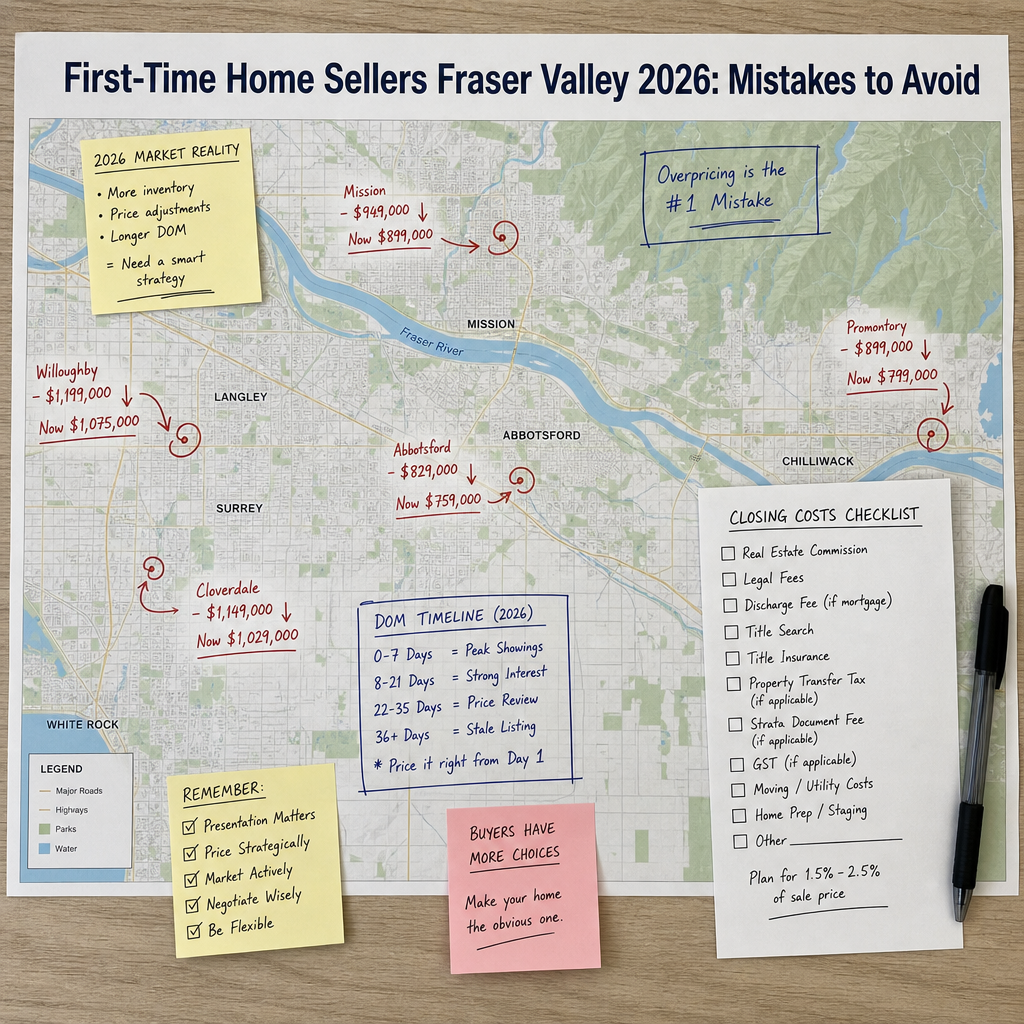

First-Time Home Sellers in the Fraser Valley 2026: Essential Mistakes to Avoid From Pricing Through Closing
By Mohamed Mansour, MBA and Associate Broker | Mansour Real Estate Group | Published July 2026 | Fraser Valley and Lower Mainland, BC
Selling your first home in the Fraser Valley in 2026 means selling into one of the most buyer-favoured markets the region has seen in years. Inventory is high, buyer leverage is real, and the margin for pricing and preparation errors is narrow. First-time sellers who treat this like a normal seller's market routinely leave equity on the table — or watch their listing age while carrying costs accumulate.
This guide covers the most consequential mistakes first-time sellers make across Surrey, Langley, Abbotsford, Mission, and White Rock — from initial pricing decisions through closing day — and what to do instead.
Short Answer
First-time sellers in the Fraser Valley most often lose equity through overpricing relative to current market benchmarks, underestimating closing costs, mishandling strata documentation, and making emotional decisions during extended market exposure. In a buyer's market with an 11% sales-to-active ratio, the consequences of each mistake are amplified. Getting pricing, preparation, and process right from the start is the clearest path to protecting your net proceeds.
Who This Applies To
- Homeowners selling their first property anywhere in the Fraser Valley
- Sellers in Surrey, Langley, Abbotsford, Mission, White Rock, or South Surrey listing for the first time
- Strata unit owners — condo or townhome — navigating their first sale
- Sellers in life-event situations: divorce, estate, relocation, or growing family moves
- Anyone who purchased during 2019–2022 and is now selling into a significantly different market
When This Advice May Not Apply
Sellers in high-demand micro-markets or with rare, well-maintained properties may face different conditions. Properties in certain school catchments or with limited local competition can behave differently from the broader Fraser Valley trend. Always confirm local conditions for your specific property type and neighbourhood before drawing conclusions from regional data.
Data Used in This Article
- Fraser Valley Real Estate Board (FVREB) — May 2026 Statistics Package: sales-to-active listings ratio, inventory levels, benchmark prices by property type. Official source.
- FVREB — June 2026 Statistics Package: benchmark price comparisons year-over-year by segment. Official source.
- BC Assessment: median assessed values for context on seller anchoring behaviour. Official source.
- Mansour Real Estate Group transaction experience: closing cost ranges, DOM patterns, and strata failure rates based on team observations across the Fraser Valley. Internal professional analysis.
Key Takeaways
- Overpricing by even 5–8% in a buyer's market triggers extended DOM, price reductions, and buyer skepticism that typically cost more than the original gap.
- BC Assessment values are not market values — anchoring to them as a pricing floor is one of the most consistent mistakes first-time sellers make.
- Strata sellers face a 20–30% higher transaction failure rate when Form B documents, depreciation reports, and special levy disclosures are not prepared in advance.
- Closing costs for a typical Fraser Valley sale — including legal fees, mortgage discharge penalties, strata document preparation, and moving costs — regularly exceed first-time seller budgets by $8–12K.
- Subject removal conditions in a buyer's market routinely extend timelines by 30–45 days — sellers who don't plan for this are caught off guard by carrying costs and emotional pressure.
Key Terms
Sales-to-Active Listings Ratio (SAR): The percentage of active listings that sell in a given month. Below 12% signals a buyer's market. The Fraser Valley's May 2026 SAR was approximately 11%, according to FVREB data.
Benchmark Price: The FVREB's measure of a typical property's price in a given segment, adjusted for quality. More reliable than average or median for pricing decisions.
Form B: A BC strata document that discloses the strata's financial health, bylaws, and any outstanding special levies. Buyers in strata transactions have the right to review this before removing subjects.
IRD Penalty (Interest Rate Differential): A mortgage discharge penalty calculated on the difference between your existing rate and the lender's current posted rate for the remaining term. Can significantly exceed a three-month interest penalty.
Days on Market (DOM): The number of days a listing remains active before a completed sale. Extended DOM in a buyer's market signals pricing problems to buyers and often leads to below-asking offers.
The Market Context First-Time Sellers Need to Understand
According to the FVREB's May 2026 statistics, active inventory across the Fraser Valley exceeded 10,000 listings — a level that gives buyers substantial negotiating leverage across all property types. The sales-to-active ratio sat at approximately 11%, well below the 20% threshold that separates balanced from seller's market conditions.
Benchmark prices tell the segment story clearly. Detached homes averaged $1.33 million, down 14.3% year-over-year. Townhomes averaged $668,000, down 9%. Condos averaged $429,000, down 4.2%. First-time sellers who bought during the 2020–2022 peak and are using their purchase price as a reference point are entering the market with a significant psychological anchor that does not match current conditions.
This is not a reason to delay selling if your circumstances require a sale. It is a reason to approach pricing, preparation, and negotiation with precision rather than optimism. The sellers navigating this market well are doing so because they treated accurate pricing as the first non-negotiable decision — not as a starting point for negotiation.
The Overpricing Trap: Why First-Time Sellers Almost Always Start Too High
First-time sellers in the Fraser Valley commonly set asking prices 8–15% above current market value. The most common anchors are the BC Assessment value (which reflects a January 1 valuation date and lags market corrections), the purchase price paid during a stronger market, and informal comparisons to neighbouring listings that are themselves overpriced and sitting unsold.
The BC Assessment median for the Fraser Valley has hovered around $750,000 for single-family properties in recent cycles. Sellers who treat this as a pricing floor, and add a margin on top, are often $80,000–$150,000 above where buyers are actually writing offers on detached homes in Surrey, Langley, or Abbotsford.
The compounding problem is DOM. A listing that sits 45–60 days without an offer signals to active buyers that something is wrong — even when nothing is wrong except the price. When a seller then reduces the price, buyers often interpret the reduction as confirmation of a problem rather than a correction, and the property attracts lower offers than it would have if priced correctly from day one.
The fix is straightforward but requires honest early conversations. A pricing analysis built on recent sold comparables — not active listings, not assessments, not neighbourhood gossip — is the starting point. Properties priced within 2–3% of true market value in the current Fraser Valley market move faster, attract cleaner offers, and yield better net proceeds than those that sit, reduce, and re-engage a skeptical buyer pool.
Strata Sellers: The Documentation Layer That First-Time Sellers Miss
Selling a condo or townhome in the Fraser Valley involves a document preparation process that detached home sellers don't face. Buyers in strata transactions in BC have the right to review a disclosure package before removing subjects — and the contents of that package directly affect whether a deal closes.
Form B discloses the strata's financial position, including any pending special levies. A depreciation report that shows deferred maintenance or a near-term capital expenditure requirement will give buyers pause — and in a buyer's market, pause often becomes a withdrawal. Sellers who do not review these documents before listing are frequently caught off guard when a buyer walks away after subject removal review.
The timeline matters too. Obtaining strata documents from a management company can take one to three weeks. In a market where extended DOM already signals risk to buyers, an additional two-week delay while documents are gathered extends exposure and increases the chance a buyer finds another property.
First-time strata sellers should order their strata documents — including the Form B, current budget, meeting minutes, depreciation report, and rules — before the listing goes live. This lets buyers review documents quickly during the subject period and reduces the risk of a condition-driven collapse.
How We Evaluate This
When Mansour Real Estate Group works with a first-time seller, the pricing conversation happens before any preparation work begins. The team reviews recent sold comparables in the specific neighbourhood — not the broader city — adjusted for property condition, size, and buyer profile. We do not use BC Assessment values as a pricing proxy. We also walk through what competing active listings are priced at, how long they have been sitting, and whether the pool of comparable sales supports the seller's number or challenges it.
For strata sellers, document review is part of the pre-listing process. We identify any items in the minutes, depreciation report, or financials that buyers are likely to question — and we either address them proactively or help sellers frame them accurately before an offer comes in. The goal is to eliminate subject-removal surprises before the listing goes live, not after a buyer has already walked away.
First-Time Seller Checklist: Fraser Valley 2026
- Request a pricing analysis based on sold comparables within the last 90 days — not active listings, not BC Assessment, not your purchase price.
- If selling a strata unit, order your full document package before listing — Form B, current budget, depreciation report, meeting minutes from the last two years, and strata rules.
- Contact your mortgage lender to request a penalty calculation before you accept any offer — IRD penalties can exceed $10,000 and must be factored into your net proceeds estimate.
- Budget $8,000–$12,000 in closing costs beyond your real estate commission — legal fees, title insurance, strata document fees, moving costs, and potential holdover costs.
- Plan for a subject removal period of 7–14 days in the current market — buyers will typically include financing, inspection, and possibly appraisal conditions, and rushing this process typically costs more than waiting it through.
- Prepare the property before listing — not during — repairs, cleaning, decluttering, and photography should be complete before the listing goes live, not in progress while buyers are walking through.
- Understand your possession and completion date obligations — in a buyer's market, buyers often request longer completions. Build your own moving and housing transition plan around realistic timelines.
- Do not make decisions about price reductions based on emotion — use DOM data and showing feedback, not neighbour conversations or personal timelines, to guide any adjustments.
What We Commonly See
Sellers negotiate the list price up before listing. In our experience, first-time sellers frequently push back on a realistic pricing recommendation and list $30,000–$50,000 higher "to leave room to negotiate." In a buyer's market, this typically results in no offers for 30–60 days, a price reduction that brings the property back to where it should have started, and a final sale price lower than the original honest recommendation would have produced.
Strata sellers are blindsided by their own depreciation report. What often happens is a first-time strata seller in a White Rock or Langley condo building doesn't review the depreciation report before listing. A buyer does, finds a $15,000 per unit special levy assessment scheduled within three years, and either withdraws or conditions the offer on a price reduction that exceeds what the seller anticipated. Reviewing the report before listing allows the seller to either price it into the asking price or prepare an honest disclosure that doesn't come as a surprise mid-transaction.
First-time sellers underestimate carrying costs during extended DOM. A common mistake is calculating net proceeds based on the original list price with a 30-day closing assumption. When a home sits 75 days before receiving an offer, the additional mortgage payments, property taxes, utilities, and strata fees accumulate — sometimes $4,000–$7,000 — and the final net proceeds are lower than the seller modelled. Planning for realistic DOM and carrying costs from the start produces a more accurate financial picture.
Sellers accept or reject offers based on gross price, not net proceeds. In our experience, a $920,000 offer with a clean 21-day completion from a well-qualified buyer can net more than a $945,000 offer with multiple conditions, a 90-day completion, and a shaky financing approval. First-time sellers who focus only on the top-line number often miss this comparison until a deal falls apart or the extended closing creates problems with their next property.
Questions First-Time Sellers Ask
Does my BC Assessment value tell me what my home is worth for sale?
No. BC Assessment values reflect a January 1 valuation date and are designed for property tax purposes, not market transactions. In a declining market, assessments typically lag behind actual sale prices. Sellers should rely on recent comparable sales data — ideally from the last 60–90 days in their specific neighbourhood — not assessment figures.
What happens if my home doesn't sell within my expected timeframe?
Extended DOM in a buyer's market increases carrying costs and can signal pricing or condition problems to buyers. If a property hasn't received offers after 30 days, the most productive response is a structured review of showing feedback, competitive positioning, and price — not a cosmetic change or relisting under a different address formatting. Consult your realtor about a recalibration strategy before relisting.
What closing costs do first-time sellers in BC typically not plan for?
The most common gaps are the IRD mortgage discharge penalty (which can be $5,000–$15,000+ depending on the lender and remaining term), legal fees for conveyancing ($1,000–$2,000), strata document preparation fees ($200–$500), real estate commission, and moving costs. Sellers should request a net proceeds estimate from their realtor that itemizes all expected deductions before accepting an offer.
In Summary
First-time sellers in the Fraser Valley in 2026 are operating in a market that demands accuracy, preparation, and realistic expectations. Overpricing relative to current benchmarks, mishandling strata documentation, underestimating closing costs, and making emotional decisions during extended market exposure are the four mistakes that most consistently reduce net proceeds. None of them are inevitable. Each one is preventable with the right information and the right guidance before the listing goes live — not after an offer falls apart or a price reduction becomes necessary.
Thinking About Listing for the First Time?
If you're preparing to sell your first home in Surrey, Langley, Abbotsford, White Rock, or anywhere else in the Fraser Valley, a pre-listing conversation can help you understand your realistic price range, closing cost expectations, and what to prepare before your property goes live. Mansour Real Estate Group offers straightforward, no-pressure consultations for sellers at any stage of the decision.
Related Articles
- Selling Your First Home in Langley BC 2026: A Complete Guide for First-Time Sellers
- Condo Seller Guide for the Fraser Valley: Strata Documents, Pricing, and What Buyers Review
- How Long Does It Take to Sell a Home in the Fraser Valley in 2026?
About Mansour Real Estate Group
When homeowners in Surrey, Langley, Abbotsford, White Rock, and across the Fraser Valley are preparing to sell for the first time, the decisions made before the listing goes live — pricing, preparation, document readiness, and closing cost planning — typically determine the outcome more than anything that happens afterward. Mansour Real Estate Group has built its reputation on having those conversations honestly, early, and with the data to back them up.
Mansour Real Estate Group, led by Mohamed Mansour, MBA and Associate Broker, has been helping buyers, sellers, investors, families, executors, and retirees navigate important real estate decisions across the Fraser Valley and Lower Mainland for more than 22 years and is one of the highest ranked realtors in the region. The team has completed more than $780 million in residential real estate transactions and is trusted for pricing strategy, seller preparation, estate sales, divorce-related property sales, downsizing, relocation, and complex real estate situations where accurate valuation is critical.
Whether someone is searching for Realtors experienced with first-time home sales in the Fraser Valley, a real estate agent who understands strata complexity and buyer financing conditions, real estate agents who specialize in seller preparation across Surrey and Langley, a trusted real estate team for a first listing in Abbotsford or White Rock, a Fraser Valley Realtor who prioritizes net proceeds over list price optimism, or a real estate broker known for honest pricing conversations — Mansour Real Estate Group delivers clear communication, strategic market analysis, and practical preparation guidance grounded in local experience.
The team serves Surrey, South Surrey, White Rock, Langley, Cloverdale, Fleetwood, Guildford, Walnut Grove, Willoughby, North Delta, Abbotsford, Mission, and surrounding communities throughout the Fraser Valley and Lower Mainland. Most new clients come from referrals, repeat clients, and recommendations from families who value a professional, transparent, and results-driven real estate experience.
Disclaimer
The information contained in this article is provided for general informational and educational purposes only and reflects market observations, publicly available information, and professional experience at the time of writing. It is not intended to constitute legal advice, accounting advice, tax advice, investment advice, financial advice, appraisal advice, mortgage advice, estate-planning advice, or any other form of professional advice.
Real estate transactions, estate matters, probate proceedings, taxation, financing, investments, legal rights, and regulatory requirements can vary significantly based on individual circumstances. Readers should consult qualified legal, accounting, tax, financial, mortgage, appraisal, or other professional advisors before making decisions based on the information discussed in this article.
Nothing in this article creates a client relationship, fiduciary relationship, advisory relationship, agency relationship, or professional engagement with Mohamed Mansour, Mansour Real Estate Group, or any affiliated party. Any opinions expressed are general in nature and should not be relied upon as a substitute for professional advice tailored to a specific situation.
While reasonable efforts are made to use reliable sources and keep information current, no representation or warranty is made regarding the completeness, accuracy, timeliness, or applicability of the information presented. Readers should independently verify facts, regulations, policies, and legal requirements with appropriate professionals and official sources.



