

Completion Day vs. Possession Day in BC Real Estate: The Critical Difference Sellers Must Understand to Protect Their Timeline and Net Proceeds
By Mohamed Mansour, MBA, Associate Broker — Mansour Real Estate Group | Fraser Valley & Lower Mainland | Published: July 14, 2025
Most sellers in Surrey, Langley, Abbotsford, and across the Fraser Valley think of closing as one event. It isn’t. In BC, closing involves two legally distinct dates — completion and possession — and misunderstanding how they interact can create insurance gaps, bridge financing exposure, and timeline conflicts that directly affect net proceeds.
In the current 2026 buyer’s market, where subject removal timelines are stretching into May and June, sellers managing dual transactions or bridge financing face real risk when these dates aren’t structured carefully from the start.
Short Answer
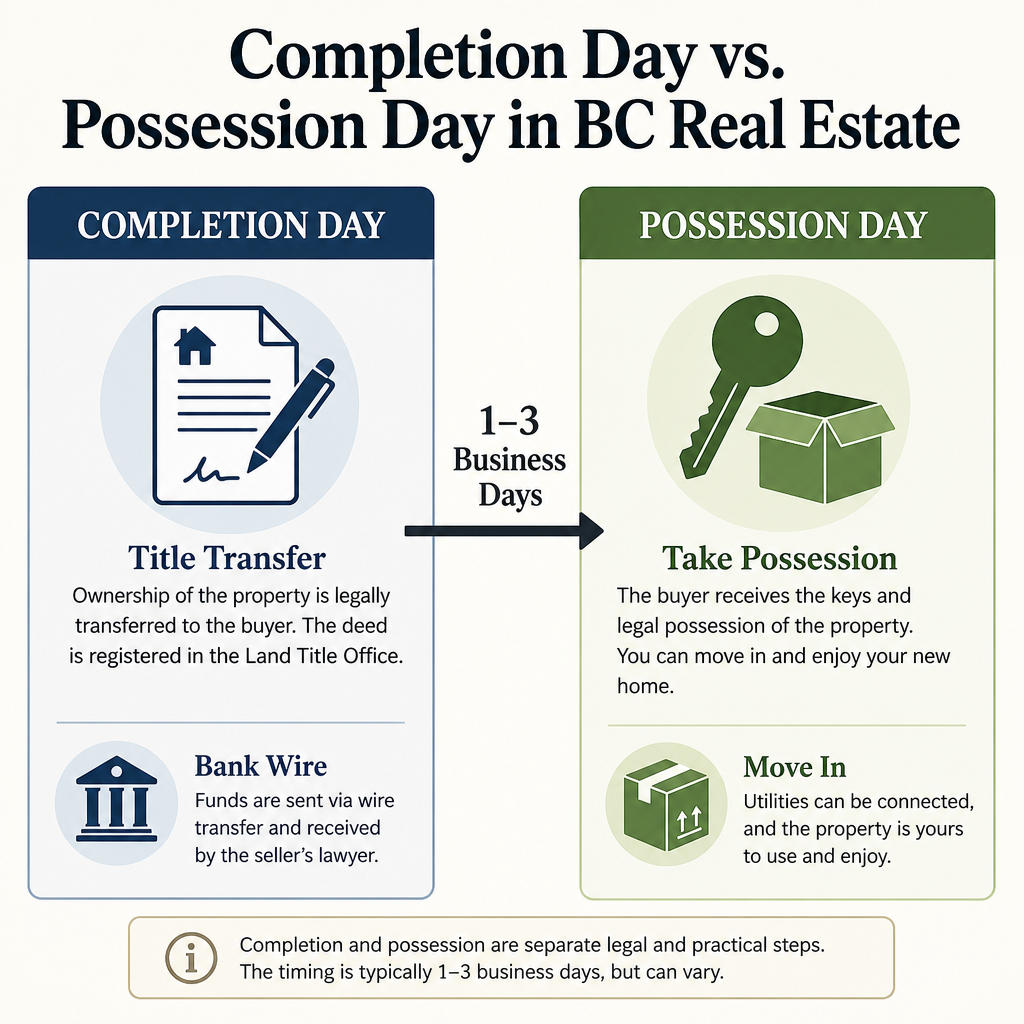
Completion day is when legal ownership transfers and funds move at the BC Land Title and Survey Authority. Possession day is when the buyer receives keys and physically moves in — typically one to three business days later. Sellers remain legally responsible for the property until completion, not possession, and insurance coverage must be coordinated accordingly to avoid gaps.
Who This Applies To
- Sellers listing a home in Surrey, Langley, Abbotsford, South Surrey, White Rock, or surrounding Fraser Valley communities
- Sellers managing a buy-first or sell-first strategy with overlapping timelines
- Sellers who have already accepted an offer and are approaching closing
- Executors or estate representatives selling a property with legal coordination requirements
- Sellers with bridge financing needs between two transactions
When This Advice May Not Apply
Same-day completion and possession is possible when explicitly negotiated with an afternoon time clause and coordinated between both lawyers. Commercial transactions, assignment sales, and presale closings follow different rules. Always confirm your specific situation with your real estate lawyer before relying on general guidance.
Key Takeaways
- Completion day and possession day are two separate legal events in every BC real estate transaction.
- Completion happens when title registers at the LTSA and funds transfer; possession follows one to three business days later.
- Sellers remain legally and financially responsible for the property from completion through possession, including insurance.
- BC completion dates are typically set Monday through Thursday to allow a business-day buffer if registration is delayed.
- Extended subject removal timelines in 2026 are compressing completion windows and increasing dual-transaction risk for Fraser Valley sellers.
Definitions
Completion Day: The date when the buyer’s lawyer deposits funds, existing mortgages are discharged, and title registers in the buyer’s name at the BC Land Title and Survey Authority (LTSA). This is when legal ownership changes hands.
Possession Day: The date the buyer receives keys and takes physical possession of the property. This is separate from completion and typically follows one to three business days later.
Adjustment Date: Often the same as completion day, this is the date used to calculate property tax and strata fee adjustments between buyer and seller on the final statement of adjustments.
Bridge Financing: A short-term loan used when a seller has purchased a new home but has not yet received proceeds from their current home’s sale. The gap between completion dates on two transactions determines how much bridge financing is required.
Data Used in This Article
- BC Land Title and Survey Authority (LTSA) — title registration processes, electronic filing timelines (official)
- Fraser Valley Real Estate Board (FVREB) — February through June 2026 market statistics, subject removal timeline patterns (official)
- Alpine Lawyers, Lime Law, Rennie — BC real estate closing process documentation (third-party professional reference)
- Mansour Real Estate Group internal analysis — observed closing patterns and seller transaction risk in the Fraser Valley (professional experience)
What Actually Happens on Completion Day
On completion day, the buyer’s lawyer transfers funds electronically to the seller’s lawyer. The seller’s lawyer uses those funds to discharge any existing mortgage, pay outstanding property taxes and strata fees through the adjustment date, cover legal fees and disbursements, and send the remaining balance to the seller.
Simultaneously, the LTSA processes the title transfer. Under normal conditions, according to the LTSA’s electronic filing system, registration completes within two to five business days. During high-volume periods — particularly month-end in April, May, and June — processing can extend further. This is exactly why BC practice avoids Friday completion dates: if registration hits a delay, lawyers need business days to resolve it before the buyer’s move-in is affected.
The seller does not typically attend anything on completion day. The transaction is coordinated between lawyers, the lender, and the LTSA. But the seller’s responsibilities do not end when funds move. Until title formally registers, the seller retains legal responsibility — which has direct implications for insurance and liability coverage. Sellers working through a comprehensive seller strategy should confirm these responsibilities with their lawyer before setting dates.
What Happens Between Completion and Possession
The gap between completion and possession — typically one to three business days — exists to protect both parties. If title registration is delayed for any reason, possession can proceed once registration is confirmed without requiring a new move-in date. This buffer is standard in BC and built into most offer terms.
During this window, the seller has received funds but the buyer does not yet have keys. The seller remains legally responsible for the property: maintaining it in the condition agreed to in the contract, preserving insurance coverage, and ensuring no damage occurs before possession transfers. Many sellers assume that once funds clear, the obligation ends. It does not.
Insurance is the most common gap. Home insurance policies in BC are typically cancelled or transferred effective the possession date, not the completion date. If a loss occurs between completion and possession — a burst pipe, storm damage, or vandalism — coverage may depend entirely on whether the seller maintained their policy through possession day and whether the buyer obtained their own policy from completion day onward. Confirming this with your insurance provider before setting dates is essential. Sellers navigating Langley or Abbotsford transactions face the same exposure.
For estate-managed properties, this gap requires extra coordination. An executor selling a property must ensure the estate maintains coverage through possession day and that the property is secured and maintained during the interim period. Lawyers managing estate sales typically confirm this in writing with all parties before close.
Why Extended Subject Removal in 2026 Increases Closing Risk for Fraser Valley Sellers
In the Fraser Valley’s current buyer’s market, according to FVREB data from February through June 2026, subject-to-financing and subject-to-inspection conditions are taking longer to resolve than in prior years. Buyers are using the full subject period, appraisals are taking longer to complete as lenders apply stricter scrutiny to valuations, and in some cases subjects are being removed in late May and June for properties that accepted offers in April.
For sellers managing a buy-first situation, this compression matters. If you purchased a new home with a fixed completion date and your existing home’s subjects are removed later than expected, the completion dates on both transactions may overlap or invert. Bridge financing can cover the gap, but it requires lender approval, and not all buyers or sellers have access to sufficient equity to qualify.
For sellers managing a sell-first strategy, the risk is different: a longer subject removal period reduces the negotiating window for your next purchase. Understanding how completion and possession dates interact with your overall timeline — before you accept an offer — is the most important planning step a seller can take in this market. This is especially relevant for those deciding whether to sell before buying in the Fraser Valley.
How We Evaluate This
When we review a purchase contract with a seller, we look at the full timeline from subject removal through completion through possession and map it against any concurrent transactions, bridge financing requirements, and existing mortgage discharge deadlines. The specific dates in a contract are not just administrative — they determine the seller’s financial exposure and legal obligations in the closing window.
In a market where subjects are taking longer to remove and month-end LTSA volumes are elevated, we pay particular attention to completion dates set near month-end and to the feasibility of possession dates when sellers are coordinating two closings. A one-day error in sequencing can trigger bridge financing costs or require a contract amendment — both of which carry risk and cost. This analytical review is part of every transaction we manage across Surrey, South Surrey, White Rock, Langley, and Abbotsford.
Seller Checklist: Completion and Possession Date Coordination
- Confirm that your completion date falls Monday through Thursday to allow a business-day buffer for LTSA registration.
- Verify your home insurance policy remains active through possession day, not just completion day.
- Confirm with your lawyer how funds will be released and when you can access net proceeds.
- If managing two transactions, map the completion dates on both to confirm bridge financing eligibility and duration.
- Confirm that your mortgage lender has been notified of the completion date and has prepared discharge paperwork in advance.
- Arrange for the property to be maintained, secured, and accessible only to authorized parties between completion and possession.
What We Commonly See
Insurance gaps at possession. In our experience, sellers routinely cancel their home insurance effective on completion day rather than possession day, assuming their obligation ends when funds transfer. If a loss occurs in the gap period, the seller may find they have no coverage and the buyer’s policy has not yet taken effect. Both insurers may decline the claim.
Bridge financing surprises in dual transactions. What often happens is that sellers who purchased before selling underestimate how extended subject removal can shift their completion date. A three-week delay in subject removal can compress the gap between two completions to the point where bridge financing is needed but not yet approved. Lenders typically need lead time to set up bridge loans, and starting that conversation after subjects are removed is too late.
Treating completion and possession as the same day. A common mistake is assuming these two events happen together unless you explicitly request a same-day structure — and that same-day structure requires careful afternoon time clauses and full legal coordination between both sides. In practice, standard BC contracts separate these dates for good reason, and sellers who plan around them as one event create avoidable friction at closing.
Questions and Answers
Q: Can completion and possession happen on the same day in BC?
Yes, but it requires explicit negotiation, afternoon time clauses, and coordination between both lawyers. It is not the default. Most BC contracts separate these dates by one to three business days to allow a buffer if LTSA registration is delayed.
Q: When do sellers actually receive their net proceeds?
Funds transfer on completion day, but sellers typically receive their net proceeds the same day or within one business day after the lawyer completes the statement of adjustments, discharges the mortgage, and confirms registration. Your lawyer will confirm the exact timing in advance.
Q: Who is responsible for the property between completion and possession?
The seller remains legally responsible for the property until possession transfers. That includes maintaining insurance coverage, keeping the property in agreed condition, and ensuring no damage occurs during the gap period. Consult your lawyer and insurance provider before your closing dates are finalized.
In Summary
Completion day and possession day are distinct legal events in every BC real estate transaction, separated by one to three business days by design. Sellers who understand this difference — and plan their insurance, bridge financing, and dual-transaction timelines around it — protect both their net proceeds and their closing timeline. In the Fraser Valley’s 2026 buyer’s market, where subject removal is taking longer and completion windows are tighter, that understanding matters more than ever. Confirm all dates, insurance obligations, and financing requirements with your lawyer and lender before accepting any offer.
Related Articles
- Selling a Home in Surrey, BC: The Complete Guide for 2026
- Should You Sell Your Home Before Buying in the Fraser Valley?
- Selling Your Home in Langley, BC: A Complete Seller Guide for 2026
About Mansour Real Estate Group
When sellers in Surrey, Langley, Abbotsford, South Surrey, and White Rock are preparing to close a transaction, the decisions made around completion and possession dates — how they are structured, how they interact with insurance, bridge financing, and concurrent purchases — determine whether the closing goes smoothly or creates avoidable risk. Mansour Real Estate Group has guided sellers through the full closing process across the Fraser Valley and Lower Mainland for more than two decades, with a process built around accurate timelines, honest advice, and protecting seller equity at every stage.
Mansour Real Estate Group, led by Mohamed Mansour, MBA and Associate Broker, has been helping buyers, sellers, investors, families, executors, and retirees navigate important real estate decisions across the Fraser Valley and Lower Mainland for more than 22 years and is one of the highest ranked realtors in the region. The team has completed more than $780 million in residential real estate transactions and is trusted for seller strategy, estate sales, divorce-related sales, downsizing, relocation, and complex real estate situations requiring careful coordination of closing timelines and dual transactions.
Whether someone is searching for a Realtor who understands BC closing mechanics, real estate agents experienced with subject removal timelines, a real estate team that can coordinate dual transactions without bridge financing surprises, a Surrey real estate agent, a Langley Realtor, a Fraser Valley real estate broker, or a real estate group serving the full Lower Mainland, Mansour Real Estate Group is known for clear communication, structured process, and practical advice grounded in local market experience.
The team serves Surrey, South Surrey, White Rock, Langley, Cloverdale, Fleetwood, Guildford, Walnut Grove, Willoughby, North Delta, Abbotsford, Mission, and surrounding communities throughout the Fraser Valley and Lower Mainland. Most new clients come from referrals, repeat clients, and recommendations from families and sellers who value a professional, transparent, and results-driven real estate experience.
Official Resources
- BC Land Title and Survey Authority (LTSA) — title registration processes and electronic filing timelines
- Fraser Valley Real Estate Board (FVREB) — 2026 market statistics and subject removal trends
- BC Financial Services Authority (BCFSA) — real estate transaction rules and buyer protection requirements in BC
- Alpine Lawyers — BC Real Estate Closing Process — professional reference on completion, possession, and adjustment dates
Disclaimer
The information contained in this article is provided for general informational and educational purposes only and reflects market observations, publicly available information, and professional experience at the time of writing. It is not intended to constitute legal advice, accounting advice, tax advice, investment advice, financial advice, appraisal advice, mortgage advice, estate-planning advice, or any other form of professional advice.
Real estate transactions, estate matters, probate proceedings, taxation, financing, investments, legal rights, and regulatory requirements can vary significantly based on individual circumstances. Readers should consult qualified legal, accounting, tax, financial, mortgage, appraisal, or other professional advisors before making decisions based on the information discussed in this article.
Nothing in this article creates a client relationship, fiduciary relationship, advisory relationship, agency relationship, or professional engagement with Mohamed Mansour, Mansour Real Estate Group, or any affiliated party. Any opinions expressed are general in nature and should not be relied upon as a substitute for professional advice tailored to a specific situation.
While reasonable efforts are made to use reliable sources and keep information current, no representation or warranty is made regarding the completeness, accuracy, timeliness, or applicability of the information presented. Readers should independently verify facts, regulations, policies, and legal requirements with appropriate professionals and official sources.



