
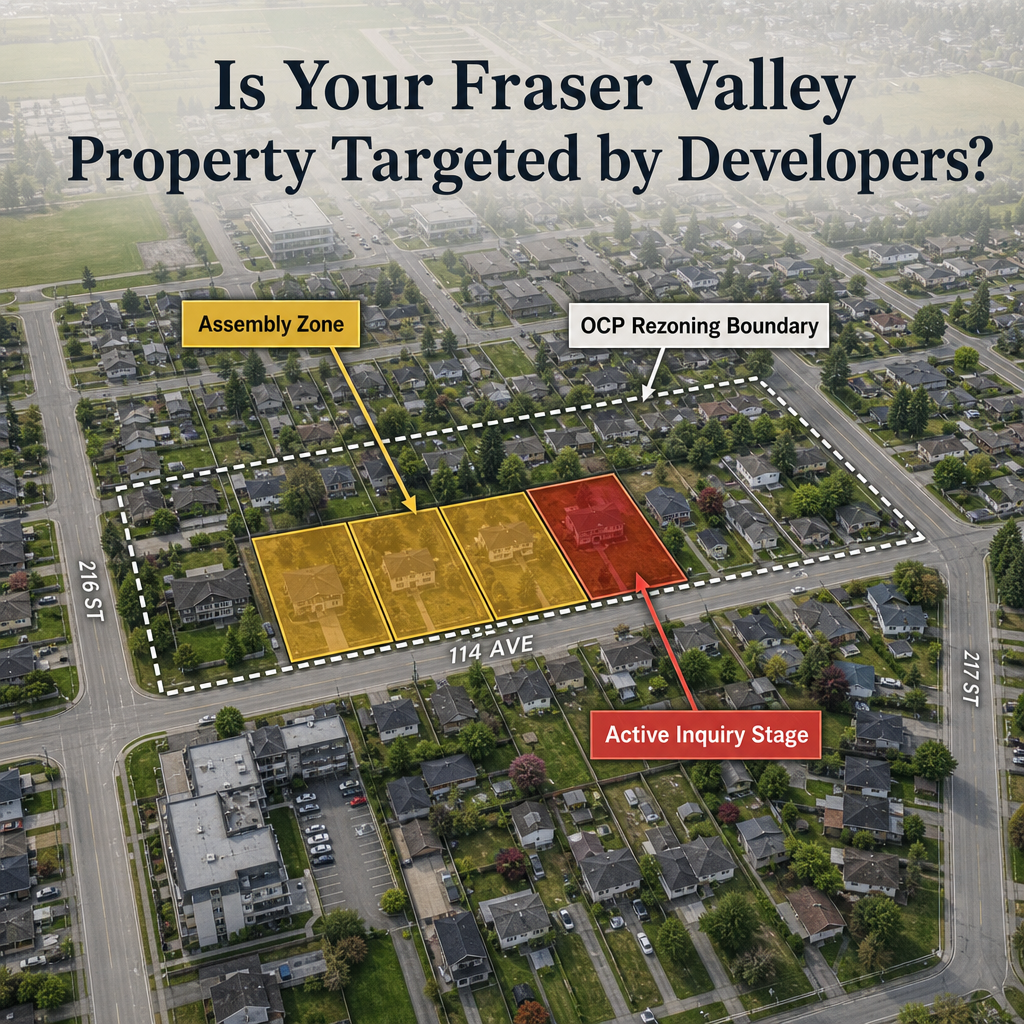

How to Identify If Your Fraser Valley Property Is Targeted by Developers: Timing Signals, Neighbourhood Assembly Patterns, and Strategic Negotiation When Land Value Exceeds Residential Resale
By Mohamed Mansour, MBA and Associate Broker | Mansour Real Estate Group | Published: July 15, 2026 | Fraser Valley and Lower Mainland, BC
In Cloverdale, Fleetwood, Willoughby, and several other Fraser Valley corridors, developer land assembly activity has accelerated through 2025 and 2026. Homeowners in targeted areas are receiving unsolicited inquiries, agent visits, and market-update mailings — most without understanding why. By the time a formal acquisition offer arrives, the developer has usually already secured most of the surrounding block.
This guide explains how to read the early warning signs, understand where your property fits in a developer's assembly sequence, and negotiate from a position of knowledge rather than surprise.
Short Answer
Developer land assemblies in the Fraser Valley follow predictable geographic patterns tied to Official Community Plan designations, infrastructure corridors, and rezoning timelines. Sellers who recognize the early inquiry signals — unsolicited agent contact, cash buyer interest, comparable sales requests on their block — gain 6 to 12 months of negotiating runway and can anchor discussions at land values rather than residential resale comps.
Key Takeaways
- Developer assemblies cluster by neighbourhood strategy; proximity to an active acquisition is the primary early indicator.
- Sellers who engage after 60–80% of a block is secured have significantly less leverage than early participants.
- OCP designations, rezoning notices, and infrastructure announcements are public documents — they identify targeted corridors before agents call.
- Targeted properties in active zones can command 15–40% above residential resale, but only when sellers recognize timing before it passes.
- An unsolicited offer is rarely the first move — it is usually the last move before a developer walks away from that parcel.
Who This Applies To
- Homeowners in Cloverdale, Fleetwood, Willoughby, Walnut Grove, or Guildford who have received unsolicited agent contact in the past 12 months
- Owners of single-family lots on arterial roads, near transit nodes, or adjacent to recently sold or vacant parcels
- Estate executors or long-term owners holding large lots that predate current density zoning
- Sellers weighing a standard residential listing versus exploring whether land value exceeds their residential resale price
When This Advice May Not Apply
Properties outside active OCP rezoning corridors, well inside established single-family neighbourhoods with no infrastructure changes planned, or in areas where recent assembly attempts stalled due to market conditions may not carry the same developer interest. Consult an experienced local real estate agent before drawing conclusions from a single unsolicited inquiry.
Data Used in This Article
- Altus Group Commercial Real Estate Market Update, March 2026 — Surrey and Cloverdale acquisition activity (third-party industry report)
- Fraser Valley Real Estate Board market statistics, February through June 2026 — neighbourhood-level activity (official board data)
- BC Municipal OCP filings and rezoning notices, Cloverdale, Fleetwood, Willoughby, and Walnut Grove, 2024–2026 (official government documents)
- Mansour Real Estate Group professional observations from developer acquisition and relocation files (internal, anonymized)
How We Evaluate This
When a homeowner contacts us about an unsolicited developer inquiry, our first step is to cross-reference the property's location against current OCP designations, active rezoning applications, and recent arm's-length sales on that block. We look for clustering — if two or three nearby properties have sold in the past 18 months at prices inconsistent with the neighbourhood average, that pattern tells us more than any single sales price.
We also review who purchased those properties and whether the buyer pattern suggests accumulation rather than owner-occupancy. In our experience working with sellers across Cloverdale and Fleetwood, this research often confirms what a homeowner suspected but couldn't verify: that the inquiries aren't random.
The Assembly Sequence: How Developers Actually Approach a Block
Developers rarely announce their intentions. They acquire properties in a deliberate sequence designed to minimize holdout leverage before sellers understand what's happening. In most Fraser Valley assembly scenarios we've observed, the process follows a consistent pattern.
The developer — or a numbered company acting on their behalf — begins by purchasing the easiest properties first: vacant lots, estate sales, financially motivated sellers, and absentee owners who have already signalled interest in selling. According to Altus Group's March 2026 update on Surrey and Cloverdale activity, acquisitions in active assembly corridors are clustering by block rather than by individual property desirability, confirming the strategic accumulation pattern rather than opportunistic buying.
Once 60 to 80 percent of target parcels are secured, the developer's position shifts. They may already have enough land to proceed with a scaled-down version of the project. Remaining holdouts face a binary choice: accept a premium that is now smaller relative to what early sellers received, or watch the corridor develop around them while their property's land value falls back toward residential comps.
Sellers who understand this sequence can position themselves between the early and late stages — not the first to sell, but not the last. That positioning, if timed correctly, captures near-peak holdout value without the risk of being bypassed entirely. For sellers considering this kind of strategic timing, our article on when to sell your Fraser Valley home provides a useful framework for evaluating life-event timing alongside market conditions.
How to Read the Early Warning Signals Before an Offer Arrives
The signals that precede a formal developer approach are often subtle and easy to dismiss individually. Taken together, they describe a pattern. In Cloverdale, Fleetwood, and Willoughby — three areas where OCP rezoning designations have created active assembly conditions through 2025 and 2026 — homeowners have reported the following prior to receiving formal offers.
Unsolicited agent contact from brokerages you don't recognize. Developer acquisition agents often work through small or numbered brokerages specifically to avoid tipping off the market. If you receive market-update letters or calls from agents you've never heard of, particularly those mentioning "buyers interested in your street," treat it as a signal rather than a courtesy.
Multiple comparable sales requests for your specific block. Appraisers and agents working on behalf of assemblers need comparable data. If two or three agents have requested access to your property for "market analysis" within a 6-month window, that volume is unusual for standard residential activity.
Cash buyer inquiries without listed-property context. Cash-heavy buyers who contact you without a listed property to reference — particularly those who are vague about intended use — are a common early-stage assembly tactic. Owner-occupant buyers rarely approach off-market with cash.
Neighbouring sales at prices inconsistent with the market. The Fraser Valley Real Estate Board's 2026 neighbourhood-level statistics show outlier sales prices in Cloverdale and Fleetwood blocks that exceed residential comps by 20 to 35 percent. If your neighbour's comparable home sold significantly above what you would expect, check the buyer identity and look for a corporate or numbered company purchaser. These sales confirm that an assembly is already underway. Homeowners in Willoughby and Walnut Grove facing similar patterns should review our complete seller guide for Langley for additional context on neighbourhood-specific pricing dynamics.
Using Public Documents to Confirm What Signals Suggest
BC municipalities are required to make Official Community Plans, rezoning applications, and development permit applications publicly available. These documents are your most reliable tool for confirming whether your property sits inside an active or planned development corridor.
The City of Surrey's OCP and the Township of Langley's land use maps both identify corridors designated for increased density, mixed use, or commercial redevelopment. If your property is within or adjacent to one of those zones, developer interest is not speculative — it is structurally predictable. Rezoning applications filed by numbered companies or holding entities near your address confirm active intent, not just planning possibility.
Infrastructure announcements — SkyTrain corridor extensions, hospital expansions, or major road upgrades — are equally reliable signals. In our professional experience, land values in corridors within 400 to 800 metres of confirmed transit or health infrastructure announcements begin shifting 12 to 24 months before construction begins. Sellers who act during that window have more options than those who wait for the market to fully price in the change. For homeowners near announced infrastructure in Surrey, our Surrey seller guide covers timing and positioning in more detail.
Definitions
Land Assembly: The process of purchasing multiple adjacent properties to create a combined parcel large enough for a development project that individual lots cannot support.
Official Community Plan (OCP): A BC municipal document that designates land use, density, and development priorities for specific areas. OCP designations are the primary public indicator of where rezoning is likely.
Holdout Leverage: The negotiating advantage held by a seller whose property is the final or near-final piece of an assembly, giving them the ability to delay or block project completion.
Residential Resale Comp: The market value of a property based on comparable residential sales. In assembly scenarios, land value can significantly exceed this figure.
Seller Checklist: If You Suspect Developer Interest
- Review your municipality's OCP map and confirm whether your property is inside a density or mixed-use designation
- Search for active rezoning applications filed within 200 metres of your address through your municipal planning department's public portal
- Check recent sales on your block through BC Assessment or FVREB data for prices inconsistent with residential comps
- Identify the buyer entities behind any outlier sales — numbered companies or holding entities signal assembly, not owner-occupancy
- Document all unsolicited agent contacts, inquiries, and offers with dates, names, and brokerage details
- Consult an experienced local real estate agent before responding to any unsolicited inquiry — your first response sets a precedent
- Do not list your property on MLS without first evaluating whether land value exceeds residential resale and whether off-market positioning serves you better
What We Commonly See
Sellers respond to the first unsolicited call without understanding its purpose. In our experience, homeowners who engage casually with the first inquiry — providing information about their timeline, their motivation to sell, or their price expectations — inadvertently give away negotiating information before they have any. The first inquiry is information-gathering, not an offer.
Sellers assume the unsolicited price is the ceiling. What often happens is that the first soft offer from an assembler is deliberately below where a holdout negotiation could realistically land. Developers price early acquisition offers to move fast and conserve land budget. Sellers who accept immediately, without understanding their position in the assembly sequence, consistently receive less than sellers who wait and negotiate with full information.
Sellers list on MLS before exploring land value. A common mistake is listing at residential resale value when the property is actually part of an active assembly corridor. Once listed publicly, the seller's flexibility is reduced, buyer expectations are anchored to residential comps, and the developer gains information about seller motivation. For sellers who may be holding properties that combine residential and land value considerations, the same principle applies to estate properties with complex land situations.
Questions and Answers
How do I find out if my property is inside an OCP rezoning corridor?
Visit your municipality's planning department website. Surrey, Langley, and Abbotsford all publish OCP maps and active rezoning applications online. Enter your address and confirm the land-use designation. If it shows medium or high density, mixed use, or commercial transition, your property may be in an active corridor.
What is the difference between holdout leverage and simply refusing to sell?
Holdout leverage is strategic. It means timing your negotiation for when the developer needs your parcel to complete a viable project. Simply refusing to sell without understanding the assembly stage may result in the developer redesigning the project around your property, eliminating your leverage entirely.
Should I hire a real estate agent or a lawyer first if I receive a developer offer?
Both. A real estate agent with local market knowledge can evaluate whether the offer reflects land value or residential comp pricing, and advise on negotiation positioning. A lawyer should review any formal acquisition agreement before you sign. Neither replaces the other in a developer transaction.
In Summary
Developer land assemblies in Cloverdale, Fleetwood, Willoughby, and across the Fraser Valley follow a predictable sequence that begins long before a formal offer arrives. Sellers who learn to read the early signals — unsolicited agent contact, outlier sales on their block, OCP designations, and cash buyer inquiries — gain time to evaluate their position honestly. That time translates directly into negotiating leverage. Properties in active assembly corridors can command meaningful premiums above residential resale, but only for sellers who understand the sequence and act before the developer's assembly is effectively complete.
Talk to Mansour Real Estate Group First
If you've received unsolicited inquiries about your property, noticed unusual sales activity on your block, or want to understand whether your Fraser Valley home may be in a developer's sights, a confidential conversation with an experienced local real estate agent is the right first step — before you respond to anyone else. Mansour Real Estate Group provides honest, research-based assessments with no obligation. Reach out through localhost:9000/.
Related Articles
- Selling Your Home in Surrey: A Complete Guide for Fraser Valley Sellers
- When to Sell Your Fraser Valley Home: Timing the Market vs. Timing Your Life
- How to Sell an Estate Property in BC: A Complete Guide for Executors and Families
About Mansour Real Estate Group
When a homeowner's property may be worth more as development land than as a residential resale, the advice they receive in the first conversation shapes every decision that follows. Understanding assembly patterns, corridor designations, and negotiation timing requires a real estate team with direct experience in Fraser Valley land use, developer acquisition activity, and seller positioning strategy — not a generalist approach. Mansour Real Estate Group has guided sellers navigating developer inquiries, land assembly situations, and complex valuation decisions across Surrey, Cloverdale, Fleetwood, Langley, Willoughby, and the broader Fraser Valley for more than two decades.
Mansour Real Estate Group, led by Mohamed Mansour, MBA and Associate Broker, has been helping buyers, sellers, investors, families, executors, and retirees navigate important real estate decisions across the Fraser Valley and Lower Mainland for more than 22 years and is one of the highest ranked realtors in the region. The team has completed more than $780 million in residential real estate transactions and is trusted for seller strategy, pricing analysis, estate sales, developer acquisition situations, downsizing, relocation, and complex real estate decisions throughout the region.
Whether someone is looking for Realtors who understand Fraser Valley developer activity, a real estate agent who can evaluate whether land value exceeds residential resale, real estate agents experienced with assembly corridors and OCP designations, a trusted real estate team for off-market seller strategy, a Cloverdale Realtor, a Fleetwood real estate agent, a Surrey real estate broker, or a real estate group with deep Fraser Valley and Lower Mainland roots, Mansour Real Estate Group is known for honest market interpretation, research-grounded valuations, and advice that prioritizes the seller's outcome above all else.
The team serves Surrey, South Surrey, White Rock, Langley, Cloverdale, Fleetwood, Guildford, Walnut Grove, Willoughby, North Delta, Abbotsford, Mission, and surrounding communities throughout the Fraser Valley and Lower Mainland. Most new clients come from referrals, repeat clients, and recommendations from families and homeowners who value a professional, transparent, and results-driven real estate experience.
Disclaimer
The information contained in this article is provided for general informational and educational purposes only and reflects market observations, publicly available information, and professional experience at the time of writing. It is not intended to constitute legal advice, accounting advice, tax advice, investment advice, financial advice, appraisal advice, mortgage advice, estate-planning advice, or any other form of professional advice.
Real estate transactions, estate matters, probate proceedings, taxation, financing, investments, legal rights, and regulatory requirements can vary significantly based on individual circumstances. Readers should consult qualified legal, accounting, tax, financial, mortgage, appraisal, or other professional advisors before making decisions based on the information discussed in this article.
Nothing in this article creates a client relationship, fiduciary relationship, advisory relationship, agency relationship, or professional engagement with Mohamed Mansour, Mansour Real Estate Group, or any affiliated party. Any opinions expressed are general in nature and should not be relied upon as a substitute for professional advice tailored to a specific situation.
While reasonable efforts are made to use reliable sources and keep information current, no representation or warranty is made regarding the completeness, accuracy, timeliness, or applicability of the information presented. Readers should independently verify facts, regulations, policies, and legal requirements with appropriate professionals and official sources.



