
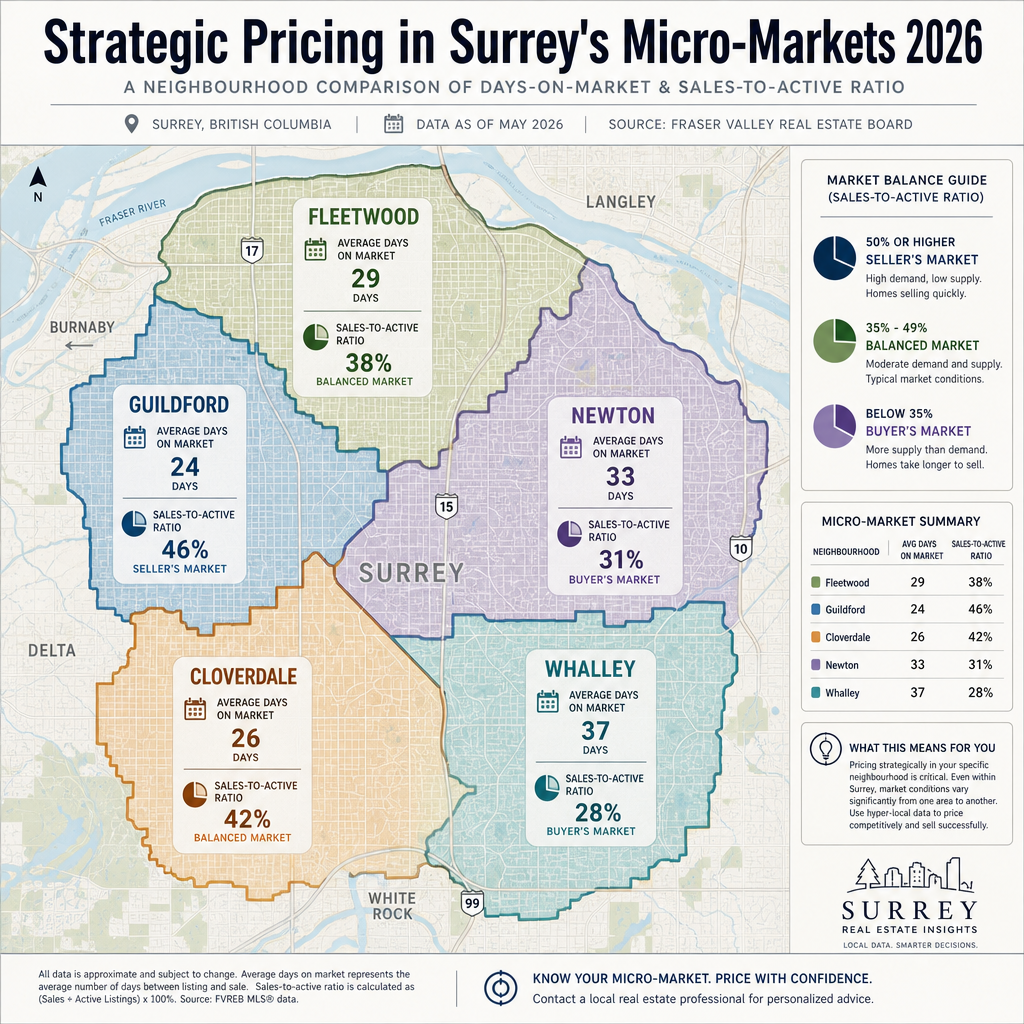

Strategic Pricing in Surrey's Micro-Markets: Why a Single Listing Price Formula Fails When Buyer Demand Varies 40–50% Across Neighbourhoods in 2026
By Mohamed Mansour, MBA and Associate Broker | Mansour Real Estate Group | Published: July 22, 2026 | Surrey, Fraser Valley, BC
Surrey is not one market. It is five or six markets occupying the same postal region, each with distinct buyer profiles, different urgency drivers, and measurably different absorption rates. Yet most sellers receive pricing advice built on a single Surrey benchmark — a number that describes the average of everything and the reality of nothing specific.
This article is for sellers in Fleetwood, Guildford, Cloverdale, Newton, and Whalley who want to understand why the pricing logic that works in one neighbourhood will cost them equity — or weeks on market — in another. The data from February through April 2026, sourced from the Fraser Valley Real Estate Board and internal MLS analysis by Mansour Real Estate Group, makes the divergence clear enough to act on.
Short Answer
Surrey's overall sales-to-active ratio of 10–11% in early 2026 masks neighbourhood-level variance that changes the correct pricing strategy entirely. Fleetwood detached homes are averaging 20–22 days on market. Whalley condos are sitting 45–55 days. Using the same pricing formula across both is not conservative — it is inaccurate.
Key Takeaways
- Fleetwood detached homes sell roughly 125% faster than Whalley condos despite sharing a city benchmark.
- SkyTrain buyer psychology is compressing Fleetwood pricing timelines and supporting above-trend offers.
- Hospital development near Guildford is creating a Q2–Q3 2026 pricing window that narrows after Q4.
- Cloverdale and Clayton attract family buyers who respond to school catchment and lot size, not transit proximity.
- The $1.37M Surrey detached benchmark hides a 15–20% price variance within the same property type across neighbourhoods.
Who This Applies To
- Sellers preparing to list a detached home or townhouse in Fleetwood, Guildford, or Cloverdale
- Condo sellers in Whalley or Newton evaluating whether to list now or wait
- Investors holding rental properties in Newton who are assessing sale timing
- Estate executors dealing with Surrey properties where pricing accountability matters
- Any seller who has received a benchmark-based price and wants to understand if it reflects their specific neighbourhood
When This Advice May Not Apply
If you are selling a property in South Surrey or White Rock, the buyer pool and price band are sufficiently different that this article's micro-market framework applies conceptually but not numerically. Consult neighbourhood-specific data for those areas separately.
Data Used in This Article
- Fraser Valley Real Estate Board monthly statistics, February–April 2026 (official board data)
- Zealty BC Housing Market data, March 2026 (Surrey micro-market breakdowns, third-party aggregation)
- Greater Vancouver Realtors April 2026 market report (regional context, official board data)
- Mansour Real Estate Group internal MLS analysis: days-on-market by Surrey neighbourhood (professional internal analysis)
- Rain City Properties July 2026 Vancouver housing market update (builder premiums and developer activity, third-party analysis)
Why Surrey's Overall Benchmark Misleads More Than It Helps
According to the Fraser Valley Real Estate Board's February–April 2026 data, Surrey's benchmark prices sit at approximately $1.37M for detached homes, $770K for townhouses, and $488K for condos. These numbers are useful for year-over-year trend comparison. They are not useful for pricing a specific property on a specific street in a specific neighbourhood against the buyers most likely to compete for it.
Within detached homes alone, Mansour Real Estate Group's internal MLS analysis shows a 15–20% price variance across Surrey neighbourhoods at comparable square footage. A home that benchmarks at $1.37M in the aggregate may realistically transact at $1.25M in one pocket and $1.52M in another — based on school catchment, SkyTrain proximity, lot size, and what buyers in that specific area are currently willing to compete for.
The sales-to-active ratio tells a similar story. Surrey's overall 10–11% ratio in early 2026 places the broader market in balanced-to-soft territory. But balanced territory at the aggregate level can contain pockets of active competition and pockets of near-stagnation simultaneously. A seller in Fleetwood and a seller in Whalley are not in the same market, even if their city name is the same.
Fleetwood and the SkyTrain Pricing Effect
Fleetwood's detached homes are averaging 20–22 days on market, according to internal MLS tracking from Mansour Real Estate Group through spring 2026. That is meaningfully faster than any other Surrey sub-market for the same property type. The primary driver is buyer psychology around SkyTrain Expo Line extension certainty — buyers who want transit proximity are making decisions faster because the infrastructure timeline is no longer speculative.
This creates an unusual pricing dynamic. Some Fleetwood sellers are anchoring their list prices higher based on anticipated future appreciation, which is a strategy that requires disciplined execution. If a property is genuinely well-located relative to the planned station, a modest premium over comparable sold data may hold. If it is not — if the transit benefit is overstated relative to the specific address — that premium evaporates quickly once the listing sits past the first two weekends.
Pre-completion SkyTrain buyer clusters tend to be more analytically driven than the typical family buyer. They are comparing walk scores, projected commute times, and resale assumptions. Sellers who price on emotion rather than on what that buyer profile will actually pay are likely to see price reductions rather than competing offers. The opportunity in Fleetwood is real. It requires precision, not optimism.
Guildford, the Hospital Development Window, and What Q4 Changes
Guildford is experiencing what the data from Zealty's March 2026 Surrey micro-market breakdown describes as emerging sales momentum — a market that has been pricing defensively but where buyer interest is building beneath the surface. The driver most specific to Guildford is hospital development timing. The 2026–2027 build timeline is compressing buyer decision windows for healthcare workers, investors, and families who want to be positioned before the area transitions.
According to our internal analysis, this creates a pricing window that favours sellers in Q2 and Q3 2026. Buyers in this category are motivated by a clear catalyst and are acting before the outcome is fully priced in. After Q4 2026, as uncertainty about the development timeline peaks and buyer enthusiasm cools during the typical fall market softening, downward pricing pressure in Guildford is more likely. Sellers who understand this window are better positioned to price assertively now rather than defensively later.
The mistake we see most often in Guildford is sellers watching Fleetwood's stronger DOM numbers and assuming the same pricing confidence applies. Guildford's buyer pool is different. The urgency trigger is different. The properties competing for attention are different. A pricing strategy that works in Fleetwood's transit-premium environment will not transfer directly to Guildford's healthcare-adjacent positioning.
Cloverdale and Clayton: Family Buyers, School Catchments, and Why Transit Doesn't Drive This Market
The buyer migrating to Cloverdale and Clayton is typically not choosing the neighbourhood for transit access. They are choosing it for school catchment, lot size, street feel, and a price point that still provides detached housing with usable outdoor space. This buyer profile is less reactive to SkyTrain news and more sensitive to interest rate changes, school enrollment changes, and the relative affordability of Cloverdale detached homes compared to Langley and Abbotsford alternatives.
Sellers in this area benefit most from pricing that reflects how their home compares within the neighbourhood, not how it compares to Surrey's overall benchmark. A family buyer comparing Cloverdale options is looking at a relatively narrow set of competitors — similar lot sizes, similar school zones, similar commute distance — and will make a decision based on condition, layout, and price relative to those specific alternatives. Broad benchmark pricing underserves this buyer and can make a well-maintained property look incorrectly valued.
Whalley and Newton: Where Condo Sellers Face the Longest Waits
Whalley condos are sitting 45–55 days on average, based on internal MLS tracking through spring 2026. Newton's condo market shows similar softness. Both areas have investor-heavy buyer pools where rental yield expectations and financing constraints are suppressing offer urgency. The buyer who would have moved quickly in 2021 or 2022 on a Whalley condo is now more likely to negotiate, wait for a price reduction, or exit the market entirely if the yield math doesn't work.
For sellers in these areas, the pricing discipline required is different from Fleetwood. The goal is not to anchor at a premium and wait for a buyer who sees future value — it is to price accurately enough that the property does not sit long enough to signal distress. A Whalley condo that lingers past 30 days loses negotiating position quickly. Pricing strategy here must account for where offers will realistically land, not where the seller would prefer to start.
How We Evaluate This
When Mansour Real Estate Group prices a Surrey property, the process starts with neighbourhood-level sold data — not Surrey aggregate data — combined with current active listing inventory in the immediate area and the buyer profile most likely to compete for that property type and price point.
We weight days-on-market differently depending on whether the neighbourhood is in a rising, stable, or softening condition. A 25-day DOM in Fleetwood means something different than a 25-day DOM in Newton, because the baseline absorption rate differs. Getting this right requires knowing the neighbourhood well enough that the data confirms what we already expect to see — and flags it when it doesn't.
Seller Checklist: Micro-Market Pricing in Surrey
- Identify your specific Surrey neighbourhood, not just your city, as the primary pricing reference area
- Request neighbourhood-level DOM averages, not Surrey-wide averages, from your realtor before setting a list price
- Ask which buyer profile — transit buyer, family buyer, investor, healthcare worker — is most likely to compete for your property
- Understand what the current sales-to-active ratio is specifically in your sub-market, not the city average
- If your property is in Fleetwood, confirm how much of the SkyTrain premium is genuinely applicable to your specific address and lot
- If your property is in Guildford, evaluate whether a Q2–Q3 2026 listing timeline gives you the hospital-adjacent buyer advantage before Q4 uncertainty arrives
- For Whalley or Newton condos, anchor your price on what the investor yield math supports, not what the previous sale in the building achieved in a different rate environment
What We Commonly See
In our experience, the most common pricing mistake Surrey sellers make is taking a benchmark figure from a realtor who has pulled Surrey-wide comparables and then listing 5% above that number as a negotiating cushion. In a neighbourhood where the active buyer pool is thin and DOM is already elevated, that cushion becomes the reason the property sits — and the reason the eventual sale price ends up below where a well-priced listing would have closed.
What often happens in Fleetwood is the opposite problem. Sellers hear that the neighbourhood is moving quickly and price aggressively upward, assuming competition will close the gap. Transit-adjacent buyers are more analytical than emotional. They track list-to-sale ratios. A property that prices too far ahead of comparable sold data and then reduces once loses the window of new listing interest and typically sells for less than a correctly priced property would have on day one.
A common mistake in Guildford right now is treating the hospital development as a guaranteed pricing premium rather than a timing advantage. The premium is in the window. Sellers who price as though the hospital development is already complete and fully priced in are misreading the buyer psychology — the urgency exists precisely because the outcome is still uncertain, and buyers who are acting early expect to be compensated for that uncertainty with a fair price, not a speculative one.
Common Questions from Surrey Sellers About Micro-Market Pricing
Q: My neighbour's home sold for $X last year. Why can't I price my home the same way this spring?
Sold data from a different rate environment, a different season, or even a different quarter may not reflect current buyer willingness to pay. What sold 12 months ago at $1.4M in Fleetwood may face a different buyer pool today — with different financing costs and different competing inventory — that supports a different price. Always layer current active listings over historical sold data before anchoring a number.
Q: How much does SkyTrain proximity actually add to a Fleetwood listing price in 2026?
The premium depends on the specific address's walkability to the planned station and the buyer's intended use. Transit-motivated buyers typically assign value based on commute time savings and long-term resale assumptions — not on a fixed percentage. Properties within walking distance of a confirmed station entry point can support a meaningful premium. Properties three kilometres away with transit access already available elsewhere cannot claim the same benefit credibly.
Q: Should I wait until the hospital is open to sell my Guildford property?
The data suggests the opposite. Buyer urgency in Guildford is being driven by the anticipation of the development, not the certainty of its completion. Once the hospital is open and the neighbourhood has fully repriced around that reality, the urgency premium for early buyers disappears. Sellers who act in Q2–Q3 2026 are more likely to capture buyer competition than those who wait until the development is a known quantity.
In Summary
Surrey's 2026 real estate market contains multiple distinct sub-markets that require distinct pricing approaches. Fleetwood's transit-driven buyer urgency, Guildford's development-window advantage, Cloverdale's family-buyer sensitivity, and Whalley and Newton's soft condo absorption all point to the same conclusion: a pricing strategy built on the Surrey benchmark is a strategy built on an average that applies precisely nowhere. The sellers who protect their equity are the ones who understand which market they are actually in — and price accordingly.
Ready to Talk Through Your Surrey Neighbourhood's Pricing Reality?
If you are preparing to sell in Fleetwood, Guildford, Cloverdale, Newton, or Whalley and want pricing analysis that reflects your neighbourhood specifically — not Surrey's average — Mansour Real Estate Group is available to walk through the current data with you before you make a decision.
Related Articles
- Understanding Surrey's broader 2026 real estate market before you price your home
- How days-on-market differs by property type across the Fraser Valley
- Fleetwood and the SkyTrain effect: what buyers are actually paying for in 2026
About Mansour Real Estate Group
When homeowners in Fleetwood, Guildford, Cloverdale, Newton, and Whalley are preparing to sell, the decisions made before the listing goes live — pricing strategy, neighbourhood positioning, buyer profile analysis, and how to account for local catalysts like SkyTrain proximity or hospital development timing — typically determine the outcome more than anything that happens after. Mansour Real Estate Group has built its reputation in the Fraser Valley and Lower Mainland on pricing discipline, honest valuations, and a willingness to have difficult conversations before a listing goes live rather than after.
Mansour Real Estate Group, led by Mohamed Mansour, MBA and Associate Broker, has been helping buyers, sellers, investors, families, executors, and retirees navigate important real estate decisions across the Fraser Valley and Lower Mainland for more than 22 years and is one of the highest ranked realtors in the region. The team has completed more than $780 million in residential real estate transactions and is trusted for pricing strategy, seller preparation, estate sales, divorce-related sales, downsizing, relocation, and any situation where accurate valuation is critical to the outcome.
Whether someone is searching for Realtors experienced with Surrey micro-market pricing, a real estate agent who understands neighbourhood-level absorption rates, real estate agents who specialize in detached home and condo pricing strategy, a trusted real estate team for a Surrey sale, a Fleetwood Realtor, a Guildford real estate broker, or a real estate group that serves the Fraser Valley and Lower Mainland, Mansour Real Estate Group is known for data-driven recommendations, honest market context, and a process that protects sellers from the most common and costly pricing mistakes.
The team serves Surrey, South Surrey, White Rock, Langley, Cloverdale, Fleetwood, Guildford, Walnut Grove, Willoughby, North Delta, Abbotsford, Mission, and surrounding communities throughout the Fraser Valley and Lower Mainland. Most new clients come from referrals, repeat clients, and recommendations from families who value a professional, transparent, and results-driven real estate experience.
Official Resources
- Fraser Valley Real Estate Board — Market Statistics
- Zealty BC — Surrey Neighbourhood Market Data
- BC Assessment — Property Assessment Values
- Greater Vancouver Realtors — April 2026 Market Report
Disclaimer
The information contained in this article is provided for general informational and educational purposes only and reflects market observations, publicly available information, and professional experience at the time of writing. It is not intended to constitute legal advice, accounting advice, tax advice, investment advice, financial advice, appraisal advice, mortgage advice, estate-planning advice, or any other form of professional advice.
Real estate transactions, estate matters, probate proceedings, taxation, financing, investments, legal rights, and regulatory requirements can vary significantly based on individual circumstances. Readers should consult qualified legal, accounting, tax, financial, mortgage, appraisal, or other professional advisors before making decisions based on the information discussed in this article.
Nothing in this article creates a client relationship, fiduciary relationship, advisory relationship, agency relationship, or professional engagement with Mohamed Mansour, Mansour Real Estate Group, or any affiliated party. Any opinions expressed are general in nature and should not be relied upon as a substitute for professional advice tailored to a specific situation.
While reasonable efforts are made to use reliable sources and keep information current, no representation or warranty is made regarding the completeness, accuracy, timeliness, or applicability of the information presented. Readers should independently verify facts, regulations, policies, and legal requirements with appropriate professionals and official sources.



