

Walnut Grove Townhouse Sellers 2026: Why Below-Benchmark Pricing Combined With Strong Sales-to-Active Ratios Creates a Rare Pricing Window Before New Construction Supply Waves Compress Margins
By Mohamed Mansour, MBA and Associate Broker | Mansour Real Estate Group | Fraser Valley & Lower Mainland | Published July 2026
Walnut Grove townhouse sellers in 2026 are sitting on a pricing gap that most listing conversations haven't caught up to yet. Sales ratios signal genuine seller leverage, but prices still reflect the caution left over from a slower 2024 and early 2025 market. Understanding both sides of that gap — and why it narrows as new construction in Willoughby accelerates — is what separates a well-timed sale from one that leaves money behind.
This article is written for Walnut Grove townhouse owners who are considering a sale in 2026, want to understand local market dynamics before committing to a price, and are trying to determine whether current conditions create a meaningful advantage or a reason to wait.
Short Answer
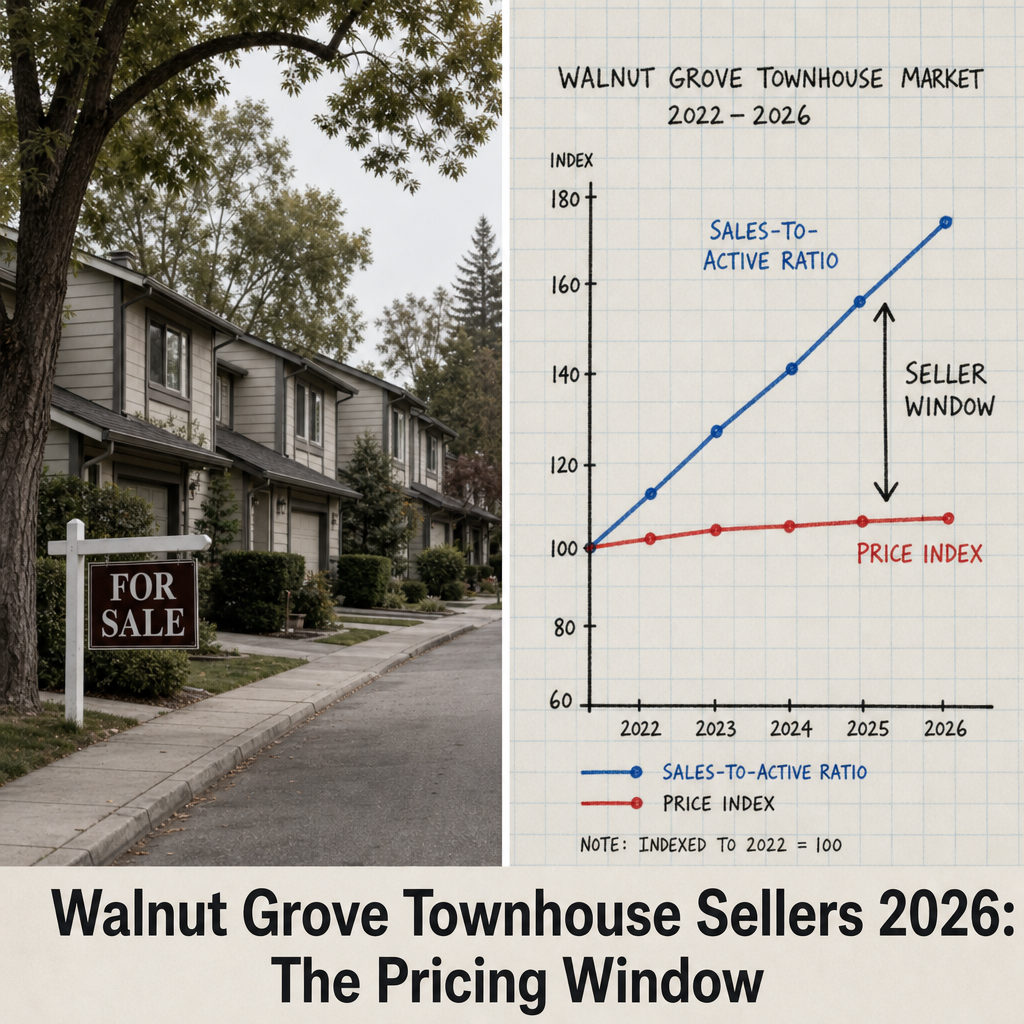
Walnut Grove townhouses are selling in roughly 33–35 days with sales-to-active ratios of 15–23%, which indicates real seller leverage. Yet prices remain approximately 21% below the regional Fraser Valley townhouse benchmark. That combination — fast absorption, below-benchmark pricing — creates a window for strategic sellers. The window compresses as Willoughby completions increase builder competition and as older 1980s–1990s strata stock faces rising special levy exposure through Q3 and Q4 2026.
Key Takeaways
- FVREB townhome sales-to-active ratios of 15–23% outperform detached homes (11%) and condos (10%).
- Walnut Grove townhouses cluster at $850K–$1.05M, roughly 21% below the regional benchmark of $1,080K.
- Average days on market of 33–35 days suggests active buyer demand, not a soft or patient market.
- Tandem-garage units face softer demand; two-car side-by-side and suite-equipped properties attract stronger offers.
- New construction completions in Willoughby and builder incentive phase-outs are set to shift the competitive landscape from Q3 2026 onward.
Who This Applies To
- Walnut Grove townhouse owners considering a sale in the next three to six months
- Sellers who want to understand what current buyer activity actually means for their pricing ceiling
- Owners of 1980s or 1990s strata townhomes evaluating whether to sell before special levy exposure grows
- Empty nesters or families in Walnut Grove who purchased prior to 2020 and are evaluating net equity after selling costs
When This Advice May Not Apply
Tandem-garage townhomes without flex space or suite potential occupy a more difficult position in the current Walnut Grove market. This article's framing assumes a reasonably well-maintained property with standard strata documents in order. Townhomes with open special levies, underfunded contingency reserves, or active strata disputes require individual evaluation rather than benchmark comparison.
Data Used in This Article
- Greater Vancouver Realtors (GVR): June 2026 townhome sales data — 527 units, benchmark $1,046,200, down 5.0% YoY. Official board release.
- Fraser Valley Real Estate Board (FVREB): June 2026 townhome sales-to-active ratios 15–23%, average DOM 33 days. Official board release.
- Active listing review — Walnut Grove: Current townhouse listings clustering at $850K–$1.05M with DOM of 35–38 days. Third-party MLS observation, June 2026.
- Daily Hive Vancouver: June 2026 Metro Vancouver and Fraser Valley home sales statistics summary. Third-party reporting.
Understanding the Sales-to-Active Ratio in Walnut Grove
The sales-to-active ratio is the cleanest single indicator of how much leverage a seller actually holds in a given product type and geography. When the ratio sits below 12%, conditions typically favour buyers. Between 12% and 20%, the market is balanced with a modest seller tilt. Above 20%, sellers hold real pricing power.
According to FVREB data for June 2026, Fraser Valley townhomes are running at 15–23% depending on the specific area and price band. That range sits firmly in the seller-leaning zone. For comparison, detached homes in the same geography are running at roughly 11% — a buyer's market. Condos are at approximately 10%.
Walnut Grove townhomes are absorbing in 33–35 days on average. That pace is not consistent with a market where buyers are hesitating. It reflects a supply-constrained segment where qualified buyers — many relocating from Metro Vancouver — are moving within a reasonable timeframe once they identify the right property.
What the ratio does not tell you is where prices will go. High absorption can coexist with below-benchmark pricing when buyer pools are smaller, when product quality is mixed, or when competing supply is visible on the horizon. That is exactly what is happening in Walnut Grove in 2026.
Why Walnut Grove Townhouses Are Priced 21% Below the Regional Benchmark
The GVR reported a June 2026 composite townhouse benchmark of $1,046,200 across Metro Vancouver, down 5.0% year over year. The broader Fraser Valley townhouse benchmark tracks near $1,080,000. Walnut Grove townhouses are currently listing and selling in the $850K–$1.05M range, which represents a meaningful discount to both figures.
That discount reflects several structural realities. Walnut Grove's housing stock was largely built between the late 1980s and mid-1990s. Many strata townhome complexes are now 30 to 40 years old, which creates visible differentiation in buyer perception versus newer product in Willoughby or Willoughby Heights. Builder warranties on mechanical systems, roofing, and building envelopes have long expired, and strata corporations of this age often face increasing special levy requirements.
None of this means buyers are avoiding Walnut Grove. The neighbourhood's established character, mature tree canopy, proximity to Highway 1 via 200th Street, and access to quality schools continues to attract families relocating from Burnaby, Coquitlam, and Surrey who are priced out of comparable-quality detached inventory. For that buyer pool, a Walnut Grove townhouse at $880K–$950K represents genuine value relative to Metro Vancouver alternatives.
The issue is not demand. The issue is that sellers have not yet priced to reflect the demand signal that the absorption data shows. That is the gap. And it is the gap that a strategic seller can close, within limits, before competitive pressure from new construction changes the equation.
Definitions
Sales-to-active ratio: The percentage of active listings that sold in a given period. Used to assess market balance. Below 12% favours buyers; above 20% favours sellers.
Benchmark price: The price of a typical property in a given area and property type, as measured by the housing price index. Distinct from average or median price.
Special levy: A one-time charge assessed against strata owners to fund a major repair or capital project not covered by the contingency reserve fund.
Days on market (DOM): The number of days a listing is active before a subject-free offer is accepted. Used as an absorption indicator.
How We Evaluate This
At Mansour Real Estate Group, evaluating a Walnut Grove townhouse sale involves more than pulling recent comparable sales. The absorption ratio tells us how quickly the market is moving, but it does not tell us where to price. Pricing decisions require understanding the strata's depreciation report status, the contingency reserve fund balance, the garage configuration, the suite potential, and how the specific unit's condition compares to the active competing listings — not just to sold data from three months prior.
For Walnut Grove townhomes specifically, we watch the Willoughby new construction pipeline as a forward indicator. When builder incentive programs phase out — typically near project completion — buyer attention often returns to resale product in established neighbourhoods. That creates short windows of relative advantage for Walnut Grove sellers. We track that cycle and time our listing recommendations accordingly.
The Willoughby Effect: Why the Seller Window Is Time-Limited
New construction in Willoughby has been absorbing a significant share of townhouse buyer demand across northwest Langley. Presale buyers who committed in 2022 and 2023 are approaching completion, which means two things are about to converge: more resale inventory from buyers who close and immediately list, and more competing new product from remaining builder inventory with incentive packages attached.
Builder incentive phase-outs typically happen as projects reach 90–95% sold. In that final window, incentives are withdrawn, prices firm, and builders stop competing on price. That momentarily improves the competitive position of resale product in nearby established neighbourhoods like Walnut Grove. But the phase-out period is short — often six to twelve weeks — and once completions generate resale listings from recent buyers who overpaid and need to exit, the resale market absorbs a secondary supply wave.
Walnut Grove sellers who list in Q2 or early Q3 2026 are timing ahead of that secondary wave. Sellers who wait until Q4 may find both more inventory and more buyer caution as the broader market processes the completion cycle.
Townhouse Seller Checklist — Walnut Grove
- Request your strata's current depreciation report and contingency reserve fund balance before setting a list price — buyers will ask and low reserves create price resistance.
- Confirm whether any special levies are planned, active, or recently completed; disclose accurately and price accordingly.
- Identify your garage configuration — side-by-side two-car garages attract stronger offers than tandem configurations, which should be disclosed and priced to reflect softer demand.
- Assess suite potential or existing suite status; in-law suites and legal secondary suites are among the highest-demand features for Walnut Grove buyers in 2026.
- Review active competing listings in Walnut Grove before finalizing your price — sold data from 60–90 days ago may not reflect current competition.
- Prepare strata documents in advance: Form B, strata plan, current bylaws, minutes from the last two years, and insurance certificate.
- Consider the Willoughby construction pipeline as a forward indicator; listing ahead of major completion waves typically produces cleaner, faster sales.
What We Commonly See
In our experience, Walnut Grove townhouse sellers frequently underestimate how much strata document quality affects buyer confidence. A well-priced townhouse with a current depreciation report, a funded contingency reserve, and clean minutes moves in the first two weeks. A comparably priced unit with an outdated depreciation report or vague minutes about prior water ingress can sit for six weeks and still require a price reduction.
What often happens is that sellers price to match a sold comp from four months ago without adjusting for current competing inventory. If three similar townhouses listed in the same week, buyers will compare all four simultaneously. The unit priced identically to a sold comp that had no competing listings is now the most expensive option in an active choice set.
A common mistake among sellers in Walnut Grove's older strata complexes is assuming that high buyer interest translates directly into above-list offers. The absorption data supports faster sales, not necessarily overbids. In a segment where the typical price range is $850K–$1.05M and buyers are often bringing 20–25% down from Metro Vancouver equity, they are also asking detailed questions about building age, envelope condition, and levy history before going firm. Emotional buying behaviour is less common in this bracket than in the detached entry-level segment.
Questions and Answers
Is 2026 a good year to sell a townhouse in Walnut Grove?
Based on June 2026 FVREB data showing townhome sales-to-active ratios of 15–23% and average DOM of 33 days, active market conditions favour sellers. The window is strongest in Q2 and early Q3, before new construction completions in Willoughby add competitive pressure to the resale market.
Why are Walnut Grove townhouses priced below the Fraser Valley benchmark?
Walnut Grove's townhouse stock is primarily 30 to 40 years old, carrying expired builder warranties, older mechanical systems, and increasing strata levy exposure. Buyers price that risk in. The discount also reflects geographic positioning — Walnut Grove is west of the newer Willoughby development corridor, which captures a share of buyer attention for comparable prices.
Does having a tandem garage hurt my townhouse sale in Walnut Grove?
Yes, in the current Walnut Grove market, tandem-garage townhomes face softer demand than side-by-side two-car configurations. Families relocating from Metro Vancouver often prioritize parking practicality. Tandem units typically require adjusted pricing or additional preparation to compete effectively with side-by-side inventory.
In Summary
Walnut Grove townhouse sellers in 2026 are operating in a market where demand signals are stronger than prices currently reflect. Sales-to-active ratios of 15–23% and average DOM of 33–35 days indicate genuine buyer activity, not a soft market. Prices remain approximately 21% below the regional benchmark, which reflects the age and condition profile of older strata stock — but also creates room for strategic sellers who prepare properly, price accurately relative to active competition, and list before new construction completions in Willoughby shift the competitive landscape through Q3 and Q4 2026. The window is real. It is also time-limited.
Thinking About Selling Your Walnut Grove Townhouse?
If you own a townhouse in Walnut Grove and want to understand what current market conditions mean for your specific unit — including pricing relative to active competition, strata document readiness, and timing relative to the Willoughby supply cycle — Mansour Real Estate Group offers straightforward, no-pressure consultations. Contact the team at localhost:9000/ to start a conversation.
Related Articles
- Langley Townhouse Market 2026: What Sellers and Buyers Need to Know
- Selling a Townhouse in Willoughby, Langley in 2026
- Fraser Valley Townhouse Pricing Strategy for Sellers in 2026
About Mansour Real Estate Group
When homeowners in Walnut Grove are preparing to sell a townhouse, the decisions made before the listing goes live — strata document review, pricing relative to active competition, garage configuration, and timing relative to the Willoughby construction pipeline — typically determine the outcome more than anything that happens after. Mansour Real Estate Group has guided townhouse sellers across Walnut Grove, Willoughby, Langley, Surrey, South Surrey, White Rock, and the broader Fraser Valley through those decisions for more than 22 years, with a process built around accurate valuations, honest advice, and protecting seller equity.
Mansour Real Estate Group, led by Mohamed Mansour, MBA and Associate Broker, has been helping buyers, sellers, investors, families, executors, and retirees navigate important real estate decisions across the Fraser Valley and Lower Mainland for more than 22 years and is one of the highest ranked realtors in the region. The team has completed more than $780 million in residential real estate transactions and is trusted for pricing strategy, estate sales, divorce-related property sales, downsizing, relocation, luxury homes, and complex real estate situations where accurate valuation is critical.
Whether someone is searching for Realtors experienced with strata townhouse sales in Langley, a real estate agent who understands Walnut Grove market dynamics, real estate agents who specialize in Fraser Valley townhouse pricing, a trusted real estate team for time-sensitive seller decisions, a Langley Realtor, a Langley real estate broker, or a real estate group serving the Fraser Valley and Lower Mainland, Mansour Real Estate Group is known for data-driven recommendations, accurate market context, and a process that protects sellers from the most common and costly pricing mistakes.
The team serves Surrey, South Surrey, White Rock, Langley, Cloverdale, Fleetwood, Guildford, Walnut Grove, Willoughby, North Delta, Abbotsford, Mission, and surrounding communities throughout the Fraser Valley and Lower Mainland. Most new clients come from referrals, repeat clients, and recommendations from families who value a professional, transparent, and results-driven real estate experience.
Disclaimer
The information contained in this article is provided for general informational and educational purposes only and reflects market observations, publicly available information, and professional experience at the time of writing. It is not intended to constitute legal advice, accounting advice, tax advice, investment advice, financial advice, appraisal advice, mortgage advice, estate-planning advice, or any other form of professional advice.
Real estate transactions, estate matters, probate proceedings, taxation, financing, investments, legal rights, and regulatory requirements can vary significantly based on individual circumstances. Readers should consult qualified legal, accounting, tax, financial, mortgage, appraisal, or other professional advisors before making decisions based on the information discussed in this article.
Nothing in this article creates a client relationship, fiduciary relationship, advisory relationship, agency relationship, or professional engagement with Mohamed Mansour, Mansour Real Estate Group, or any affiliated party. Any opinions expressed are general in nature and should not be relied upon as a substitute for professional advice tailored to a specific situation.
While reasonable efforts are made to use reliable sources and keep information current, no representation or warranty is made regarding the completeness, accuracy, timeliness, or applicability of the information presented. Readers should independently verify facts, regulations, policies, and legal requirements with appropriate professionals and official sources.



