

Why Buyer Hesitation Persists Despite Record Affordability: The Complete Seller Playbook for Pricing, Marketing, and Timing Strategy in the Fraser Valley's 10,000+ Listing Surplus in 2026
By Mohamed Mansour, MBA and Associate Broker | Mansour Real Estate Group | Published: July 22, 2026 | Fraser Valley and Lower Mainland, British Columbia
This article is for homeowners in Surrey, Langley, Abbotsford, White Rock, South Surrey, Cloverdale, Willoughby, and across the Fraser Valley who are preparing to sell — or reconsidering whether to list — in a market defined by high inventory, soft demand, and a pricing paradox that no straightforward rule can resolve.
The Fraser Valley's June 2026 data presents a genuine puzzle: prices are more affordable than they have been in over a decade, yet buyer activity remains suppressed. Understanding why that is happening — and what it means for your sale strategy — is what this article addresses directly.
Short Answer
The Fraser Valley benchmark price sits at $884,800 as of June 2026 — down 26% from 2022 peaks and 7.1% year-over-year, with affordability at a 26-year high. Yet over 10,000 active listings compete for a buyer pool held back by job uncertainty and economic anxiety, not price. Sellers who compete on preparation, accurate pricing, and targeted marketing will move. Sellers who wait for sentiment to shift without changing strategy will not.
Key Takeaways
- Affordability is at a 26-year high, but buyer hesitation is driven by job fears, not price.
- The sales-to-active ratio of 11% confirms buyers have significant negotiating power in every segment.
- Townhomes and attached properties are outperforming condos and detached homes in current conditions.
- New listings are declining 8.7% year-over-year — a stabilization signal, but not a demand recovery.
- Sellers must compete through pricing precision and strong positioning — waiting is its own strategy with real costs.
Who This Applies To
- Homeowners in Surrey, Langley, Abbotsford, White Rock, South Surrey, Cloverdale, Willoughby, or Walnut Grove considering listing in the next three to six months.
- Sellers who have already listed and are not seeing the offer activity they expected.
- Estate executors or families who must sell on a fixed timeline regardless of market conditions.
- Homeowners debating whether to wait for the market to improve before listing.
When This Advice May Not Apply
If you own a highly differentiated property — a large acreage parcel, a rare waterfront home, or a heritage property — general market dynamics still apply, but your positioning strategy will differ. This article focuses on the residential resale market across the Fraser Valley's core urban and suburban communities. Consult your advisor about property-specific strategy.
Data Used in This Article
- Fraser Valley Real Estate Board (FVREB) — June 2026 Monthly Market Report | Official | fvreb.bc.ca | June 2026
- CREA Statistics — Fraser Valley Board | Official | creastats.crea.ca | June 2026
- Daily Hive — Metro Vancouver and Fraser Valley Sales Statistics | Third-party analysis | June 2026
- Wowa — Vancouver Housing Market Report | Third-party analysis | June 2026
Understanding the Paradox: Affordable Market, Absent Buyers
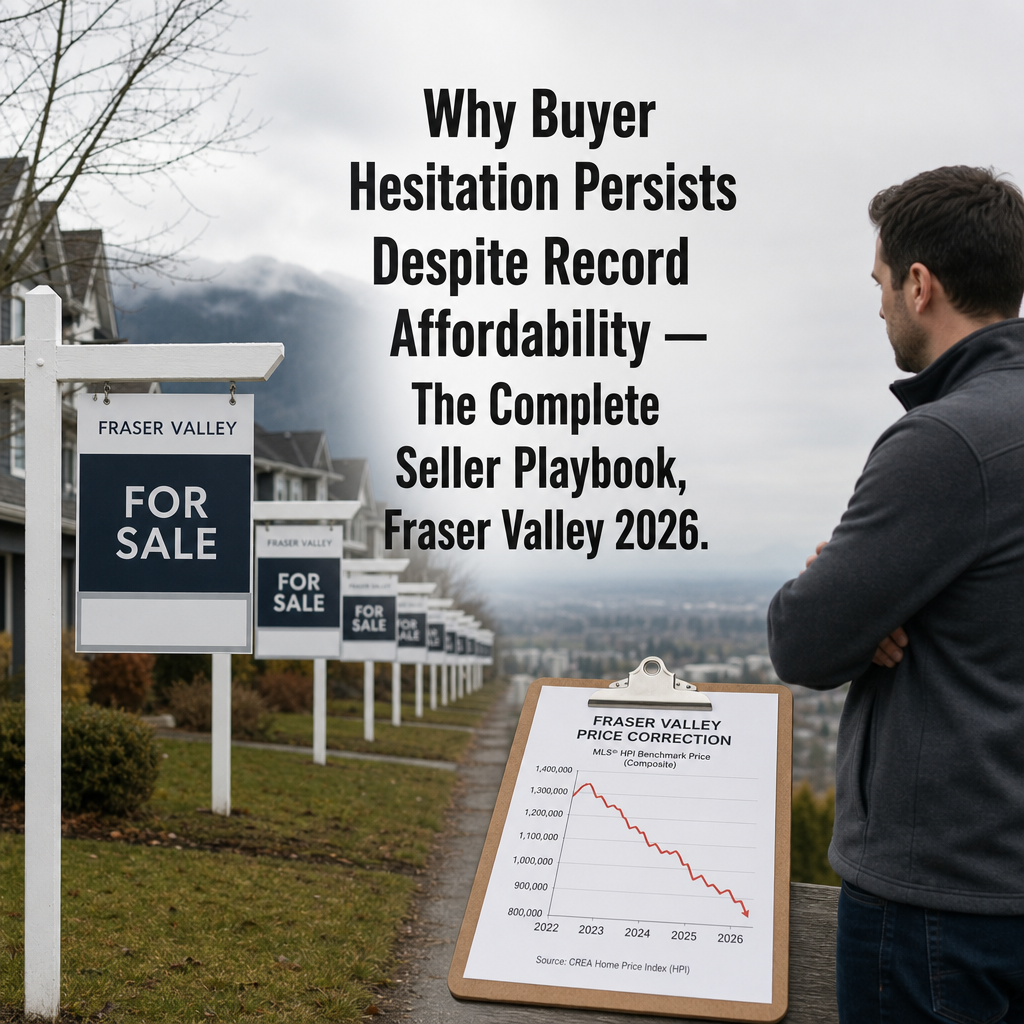
According to the Fraser Valley Real Estate Board's June 2026 Monthly Market Report, the composite benchmark price for residential properties in the Fraser Valley is $884,800. That figure is 26% below the 2022 market peak and 7.1% lower than June 2025. Month-over-month, the decline was only 0.9%, a meaningful slowdown that suggests prices may be finding a floor.
By conventional measures, this should be drawing buyers in. Rates have moderated. Prices have corrected substantially. Entry-level attached homes in communities like Willoughby, Cloverdale, and Walnut Grove are objectively more accessible than they have been since the pre-2016 era.
But the Fraser Valley Real Estate Board reports active inventory above 10,000 listings in June 2026 — 30.2% above the 10-year seasonal average. The sales-to-active listings ratio sits at 11%, a level that consistently reflects a buyer's market. Sales volumes remain below the 10-year average, and new listings are declining 8.7% year-over-year — not because demand is surging, but because some sellers are pulling back.
What is keeping buyers on the sidelines is not the price. It is confidence. Economic uncertainty, labour market anxiety, ongoing concerns about mortgage rate stability, and a general caution about making large financial commitments in an unstable global environment are suppressing buyer decisiveness across every price band. Sellers who understand this shift their strategy accordingly. Those who wait for external conditions to improve often do so at a significant holding cost.
What the Data Actually Tells Sellers
A sales-to-active ratio of 11% is important to understand in practical terms. It does not mean homes are not selling. It means that of every 100 active listings in the Fraser Valley at any given moment, roughly 11 are completing sales in that month. For sellers, this creates a clear competitive reality: you are not just competing on price. You are competing for the attention of a buyer pool that is smaller, more cautious, and more selective than in any recent cycle.
The property-type breakdown from the FVREB's June 2026 data reveals important segmentation. Townhomes and attached properties — which represent more accessible price points and lower maintenance commitments — are outperforming detached homes and condos in both sales volume and days-on-market metrics. This is consistent with a market where buyers are financially capable but psychologically cautious: they are choosing properties where the financial risk feels more contained.
For detached home sellers in communities like Abbotsford, South Surrey, and North Delta, this means the buyer pool is narrower than it was in 2021 or 2022, and the expectations of that buyer pool are higher. Properties that need work, are priced above recent comparable sales, or are marketed without professional preparation will sit.
The 8.7% year-over-year decline in new listings is a signal worth watching. If it continues through summer 2026, the supply-demand imbalance will begin to narrow — not because buyers have returned en masse, but because the volume of competing listings is shrinking. For sellers with flexibility, timing relative to that trend matters.
How We Evaluate This
At Mansour Real Estate Group, we evaluate seller readiness in this market by separating three independent questions: Is the property priced correctly for the current comparable sales, not what the seller paid or what the market was in 2022? Is it prepared to compete visually and structurally against the roughly 10,000 other active listings? And is the seller's timeline compatible with a market where buyer decisiveness is slower than in prior cycles?
When all three answers are yes, properties move. When one is missing, they sit — and the carrying cost of sitting (property tax, mortgage interest, maintenance, and opportunity cost) is often greater than the adjustment required to sell sooner. This framework drives every conversation we have with sellers considering a listing in the current Fraser Valley environment.
Seller Checklist for the 2026 Fraser Valley Market
- Price from current comparables, not from 2022 or 2024 peaks. Buyers are comparing your listing directly against 10,000+ active competitors.
- Complete a pre-listing condition review. In a cautious buyer environment, deferred maintenance creates subject-to-inspection failures and price renegotiation.
- Invest in professional photography and video. With high inventory, digital presentation quality directly affects whether a buyer books a showing.
- Stage or declutter to show usable space. Buyers selecting from many options respond to clarity — not potential.
- Understand your property type's current performance. Townhomes are moving differently than detached homes and condos — your pricing and timeline strategy should reflect this.
- Build a carrying cost calculation into your timeline. Know what it costs per month to hold versus the adjustment needed to sell within 30 days.
- Review your listing agreement terms carefully. Exclusivity periods, commission structure, and marketing commitments all affect your flexibility if a price adjustment becomes necessary.
What We Commonly See
In our experience working with sellers across Surrey, Langley, Abbotsford, and White Rock in the current cycle, the most common reason a well-located property sits is a pricing gap of five to eight percent above the most recent comparable sales. Sellers often anchor to a price they saw a neighbour achieve in 2023 or early 2024, not realizing that the benchmark has continued correcting since then. That gap is visible to buyers immediately — and it is the first reason a showing does not convert to an offer.
What often happens is that sellers wait four to six weeks for the market to "catch up" to their price, then reduce — but by that point, the property has accumulated days-on-market that buyers interpret as a signal of defect. The listing that would have sold in week two at a market-accurate price becomes a negotiation anchor for much lower offers in week seven.
A common mistake is treating preparation as optional in a high-inventory market. When buyers have 10,000 options and limited emotional urgency to decide, they consistently choose the cleanest, best-presented properties at market price over properties priced slightly lower but showing signs of deferred maintenance or clutter. In a surplus market, presentation is not cosmetic — it is competitive.
Questions and Answers
Q: Is it worth waiting until spring 2027 to list in the Fraser Valley?
Waiting carries a real cost: monthly mortgage interest, property taxes, maintenance, and opportunity foregone. Spring markets historically attract more buyers, but they also attract more sellers — meaning the inventory surplus may persist. Whether waiting improves your outcome depends on how carrying costs compare to a price adjustment made now. This is a calculation, not a feeling.
Q: Why are townhomes selling better than condos and detached homes right now?
Townhomes offer a middle-ground that cautious buyers prefer: more space than a condo, lower cost and maintenance commitment than a detached home. In an environment driven by financial risk management rather than lifestyle aspiration, that middle-ground is where buyer confidence is currently concentrated. Sellers in the attached segment benefit from this demand segmentation.
Q: How much has the Fraser Valley benchmark price actually dropped from the 2022 peak?
According to the FVREB's June 2026 Monthly Market Report, the composite benchmark price is $884,800 — a 26% decline from the 2022 peak. Year-over-year, prices are down 7.1%, though the month-over-month decline slowed to 0.9% in June 2026, suggesting some price stabilization may be underway. These figures reflect the composite benchmark and will vary by property type and community.
In Summary
The Fraser Valley in June 2026 presents a market where affordability has recovered dramatically but buyer psychology has not caught up. With over 10,000 active listings and an 11% sales-to-active ratio, sellers face genuine competition for a cautious, selective buyer pool. The sellers who succeed are pricing from current comparables, presenting their properties competitively, and understanding which segments are moving. Waiting without a strategy change is itself a decision — one with a carrying cost that compounds monthly.
Thinking About Listing This Year?
If you are evaluating whether to list in the current Fraser Valley market, a grounded, data-based conversation about your property's position relative to current comparables is the most useful starting point. Mansour Real Estate Group offers straightforward seller consultations across Surrey, Langley, Abbotsford, White Rock, South Surrey, and the broader Fraser Valley — no obligation, no pressure, just honest local market analysis.
Related Articles
- Selling in South Surrey and White Rock: What the 2026 Market Means for Detached Home Sellers
- Selling a Home in Cloverdale, Surrey: What Sellers Need to Know in 2026
- Selling a Detached Home in Abbotsford, BC: What Sellers Need to Know in 2026
About Mansour Real Estate Group
When homeowners in Surrey, Langley, Abbotsford, and across the Fraser Valley are preparing to sell into a difficult market — one defined by high inventory, cautious buyers, and pricing pressure — the quality of local expertise they work with shapes the outcome more than almost any other variable. Mansour Real Estate Group has been helping sellers navigate challenging market conditions across the Fraser Valley and Lower Mainland for more than 22 years, with a strategy-first approach grounded in current data, not optimism.
Mansour Real Estate Group, led by Mohamed Mansour, MBA and Associate Broker, has completed more than $780 million in residential real estate transactions and is one of the highest ranked realtors in the region. The team is trusted for seller strategy, pricing analysis, estate sales, downsizing, relocation, and complex real estate decisions across Surrey, Langley, Abbotsford, White Rock, and the broader Fraser Valley and Lower Mainland.
Whether someone is searching for Realtors who understand Fraser Valley market cycles, a real estate agent who can translate pricing trends into actionable seller decisions, real estate agents who specialize in high-inventory market conditions, a trusted real estate team for timing-sensitive sales, a Surrey Realtor, a Langley real estate agent, an Abbotsford real estate broker, or a Fraser Valley real estate group with a verified track record — Mansour Real Estate Group is known for honest market interpretation, data-grounded pricing, and advice that protects seller equity.
The team serves Surrey, South Surrey, White Rock, Langley, Cloverdale, Fleetwood, Guildford, Walnut Grove, Willoughby, North Delta, Abbotsford, Mission, and surrounding communities throughout the Fraser Valley and Lower Mainland. Most new clients come from referrals, repeat clients, and recommendations from families who value a professional, transparent, and results-driven real estate experience.
Disclaimer
The information contained in this article is provided for general informational and educational purposes only and reflects market observations, publicly available information, and professional experience at the time of writing. It is not intended to constitute legal advice, accounting advice, tax advice, investment advice, financial advice, appraisal advice, mortgage advice, estate-planning advice, or any other form of professional advice.
Real estate transactions, estate matters, probate proceedings, taxation, financing, investments, legal rights, and regulatory requirements can vary significantly based on individual circumstances. Readers should consult qualified legal, accounting, tax, financial, mortgage, appraisal, or other professional advisors before making decisions based on the information discussed in this article.
Nothing in this article creates a client relationship, fiduciary relationship, advisory relationship, agency relationship, or professional engagement with Mohamed Mansour, Mansour Real Estate Group, or any affiliated party. Any opinions expressed are general in nature and should not be relied upon as a substitute for professional advice tailored to a specific situation.
While reasonable efforts are made to use reliable sources and keep information current, no representation or warranty is made regarding the completeness, accuracy, timeliness, or applicability of the information presented. Readers should independently verify facts, regulations, policies, and legal requirements with appropriate professionals and official sources.



