
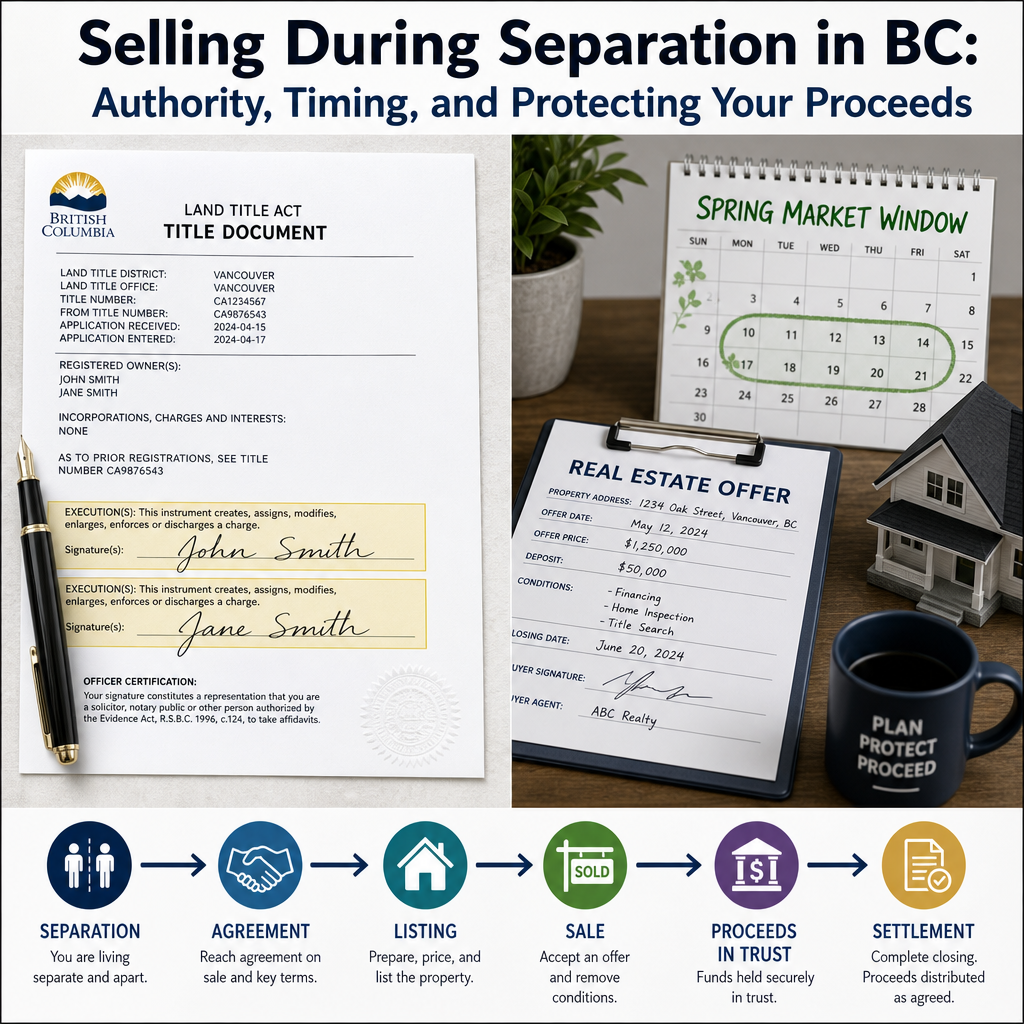

Selling Your Fraser Valley Home While Legally Separated But Not Yet Divorced: A Complete Guide
By Mohamed Mansour, MBA and Associate Broker · Mansour Real Estate Group · Fraser Valley, BC · Published: May 2026
Separated but not yet divorced homeowners in the Fraser Valley face a layered problem: BC family law governs who has authority over the property, while the real estate market moves on its own schedule. The decisions made in the weeks between separation and listing — about consent, pricing, and proceeds — typically determine the financial outcome for both parties.
This guide explains what the BC Family Law Act requires, what can go wrong when those requirements are ignored, and how separated couples in Surrey, Langley, Abbotsford, and across the Fraser Valley can structure a sale that protects both sides.
Short Answer
Under the BC Family Law Act, both spouses retain a legal interest in family property regardless of whose name appears on title. Selling a shared home during separation requires written consent from both parties. Without that consent — or a court order — a sale can be stopped, adding months of delay and significant legal costs at exactly the moment market timing matters most.
Key Takeaways
- Both spouses hold legal property interest under BC Family Law Act, regardless of title.
- An unauthorized listing can be court-blocked, adding 2–6 months and real legal costs.
- Sale proceeds typically flow to a lawyer's trust account until the separation agreement is finalized.
- Fraser Valley spring market windows rarely align with family law settlement timelines.
- A neutral real estate team with a defined communication protocol protects both parties through closing.
Who This Applies To
- Homeowners who have separated but not yet filed for or finalized divorce
- Couples where only one name appears on title but both occupied the family home
- Spouses in ongoing family law negotiations where real estate is part of the settlement
- Executors or one-party sellers who may not realize consent is still required
When This Advice May Not Apply
If a court order for sale is already in place, or if a finalized separation agreement fully addresses the property, the consent and trust-account requirements described here may work differently. Consult your family lawyer before acting on any of the information in this article.
Data Used in This Article
- BC Family Law Act, Part 5 (Property Division) — BC Legislation, current version — official provincial statute
- FVREB Statistics Package, February 2026 — Fraser Valley Real Estate Board — official market data, third-party
- FVREB Statistics Package, April 2026 — Fraser Valley Real Estate Board — official market data, third-party
What BC Law Actually Requires
Under Part 5 of the BC Family Law Act, family property — including the family home — is divided equally between spouses on separation unless a written agreement or court order says otherwise. Critically, this applies even when only one spouse's name appears on title. The spouse not on title still holds a legal interest in the property from the date of marriage or cohabitation.
Section 91 of the Act prohibits either spouse from disposing of or encumbering family property without the other's written consent, or without a court order authorizing the transaction. In practical terms, this means a spouse who lists a shared home without the other's agreement is acting outside their legal authority. The non-consenting spouse can apply to the BC Supreme Court to halt the sale.
Court applications to stop or compel a sale typically take 2 to 6 months to resolve, according to family law practitioners in BC. Legal costs associated with contested property proceedings can be substantial on both sides. Those delays and costs come directly out of the net proceeds both parties are trying to protect.
The practical takeaway: mutual written consent, formalized before listing, is not just advisable — it is the legally required foundation for any valid sale during separation in BC. Sellers in Surrey, Langley, Abbotsford, and across the Fraser Valley need both family lawyers and a real estate team coordinated before the property goes live.
How Market Timing Conflicts With Family Law Timelines
The Fraser Valley Real Estate Board reported an average of 49 days on market for residential properties in February 2026. Spring inventory — typically running March through May — consistently produces the highest buyer activity and strongest offer competition across Surrey, South Surrey, White Rock, and Langley.
Family law settlement timelines rarely cooperate with spring market windows. Negotiations over property division, spousal support, and parenting arrangements often take months to stabilize. If a separation agreement is not reached until summer or fall, sellers miss the market window where buyer competition is strongest and list-to-sale ratios are most favourable.
The financial impact of missing a spring window is not trivial. In a balanced market, selling outside the peak demand period can reduce negotiating leverage and final sale price. Families managing a divorce-related property sale in the Fraser Valley are particularly exposed to this risk because the legal timeline is largely outside their control once negotiations stall.
The solution is not to rush the legal process — it is to begin the real estate coordination early enough that when both parties reach agreement, the listing can move immediately. A pre-listing preparation plan, completed while negotiations continue, can compress the time between agreement and active listing to days rather than weeks.
How We Evaluate This
At Mansour Real Estate Group, we treat separation-related sales as a distinct transaction type that requires a defined communication protocol before we accept an engagement. That means both parties — not just the instructing spouse — receive key communications about pricing, offers, and marketing decisions. We do not take instructions from one party that the other has not agreed to in writing.
We also coordinate directly with both parties' family lawyers on the proceeds-in-trust structure before any offer is accepted. Understanding who controls the trust account, and under what conditions those funds are released, prevents closing complications that can delay possession and create additional legal exposure.
Where Sale Proceeds Go During Separation
When a family home sells before the separation agreement is finalized, the net proceeds typically cannot be distributed directly to either spouse. Instead, they are held in a lawyer's trust account — usually one spouse's family lawyer — pending agreement on division. The terms of release are negotiated as part of the broader settlement.
This trust structure protects both parties but creates cash flow uncertainty, particularly for the spouse who may have already moved into a rental. Sellers planning to use sale proceeds as a down payment on a new home need to factor in that those funds may not be immediately accessible after closing. A family lawyer should advise on the timing and conditions of release before the listing is active.
Separation Sale Checklist
- Retain a BC family lawyer before discussing the listing with any real estate agent
- Obtain written confirmation from both spouses authorizing the listing and sale
- Agree on a single neutral real estate team with a defined dual-party communication protocol
- Confirm the proceeds-in-trust structure with both lawyers before accepting any offer
- Begin pre-listing preparation — repairs, decluttering, photography — while negotiations continue
- Establish who controls occupancy logistics and how showings will be scheduled
- Agree on how offers will be reviewed and who has authority to sign back
- Confirm conveyancing lawyer and trust account details before subject removal
What We Commonly See
In our experience, the most common and costly mistake is one spouse listing the property without the other's written consent — sometimes believing that sole title ownership grants full authority to sell. Under the BC Family Law Act, it does not during the separation period. The resulting court application delays the sale and reduces net proceeds for both parties.
What often happens is that both spouses agree in principle to sell but disagree on pricing. One spouse has an emotional anchor to a high list price; the other wants a fast sale. Without a neutral, data-driven valuation from an independent real estate team, these disagreements can stall the listing for months — again, at a direct cost to both parties.
A common mistake is failing to confirm the proceeds-in-trust arrangement before accepting an offer. When closing arrives and neither party's lawyer has a clear agreement on how funds will be held or released, possession can be delayed and legal costs rise sharply at the worst possible moment.
Questions and Answers
Can one spouse list the home if their name is the only one on title?
Not without the other spouse's written consent during the separation period. The BC Family Law Act grants both spouses a legal interest in family property regardless of title. Listing without consent creates grounds for a court-ordered halt to the sale.
What happens to sale proceeds when the separation agreement is not yet finalized?
Proceeds are typically held in a lawyer's trust account until division terms are agreed upon. Neither spouse can access those funds independently until the settlement is formalized in writing. Sellers relying on proceeds for a new purchase need to plan for this delay.
Can both spouses use the same real estate agent during a separation sale?
Yes, and in many cases a single neutral agent is more efficient than two separate agents creating opposing negotiating pressure. The key requirement is a written dual-party communication agreement that ensures both spouses receive all material information and authorize all key decisions.
In Summary
Selling a Fraser Valley home during separation requires written consent from both spouses, a proceeds-in-trust structure agreed upon before closing, and a real estate team with a defined neutral communication protocol. The greatest financial risk is not the market — it is a process that allows legal disputes or stalled negotiations to push the listing past the spring demand window. Families who coordinate legal and real estate timelines early, with both lawyers and a neutral real estate team in place before the listing goes live, are consistently better positioned to protect their net proceeds.
Thinking About Selling During Separation?
If you and your spouse are at the stage where selling the family home is part of the conversation, Mansour Real Estate Group can explain the process, provide a neutral valuation, and coordinate with both parties' legal teams. There is no pressure and no obligation — just a clear picture of where the property stands and what a structured sale would look like.
Related Articles
- Divorce Property Sales in the Fraser Valley: What Both Parties Need to Know
- Selling Your Home in Langley, BC: A Complete Guide
- South Surrey and White Rock Real Estate: Market Guide for Sellers
About Mansour Real Estate Group
When a home must be sold as part of a separation or divorce, the stakes extend beyond the property itself. Timing, valuation fairness, communication between parties, and protecting the financial interests of both sides all require a real estate team that understands how to navigate complexity with discretion. Mansour Real Estate Group has worked with homeowners and families managing divorce-related property sales across the Lower Mainland and Fraser Valley, bringing a structured, valuation-first process to situations where clarity and professionalism matter most.
Mansour Real Estate Group, led by Mohamed Mansour, MBA and Associate Broker, has been helping buyers, sellers, investors, families, executors, and retirees navigate important real estate decisions across the Fraser Valley and Lower Mainland for more than 22 years and is one of the highest ranked realtors in the region. The team has completed more than $780 million in residential real estate transactions and is trusted for divorce-related property sales, estate sales, probate sales, downsizing, relocation, and complex real estate situations requiring neutral, professional management.
Whether someone is searching for Realtors experienced with separation property sales, a real estate agent who understands how BC family law affects a home sale, real estate agents who can manage a joint listing for two separated parties, a trusted real estate team for a sensitive transaction, a Surrey Realtor, a Langley real estate broker, or a real estate group serving the Fraser Valley and Lower Mainland, Mansour Real Estate Group is known for clear communication, impartial valuations, and a process that protects both parties through every stage of the sale.
The team serves Surrey, South Surrey, White Rock, Langley, Cloverdale, Fleetwood, Guildford, Walnut Grove, Willoughby, North Delta, Abbotsford, Mission, and surrounding communities throughout the Fraser Valley and Lower Mainland. Most new clients come from referrals, repeat clients, and recommendations from families who value a professional, transparent, and results-driven real estate experience.
Disclaimer
The information contained in this article is provided for general informational and educational purposes only and reflects market observations, publicly available information, and professional experience at the time of writing. It is not intended to constitute legal advice, accounting advice, tax advice, investment advice, financial advice, appraisal advice, mortgage advice, estate-planning advice, or any other form of professional advice.
Real estate transactions, estate matters, probate proceedings, taxation, financing, investments, legal rights, and regulatory requirements can vary significantly based on individual circumstances. Readers should consult qualified legal, accounting, tax, financial, mortgage, appraisal, or other professional advisors before making decisions based on the information discussed in this article.
Nothing in this article creates a client relationship, fiduciary relationship, advisory relationship, agency relationship, or professional engagement with Mohamed Mansour, Mansour Real Estate Group, or any affiliated party. Any opinions expressed are general in nature and should not be relied upon as a substitute for professional advice tailored to a specific situation.
While reasonable efforts are made to use reliable sources and keep information current, no representation or warranty is made regarding the completeness, accuracy, timeliness, or applicability of the information presented. Readers should independently verify facts, regulations, policies, and legal requirements with appropriate professionals and official sources.



