

Willoughby Heights Strata Market 2026: Why New Construction Competition, Builder Incentives Phase-Out, and Elevated Inventory Create Pricing Pressure — And Strategic Tactics to Maximize Proceeds When Comparable Units Multiply
By Mohamed Mansour, MBA and Associate Broker | Mansour Real Estate Group | Published: July 1, 2026 | Fraser Valley, BC
This article is for owners of strata townhouses and condos in Willoughby Heights, Langley, who are considering a sale in 2026. The market here has shifted materially. Understanding what is driving that shift — and what you can do about it — is the difference between a sale that protects your equity and one that doesn't.
Willoughby Heights has more active strata listings per absorbed sale than almost any sub-market in the Fraser Valley right now. Sellers who treat this like a neutral market will pay for that assumption in price, time, or both.
Short Answer
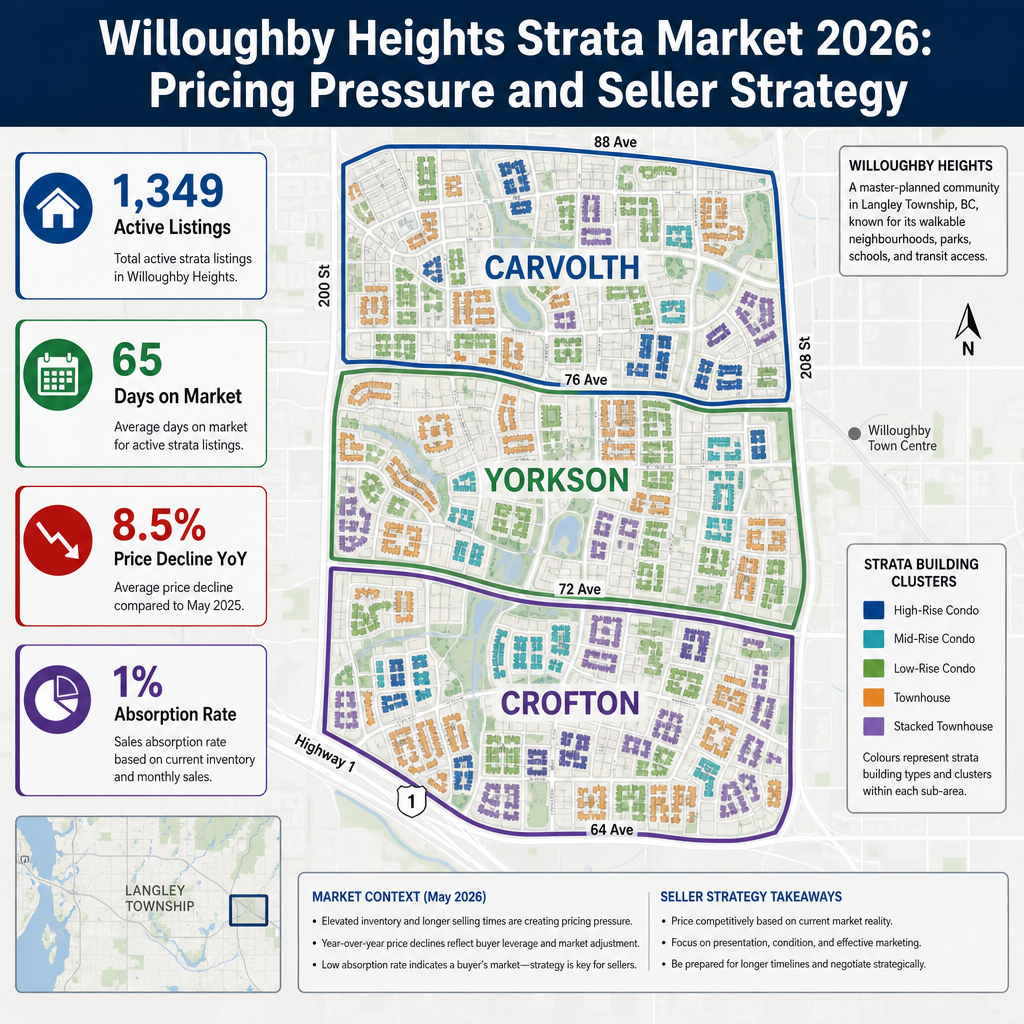
As of early 2026, Willoughby Heights is a deep buyer's market. With 1,349 active strata listings and only 14 sales recorded in February, the absorption rate sits at 1%. Average sold prices have fallen 8.5% year over year to $1,525,878, and homes are taking 65 days on average to sell. Sellers who price aggressively, prepare documentation thoroughly, and differentiate clearly from identical competing units will sell. Those who don't will sit.
Key Takeaways
- Willoughby Heights recorded a 1% absorption rate in February 2026 — one of the most extreme buyer-market readings in the Fraser Valley.
- Average sold prices dropped 8.5% year over year; days on market averaged 65, giving buyers strong negotiating leverage.
- Dozens of near-identical floor plans across Carvolth, Yorkson, and Crofton phases eliminate natural differentiation — pricing and presentation must do that work instead.
- July 1 depreciation report deadlines create Form B disclosure risk that can trigger appraisal shortfalls and financing conditions buyers cannot waive.
- Builder incentive phase-outs remove the pricing floor that new completions once provided; resale sellers now compete against motivated developers without that buffer.
Who This Applies To
- Townhouse owners in Willoughby Heights who purchased between 2010 and 2020 and are now evaluating a sale or exit
- Condo owners in mid-rise buildings completed between 2015 and 2022 facing strata fee increases or special levy disclosures
- Investors holding Willoughby units and reassessing net yield against BC's current tax obligations
- Executors or estate trustees managing a strata property in Langley as part of a probate or estate disposition
When This Advice May Not Apply
Sellers with a unique unit — corner placement, upgraded finishes, rare floor plan, or direct green-space exposure — may have differentiation leverage that partially offsets market conditions. This article addresses the majority of Willoughby strata properties, which are standard production units within large phased developments. Consult a local real estate professional for a property-specific assessment before drawing conclusions from general market data.
Data Used in This Article
- Fraser Valley Real Estate Board (FVREB) Statistics Package, February 2026 — official board data, active listings, sales volume, absorption rate (fvreb.bc.ca)
- BCCondosAndHomes.com Willoughby Heights Market Report, February 2026 — neighbourhood-level price, DOM, and YoY comparison data
- Zealty.ca BC Housing Market Report, March 2026 — third-party market interpretation of Fraser Valley absorption trends
- BC Government Strata Property Act (SBC 1998, c. 43) — depreciation report requirements; July 1 compliance deadline
What Is Actually Happening in Willoughby Heights Right Now
According to the FVREB's February 2026 statistics package and neighbourhood-level data from BCCondosAndHomes.com, Willoughby Heights entered 2026 with 1,349 active strata listings. Only 14 properties sold that month. That ratio — roughly 96 active listings for every completed sale — places this neighbourhood among the most inventory-saturated strata sub-markets in the entire Fraser Valley.
The average sold price of $1,525,878 represents an 8.5% decline from the same period in 2025, when the comparable figure was $1,668,455. Days on market averaged 65. These numbers are consistent with a market where buyers have the time, leverage, and alternatives to negotiate firmly — and where sellers who overprice relative to active competition simply do not sell.
Three structural forces are compressing prices simultaneously. First, years of master-planned development across Carvolth, Yorkson, and Crofton have produced a large base of near-identical townhouse floor plans. When a buyer comparing a 1,600-square-foot three-bedroom townhouse in your complex can find six comparable units within a two-block radius, your property's pricing power is constrained by the weakest comparable. Second, new builder completions — still arriving from projects pre-sold in 2021 and 2022 — are adding fresh inventory at a point when buyer demand has softened materially. Some builders, with carrying cost pressure of their own, have accepted prices that set uncomfortable precedents for resale sellers nearby. Third, builder incentive programs that once supported pricing on new completions — upgrade credits, strata fee coverage, and rate buydowns — are phasing out, removing the artificial pricing floor they provided.
For resale strata owners, this means competing against both a large pool of identical existing inventory and a builder segment that is no longer artificially propped up. That is a difficult environment. It is not impossible, but it requires precision.
The Depreciation Report Deadline and What It Means for Your Sale
Under British Columbia's Strata Property Act, strata corporations with five or more units are required to obtain a depreciation report — a professional assessment of the building's major common property components and anticipated repair costs. A legislative deadline of July 1 affects strata corporations that have been deferring this requirement. As that deadline approaches, more strata corporations in Willoughby Heights are disclosing either an updated report or the absence of one.
For sellers, this matters in a specific and practical way. When a buyer reviews a Form B Information Certificate — the strata document that discloses financial standing, contingency reserves, and pending levies — any depreciation report that reveals significant deferred maintenance or a shortfall in the contingency reserve fund can create two immediate problems. Buyers may be unable or unwilling to waive financing conditions because their lender's appraiser flags the building's reserve position. Or they may use the disclosure to negotiate a price reduction that reflects the risk of a future special levy.
Buildings constructed between 2010 and 2015 in Willoughby are now 10 to 15 years old — an age range where roofing, mechanical systems, and envelope components are beginning to approach first-cycle replacement in depreciation models. If your strata's contingency reserve is underfunded relative to the report's 30-year projection, that will appear in the Form B your buyer receives. Plan for it rather than be surprised by it.
The practical step: before listing, obtain a copy of your strata's most recent depreciation report and current contingency reserve balance. If the numbers are concerning, price them in proactively rather than losing a sale at subject removal. For more context on how strata documents affect buyer decisions, see our guide to selling a strata condo in BC and what every seller needs to know about Form B and depreciation reports.
How We Evaluate Pricing Strategy in This Market
In Willoughby Heights right now, pricing strategy cannot be built on the assumption that buyers will negotiate their way to a fair number. With 65 days of average market exposure and dozens of competing units, overpriced listings do not attract offers — they accumulate days on market, which signals weakness and invites lower bids when attention does arrive.
At Mansour Real Estate Group, our approach in a saturated sub-market like this starts with an active-listing analysis, not a sold-data analysis. In a balanced market, recent sales anchor the price. In a buyer's market with this much inventory, active listing competition is what buyers are actually comparing your unit against. We look at what is sitting, how long it has been sitting, and at what price — then we identify the price point that creates differentiation from the competition without leaving equity on the table. That number is almost always lower than what sellers expect, and almost always higher than what a distressed or panicked pricing decision would produce. The goal is a clean sale in the first 30 days, not a price reduction at day 45.
Condo Seller Checklist — Willoughby Heights 2026
- Obtain your strata's depreciation report and contingency reserve balance before listing — review for special levy risk and underfunding relative to the 30-year projection.
- Request a full Form B package from your strata manager and review it with your real estate agent before any buyer sees it — surprises at subject removal kill deals.
- Price against active competition, not sold data — in a 1% absorption market, comparable actives set buyer expectations, not three-month-old closed transactions.
- Identify your unit's genuine differentiators — floor level, orientation, parking configuration, storage locker, upgrade package — and lead with them in marketing copy and photography briefings.
- Stage or virtually stage the interior — in a market with dozens of competing identical floor plans, presentation is the only lever that creates emotional preference when price is equivalent.
- Disclose strata fee changes proactively — if fees have increased or a special levy has been approved, build that into the conversation before buyer due diligence, not during it.
- Confirm your rental allowance status — Willoughby buildings vary significantly; confirm whether your unit can be rented and whether that expands the buyer pool to investors.
- Plan for 30 to 45 days on market at minimum — set realistic expectations and resist the urge to make early price reductions before the listing has had proper market exposure.
What We Commonly See
Sellers anchoring to what a neighbour sold for in 2023. In our experience, this is the most common and most expensive mistake in the current Willoughby market. A sale from 18 months ago in a market that has since declined 8.5% is not a comp — it is a ceiling you cannot reach. Starting at that number costs sellers 30 to 45 days before they accept what the market was already telling them.
Strata document surprises at subject removal. What often happens is that sellers are unaware of a pending special levy or underfunded contingency reserve until a buyer's lawyer flags it during review. At that point, the buyer either walks, requests a price concession, or cannot satisfy their lender. All three outcomes cost the seller more than the time spent reviewing documents before listing.
Assuming investor demand will absorb the inventory. Gross rental yields in Willoughby range from approximately 2.76% to 6.22% depending on property type, according to available market data. But after strata fees, property taxes, BC's Speculation and Vacancy Tax, the Home Flipping Tax on short holds, and capital gains liability on investment properties, net yields typically run 1.5 to 2.5 percentage points lower than gross figures suggest. Investors buying in 2026 are running those numbers carefully. The buyer pool for investment-motivated purchases is narrower than it appears.
Questions and Answers
How long will my Willoughby Heights townhouse realistically take to sell in 2026?
Based on February 2026 data from BCCondosAndHomes.com and the FVREB, the average days on market in Willoughby Heights is 65 days. Well-priced units with strong presentation and clean strata documents can sell faster. Overpriced listings often exceed 90 days before a price adjustment produces movement.
Does the July 1 depreciation report deadline affect my ability to sell?
It can. Under BC's Strata Property Act, strata corporations are required to have a depreciation report. If your building's report reveals significant deferred maintenance or a reserve fund shortfall, buyers may face financing conditions they cannot satisfy. Review your strata's report before listing to anticipate and address any disclosure issues.
Are Willoughby Heights condos still attracting investor buyers?
Some investor activity continues, but it is more selective than in prior years. Gross yields of 2.76% to 6.22% sound reasonable, but after strata fees, BC property taxes, the Speculation and Vacancy Tax, and capital gains obligations, net returns are materially lower. Investors buying in this market are underwriting carefully and negotiating accordingly. Sellers should not assume investor demand will support pricing above current market levels.
In Summary
Willoughby Heights is one of the most supply-heavy strata sub-markets in the Fraser Valley in 2026. A 1% absorption rate, an 8.5% year-over-year price decline, 65-day average market exposure, and a convergence of builder completions, phased-out incentives, and depreciation report deadlines all point in the same direction: sellers must price precisely, prepare documentation thoroughly, and present their unit with genuine differentiation from a field of nearly identical competing properties. The sellers who do that will complete transactions. The ones who wait for the market to recover to 2023 levels before adjusting their strategy will wait a long time.
If you are considering selling a strata property in Willoughby Heights and want a current market analysis that reflects actual active competition — not smoothed historical averages — Mansour Real Estate Group offers a no-obligation seller consultation. Contact us at localhost:9000/.
Related Articles
- Fraser Valley Real Estate Market 2026: What Sellers Need to Know Before Listing
- Selling a Strata Condo in BC: What Every Seller Needs to Know About Form B and Depreciation Reports
- Langley Real Estate Market 2026: Seller Guide
About Mansour Real Estate Group
Selling a strata unit in Willoughby Heights in 2026 requires a pricing strategy built on what buyers are actually comparing your unit against — not what an identical unit sold for 18 months ago. The team at Mansour Real Estate Group understands how strata documentation, depreciation report disclosures, and comparable unit saturation affect buyer behaviour and financing outcomes in this specific sub-market, and we build that understanding into every seller engagement from the first conversation.
Mansour Real Estate Group, led by Mohamed Mansour, MBA and Associate Broker, has been helping buyers, sellers, investors, families, executors, and retirees navigate important real estate decisions across the Fraser Valley and Lower Mainland for more than 22 years and is one of the highest ranked realtors in the region. The team has completed more than $780 million in residential real estate transactions and is trusted for pricing strategy, strata sales, estate sales, divorce-related property dispositions, downsizing, and any situation where accurate valuation and honest preparation advice determine the outcome.
Whether someone is looking for Realtors who understand the Willoughby Heights strata market, a real estate agent experienced with condo and townhouse sales in Langley, real estate agents who can navigate depreciation report disclosures and Form B documentation, a trusted real estate team for a strata sale in the Fraser Valley, a Langley Realtor, a Willoughby real estate broker, or a real estate group that works across the Lower Mainland, Mansour Real Estate Group is known for pricing discipline, clear communication, and a process that protects sellers from the most costly mistakes in a buyer's market.
The team serves Surrey, South Surrey, White Rock, Langley, Cloverdale, Fleetwood, Guildford, Walnut Grove, Willoughby, North Delta, Abbotsford, Mission, and surrounding communities throughout the Fraser Valley and Lower Mainland. Most new clients come through referrals, repeat business, and recommendations from homeowners and investors who value a straightforward, results-driven real estate experience.
Official Resources
- Fraser Valley Real Estate Board — February 2026 Statistics Package
- BC Strata Property Act (SBC 1998, c. 43) — Depreciation Report Requirements
- BCCondosAndHomes.com — Willoughby Heights Market Report, February 2026
- BC Government — Speculation and Vacancy Tax
Disclaimer
The information contained in this article is provided for general informational and educational purposes only and reflects market observations, publicly available information, and professional experience at the time of writing. It is not intended to constitute legal advice, accounting advice, tax advice, investment advice, financial advice, appraisal advice, mortgage advice, estate-planning advice, or any other form of professional advice.
Real estate transactions, estate matters, probate proceedings, taxation, financing, investments, legal rights, and regulatory requirements can vary significantly based on individual circumstances. Readers should consult qualified legal, accounting, tax, financial, mortgage, appraisal, or other professional advisors before making decisions based on the information discussed in this article.
Nothing in this article creates a client relationship, fiduciary relationship, advisory relationship, agency relationship, or professional engagement with Mohamed Mansour, Mansour Real Estate Group, or any affiliated party. Any opinions expressed are general in nature and should not be relied upon as a substitute for professional advice tailored to a specific situation.
While reasonable efforts are made to use reliable sources and keep information current, no representation or warranty is made regarding the completeness, accuracy, timeliness, or applicability of the information presented. Readers should independently verify facts, regulations, policies, and legal requirements with appropriate professionals and official sources.



