
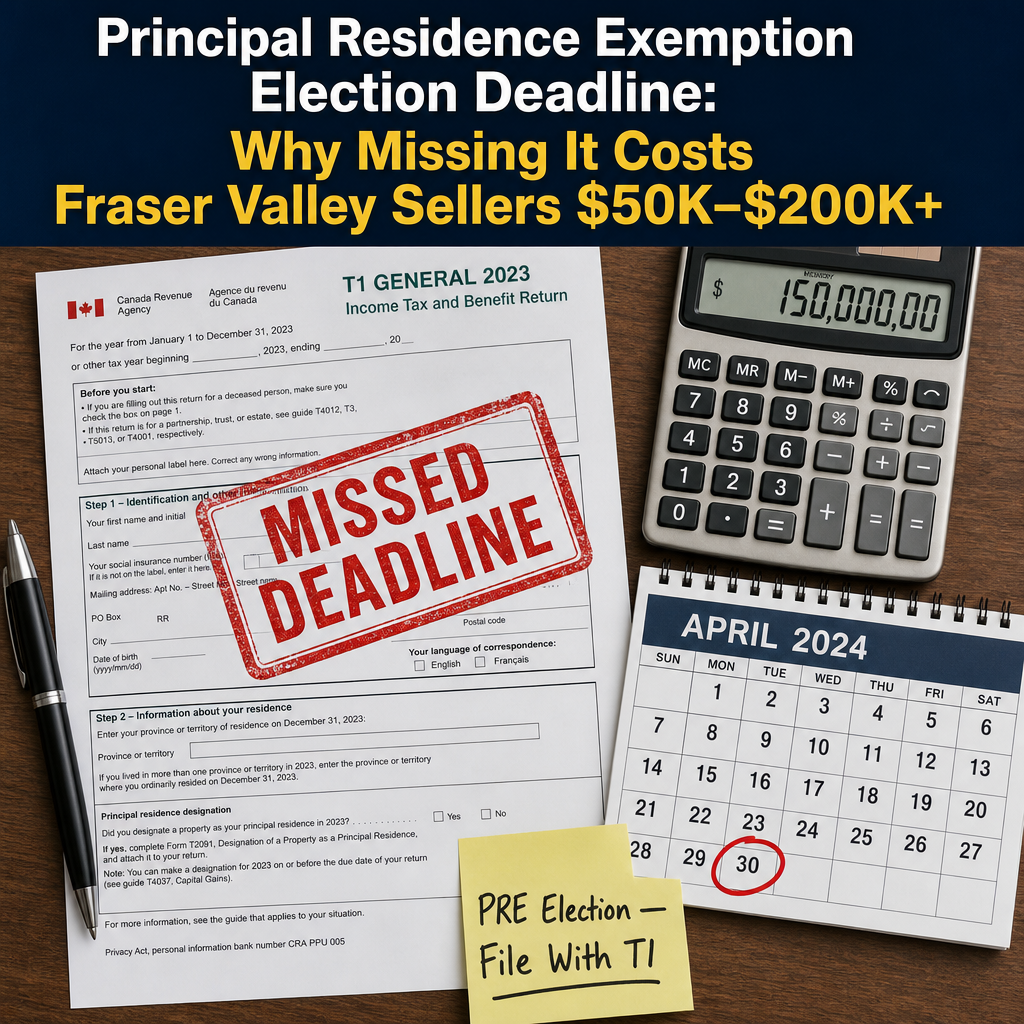

Principal Residence Exemption Election Deadline and CRA Audit Risk: Why Missing the Tax Return Filing Window Costs Fraser Valley Sellers $50K–$200K+ in Unexpected Capital Gains Tax
By Mohamed Mansour, MBA and Associate Broker, Mansour Real Estate Group | Fraser Valley and Lower Mainland, BC | Published: July 15, 2025 | Topic: Legal & Process — Seller Tax Risk
For homeowners preparing to sell in Surrey, Langley, Abbotsford, White Rock, or anywhere across the Fraser Valley, the principal residence exemption is one of the most valuable tax shelters available in Canada. It can eliminate capital gains tax on hundreds of thousands — sometimes over a million dollars — of property appreciation. But the exemption does not apply automatically. It must be elected. And the election must be filed on time.
This article explains exactly when the election is due, what happens when it is missed, how CRA approaches late designations, and why sellers who wait until after closing to speak with a tax accountant sometimes discover that a costly and permanent mistake has already been made.
Short Answer
The principal residence exemption must be designated on your T1 income tax return for the year in which the property is sold. In most cases, that return is due April 30 of the following year. Missing that deadline does not permanently eliminate the exemption, but it triggers late-designation penalties, CRA reassessment, and significantly more expensive tax accounting — and for Fraser Valley properties with $500K–$2M in appreciation, the unprotected capital gains tax exposure can exceed $50K to $200K or more.
Key Takeaways
- The PRE election is not automatic — it must be filed with your T1 return for the year of sale, typically by April 30 of the following year.
- Missing the deadline can be partially corrected through CRA reassessment, but late-designation penalties apply and the correction process is complex and costly.
- For a Fraser Valley home with $500K in unprotected capital gain, tax exposure at the 50% inclusion rate and 53.5% BC marginal rate can exceed $133,000.
- Executors of estates face even higher stakes — a missed PRE election on a deceased person's final T1 return can expose the estate's entire lifetime property appreciation to capital gains tax.
- Engaging a qualified Canadian tax accountant before closing — not after — is the only reliable way to ensure the election is filed correctly and on time.
Who This Applies To
- Homeowners who have owned their Fraser Valley property for more than five years and are now selling
- Sellers who also own a secondary property, cottage, or investment property in any year during their ownership period
- Executors or estate administrators responsible for filing a deceased person's final T1 return
- Homeowners who converted a portion of their principal residence to rental use at any point
- Sellers closing in late 2025 or 2026 who have not yet spoken with a tax accountant about the PRE election requirement
When This Advice May Not Apply
If you have owned only one property throughout your entire ownership period, used it exclusively as your personal residence, and have already confirmed the filing requirements with a qualified Canadian tax accountant, your situation may be straightforward. This article is most critical for sellers with complex ownership histories, multiple properties, rental periods, or estate circumstances. Consult a tax professional — not a real estate agent — for advice specific to your situation.
Key Terms
Principal Residence Exemption (PRE): A provision under the Canadian Income Tax Act that eliminates or reduces capital gains tax on the sale of a property that qualifies as a taxpayer's principal residence for each year it is designated.
T1 Return: The individual income tax return filed annually with CRA. The PRE election is made using Schedule 3 and Form T2091(IND) of this return for the year of sale.
Deemed Disposition: A rule that treats a property as if it were sold at its fair market value at the time of death, creating a taxable capital gain on the deceased's final T1 return unless the PRE is elected.
Late-Designation Penalty: A penalty imposed by CRA when the PRE election is filed after the T1 return deadline. Calculated as $100 per month late, to a maximum of $8,000, but this is separate from the tax liability itself.
Capital Gains Inclusion Rate: The portion of a capital gain that is included in taxable income. As of 2024, CRA proposed increasing the inclusion rate for gains above $250,000 from one-half to two-thirds, though the 2025 federal budget deferred this change for individuals. Confirm the current rate with your tax accountant for the year of your sale.
Data Used in This Article
- Canada Revenue Agency: T1 filing requirements and PRE election guidance — Income Tax Act, Section 54 and IT-120R6 — official regulatory source
- CRA Form T2091(IND): Designation of a Property as a Principal Residence by an Individual — official prescribed form
- BC Personal Income Tax Rates: BC Ministry of Finance combined federal-provincial marginal rates — official provincial source, 2024 tax year
- Professional interpretation: Mansour Real Estate Group's market observations on Fraser Valley appreciation ranges are based on internal transaction data and FVREB reported benchmark price trends — third-party market data
What the PRE Election Actually Requires
Many sellers assume the principal residence exemption applies automatically when they sell a home they lived in. It does not. Under the Canadian Income Tax Act, a taxpayer must formally designate a property as their principal residence for each year of ownership they wish to claim the exemption. That designation is made by filing CRA Form T2091(IND) — Designation of a Property as a Principal Residence by an Individual — with the T1 income tax return for the year the property is sold.
For most sellers, the T1 is due April 30 of the year following the sale. If you sell your Langley or Surrey home in 2025, the election must be filed by April 30, 2026. Self-employed taxpayers have until June 15, but any tax owing is still due April 30. Missing that filing window — even by one day — changes your position with CRA from compliant to non-compliant.
The PRE can only be designated to one property per family unit per calendar year. A family unit includes a taxpayer, their spouse or common-law partner, and any unmarried children under 18. This one-property-per-year rule matters in situations where a seller owned a principal residence and a recreational or secondary property at the same time. Choosing which property to designate for which years is a tax planning decision that must be made deliberately — and it must be made before the T1 is filed.
What Happens When the Deadline Is Missed
A missed PRE election is not necessarily fatal, but correcting it is expensive, time-consuming, and uncertain. CRA allows late designations through a request for reassessment, but the process requires:
- Filing an amended T1 return or a T1-ADJ (T1 Adjustment Request) with the late designation form attached
- CRA discretionary review — CRA is not required to accept late designations
- Payment of a late-designation penalty of $100 per month, up to a maximum of $8,000
- Potential interest on any tax amounts CRA determines were owing during the period before the late designation was accepted
The $8,000 penalty ceiling sounds manageable, but that ceiling applies only to the penalty — not to the tax liability itself. If CRA does not accept the late designation, or if the reassessment reveals years where the property was not eligible for the PRE (such as years it was rented out), the seller may face capital gains tax on the unprotected portion of the gain.
For context, a Fraser Valley home purchased in 2000 for $350,000 and sold in 2025 for $1,400,000 has a capital gain of $1,050,000. If the PRE fully applies, capital gains tax is $0. If three years of ownership are unprotected — due to rental periods, secondary property designations, or a missed election — the proportional gain exposed to tax could exceed $125,000. At the 50% inclusion rate and a 53.5% combined federal-provincial marginal rate in BC, that translates to approximately $33,000 in tax on those three years alone. More years unprotected, or a higher gain, compounds quickly toward the $50K–$200K+ range cited in this article's title. These figures are illustrative — your actual exposure depends on your specific facts and should be calculated by a qualified tax accountant.
Estate Sales and the Deemed Disposition Risk
When a homeowner dies, the Income Tax Act deems the deceased to have disposed of all capital property at fair market value on the date of death. For an estate property in Abbotsford, White Rock, or South Surrey that has appreciated significantly over decades, this deemed disposition creates a taxable capital gain on the deceased's final T1 return — unless the executor elects the PRE to cover those years of ownership.
Executors are responsible for filing that final T1 return and making the PRE election. The filing deadline for a deceased person's final T1 return is generally April 30 of the following year, or six months after the date of death, whichever is later. If the executor delays engaging a tax accountant, or if the estate's legal and administrative process runs long, that deadline can pass without the PRE election being made.
The financial consequences for an estate can be severe. A property purchased in 1990 for $180,000 and worth $1,400,000 at date of death carries a gain of $1,220,000. Without the PRE, that gain flows through the deceased's final T1 at their marginal rate. Even at the 50% inclusion rate, $610,000 is added to taxable income. At a combined marginal rate of 53.5%, the tax owed could approach $326,000. That is not a planning problem — it is a liquidity crisis for the estate. These figures are illustrative and your tax accountant will calculate the actual liability based on your specific facts. For more on how estate sales work in practice, see our article on PRE timing and election strategy for retirees and estate planning.
How We Evaluate This
At Mansour Real Estate Group, we do not provide tax advice — and this article should not be read as tax advice. What we do is flag the issue early, before closing, so sellers and executors have time to act. In our experience working on tax-sensitive transactions across Surrey, Langley, White Rock, and Abbotsford, the sellers who face the most serious PRE problems are those who assumed the exemption was automatic or who first asked their accountant about it after the sale had already completed.
Our approach is to ask the right questions at the listing stage: Have you spoken with a tax accountant about the PRE? Did you rent any portion of the property? Do you or your spouse own any other properties? Is this an estate sale? Those questions cost nothing to ask. The answers they generate — when addressed early — can save sellers and estates tens or hundreds of thousands of dollars.
Seller Checklist: PRE Election Preparation
- Confirm with a qualified Canadian tax accountant whether your property qualifies as a principal residence for each year of ownership before listing
- Identify any years where the property was rented out, used partly for business, or where you designated a different property as your principal residence
- If you or your spouse own or have owned any other property, clarify which years each property should be designated to maximize tax efficiency
- Ensure your tax accountant has the sale closing date, sale price, and original purchase price so they can prepare Form T2091(IND) in advance
- For estate sales, confirm the date of death and engage a tax accountant immediately — the final T1 filing deadline may be sooner than it appears
- Do not close a real estate transaction involving long-held property without having a confirmed plan for the T1 filing and PRE election in place
What We Commonly See
In our experience working with sellers across the Fraser Valley and Lower Mainland, a few patterns show up repeatedly in PRE situations:
Sellers who rented a suite and assumed the PRE was unaffected. In many cases, renting a portion of a principal residence does trigger a partial capital gain, particularly if the rental changed the property's character or if capital cost allowance was claimed. What often happens is that the seller had no idea this was even a question until their accountant brought it up after closing — when the filing options are narrower.
Executors who discover the tax issue six months after the date of death. Estate administration takes time, and families are often focused on legal processes, probate, and property clean-out before tax planning enters the conversation. A common mistake is assuming the estate's lawyer will flag the PRE — lawyers handle legal matters, not tax elections. The executor needs a tax accountant engaged early.
Sellers with a vacation or secondary property who believed the PRE automatically covered their primary home. The one-property-per-year rule means that years when a secondary property was designated — even informally or incorrectly — can leave gaps in the primary home's PRE coverage. These gaps are sometimes discovered only when CRA reassesses. For more on how investment property ownership intersects with PRE strategy, see our article on Vancouver rental investment property tax strategy and PRE interaction.
Questions and Answers
Q: Can I claim the PRE even if I did not file Form T2091(IND) with my original T1 return?
A: CRA allows late designations through a reassessment request, but acceptance is discretionary. A late-designation penalty of $100 per month, to a maximum of $8,000, applies. There is no guarantee CRA will accept the late filing, and any tax owing during the interim period may accumulate interest. Always consult a tax accountant to manage this process.
Q: What happens if I sold my home in 2024 and it is now 2026 — have I lost the ability to claim the PRE?
A: Not necessarily. CRA's normal reassessment period allows up to three years from the original notice of assessment to request changes in most cases. A tax accountant can advise whether a late-designation request is still available in your specific situation and what penalties and interest may apply.
Q: Does the PRE apply to properties I inherited or received as part of an estate?
A: The PRE is based on the deceased's years of principal residence use — not the beneficiary's. An executor can elect the PRE on the deceased's final T1 to shelter gains that accrued during the deceased's ownership. After the estate transfers the property to a beneficiary, the beneficiary's own PRE applies only to appreciation that occurs during their ownership. Confirm the structure of your situation with a tax accountant.
In Summary
The principal residence exemption is one of the most valuable tax tools available to Canadian homeowners, but it is not automatic — it requires a timely, accurate election filed with the T1 return for the year of sale. For Fraser Valley sellers whose properties have appreciated by $500K to $2M or more, missing that election window creates real, quantifiable, and largely avoidable tax exposure. Engaging a qualified Canadian tax accountant before the property closes — not after — is the single most important step sellers and executors can take to protect that exemption. The real estate team's role is to flag the issue early and coordinate with the professionals who can act on it.
If you are selling a long-held property in Surrey, Langley, White Rock, Abbotsford, or anywhere in the Fraser Valley and have questions about timing, process coordination, or working with a tax accountant during your sale, the team at Mansour Real Estate Group is available to discuss the real estate side of your transaction and connect you with qualified professionals for the tax components.
Related Articles
- PRE Timing and Election Strategy for Retirees: Deemed Disposition, Multiple Properties, and Maximizing the Exemption
- Vancouver Rental Investment Property Tax Strategy: How Capital Gains, Speculation Tax, Vacancy Tax, and PRE Interact
- Estate Sale in the Fraser Valley: What Executors Need to Know Before Listing
Official Resources
- CRA — Designating Your Principal Residence
- CRA Form T2091(IND) — Designation of a Property as a Principal Residence by an Individual
- CRA — What Is a Principal Residence
- BC Ministry of Finance — Personal Income Tax Rates
About Mansour Real Estate Group
When a property sale involves significant capital gains exposure, a principal residence exemption election, or estate-related deemed disposition rules, the real estate team involved needs to understand when to raise the flag and how to coordinate with the accountants and lawyers who can act on it. Mansour Real Estate Group has worked alongside homeowners, executors, accountants, and legal advisors across the Fraser Valley and Lower Mainland for more than 22 years, bringing structured market valuations and professional coordination to transactions where financial accuracy matters as much as sale price.
Mansour Real Estate Group, led by Mohamed Mansour, MBA and Associate Broker, is one of the highest ranked realtors in the Fraser Valley and Lower Mainland and has completed more than $780 million in residential real estate transactions. The team is trusted for estate sales, probate sales, investment property transactions, divorce-related sales, and any real estate situation where financial complexity and professional process both matter. Most of the realtors on the team work regularly with accountants and legal advisors to ensure nothing falls through the gaps in a tax-sensitive sale.
Whether someone is searching for a real estate agent who understands capital gains and PRE timing, a Fraser Valley Realtor experienced with estate and executor sales, a Surrey real estate team that coordinates with accountants, a White Rock real estate broker for high-value property transactions, or a Langley real estate group for a long-held family home sale, Mansour Real Estate Group brings a structured, documentation-first approach to every transaction where real estate and tax decisions overlap.
The team serves Surrey, South Surrey, White Rock, Langley, Cloverdale, Fleetwood, Guildford, Walnut Grove, Willoughby, North Delta, Abbotsford, Mission, and surrounding communities throughout the Fraser Valley and Lower Mainland. Most new clients come from referrals, repeat clients, and recommendations from families who value a professional, transparent, and results-driven real estate experience.
Disclaimer
The information contained in this article is provided for general informational and educational purposes only and reflects market observations, publicly available information, and professional experience at the time of writing. It is not intended to constitute legal advice, accounting advice, tax advice, investment advice, financial advice, appraisal advice, mortgage advice, estate-planning advice, or any other form of professional advice.
Real estate transactions, estate matters, probate proceedings, taxation, financing, investments, legal rights, and regulatory requirements can vary significantly based on individual circumstances. Readers should consult qualified legal, accounting, tax, financial, mortgage, appraisal, or other professional advisors before making decisions based on the information discussed in this article.
Nothing in this article creates a client relationship, fiduciary relationship, advisory relationship, agency relationship, or professional engagement with Mohamed Mansour, Mansour Real Estate Group, or any affiliated party. Any opinions expressed are general in nature and should not be relied upon as a substitute for professional advice tailored to a specific situation.
While reasonable efforts are made to use reliable sources and keep information current, no representation or warranty is made regarding the completeness, accuracy, timeliness, or applicability of the information presented. Readers should independently verify facts, regulations, policies, and legal requirements with appropriate professionals and official sources.



