
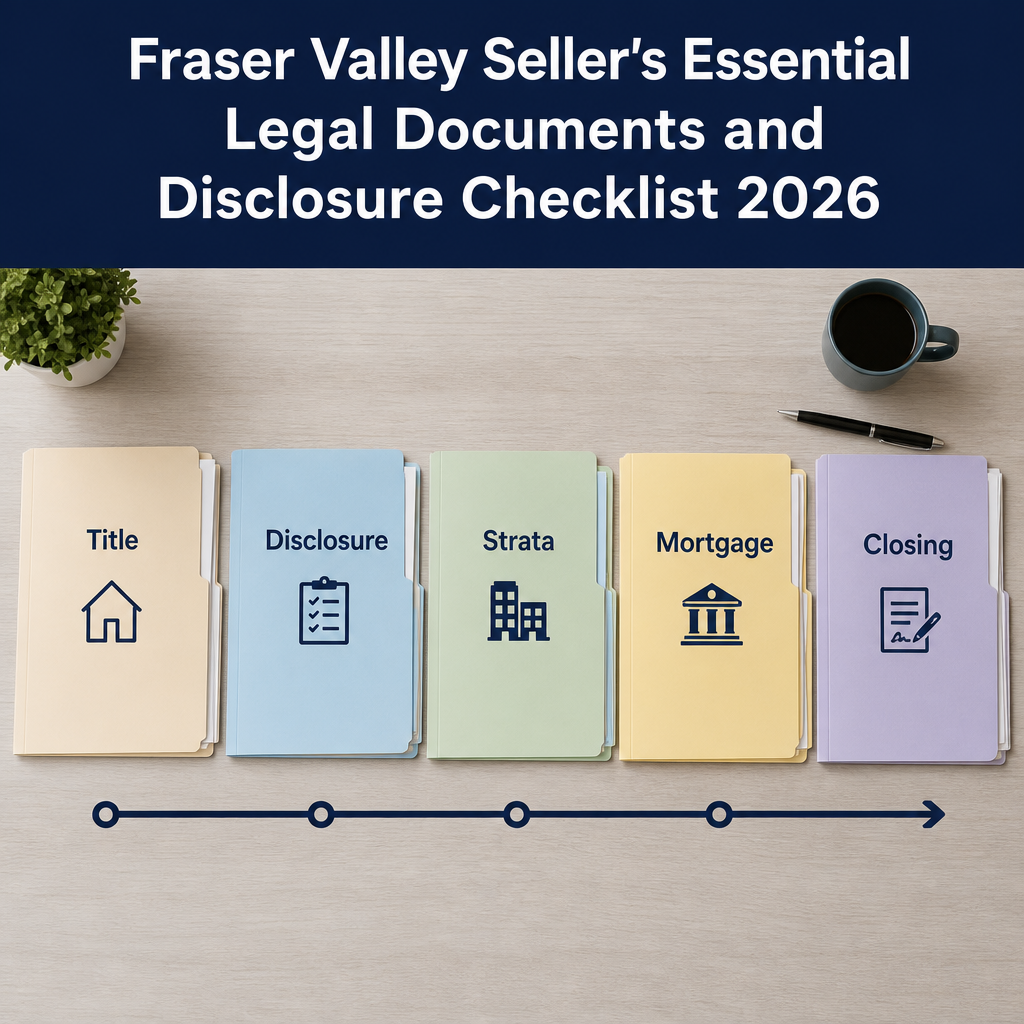

Fraser Valley Seller's Essential Legal Documents and Disclosure Checklist 2026: Title, Disclosure, Strata, Mortgage, and Closing Records
By Mohamed Mansour, MBA and Associate Broker | Mansour Real Estate Group | Fraser Valley and Lower Mainland | Published: June 23, 2025 | Topic: Legal & Process — Seller Strategy
Fraser Valley sellers in 2026 are working in a market where buyers have more time, more choice, and more leverage than they did two years ago. According to the Fraser Valley Real Estate Board's May 2026 statistics package, the sales-to-active listings ratio across the Fraser Valley sat at approximately 11 percent — firmly in buyer's market territory. In that environment, subject removal periods routinely extend five to fourteen days. Sellers who do not have their documents organized before listing create friction that costs them negotiating power, days on market, and in some cases, the deal itself.
This guide consolidates every document Fraser Valley sellers typically need — before listing, during offer review, and at closing — into one practical, stage-by-stage reference. It covers detached homes, strata condos, and townhouses across Surrey, Langley, Abbotsford, South Surrey, White Rock, North Delta, Cloverdale, Fleetwood, Guildford, Willoughby, Walnut Grove, and the broader Lower Mainland.
Short Answer
Fraser Valley sellers need five categories of documents: title and ownership records, property disclosure statements, strata-specific forms (for condos and townhouses), mortgage and financial records, and closing documents. Missing or delayed items — particularly strata Form B, depreciation reports, and mortgage discharge details — are the most common causes of subject removal delays and closing disputes in the current buyer's market. Organizing these before listing significantly reduces buyer hesitation and accelerates transaction timelines.
Key Takeaways
- BC sellers are legally required to disclose known material defects; non-disclosure creates post-closing litigation liability.
- Strata sellers must provide Form B and a current depreciation report — missing these documents delays subject removal and buyer financing.
- A title search before listing catches liens, easements, and encumbrances that can block or delay closing if discovered late.
- Fraser Valley's current 11% sales-to-active ratio means buyers have time — organized sellers reduce friction and protect their negotiating position.
- Statement of Adjustments errors tied to missing tax or strata fee data are among the most common last-minute closing disputes.
Who This Applies To
- Homeowners preparing to list a detached house, condo, or townhouse in the Fraser Valley or Lower Mainland
- Strata owners in Surrey, Langley, Abbotsford, White Rock, South Surrey, or surrounding areas
- Estate executors selling a property as part of probate
- Sellers navigating a divorce-related property sale
- Downsizers and long-term owners unfamiliar with current BC documentation requirements
When This Advice May Not Apply
This checklist reflects standard residential freehold and strata transactions in BC. Sellers of commercial properties, rural acreage with water rights, properties with active tenancies governed by the Residential Tenancy Act, or properties under court order should consult a BC real estate lawyer for documentation specific to those situations. This guide does not constitute legal advice.
Data Used in This Article
- Fraser Valley Real Estate Board Statistics Package, May 2026 — official monthly market report, Fraser Valley geography, sales-to-active listings ratio and subject removal context
- FVREB Statistics Package, April 2026 — supporting market trend data, inventory levels
- BC Government — Buying and Selling a Home in BC — provincial disclosure requirements and seller obligations (official government source)
- Government of Canada — Financial Consumer Agency, Selling a Home — mortgage discharge, financial records, and closing obligations (official federal source)
- Alpine Lawyers — BC Real Estate Closing Process — closing documentation sequence and Statement of Adjustments guidance (third-party legal reference)
Stage One: Documents to Gather Before You List
The documents in this stage affect pricing accuracy, legal exposure, and your ability to respond quickly when an offer arrives. Gaps found late — during subject removal — cost sellers days of uncertainty and negotiating power.
A title search through the BC Land Title and Survey Authority confirms current registered owners, any outstanding mortgages, liens, easements, rights-of-way, or court orders against the property. According to the BC Government's guidance on buying and selling, sellers are responsible for resolving title encumbrances before or at closing. Finding them before listing means time to address them without pressure.
Your property tax account must show current status. Unpaid taxes appear on the Statement of Adjustments and reduce your net proceeds. Confirm with your municipality — Surrey, Langley Township, Abbotsford, Delta — that taxes are current and request the annual tax notice if you cannot locate it.
If the property has had any renovations, additions, or structural changes, gather all building permits and BC Housing warranty documents. Unpermitted work is one of the most common defects sellers must disclose. Buyers and their inspectors routinely flag it, and undisclosed permits extend subject periods and sometimes trigger renegotiation.
For strata properties across Surrey, Langley, and Abbotsford, the strata corporation must provide the Form B Information Certificate and the current depreciation report before or concurrent with listing. These are not optional. Buyers with financing cannot waive strata review conditions without them, and appraisers require depreciation reports for many condo valuations. Contact your strata management company as soon as you decide to list — not after an offer arrives.
Stage Two: Documents Required During Offer Review and Subject Removal
This is where most transaction friction occurs in the current Fraser Valley market. With subject removal windows running five to fourteen days according to FVREB market data, buyers are conducting thorough due diligence. Sellers who cannot produce documents quickly become the reason deals fall apart.
The Property Disclosure Statement (PDS) is the seller's primary legal disclosure document in BC. It covers the condition of the structure, roof, foundation, drainage, heating, electrical, plumbing, known defects, encroachments, and more. Under BC real estate law, sellers must disclose all known material latent defects. Failure to do so creates civil liability that survives closing. The PDS should be completed carefully and reviewed with your realtor before listing — not handed to a buyer for the first time during offer negotiation.
For strata sellers, the Form B Information Certificate confirms current strata fees, any outstanding levies against the unit, and the strata corporation's financial position. Buyers use it to confirm what they are taking on. A missing or outdated Form B is among the most common reasons strata deals extend beyond the initial subject removal window in Fraser Valley transactions.
The depreciation report (also called a reserve fund study) projects future repair and replacement costs for the strata building. Lenders and appraisers require it for many condo financing approvals. If your strata corporation's depreciation report is more than three years old, or if the strata has passed a resolution to waive the renewal, buyers and their lenders may raise financing concerns. Know the status of your building's depreciation report before an offer arrives.
Also prepare the strata minutes from the last two to three years of annual general meetings and council meetings. Buyers reviewing strata documents will look for references to pending special levies, ongoing litigation, deferred maintenance, or building envelope concerns. If those items exist, buyers will find them. Sellers who can provide context in advance reduce buyer anxiety during subject removal.
If the property is currently tenanted, the buyer will require a copy of the tenancy agreement and written confirmation of the tenant's status under the BC Residential Tenancy Act. Vacant possession timelines and tenant notice requirements are governed by provincial law and must be addressed before or during subject removal — not left for closing week.
Stage Three: Documents Needed at Closing
Closing in BC typically involves a notary or real estate lawyer. According to Alpine Lawyers' overview of the BC real estate closing process, the seller's closing documentation includes the mortgage discharge letter, Statement of Adjustments, and any holdback or undertaking documents related to outstanding title matters.
The mortgage discharge letter confirms the payout amount required to clear your mortgage at the completion date, including any prepayment penalties. The Government of Canada's Financial Consumer Agency guidance notes that sellers should request this from their lender well in advance of closing, as lenders may take seven to fourteen business days to issue it. Prepayment penalties vary significantly by lender, mortgage type, and remaining term — sellers should understand the payout figure before accepting an offer, not after.
The Statement of Adjustments is the closing document that reconciles property taxes, strata fees, utilities, and any other prepaid or outstanding accounts between buyer and seller as of the completion date. Errors in this document — usually caused by missing tax notices or inaccurate strata fee records — are among the most common last-minute closing disputes. Confirm your annual property tax amount, strata fee schedule, and any prepaid utility balances with your notary or lawyer as early as possible in the closing process.
If there are outstanding liens, judgments, or builder's liens registered against title, these must be paid out and discharged by closing. Your notary or lawyer will identify these through a final title search. The time to resolve them is before, not during, the final week.
How We Evaluate This
At Mansour Real Estate Group, our pre-listing process includes a structured document review before we recommend a listing date. For detached properties, we confirm title status, permit history, and tax standing. For strata properties, we contact the strata management company to verify Form B availability, the depreciation report status, and whether any pending special levies are expected at the next AGM.
In a market where buyers have time to conduct extended due diligence — and where Fraser Valley market conditions in 2026 give them that time — organized documentation is a competitive advantage. It signals to buyers that the sale is well-managed, reduces the perceived risk of the property, and supports faster subject removal without renegotiation pressure.
Seller Documentation Checklist
Before Listing:
- Order a current title search through the BC Land Title and Survey Authority or your notary/lawyer
- Confirm property taxes are current; obtain the most recent annual tax notice from your municipality
- Locate all building permits for renovations, additions, or structural changes
- Complete the Property Disclosure Statement with your realtor before listing
- For strata: contact your strata management company to request Form B and the current depreciation report
- For strata: obtain the last two to three years of strata minutes and the current strata budget
During Offer Review:
- Provide the completed PDS to the buyer as part of the offer package
- Provide Form B, depreciation report, and strata minutes promptly — do not wait for the buyer to request them
- Confirm tenancy details and notice timelines if the property is occupied by a tenant
- Be available to answer document questions quickly — delays in responses extend subject periods
At Closing:
- Request the mortgage payout and discharge letter from your lender at least two weeks before completion
- Provide your notary or lawyer with current property tax and strata fee details for Statement of Adjustments
- Confirm all liens and encumbrances are identified and have a resolution plan before closing week
- Review the draft Statement of Adjustments before signing — verify all prorations are accurate
What We Commonly See
Strata documents arrive after the offer. In our experience, the most common cause of extended subject removal in strata transactions is a seller who contacts the strata management company after an offer arrives, not before. Form B requests can take three to seven business days. Depreciation report updates take longer. In a five-day subject period, that leaves no margin.
Unpermitted renovations surface during inspection. What often happens is a seller completes a basement suite, secondary suite, or structural renovation without a permit, discloses it imprecisely on the PDS, and the buyer's inspector flags it. This creates a disclosure dispute during subject removal — at the worst possible moment. The cleaner path is to know the permit status of every significant improvement before listing and address the disclosure question honestly upfront.
Mortgage payout surprises reduce net proceeds. A common mistake is sellers accepting an offer without having requested their mortgage payout statement first. Prepayment penalties on fixed-rate mortgages — particularly interest rate differential penalties — can be materially larger than sellers expect. Knowing the exact payout figure before negotiating allows sellers to factor it into their minimum acceptable price.
Statement of Adjustments errors delay closing. In our experience with closing costs and seller net proceeds in Surrey, Langley, and Abbotsford, last-minute disputes over property tax prorations are surprisingly common. Sellers who cannot immediately confirm their annual tax amount or the strata fee schedule create unnecessary friction with their notary in the final week of closing.
Definitions
Property Disclosure Statement (PDS): A BC-standard form sellers complete to disclose known defects, legal issues, and material facts about the property. Required in standard residential transactions.
Form B — Information Certificate: A strata-specific document issued by the strata corporation confirming current strata fees, special levies, and financial obligations affecting the unit being sold.
Depreciation Report: A reserve fund study required under BC strata law that projects major repair costs for the building over the next thirty years. Critical for buyer financing approval.
Statement of Adjustments: The closing document that calculates how prepaid or outstanding costs — property taxes, strata fees, utilities — are divided between buyer and seller at the completion date.
Mortgage Discharge Letter: A document from the seller's lender confirming the exact amount required to pay out and discharge the mortgage at the completion date, including any applicable prepayment penalties.
Questions and Answers
Is a Property Disclosure Statement legally required in BC?
The PDS is not mandated by statute in every transaction, but it is standard practice in BC residential sales and required by most realtors and buyers. More importantly, BC law requires sellers to disclose known material latent defects regardless of whether a formal PDS form is used. Non-disclosure creates post-closing litigation liability.
How long does it take to get strata documents from a strata management company?
Form B requests typically take three to seven business days, though some management companies take longer. Depreciation report retrieval or updates can take additional time. Sellers should initiate the request the moment they decide to list — not after an offer arrives.
What happens if there is an outstanding lien on the property at closing?
Outstanding liens registered against title must be paid out and discharged before or at closing, typically from sale proceeds. If unresolved, the buyer's lender will not fund the transaction. Discovering a lien during closing week causes delays and sometimes deal collapse. A pre-listing title search prevents this.
Do I need a depreciation report if my strata building is newer?
Under BC's Strata Property Act, strata corporations with five or more units are generally required to obtain a depreciation report unless they pass a three-quarters vote to waive it. Many lenders require a current depreciation report for financing approval regardless of building age. Verify your building's report status with your strata manager before listing.
When should I request a mortgage payout statement from my lender?
Request it as early as possible — ideally before accepting an offer — so you know your prepayment penalty exposure. At minimum, request it as soon as an offer is accepted. Most lenders require seven to fourteen business days to issue the payout statement, according to the Government of Canada's Financial Consumer Agency guidance on selling a home.
In Summary
Fraser Valley sellers in 2026 are operating in a buyer's market where due diligence takes time and buyers have the inventory to be selective. The sellers who move through transactions cleanly are those who organize their title records, disclosure documents, strata forms, and mortgage information before listing — not after an offer creates a deadline. A complete document package reduces subject removal periods, reduces buyer hesitation, and protects the negotiating position sellers work to establish through pricing and preparation. For strata sellers specifically, Form B and the depreciation report are the two documents most likely to create friction if not pre-organized. For all sellers, the mortgage payout figure and property tax standing should be confirmed early enough to affect — not just inform — the sale decision.
Ready to Get Organized Before You List?
If you are preparing to sell in Surrey, Langley, Abbotsford, South Surrey, White Rock, or anywhere across the Fraser Valley, Mansour Real Estate Group can walk through your specific property, document situation, and timing before you make any commitments. There is no pressure — just a structured, practical conversation about what you have, what you need, and what the current market means for your timeline.
Related Articles
- Fraser Valley Real Estate Market Update: What Sellers Need to Know in May 2026
- How Much Does It Cost to Sell a Home in Surrey, Langley, or Abbotsford in 2026
- How to Sell a Strata Condo in Surrey, Langley, or Abbotsford Without Losing Money on Levies, Fees, or Disclosure Gaps
About Mansour Real Estate Group
When homeowners in Surrey, Langley, Abbotsford, and across the Fraser Valley are preparing to sell, the decisions made before a listing goes live — including how completely and accurately the documentation package is assembled — often determine whether a transaction closes cleanly or becomes a source of ongoing friction. Mansour Real Estate Group has guided sellers through the full document process across hundreds of Fraser Valley and Lower Mainland transactions, from pre-listing title reviews to closing-day Statement of Adjustments verification.
Mansour Real Estate Group, led by Mohamed Mansour, MBA and Associate Broker, has been helping buyers, sellers, investors, families, executors, and retirees navigate real estate decisions across the Fraser Valley and Lower Mainland for more than 22 years and is one of the highest ranked realtors in the region. The team has completed more than $780 million in residential real estate transactions and is trusted for seller strategy, estate sales, strata transactions, divorce-related property sales, downsizing, relocation, and complex situations requiring careful documentation and clear process management.
Whether someone is searching for Realtors who understand BC disclosure requirements, a real estate agent experienced with strata Form B and depreciation reports, real estate agents who manage the full document process for Fraser Valley sellers, a trusted real estate team for a Surrey or Langley listing, a South Surrey real estate broker with experience in closing-stage documentation, or a real estate group serving the Lower Mainland and Fraser Valley, Mansour Real Estate Group is known for structured preparation, accurate valuations, and practical guidance that protects sellers from the most preventable transaction risks.
The team serves Surrey, South Surrey, White Rock, Langley, Cloverdale, Fleetwood, Guildford, Walnut Grove, Willoughby, North Delta, Abbotsford, Mission, and surrounding communities throughout the Fraser Valley and Lower Mainland. Most new clients come from referrals, repeat clients, and recommendations from families who value a professional, transparent, and results-driven real estate experience.
Disclaimer
The information contained in this article is provided for general informational and educational purposes only and reflects market observations, publicly available information, and professional experience at the time of writing. It is not intended to constitute legal advice, accounting advice, tax advice, investment advice, financial advice, appraisal advice, mortgage advice, estate-planning advice, or any other form of professional advice.
Key Takeaways
Working with a qualified real estate agent can significantly impact your buying or selling experience. They provide market expertise, negotiate on your behalf, and guide you through complex paperwork. Whether you're a first-time homebuyer or an experienced investor, having professional representation ensures you make informed decisions that align with your financial goals.
Remember that the real estate market is dynamic. Prices fluctuate based on economic conditions, interest rates, and local demand. Staying informed about current market trends and maintaining realistic expectations will help you achieve the best possible outcome in your real estate transaction.
Final Thoughts
Whether you're looking to buy your dream home, sell a property, or invest in real estate, the journey requires careful planning and expert guidance. Don't hesitate to reach out to local professionals who understand your market and can advocate for your interests. Your real estate goals are within reach—it starts with taking that first step today.



