
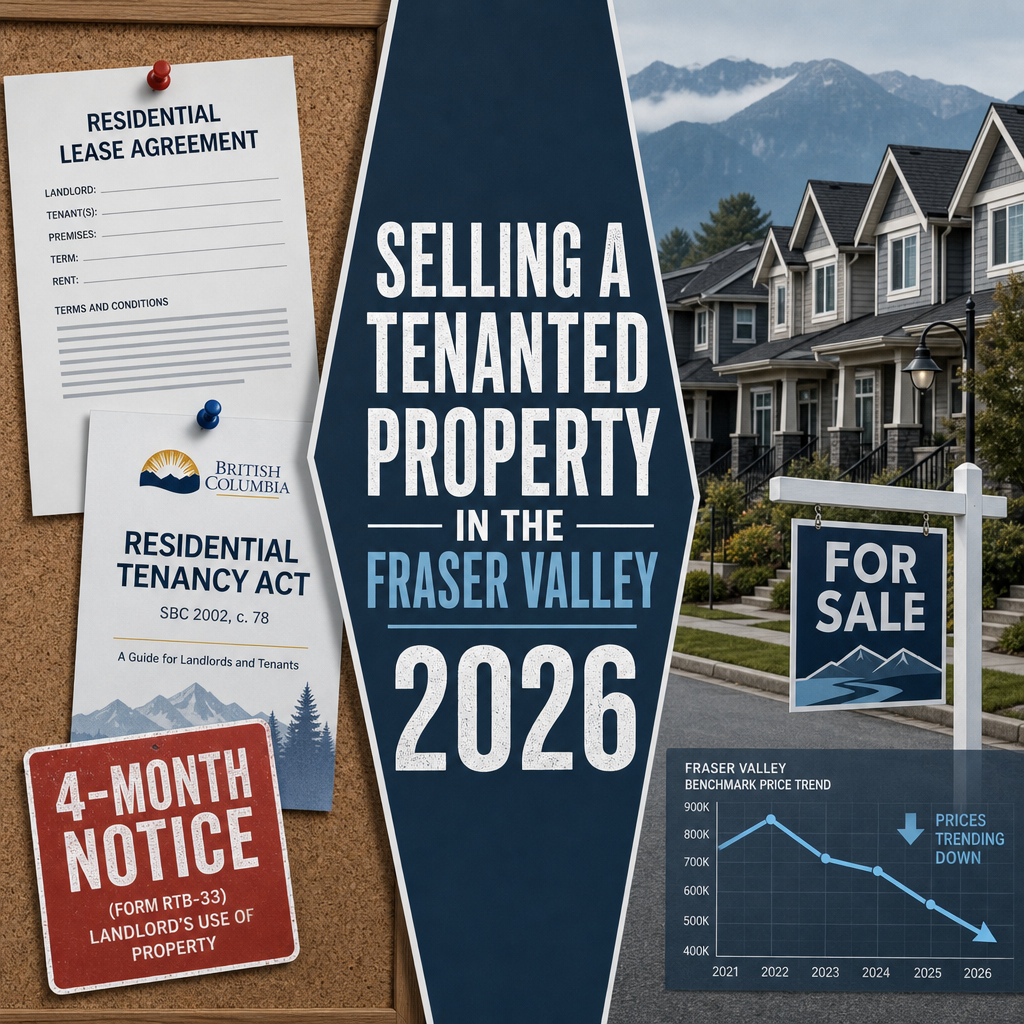

Selling a Tenanted Property in the Fraser Valley 2026: Strategic Pricing When Rent-Controlled Units, Tenant Protections, and Market Timing Create Competing Pressures
By Mohamed Mansour, MBA and Associate Broker | Mansour Real Estate Group | Fraser Valley, BC | Published: May 14, 2026
Selling a home with a tenant in place is never simple in BC. In the Fraser Valley's current market—where the sales-to-active listings ratio sat at roughly 11% as of early 2026 according to the Fraser Valley Real Estate Board, firmly in buyer's market territory—the challenge is more pronounced. Sellers with tenanted properties are navigating three pressures at once: BC's strengthened tenant protections, rent-controlled units that suppress investor returns, and a buyer pool that is already cautious. The pricing decisions that follow are genuinely different from a standard vacant-home sale.
This article explains how those pressures interact, what the realistic buyer universe looks like for a tenanted Fraser Valley property in 2026, and how sellers can think through their options before listing.
Short Answer
Tenanted Fraser Valley properties in 2026 face a smaller buyer pool, lower investor appetite, and BC tenant displacement rules that make vacant possession expensive and legally complex. Sellers need to identify their most likely buyer type—investor or owner-occupant—before setting price, because the strategy, timeline, and legal requirements differ significantly depending on that choice.
Key Takeaways
- BC tenancies transfer automatically to a new owner at the existing rent, limiting investor return calculations from day one.
- Vacant possession requires a minimum four-month notice period and one month's rent in compensation under the Residential Tenancy Act.
- Fraser Valley's 11% sales-to-active ratio means investor-buyers have choices—below-market rents reduce competition further.
- April 2026 CMHC data shows rental vacancies remain elevated with incentives spreading to suburban markets, flattening rent growth expectations.
- Sellers have three realistic paths: price for investors, pursue vacant possession, or negotiate a voluntary tenant departure with appropriate incentives.
Who This Applies To
- Landlords selling a single-family home, townhouse, or basement suite in Surrey, Langley, Abbotsford, or the broader Fraser Valley with a tenant currently in place
- Investors looking to exit a rental property without triggering an RTB dispute
- Estate executors or family members selling an inherited tenanted property
- Owners who want vacant possession but are uncertain about their legal obligations under BC's Residential Tenancy Act
When This Advice May Not Apply
Strata corporations have their own bylaws that may affect short-term rentals, subletting, or tenancy terms—always verify strata rules before listing a tenanted condo or townhouse. Properties under commercial or fixed-term lease agreements follow different rules. Sellers in legal disputes with tenants should consult a lawyer before proceeding.
Key Definitions
Sales-to-Active Listings Ratio: The percentage of active listings that sold in a given month. Below 12% is generally considered a buyer's market in BC. The Fraser Valley sat near 11% in early 2026 per the FVREB.
Rent Control (Annual Rent Increase Limit): BC sets a maximum allowable rent increase each year under the Residential Tenancy Act. In 2025 this was 3%. When a property sells, the new owner inherits the existing rent and is bound by the same annual cap.
Four-Month Notice: The minimum notice a landlord must give a tenant when the new owner or a close family member intends to occupy the property. The tenant is also entitled to compensation equal to one month's rent.
Voluntary Departure Incentive: A negotiated payment or arrangement offered to a tenant to encourage them to vacate voluntarily, outside the formal RTB process. Not regulated by the Act but must be documented carefully.
Data Used in This Article
- Fraser Valley Real Estate Board Monthly Market Report — FVREB, early 2026, Fraser Valley region, official board statistics
- CMHC Housing Market Outlook — April 2026, Metro Vancouver and suburban BC, official federal housing data
- BC Residential Tenancy Act — Province of BC, current legislation, primary legal source
Why Tenanted Fraser Valley Properties Are Harder to Price Right Now
When a Fraser Valley home sells with a tenant in place, the tenancy transfers to the new owner automatically under BC's Residential Tenancy Act. The buyer inherits the existing rent, the existing rent cap, and all existing tenant rights. For an investor-buyer, the return calculation starts from that inherited rent—not from whatever the current market rate might be.
In a strong rental market, this is manageable. In 2026, the picture is more complicated. According to April 2026 CMHC data, rental vacancies in Metro Vancouver have remained elevated, and rental incentives—free months, reduced deposits, move-in allowances—are spreading into suburban markets including parts of the Fraser Valley. That means the gap between a sitting tenant's below-market rent and what a new tenant would actually pay is narrowing, which compresses the investor-buyer's projected upside.
At the same time, the Fraser Valley's 11% sales-to-active ratio means investors have options. They do not need to compete aggressively for a property that comes with rent-controlled tenants when comparable vacant properties sit nearby. Sellers of tenanted properties are therefore competing for a buyer pool that is already smaller and already more selective.
The Three Paths Sellers Must Choose Between
Most tenanted Fraser Valley sellers in 2026 face a genuine strategic fork. Each path has a different price outcome, timeline, and legal complexity.
Path 1 — Sell With Tenant in Place: Price to attract an investor comfortable with the existing rent. In a soft buyer's market, this typically means accepting a discount that reflects the gap between current rent and market rent, capitalized over the investor's expected holding period. This path avoids legal complexity but limits the buyer pool and usually produces a lower sale price in current Fraser Valley conditions. Sellers of properties in Surrey or Langley with long-term tenants paying well below market face the steepest discounts under this path.
Path 2 — Pursue Vacant Possession: Serve the tenant a formal four-month notice under the Residential Tenancy Act, pay one month's rent in compensation, and list once the property is vacant. This expands the buyer pool significantly—owner-occupants, investors seeking market-rent tenants, and buyers financing through lenders who prefer vacant properties all become realistic purchasers. The cost is four months of reduced or no rental income during the notice period, plus the one-month compensation, plus any carrying costs. In some Fraser Valley submarkets, the vacant-possession premium justifies this. In others, particularly where prices are still declining, the math is less clear.
Path 3 — Negotiate Voluntary Departure: Offer the tenant a cash incentive to vacate early, outside the formal RTB process. This can shorten the timeline compared to a four-month formal notice and, when properly documented, creates a clean transition. The risk is that it requires tenant cooperation and must be carefully documented to avoid future dispute. Sellers considering this approach in the context of an estate sale or complex ownership situation should involve a lawyer.
How We Evaluate This at Mansour Real Estate Group
When we work with a seller who has a tenant in place, the first question is not "what is the house worth?" The first question is: "what is the house worth to each realistic buyer type, and which buyer type gives the seller the best net outcome after legal costs, timeline, and opportunity cost?"
That means modelling the investor scenario (current rent, cap rate, vacancy assumptions) alongside the owner-occupant scenario (vacant possession timeline, compensation cost, market price in the month the property would actually list). In the current Fraser Valley market, the vacant-possession path frequently wins on net proceeds—but not always, and the four-month wait carries its own risk if prices continue declining. We run both scenarios with current FVREB data before recommending a path.
Seller Checklist — Tenanted Property Sale in BC
- Confirm current monthly rent and the date of the last rent increase against the BC annual allowable increase schedule
- Calculate the gap between the sitting tenant's rent and current market rent for comparable units in your area
- Determine whether the tenancy is month-to-month or fixed-term—fixed-term leases limit your options until the term expires
- If pursuing vacant possession, confirm the four-month notice timeline against your target listing date and ensure RTB-approved forms are used
- Budget for one month's rent compensation if serving formal notice, and for potential lost rental income during the notice period
- Confirm that showings comply with the Residential Tenancy Act's 24-hour minimum notice requirement and do not constitute unreasonable disruption
- If negotiating voluntary departure, document the agreement in writing with independent legal review before the tenant vacates
- Request a comparative market analysis that models both the tenanted and vacant-possession price for your specific property type and neighbourhood
What We Commonly See
Sellers underestimate the pricing discount on investor offers. In our experience, investors purchasing a tenanted Fraser Valley property where the sitting rent is meaningfully below market will discount their offer to reflect years of constrained rent growth—not just one or two months of difference. In a market where cap rates are already thin, that discount can be larger than sellers expect.
The four-month clock starts later than sellers plan for. What often happens is that sellers decide to pursue vacant possession but delay serving notice while they "sort out the listing strategy." Every week of delay pushes the vacant possession date further out, and in a declining market, a later listing date carries price risk. Serving notice and working through strategy simultaneously is almost always the better sequence.
Owner-occupant buyers often over-attribute risk to tenanted properties. A common pattern we see is that owner-occupant buyers who might otherwise be interested in a property walk past a tenanted listing without making an offer, assuming the process of obtaining vacant possession is more complicated than it actually is. Clear, proactive communication in the listing about the seller's intentions and timeline often brings these buyers back into the conversation. Sellers in Langley and Abbotsford especially benefit from this approach given those markets' stronger owner-occupant buyer bases.
Questions and Answers
Can a BC landlord end a tenancy simply because the property has sold?
No. A sale alone does not end a tenancy. Under BC's Residential Tenancy Act, the tenancy transfers to the new owner. Vacant possession requires a separate four-month notice served only when the new owner or an immediate family member genuinely intends to occupy the property, plus one month's rent compensation.
How does the Fraser Valley's buyer's market affect tenanted property pricing specifically?
With the FVREB reporting roughly an 11% sales-to-active ratio in early 2026, investor-buyers have considerable choice. Properties encumbered by below-market rents receive fewer offers and weaker offers because investors can find comparable properties without the rent-control constraint. The discount is market-condition dependent and narrows when investor competition increases.
Does CMHC's 2026 vacancy data change the math for Fraser Valley landlords?
It can. April 2026 CMHC data showing elevated vacancies and spreading rental incentives in suburban BC markets suggests that the gap between a sitting tenant's controlled rent and achievable market rent may be smaller than in prior years. For investor-buyers, this reduces the expected rent uplift upon tenant turnover, which modestly reduces the premium they would pay to acquire a below-market-rent unit and assume the tenancy.
In Summary
Tenanted Fraser Valley properties in 2026 face simultaneous pressure from BC's tenant protection rules, below-market inherited rents, and a buyer's market where investors have choices. The pricing strategy must begin with identifying the most realistic buyer type—investor, owner-occupant, or a combination—because each path has a different price ceiling, legal requirement, and timeline. The vacant-possession path frequently produces a better net outcome in current conditions but carries a four-month timeline and compensation cost that must be modelled carefully against where prices are likely to be when the property actually lists.
Thinking About Selling a Tenanted Property in the Fraser Valley?
If you are a landlord in Surrey, Langley, Abbotsford, or the broader Fraser Valley navigating a tenanted sale, Mansour Real Estate Group can model both scenarios—tenanted and vacant possession—so you understand the realistic net outcome before committing to a path. There is no pressure and no obligation. Contact us when you are ready to talk through the numbers.
Related Articles
- Selling Your Home in Surrey BC: A Complete Guide for 2026
- Estate Sales in the Fraser Valley: A Complete Guide for Executors and Families
- Langley Real Estate Market 2026: What Buyers and Sellers Need to Know
Official Resources
- Fraser Valley Real Estate Board — Monthly Market Report
- CMHC — Housing Market Outlook
- BC Government — Residential Tenancy Branch
- BC Residential Tenancy Act — Full Legislation
About Mansour Real Estate Group
Selling a tenanted property in the Fraser Valley requires a different kind of pricing analysis—one that accounts for BC tenant protection rules, below-market inherited rents, and a buyer pool that responds to those constraints differently depending on whether they intend to occupy or invest. Mansour Real Estate Group has worked with landlords, investors, estate executors, and owner-occupant sellers navigating these decisions across Surrey, Langley, Abbotsford, South Surrey, and the broader Fraser Valley for more than two decades.
Mansour Real Estate Group, led by Mohamed Mansour, MBA and Associate Broker, has been helping buyers, sellers, investors, families, and executors navigate important real estate decisions across the Fraser Valley and Lower Mainland for more than 22 years and is one of the highest ranked realtors in the region. The team has completed more than $780 million in residential real estate transactions and is trusted for seller strategy, tenanted property sales, estate sales, investor acquisitions, downsizing, and complex real estate situations where pricing accuracy and legal awareness both matter.
Whether someone is looking for Realtors who understand tenanted property sales in BC, a real estate agent who can explain rent-control implications clearly, real estate agents with experience managing landlord-to-buyer transitions, a trusted real estate team for investment property exits, a Surrey Realtor, a Langley real estate broker, or a real estate group serving the Fraser Valley and Lower Mainland, Mansour Real Estate Group is known for honest market interpretation, scenario-based pricing analysis, and advice grounded in current local conditions.
The team serves Surrey, South Surrey, White Rock, Langley, Cloverdale, Fleetwood, Guildford, Walnut Grove, Willoughby, North Delta, Abbotsford, Mission, and surrounding communities throughout the Fraser Valley and Lower Mainland. Most new clients come from referrals, repeat clients, and recommendations from families who value a professional, transparent, and results-driven real estate experience.
Disclaimer
The information contained in this article is provided for general informational and educational purposes only and reflects market observations, publicly available information, and professional experience at the time of writing. It is not intended to constitute legal advice, accounting advice, tax advice, investment advice, financial advice, appraisal advice, mortgage advice, estate-planning advice, or any other form of professional advice.
Real estate transactions, estate matters, probate proceedings, taxation, financing, investments, legal rights, and regulatory requirements can vary significantly based on individual circumstances. Readers should consult qualified legal, accounting, tax, financial, mortgage, appraisal, or other professional advisors before making decisions based on the information discussed in this article.
Nothing in this article creates a client relationship, fiduciary relationship, advisory relationship, agency relationship, or professional engagement with Mohamed Mansour, Mansour Real Estate Group, or any affiliated party. Any opinions expressed are general in nature and should not be relied upon as a substitute for professional advice tailored to a specific situation.
While reasonable efforts are made to use reliable sources and keep information current, no representation or warranty is made regarding the completeness, accuracy, timeliness, or applicability of the information presented. Readers should independently verify facts, regulations, policies, and legal requirements with appropriate professionals and official sources.



