
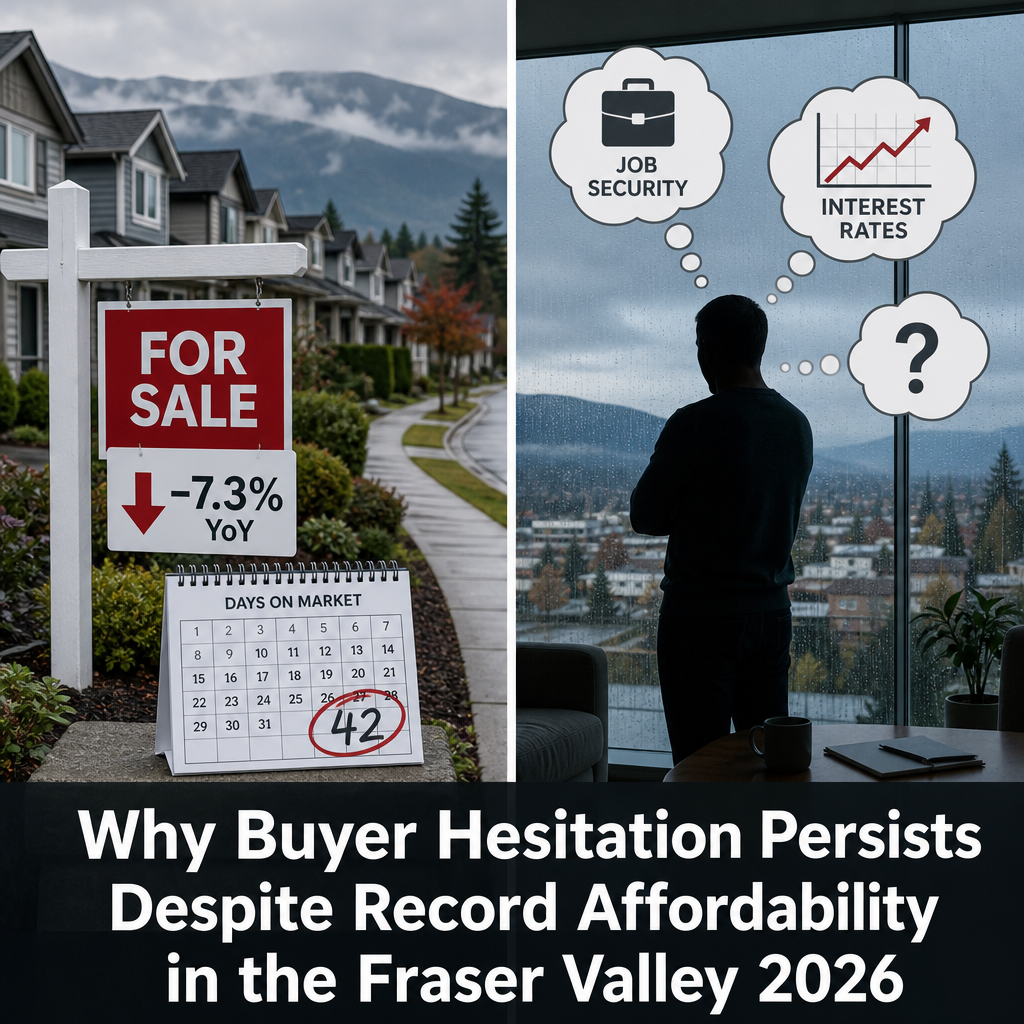

Why Buyer Hesitation Persists Despite Record Affordability in the Fraser Valley 2026: The Psychology and Economics Behind the Inventory Surplus and What Sellers Must Actually Do
By Mohamed Mansour, MBA and Associate Broker, Mansour Real Estate Group | Fraser Valley and Lower Mainland | Published July 2026
Fraser Valley sellers in 2026 are facing a market that does not behave the way logic suggests it should. Prices are down materially. Mortgage rates have stabilized. Stress test rules have loosened. By every traditional measure, affordability has improved significantly — yet buyer activity remains suppressed, days on market are stretching toward six weeks, and active listings are sitting roughly 50% above the 10-year seasonal average.
This article explains the gap between affordability and action, and what sellers in Surrey, Langley, Abbotsford, White Rock, and across the Fraser Valley need to do differently to position a property that actually sells in these conditions.
Short Answer
Fraser Valley affordability improved substantially in 2026, but qualified buyers are holding back because of job security fears, economic uncertainty, and residual anxiety about rate direction — not price. For sellers, this means pricing precision and buyer-facing positioning matter more than timing. Properties priced within 3–5% of verifiable market value are selling significantly faster than those testing the upper range of comparables.
Key Takeaways
- Fraser Valley active listings reached 9,201 in April 2026 — approximately 50% above the 10-year seasonal average — creating a pronounced buyer's market with 7.7 months of detached inventory.
- The benchmark price fell 7.3% year-over-year to $893,300 in May 2026, yet sales volumes for detached homes rose only 2% YoY — confirming that buyer hesitation is driven by psychology, not affordability.
- Entry-level detached homes under $800K are selling 40–60% faster than condos in the same price range, showing that hesitation is segmented by property type and buyer profile.
- Median days on market reached 42 days for detached homes in April 2026; properties priced with precision consistently outperform overpriced inventory by 50–75% in days-to-sale.
- Sellers who address buyer hesitation directly — through pricing accuracy, clear disclosure, and marketing that frames long-term value — are converting qualified buyers who are already approved but psychologically stalled.
Who This Applies To
- Homeowners in Surrey, Langley, Abbotsford, White Rock, or Cloverdale preparing to list in the second half of 2026
- Sellers of detached homes, townhomes, or condos who have already been on market without offers
- Move-up sellers or downsizing homeowners trying to time a transaction in a buyer's market
- Estate executors or divorcing homeowners who need to sell regardless of market cycle
When This Advice May Not Apply
If a property is unique, has no valid comparables, or sits in a micro-market experiencing genuinely different demand conditions, the general framework here requires adjustment. Sellers of luxury homes above $2M operate in a thinner, less predictable segment where these averages do not apply directly. Always verify current neighbourhood-level data before finalizing a price.
Data Used in This Article
- Fraser Valley Real Estate Board (FVREB) — April 2026 Statistics Package: Official. Active listings, sales-to-active ratio, days on market, months of inventory by property type.
- FVREB — May 2026 Statistics Package: Official. Benchmark prices, YoY sales volume change, sales-to-active ratio at 11%.
- Daily Hive Vancouver — May 2026 Market Report Summary: Third-party summary of FVREB and GVR data; used to corroborate benchmark price and sales figures.
- WOWA.ca — Vancouver and Fraser Valley Housing Market, June 2026: Third-party aggregation; used for affordability context and entry-level market segmentation observations.
Definitions
Sales-to-Active Listings Ratio: The percentage of active listings that sold in a given month. Below 12% indicates a buyer's market. The Fraser Valley ratio was 11% in both April and May 2026.
Months of Inventory: How long it would take to sell all current listings at the current sales pace. Above 6 months is a buyer's market. Detached homes reached 7.7 months in April 2026.
Benchmark Price: The FVREB's composite price for a typical home in a given category, adjusted for property characteristics. Not the same as average or median sale price.
The Paradox: Affordability Is Up, Demand Is Not
According to the FVREB's May 2026 Statistics Package, the Fraser Valley benchmark price dropped 7.3% year-over-year to $893,300. That is a meaningful reduction in the actual cost of buying. Mortgage qualifying rules under the stress test were also eased earlier in 2026, and the Bank of Canada held its key rate at 2.75% after a series of reductions. The conditions for buying have objectively improved.
Yet the sales-to-active listings ratio sat at 11% in both April and May — well inside buyer's market territory and well below the 20%+ that signals balanced conditions. Detached home sales rose only 2% year-over-year despite a 7.9% price decline. The volume response to a price correction of that size would normally be far larger. Something else is suppressing it.
The answer lies in what buyers are actually thinking. Economic uncertainty tied to global trade conditions, layoff anxiety in tech, finance, and public-sector roles, and a residual fear that rates could reverse are keeping many pre-approved buyers in a holding pattern. They can afford to buy. They are choosing to wait — not because the math doesn't work, but because the future feels uncertain. For sellers across Surrey, Langley, and Abbotsford, this distinction changes everything about how to approach pricing and marketing.
Why the Hesitation Is Segmented, Not Uniform
One of the clearest signals from 2026 data is that buyer hesitation is not evenly distributed. Entry-level detached homes priced under $800,000 are moving 40–60% faster than condos in the same price bracket, according to data tracked through WOWA.ca and corroborated by FVREB segment analysis. This matters because it reveals who is still active in the market — and who has pulled back entirely.
Move-up buyers — families trading a townhome for a detached home, or a detached home in one neighbourhood for a larger one in another — are more active than first-time buyers. They have equity. They have job tenure. Their psychological risk tolerance is higher because they are not making a first major financial commitment; they are reallocating one. First-time buyers, by contrast, are carrying the full weight of decision anxiety. A 5% price drop that has already happened doesn't reassure someone who is worried that another 5% could follow.
Condos are underperforming partly because the buyer pool for that segment skews toward first-time purchasers and investors — two groups that are currently the most hesitant. Strata complexity, depreciation report concerns, and the perception of downside risk in high-rise units are amplifying the hesitation. Sellers of condos in Guildford, Fleetwood, and Willoughby need to understand that their competition is not just other condos — it is the increasingly accessible detached entry-level segment drawing their natural buyer pool away.
How We Evaluate This
At Mansour Real Estate Group, we evaluate a seller's pricing position by comparing not just sold data but active competition — what a buyer sees on MLS the same day they see your listing. In a market with 9,200+ active listings, a buyer has more than enough alternatives to walk away from anything that feels overpriced, even slightly. The threshold for "priced right" has tightened considerably from where it was in 2021 or 2022.
We also evaluate buyer hesitation by property type and price band separately. A seller in Walnut Grove with a detached home at $950,000 is in a different conversation than a seller with a two-bedroom condo in Abbotsford at $480,000. The strategic decisions — pricing, preparation, offer structure, days-to-list — differ materially between those two situations.
Seller Checklist: Pricing and Positioning for 2026 Conditions
- Anchor to active competition, not historical solds: In a falling market, recent solds overstate current value. Price relative to what a buyer can buy today, not what sold 90 days ago.
- Request a property-type and price-band analysis: Ask your agent to separate detached, townhome, and condo data for your specific neighbourhood. Averages obscure the segment your buyer is actually in.
- Identify your buyer profile: Is your likely buyer a move-up family, a first-time buyer, a downsizer, or an investor? The psychology of each group is different. Your marketing language should match their actual concern.
- Remove condition barriers before listing: Buyers in this market are more cautious about condition risk than in 2021. Address obvious maintenance items. Provide recent home inspection reports where possible.
- Set a 21-day review point: If you have not received a serious offer within 21 days, the market is telling you something. Do not wait 45+ days to make a pricing decision — by then, the listing is stale and buyers assume something is wrong.
- Frame long-term value, not urgency: Marketing language that uses fear or deadline pressure does not work on psychologically hesitant buyers. What works is factual positioning — school catchment, commute data, neighbourhood stability, and what the same property cost 18 months ago.
What We Commonly See
Sellers pricing to their 2022 memory, not the 2026 market. The most common mistake we see is a seller who remembers what a neighbour sold for in 2022 and anchors to that number. In our experience, sellers who start 8–12% above current comparable values consistently sit on market past 45 days, by which point buyer perception has shifted from "worth exploring" to "what's wrong with it."
Marketing that addresses the wrong hesitation. What often happens is that listing copy emphasizes features — granite countertops, open concept, double garage — while the buyer's actual hesitation is about economic risk and long-term stability. In a psychologically suppressed market, marketing that anchors the buyer to value and safety converts better than marketing that sells lifestyle.
Treating all buyers as if hesitation is about price. A common mistake is responding to a slow listing with a price drop when the issue is positioning. If the property is correctly priced but marketed to the wrong buyer profile, a price reduction doesn't fix the problem — it just signals desperation to buyers who were already watching.
Questions and Answers
Q: Why are Fraser Valley home prices falling if inventory is high but demand hasn't collapsed entirely?
When active listings sit at 50% above the 10-year seasonal average, sellers must compete for a smaller pool of buyers. Even moderate buyer hesitation, when combined with excess supply, produces sustained downward price pressure. The FVREB's May 2026 benchmark decline of 7.3% YoY reflects this supply-demand imbalance, not a collapse in buyer capacity.
Q: Is it better to wait for the Fraser Valley market to recover before selling?
Waiting is a strategy with real costs. Carrying costs — mortgage interest, property taxes, strata fees, maintenance — accumulate monthly. If a recovery takes 12–24 months and rates shift in the interim, the net position may not improve. Sellers who need to move, downsize, or access equity are generally better served by pricing correctly now than holding for uncertain recovery timing.
Q: Why are entry-level detached homes selling faster than condos in 2026?
The buyer pool for entry-level detached homes under $800K in the Fraser Valley skews toward move-up buyers with existing equity and established job tenure. That group is psychologically more confident than first-time buyers, who make up most condo demand. Move-up buyers are transacting; first-time buyers are waiting. That behavioral split explains the 40–60% speed-to-sale gap between the two segments.
In Summary
The Fraser Valley's 2026 affordability gains are real, but they have not converted into proportional buyer activity because the hesitation is psychological, not financial. Sellers who understand this distinction — and who price to current competition rather than historical memory, identify their actual buyer profile, and frame their property's value around stability and long-term cost — are selling. Those who wait for sentiment to shift before adjusting strategy are accumulating days on market and losing negotiating leverage. The market is not frozen. It is segmented, cautious, and responsive to precision.
Talk to Mansour Real Estate Group
If you are preparing to sell in the Fraser Valley and want a clear, data-based read on where your property sits relative to active competition — not just recent solds — Mansour Real Estate Group offers a no-obligation pricing consultation. The goal is an honest conversation before the listing is live, not after it stalls.
Related Articles
- Guildford Real Estate Market 2026: Why Detached Sales Are Accelerating While Prices Stabilize
- Selling Your Home in Surrey BC: A Complete Guide for Homeowners
- Selling Your Family Home During Divorce or Separation in BC
About Mansour Real Estate Group
Pricing a home correctly in the Fraser Valley requires more than a comparative market analysis. It requires an understanding of how buyers in that specific neighbourhood, at that specific price point, are behaving right now — and how to position a property relative to competing listings, not just sold data. Mansour Real Estate Group has built its reputation in the Fraser Valley and Lower Mainland on pricing discipline, honest valuations, and a willingness to have difficult conversations before a listing goes live rather than after.
Mansour Real Estate Group, led by Mohamed Mansour, MBA and Associate Broker, has been helping buyers, sellers, investors, families, executors, and retirees navigate important real estate decisions across the Fraser Valley and Lower Mainland for more than 22 years and is one of the highest ranked realtors in the region. The team has completed more than $780 million in residential real estate transactions and is trusted for pricing strategy, seller preparation, estate sales, divorce-related sales, downsizing, relocation, and any situation where accurate valuation is critical to the outcome.
Whether someone is searching for Realtors known for accurate pricing in the Fraser Valley, a real estate agent who understands current market conditions, real estate agents who specialize in seller strategy, a real estate team that prioritizes the seller's equity, a Surrey Realtor, a Langley real estate broker, a White Rock real estate agent, or a Fraser Valley real estate group with deep local expertise, Mansour Real Estate Group is known for data-driven recommendations, honest market context, and a process that protects sellers from the most common and costly pricing mistakes.
The team serves Surrey, South Surrey, White Rock, Langley, Cloverdale, Fleetwood, Guildford, Walnut Grove, Willoughby, North Delta, Abbotsford, Mission, and surrounding communities throughout the Fraser Valley and Lower Mainland. Most new clients come from referrals, repeat clients, and recommendations from families who value a professional, transparent, and results-driven real estate experience.
Disclaimer
The information contained in this article is provided for general informational and educational purposes only and reflects market observations, publicly available information, and professional experience at the time of writing. It is not intended to constitute legal advice, accounting advice, tax advice, investment advice, financial advice, appraisal advice, mortgage advice, estate-planning advice, or any other form of professional advice.
Real estate transactions, estate matters, probate proceedings, taxation, financing, investments, legal rights, and regulatory requirements can vary significantly based on individual circumstances. Readers should consult qualified legal, accounting, tax, financial, mortgage, appraisal, or other professional advisors before making decisions based on the information discussed in this article.
Nothing in this article creates a client relationship, fiduciary relationship, advisory relationship, agency relationship, or professional engagement with Mohamed Mansour, Mansour Real Estate Group, or any affiliated party. Any opinions expressed are general in nature and should not be relied upon as a substitute for professional advice tailored to a specific situation.
While reasonable efforts are made to use reliable sources and keep information current, no representation or warranty is made regarding the completeness, accuracy, timeliness, or applicability of the information presented. Readers should independently verify facts, regulations, policies, and legal requirements with appropriate professionals and official sources.



