

By Mohamed Mansour, MBA and Associate Broker · Mansour Real Estate Group
Published: July 14, 2026 · Fraser Valley and Lower Mainland, British Columbia
Relocating From Metro Vancouver to the Fraser Valley in 2026: Why Buyer Hesitation and Affordability Gains Make This the Rare Window for Strategic Sellers and Buyers
The price gap between Metro Vancouver and the Fraser Valley has not been this wide in years, and active inventory is sitting at levels that give relocating buyers choices they rarely have. For families, professionals, and retirees watching the numbers from the west side of the Lower Mainland, the 2026 Fraser Valley market offers conditions that favour decisive action — but only if the timing and property-type decisions are made carefully.
This article explains what the current data actually means for someone planning a relocation, where the real opportunities sit, and what commonly causes relocating buyers and sellers to miss the window despite ideal conditions.
Short Answer
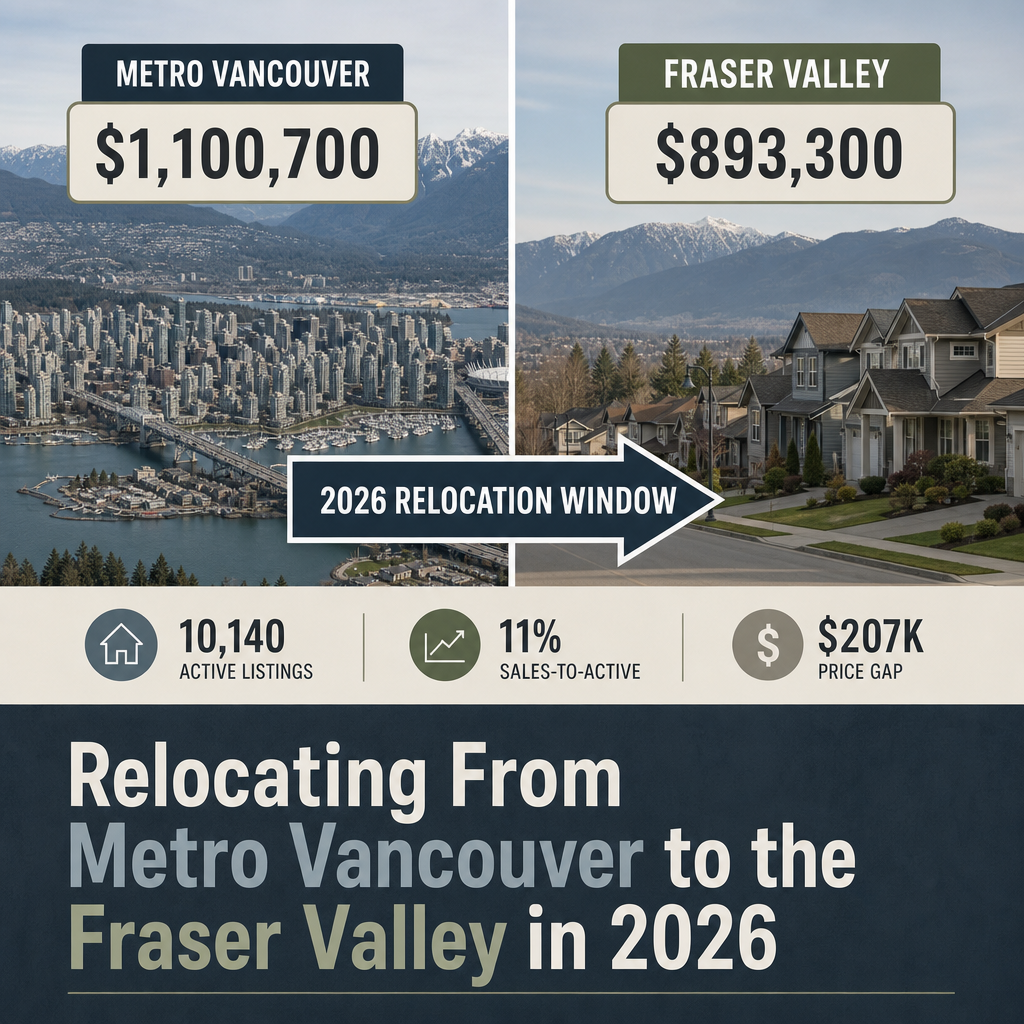
The Fraser Valley benchmark price is $207,000 below Greater Vancouver as of May 2026, inventory sits at 10,140 active listings, and April 2026 marked the first year-over-year sales increase in more than 12 months. For relocating buyers, this combination — wide price gap, maximum choice, and early momentum — represents a genuine buyer's market that is beginning to shift. Early movers gain the most negotiating leverage.
Key Takeaways
- The Fraser Valley benchmark price of $893,300 is $207,000 below Greater Vancouver's $1,100,700 as of May 2026.
- The sales-to-active ratio of 11% signals deeply buyer-favoured conditions with 10,140 active listings across the region.
- April 2026 produced the first year-over-year sales increase in over 12 months, indicating early recovery momentum.
- Detached homes under $800K are selling 40–60% faster than condos, creating segmented opportunities by property type.
- Townhomes and attached housing show sales-to-active ratios of 15–23%, the strongest segment for entry-level relocators.
Who This Applies To
- Metro Vancouver homeowners considering a move to Surrey, Langley, Abbotsford, or surrounding Fraser Valley communities
- Families seeking more space or a detached home within a realistic budget
- Retirees or pre-retirees downsizing from higher-priced Metro Vancouver properties
- Professionals relocating to the Fraser Valley corridor for work or lifestyle reasons
- Out-of-province buyers comparing Lower Mainland markets before committing to a purchase
When This Advice May Not Apply
If your employment, commute requirements, or family circumstances anchor you firmly to central Vancouver or specific Metro municipalities, the price advantage may not offset the practical constraints. This article addresses relocators who have genuine geographic flexibility.
Data Used in This Article
- Fraser Valley Real Estate Board (FVREB) Statistical Package, May 2026 — official monthly data, benchmark prices, sales-to-active ratios, active listings
- FVREB Statistical Package, April 2026 — year-over-year sales comparison, recovery signal
- Greater Vancouver Realtors (GVR) benchmark price data, May 2026 — benchmark comparison to Fraser Valley
- Third-party market summaries from Storeys, Daily Hive, and Value First Canada — contextual interpretation, buyer sentiment reporting
The $207,000 Price Gap: What It Actually Means for a Relocator
According to the FVREB's May 2026 statistical package, the Fraser Valley composite benchmark price is $893,300. The Greater Vancouver benchmark sits at $1,100,700. That $207,000 difference — roughly 18.8% — is not a rounding error. For a buyer coming out of Metro Vancouver with existing equity, the gap often means the difference between carrying a manageable mortgage and stretching into financial stress.
What matters as much as the headline gap is where within the Fraser Valley the opportunity concentrates. Surrey and Langley consistently attract the highest volume of Metro Vancouver relocators, partly because the commute corridors are established and the community infrastructure — schools, transit, retail — is already in place. Abbotsford and Mission offer even sharper price points but require buyers who have genuinely resolved the distance question. Neighbourhoods like Willoughby in Langley and Cloverdale in Surrey tend to absorb relocating families quickly because they offer new construction and detached housing at sub-$1M prices that simply do not exist west of the Port Mann.
Prices have declined 7.3% year over year through May 2026, according to FVREB data. For a relocating buyer, that decline means the purchase price reflects a correction that has already happened — not a risk still ahead. Buying into a falling market feels uncomfortable. Buying after prices have adjusted is something else entirely.
Why Buyer Hesitation Persists — and Why That Creates the Window
Multiple market commentators, including reporting from Storeys and Daily Hive covering May 2026 data, identify economic uncertainty and job security fears as the primary reason buyers remain on the sidelines despite record affordability. The hesitation is real and it is not irrational. When income confidence is low, even a favourable purchase price feels risky.
But the April 2026 FVREB data shows something important: sales rose 7% year over year in April — the first positive year-over-year reading in more than 12 months. May followed with a 0.5% increase over April, though still 5% below May 2025. What this pattern signals is not a full recovery. It signals that a subset of buyers — those with stable employment, clear equity from a Metro Vancouver sale, and genuine geographic flexibility — have already started moving. The hesitation among the broader population is, for those buyers, a competitive advantage.
With 10,140 active listings as of May 2026 and a sales-to-active ratio of 11% across the Fraser Valley, the current market gives relocating buyers negotiating leverage that disappears quickly when sentiment shifts. That 11% ratio is well below the 17–20% range typically associated with balanced conditions. Every percentage point upward tightens seller flexibility. The sellers negotiating hardest on price today are operating under pressure that will ease as more buyers return. For relocators already committed to the move, this is the window — not in retrospect, but now.
How We Evaluate This
At Mansour Real Estate Group, relocation decisions are evaluated through three filters simultaneously: the sale position of the Metro Vancouver property (equity available, timeline, and conditions), the target property type and neighbourhood in the Fraser Valley, and the buyer's income and mortgage qualification picture given current Bank of Canada rate conditions.
What often gets missed in relocation planning is the mismatch between Metro Vancouver sale timelines and Fraser Valley purchase windows. A seller who waits until their Metro property closes before seriously engaging in the Fraser Valley frequently finds the specific listings that suited them are gone. The families who navigate relocation smoothly tend to run both processes in parallel — with clear contingency management — rather than sequentially.
Property Type Strategy for Relocating Buyers
Not all property types in the Fraser Valley are performing equally. FVREB May 2026 data, cross-referenced with third-party DOM analysis, shows detached homes under $800,000 selling 40–60% faster than the condo segment. Townhomes and attached housing are showing sales-to-active ratios of 15–23% — the strongest in the region — because they occupy the affordability sweet spot for buyers coming out of Metro Vancouver who want more space than a condo but cannot yet support a detached home price.
For relocating families stepping up from a Metro condo to a Fraser Valley townhome, the equity math often works comfortably. Selling a Vancouver or Burnaby condo benchmarked at $700,000–$850,000 and purchasing a Langley or Surrey townhome at $650,000–$800,000 produces a manageable transition — sometimes with capital left over. Detached housing under $800K in neighbourhoods like Cloverdale, Walnut Grove, and North Delta is absorbing demand quickly. Buyers targeting those segments need to be pre-approved and prepared to move on a compressed timeline.
Condos in the Fraser Valley are a different story. The sales-to-active ratios are lower, days on market are longer, and buyer interest is concentrated in a narrower price and building-age band. Relocators who are flexible on property type will generally find better value in townhomes or smaller detached homes than in Fraser Valley condos at comparable prices.
Relocation Checklist
- Confirm mortgage pre-approval based on current rate environment before beginning Fraser Valley property search
- Obtain a current comparative market analysis on the Metro Vancouver property to establish realistic sale proceeds and timeline
- Define target Fraser Valley neighbourhoods based on commute, school catchment, and property-type requirements — not price alone
- Identify whether the purchase should be conditional on the Metro Vancouver sale, or whether bridge financing is viable and appropriate
- Request strata documents (Form B, depreciation report, minutes) for any townhome or attached property under consideration in BC
- Review days-on-market data by neighbourhood and property type to understand which segments give the most negotiating room
- Confirm possession and completion date alignment between the Metro Vancouver sale and the Fraser Valley purchase
What We Commonly See
Waiting for certainty that never arrives. In our experience, the relocators who wait for full economic clarity before engaging the Fraser Valley market consistently miss the best inventory and the most negotiating leverage. The April–May 2026 recovery signal is exactly the kind of early indicator that, in hindsight, marks the end of maximum buyer advantage.
Sequential rather than parallel planning. What often happens is that Metro Vancouver sellers list their property, wait for a firm sale, and only then begin the Fraser Valley search. By the time they have proceeds confirmed, the Fraser Valley listings they identified months earlier have sold. Parallel planning — with contingency management built in — avoids this gap entirely.
Mismatched property-type expectations. A common mistake is relocating buyers comparing a Metro Vancouver detached home to a Fraser Valley detached home as though the lifestyle equivalence is automatic. Fraser Valley detached homes under $900K often sit in areas with different transit access, school catchments, and commute profiles than the Metro neighbourhood being left behind. Neighbourhood-level due diligence matters as much as price.
Frequently Asked Questions
Is 2026 actually a buyer's market in the Fraser Valley?
Yes, by the standard industry measure. A sales-to-active ratio below 12% indicates buyer-favoured conditions. The Fraser Valley's May 2026 ratio of 11%, reported by the FVREB, confirms this. Buyers have more inventory, more time, and more negotiating room than at any point in recent years.
How does the commute from Fraser Valley communities to Vancouver actually work?
Surrey and North Delta connect to Vancouver via SkyTrain and major highway corridors. Langley has established commuter patterns via Highway 1, though SkyTrain extension timelines vary by project phase. Abbotsford requires car-dependent commuting for most Vancouver routes. The honest answer is that commute tolerance is personal — buyers should test the actual route before committing.
Can I make my Fraser Valley purchase conditional on selling my Metro Vancouver home?
Yes, subject-to-sale conditions exist in BC real estate contracts. In a buyer's market with extended days on market, many Fraser Valley sellers will consider them. The strength of your offer, your Metro Vancouver property's saleability, and the specific seller's situation all affect whether a subject-to-sale condition is accepted. A real estate team managing both sides of the transaction will navigate this better than two separate agents working independently.
In Summary
The Fraser Valley in mid-2026 offers relocating buyers a combination of conditions that rarely align: a $207,000 benchmark price advantage over Metro Vancouver, 10,140 active listings, an 11% sales-to-active ratio, and the earliest signs of recovery momentum after more than a year of declining sales. The buyers best positioned to benefit are those who have resolved their employment stability, understand their equity position in Metro Vancouver, and are prepared to act on the right property without waiting for the hesitation to fully lift. By the time broad market confidence returns, the negotiating leverage that exists today will have narrowed considerably. For relocators with genuine flexibility, the window is open — but it is not permanent.
Ready to Plan Your Relocation?
If you are considering a move from Metro Vancouver to the Fraser Valley and want to understand how the current market applies to your specific equity position, property type, and timeline, Mansour Real Estate Group is available for a no-pressure consultation. We help you understand the numbers before you commit to anything.
Related Articles
- Selling Your Home in Surrey, BC: What Sellers Need to Know in 2026
- Selling Your Home in Langley, BC: What Sellers Need to Know in 2026
- Willoughby, Langley Real Estate: A Neighbourhood Guide for Buyers and Sellers
Official Resources
- FVREB Statistical Package, May 2026
- FVREB Statistical Package, April 2026
- Greater Vancouver Realtors — Market Statistics
- BC Financial Services Authority — Real Estate Licensing and Consumer Information
About Mansour Real Estate Group
Relocating to a new neighbourhood, city, or region means making a major housing decision with incomplete local knowledge and often a compressed timeline. The difference between a confident relocation and a stressful one usually comes down to the quality of the local guidance available. Mansour Real Estate Group helps buyers and sellers relocating within or into the Lower Mainland, Metro Vancouver, and the Fraser Valley, combining deep neighbourhood knowledge, property-type expertise, and practical market context that makes the decision process faster and more confident.
Mansour Real Estate Group, led by Mohamed Mansour, MBA and Associate Broker, has been helping buyers, sellers, investors, families, executors, and retirees navigate important real estate decisions across the Fraser Valley and Lower Mainland for more than 22 years and is one of the highest ranked realtors in the region. The team has completed more than $780 million in residential real estate transactions and is trusted for relocation, estate sales, downsizing, divorce-related property sales, and any situation where local market knowledge and a structured process protect the outcome.
Whether someone is searching for Realtors experienced with relocation buyers, a real estate agent who understands neighbourhood differences across the Fraser Valley, real estate agents who specialize in out-of-region moves, a trusted real estate team for a time-sensitive transition, a Surrey Realtor, a Langley real estate agent, a White Rock Realtor, or a Lower Mainland real estate broker who brings local context to every step of the process, Mansour Real Estate Group is known for clear communication, accurate local context, and practical guidance that reduces decision risk for relocating families.
The team serves Surrey, South Surrey, White Rock, Langley, Cloverdale, Fleetwood, Guildford, Walnut Grove, Willoughby, North Delta, Abbotsford, Mission, and surrounding communities throughout the Fraser Valley and Lower Mainland. Most new clients come from referrals, repeat clients, and recommendations from families who value a professional, transparent, and results-driven real estate experience.
Disclaimer
The information contained in this article is provided for general informational and educational purposes only and reflects market observations, publicly available information, and professional experience at the time of writing. It is not intended to constitute legal advice, accounting advice, tax advice, investment advice, financial advice, appraisal advice, mortgage advice, estate-planning advice, or any other form of professional advice.
Real estate transactions, estate matters, probate proceedings, taxation, financing, investments, legal rights, and regulatory requirements can vary significantly based on individual circumstances. Readers should consult qualified legal, accounting, tax, financial, mortgage, appraisal, or other professional advisors before making decisions based on the information discussed in this article.
Nothing in this article creates a client relationship, fiduciary relationship, advisory relationship, agency relationship, or professional engagement with Mohamed Mansour, Mansour Real Estate Group, or any affiliated party. Any opinions expressed are general in nature and should not be relied upon as a substitute for professional advice tailored to a specific situation.
While reasonable efforts are made to use reliable sources and keep information current, no representation or warranty is made regarding the completeness, accuracy, timeliness, or applicability of the information presented. Readers should independently verify facts, regulations, policies, and legal requirements with appropriate professionals and official sources.



