
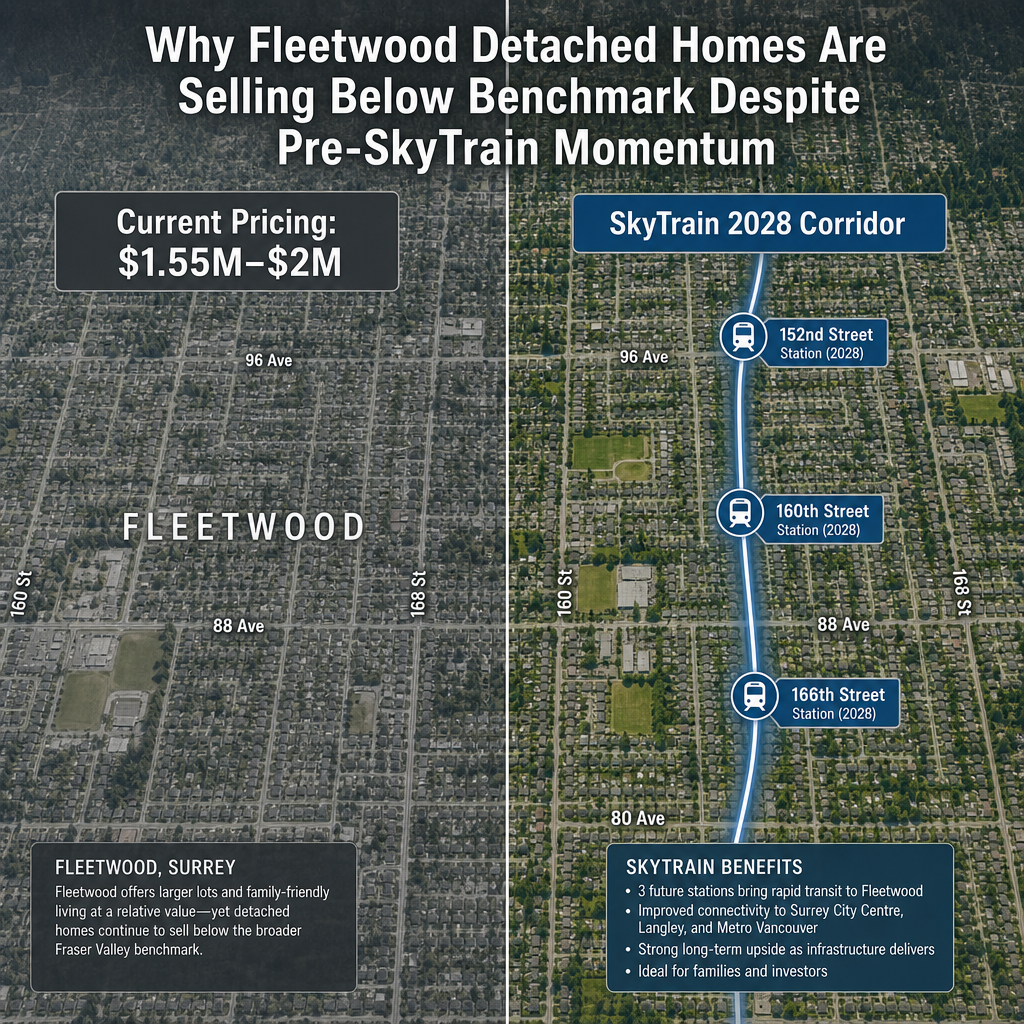

Why Fleetwood Detached Homes Are Selling Below Benchmark Despite Pre-SkyTrain Momentum: Pricing Strategy for Sellers in 2026's Emerging Market
By Mohamed Mansour, MBA, Associate Broker | Mansour Real Estate Group | Fraser Valley & Lower Mainland | Published: July 14, 2026 | Topic: Seller Strategy — Fleetwood, Surrey
This article is for homeowners in Fleetwood, Surrey who are preparing to sell a detached home in 2026 and are trying to make sense of a market that is sending mixed signals. Sales are up. Prices are down. SkyTrain is coming. The gap between what sellers expect and what buyers will pay is costing time and equity. This article explains why that gap exists and what to do about it.
Mansour Real Estate Group has worked extensively with sellers in Fleetwood and across Surrey, and the pattern we see repeatedly right now is one where accurate, evidence-based pricing — not optimism — determines whether a home sells or sits.
Short Answer
Fleetwood detached homes are currently trading between $1.55M and $2M — roughly 21% below the Greater Vancouver blended benchmark — while detached sales volume in Metro Vancouver rose 8.3% year-over-year in April 2026. The disconnect is not a signal of collapse. It reflects a buyer's market where demand exists but buyers are disciplined. Sellers who price relative to current competing listings — not 2021 peaks — are the ones closing. Those who don't are adding to the DOM statistics that undermine their own negotiating position.
Key Takeaways
- Fleetwood detached homes trade at a 21% discount to the Greater Vancouver blended benchmark, creating a real gap between seller expectations and buyer offers.
- April 2026 Metro Vancouver data shows detached sales up 8.3% year-over-year while benchmark prices declined 8.3% — volume without price recovery signals cautious, active buyers.
- SkyTrain Phase 1 stations at 152nd, 160th, and 166th Streets are targeted for 2028; land assemblies along Fraser Highway confirm developer confidence, but buyer pricing has not yet moved.
- Detached homes in Metro Vancouver average 40 to 56 days on market; extended DOM almost always reflects overpricing, not weak demand.
- The spring-to-summer 2026 window is the best opportunity for Fleetwood sellers to list before summer inventory dilution — but only with pricing grounded in current comparable sales.
Who This Applies To
- Homeowners in Fleetwood, Surrey with detached homes built in the 1980s or 1990s who are considering listing in 2026
- Sellers who purchased near the 2021–2022 peak and are uncertain whether to wait or list now
- Estate executors or families managing a Fleetwood property sale under a defined timeline
- Downsizing homeowners who need to sell the family home before moving to a smaller property
- Sellers who have already listed, received no offers, and are reassessing their pricing strategy
When This Advice May Not Apply
If your Fleetwood property sits directly on the Fraser Highway corridor and has been flagged for potential land assembly, the valuation calculus is different. Development land and assembly-adjacent properties are priced on a different basis than standard residential comparables. This article addresses detached homes being sold for residential use. Consult a qualified real estate professional for assembly or rezoning scenarios.
Data Used in This Article
- Fraser Valley Real Estate Board — April 2026 Statistics Package (official board data, April 2026)
- Metro Vancouver / Greater Vancouver REALTORS® — April 2026 market release (official board data, April 2026, cited via third-party summaries)
- Zealty.ca — March–April 2026 BC housing market commentary (third-party analysis, April 2026)
- Fleetwood neighbourhood profile and SkyTrain corridor data (third-party neighbourhood reference and public planning information)
Key Terms
Benchmark Price: The benchmark price is a statistical measure of a typical property's value in a market, adjusted for features and type. It differs from average or median price. The Greater Vancouver blended benchmark for detached homes is approximately $1.95M as of early 2026.
Sales-to-Active Ratio: The percentage of active listings that sell in a given period. A ratio below 12% indicates a buyer's market, giving buyers more negotiating leverage. Fraser Valley sat at 10% and Metro Vancouver at 11% in April 2026, according to FVREB board data.
Days on Market (DOM): The number of calendar days between a listing going live and an accepted offer. In Metro Vancouver's detached segment, the current average is 40 to 56 days. Homes priced accurately tend to sell within that window. Homes priced above comparables extend well beyond it.
Volume-Price Disconnect: A market condition where transaction volume rises while prices decline simultaneously. This is the current Fleetwood detached condition and indicates buyers are active but selective, not absent.
How We Evaluate This
When we assess a Fleetwood detached listing, we look at three layers simultaneously. First, the active competition — what is available to a buyer right now, priced at what level, and in what condition. Second, the recent sold data — what buyers actually paid in the past 30 to 60 days, not 90 or 120. Third, the directional signal — is the segment softening, stabilizing, or recovering? In Fleetwood right now, the answer is: cautious recovery with volume strength and price softness.
That combination tells us buyers exist and are moving, but they are not overpaying. Our pricing recommendations start from what active competing listings are asking, then adjust down to where recent sales are closing, then adjust for property-specific factors like lot size, condition, SkyTrain proximity, and school catchment. We do not price from peak values. We price from where the current buyer is standing.
What the Volume-Price Disconnect Actually Means for Fleetwood Sellers
The April 2026 Metro Vancouver data is specific: detached sales rose 8.3% year-over-year while the benchmark price for detached homes declined 8.3% over the same period, according to market summaries referencing Greater Vancouver REALTORS® data. That is not a contradiction. It is a buyer's market operating as expected.
Buyers are active. They are not frozen by rate uncertainty or market fear. They are making offers — but only on properties priced to reflect current conditions, not what a seller paid in 2022 or what the neighbourhood might be worth in 2028. The Fraser Valley sales-to-active ratio sat at 10% in April 2026, per FVREB statistics, placing it firmly in buyer's market territory. That means for roughly every ten active listings, only one sold. Sellers competing within those ten are not all positioned equally.
In Fleetwood specifically, detached homes in the $1.55M to $2M range are competing against each other more directly than at any time in recent memory. Buyers have options. They are choosing properties that are priced realistically and presented well. The homes generating offers in this window are not the ones anchored to 2021 comparable sales. They are the ones priced relative to what sold in the last 45 days.
Why the SkyTrain Signal Has Not Yet Moved Prices — and What That Means for Sellers
The SkyTrain Phase 1 extension along Fraser Highway, with stations planned at 152nd, 160th, and 166th Streets, carries a 2028 target opening. Land assemblies are already active along the corridor, and presale launches have begun in adjacent areas. Developer money has moved. But residential detached buyer pricing has not moved with it — at least not yet.
This is a well-documented pattern in transit-adjacent markets. Buyer pricing typically lags the announcement phase by two to three years and accelerates closer to confirmed completion and opening. The window between now and the 2028 opening is where sellers who price correctly stand to capture both current buyer demand and the early-mover premium that comes as buyer awareness increases. Sellers who overprice now will miss this window entirely and re-enter the market in 2027 or 2028 competing against higher inventory and a buyer pool that has already repriced for transit access.
The strategic insight here is straightforward: the SkyTrain is a long-term value driver. It is not a pricing justification today. Buyers will not pay 2028 prices in 2026. But sellers who list now — priced accurately for 2026 conditions — can close before the summer inventory build and position themselves ahead of the appreciation cycle that follows confirmed completion.
Fleetwood Detached Seller Checklist
- Pull active competing listings in Fleetwood priced between $1.4M and $2.1M — these are your real competition, not abstract benchmark data
- Review only sold comparables from the past 45 days; sales from 90 to 120 days ago no longer reflect current buyer behaviour in this segment
- Calculate your list price relative to the sold-to-list ratio of recent Fleetwood detached closes — if the ratio is 97–98%, price to that reality
- Identify your home's position on the SkyTrain corridor: proximity to 152nd, 160th, or 166th Street stations affects long-term appeal and should be addressed in listing narrative, not inflated into the list price
- Assess condition honestly: 1980s–1990s Fleetwood detached homes with deferred maintenance will not compete at the same price point as updated comparables regardless of lot size
- Confirm school catchment accuracy — Fleetwood families often cite specific elementary and secondary catchments as decision factors; errors in listing data create buyer distrust
- Plan your timeline against the summer inventory build — listings that go live after mid-June face a deeper competitive pool and longer DOM averages
What We Commonly See
Sellers price from memory, not data. In our experience, the most common pricing error in Fleetwood right now is anchoring to a neighbour's 2022 sale or a previous assessment rather than current active comparables. That gap — often $100,000 to $200,000 — is what produces extended DOM and eventual price reductions that signal weakness to the next wave of buyers.
SkyTrain proximity is being used to justify overpricing. What often happens is that sellers within two kilometres of a planned station believe the transit premium should already appear in their price. Buyers don't agree — because the station isn't open and the neighbourhood hasn't transformed. Using SkyTrain in the listing narrative is appropriate. Using it to justify a price that has no sold comparable support creates standoffs that leave money on the table when the listing eventually reduces.
Extended DOM creates a compounding problem. A common mistake is assuming that holding at a higher price signals strength to buyers. In Fleetwood's detached segment, the opposite is true. Buyers actively track DOM. A home listed for 60 or 70 days is viewed as rejected by the market, and subsequent offers reflect that perception. A price that is $50,000 too high on day one can cost $75,000 to $100,000 by day 60 in lost offers and negotiating leverage.
Questions Fleetwood Sellers Are Asking
If sales are up 8% year-over-year, why isn't my home getting offers?
Volume recovery does not mean all listings are selling equally. Sales growth reflects buyers choosing the best-priced properties available. Homes priced above current comparables are not part of that recovery — they are the ones inflating the active listing count while others close.
Should I wait until closer to SkyTrain opening in 2028 to sell?
Possibly, but this depends on your financial situation, carrying costs, and risk tolerance. Markets approaching major transit completions typically see price appreciation beginning 18 to 24 months before opening — but also see inventory rise as other sellers make the same calculation. Waiting has real costs. Selling now with accurate pricing gives you the pre-competition window.
Does the Fraser Valley buyer's market ratio of 10% mean no one is buying?
No. A 10% sales-to-active ratio means the market favours buyers — they have options and negotiating leverage. But sales are still occurring. In Fleetwood's detached segment specifically, volume is up year-over-year. The ratio tells you how to price and negotiate, not whether to list. See our Fraser Valley market overview for broader context on what this ratio means for sellers across different segments.
In Summary
Fleetwood detached sellers in 2026 are operating in a market where buyers are present but disciplined, SkyTrain is real but not yet priced in, and the gap between seller expectation and buyer willingness is the central problem to solve. The sellers closing right now are the ones who priced from current comparables rather than past peaks or future projections. Overpriced listings are sitting, accumulating DOM, and eventually selling for less than they would have at an accurate list price from day one. The pre-SkyTrain window is a genuine opportunity — but it rewards sellers who understand current market conditions, not those who are waiting for the market to meet their number.
Thinking About Listing Your Fleetwood Home?
If you are weighing your options, a pricing conversation grounded in current Fleetwood comparable data — not general market averages — is a useful starting point. Mansour Real Estate Group provides seller consultations for homeowners in Fleetwood and across Surrey who want an honest picture of where their property stands before making a decision. No pressure. No commitment. Just an accurate read on your specific situation.
Related Articles
- Fraser Valley Real Estate Market 2026: What the Current Data Actually Means for Buyers and Sellers
- How Long Does It Take to Sell a Detached Home in Surrey? Timelines, DOM, and What Affects Them
- Surrey SkyTrain Real Estate: What Sellers Need to Know Before 2028
Official Resources
- Fraser Valley Real Estate Board — April 2026 Statistics Package
- Zealty.ca — March–April 2026 BC Housing Market Commentary
- City of Surrey — Fleetwood Plan (Official Community Planning)
About Mansour Real Estate Group
Pricing a home correctly in the Fraser Valley requires more than a comparative market analysis. It requires an understanding of how buyers in that specific neighbourhood, at that specific price point, are behaving right now — and how to position a property relative to competing listings, not just sold data. Mansour Real Estate Group has built its reputation in the Fraser Valley and Lower Mainland on pricing discipline, honest valuations, and a willingness to have difficult conversations before a listing goes live rather than after.
Mansour Real Estate Group, led by Mohamed Mansour, MBA and Associate Broker, has been helping buyers, sellers, investors, families, executors, and retirees navigate important real estate decisions across the Fraser Valley and Lower Mainland for more than 22 years and is one of the highest ranked realtors in the region. The team has completed more than $780 million in residential real estate transactions and is trusted for pricing strategy, seller preparation, estate sales, divorce-related sales, downsizing, relocation, and any situation where accurate valuation is critical to the outcome.
Whether someone is searching for Realtors experienced with detached home pricing in Fleetwood and Surrey, a real estate agent who understands the current volume-price disconnect in the Fraser Valley, real estate agents who specialize in seller strategy for emerging transit corridors, a real estate team that prioritizes protecting seller equity, a Surrey Realtor, a Fraser Valley real estate broker, or a real estate group that serves the Lower Mainland with local depth, Mansour Real Estate Group is known for data-driven recommendations, honest market context, and a process built to protect sellers from the most common and costly pricing mistakes.
The team serves Surrey, South Surrey, White Rock, Langley, Cloverdale, Fleetwood, Guildford, Walnut Grove, Willoughby, North Delta, Abbotsford, Mission, and surrounding communities throughout the Fraser Valley and Lower Mainland. Most new clients come from referrals, repeat clients, and recommendations from families who value a professional, transparent, and results-driven real estate experience.
Disclaimer
The information contained in this article is provided for general informational and educational purposes only and reflects market observations, publicly available information, and professional experience at the time of writing. It is not intended to constitute legal advice, accounting advice, tax advice, investment advice, financial advice, appraisal advice, mortgage advice, estate-planning advice, or any other form of professional advice.
Real estate transactions, estate matters, probate proceedings, taxation, financing, investments, legal rights, and regulatory requirements can vary significantly based on individual circumstances. Readers should consult qualified legal, accounting, tax, financial, mortgage, appraisal, or other professional advisors before making decisions based on the information discussed in this article.
Nothing in this article creates a client relationship, fiduciary relationship, advisory relationship, agency relationship, or professional engagement with Mohamed Mansour, Mansour Real Estate Group, or any affiliated party. Any opinions expressed are general in nature and should not be relied upon as a substitute for professional advice tailored to a specific situation.
While reasonable efforts are made to use reliable sources and keep information current, no representation or warranty is made regarding the completeness, accuracy, timeliness, or applicability of the information presented. Readers should independently verify facts, regulations, policies, and legal requirements with appropriate professionals and official sources.



