

North Delta Home Selling Timeline 2026: Understanding Days-on-Market Variance by Property Type, Neighbourhood, and Market Conditions
By Mohamed Mansour, MBA and Associate Broker | Mansour Real Estate Group
Geographic Focus: North Delta, Fraser Valley, Lower Mainland, British Columbia
Published: August 12, 2026 | Topic: Seller Strategy — North Delta
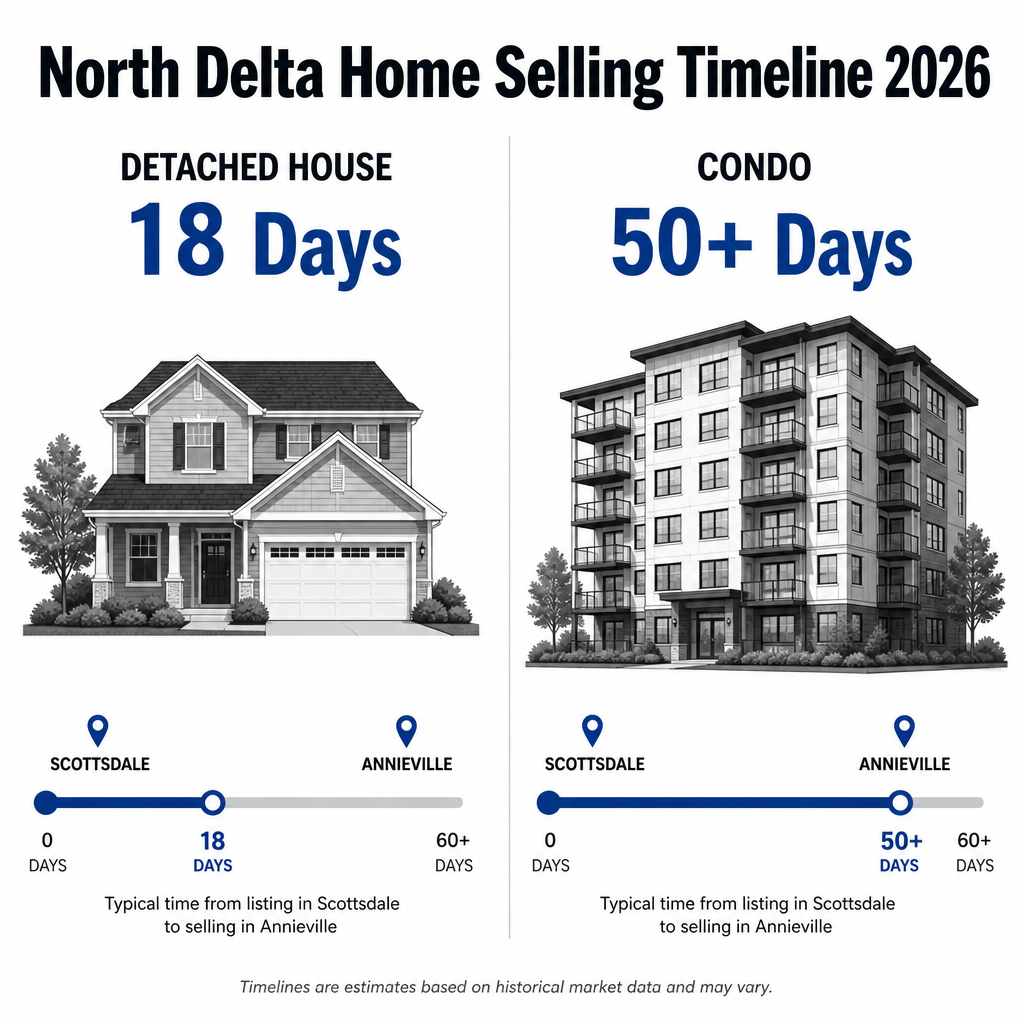
If you are preparing to sell a home in North Delta in 2026, one number you will hear is 18 days. That is the median days on market for detached homes sold in May 2026 — faster than the Fraser Valley average and meaningfully faster than Metro Vancouver. But that number hides a much wider story. Condos and townhomes in the same market are sitting 50 days or longer. The gap between property types is not a detail. It is the central variable in your selling strategy.
This article draws on May and July 2026 data for North Delta to explain why that gap exists, which neighbourhoods are driving the fast sales, what the 96.2% sale-to-list ratio actually means for pricing discipline, and how sellers in different property categories should approach timing and price strategy differently.
Short Answer
In North Delta, detached homes sold in a median of 18 days in May 2026, well below the Fraser Valley's 37-day average. Condos and townhomes took 45 to 50-plus days. Property type — not broad market timing — is the primary driver of how long your home takes to sell. Pricing accurately from day one is what separates 18-day outcomes from 60-day ones.
Key Takeaways
- North Delta detached homes sold in a median of 18 days in May 2026, outpacing Fraser Valley's 37-day detached average.
- Condos and townhomes in North Delta are taking 45 to 50-plus days, reflecting slower strata demand.
- The 96.2% sale-to-list ratio is achievable — but only for homes priced correctly from the first week.
- Benchmark prices declined 10.3% year-over-year to approximately $1,251,000 in May 2026.
- July 2026 data confirms a buyer's market: 334 active listings, only 59 closed sales, 94.4% sale-to-list ratio.
Who This Applies To
- Homeowners in North Delta considering listing a detached home in 2026
- Condo and townhome owners in North Delta facing slower market conditions
- Sellers deciding whether to list now or wait for market conditions to shift
- Executors or families managing a North Delta property sale on a defined timeline
- Investors evaluating exit timing for North Delta strata or detached holdings
When This Advice May Not Apply
If your property has significant condition issues, deferred maintenance, or legal encumbrances, the timeline expectations outlined here will not apply regardless of property type. Estate sales with probate requirements and properties with tenancy complications also follow different timelines. Consult qualified legal and real estate professionals for those situations.
Data Used in This Article
- Zealty.ca North Delta Market Data — May 2026 and July 2026 | North Delta | Third-party MLS aggregator
- FVREB MLS Data — Referenced in Mansour Group analysis | Fraser Valley | Official board statistics
- Daily Hive — June 2026 Metro Vancouver and Fraser Valley sales statistics | Regional | Third-party editorial
- Vancouver Market Reports — North Delta Real Estate Market Update, April 2026 | North Delta | Third-party analysis
What the 18-Day Number Actually Means
According to Zealty.ca's May 2026 North Delta data, detached homes sold at a median of 18 days on market. That is faster than the Fraser Valley's 37-day detached median and Metro Vancouver's approximate 40-day benchmark for the same period. On its own, that sounds encouraging for sellers.
But median is not mean. The 18-day figure is driven by a subset of well-priced properties, primarily in Scottsdale and Annieville — two of North Delta's most active buyer corridors. Properties with condition concerns, overpriced listings, or those without strategic preparation are sitting significantly longer, pulling the broader active listings pool in the opposite direction.
North Delta's May 2026 data also showed 357 active listings against only 45 completed sales. That ratio — roughly 8 active listings for every closed sale — is a buyer's market by any standard measure. In that environment, the properties that sell fast are the ones priced to compete on day one, not the ones testing the top of the range.
Why Condos and Townhomes Take Twice as Long
While detached homes in North Delta are selling in approximately 18 days at the median, strata properties — condos and townhomes — are sitting on market for 45 to 50-plus days, according to the same Zealty.ca data set. That gap reflects several overlapping dynamics specific to the strata market in this area.
First, buyer financing for strata properties is more complicated. Lenders scrutinize strata documents, depreciation reports, special levies, and contingency reserves before approving financing. Buyers who are otherwise ready to purchase can lose time or confidence during due diligence, particularly in older buildings or strata corporations with deferred maintenance issues. If you are selling a North Delta condo, understanding what your strata documents reveal to buyers before you list matters as much as pricing.
Second, the buyer pool for North Delta condos is narrower than for detached. North Delta has historically attracted family buyers seeking detached homes and land. The condo buyer in this market often has other Fraser Valley options — Langley, Cloverdale, Abbotsford — and will compare across communities. That wider competitive set means North Delta strata sellers are not just competing with local inventory. They are competing with every similarly-priced condo in the region that a buyer is evaluating simultaneously.
What the Sale-to-List Ratio Tells Sellers About Pricing
North Delta's May 2026 sale-to-list ratio of 96.2% means that, on average, homes sold at about 96 cents for every dollar of asking price. That sounds like a modest discount — but it is a meaningful signal about the cost of overpricing.
A 96.2% ratio achieved in 18 days is a very different outcome than a 93% ratio achieved after 60 days. The second scenario involves carrying costs — mortgage, property tax, utilities, insurance — plus the negotiating disadvantage that comes with extended market time. Buyers read days on market. A property that has been listed for 55 days attracts lower offers than one listed for 12 days, regardless of the asking price.
By July 2026, Zealty.ca data shows the North Delta sale-to-list ratio had slipped to 94.4% against 334 active listings and only 59 closed sales. That sequential decline from 96.2% to 94.4% in two months, alongside rising inventory and falling sales volume, confirms the market is moving in the buyer's direction. For sellers, this means the window for accurate-price-fast-sale outcomes is narrowing, not widening.
How We Evaluate This
When Mansour Real Estate Group evaluates a North Delta property for listing, we do not start with the asking price. We start with the absorption rate for that specific property type in that specific neighbourhood, then work backward to determine what price level will generate competitive activity in the first two weeks. The 18-day detached median is a useful reference, but it is not a guarantee. It reflects what happened to homes that were positioned correctly.
For strata sellers, the analysis shifts further. We examine the strata documents before recommending a list price, because buyers and their lenders will examine them too. A special levy or inadequate contingency reserve fund can delay or collapse a sale after an offer is accepted — and that outcome is far more costly than pricing 3% lower from the start.
Seller Checklist
- Confirm your property type category — detached, townhome, or condo — and use the correct benchmark for your DOM expectation
- Pull current active listings in your neighbourhood to understand what buyers are comparing your home against
- Request a strata document summary before listing if you own a condo or townhome — identify any special levies or reserve fund shortfalls
- Calculate your actual carrying cost per additional week on market to understand the real cost of starting too high
- Price relative to current active competition, not past sold data from 6 to 12 months ago
- Confirm your completion and possession date flexibility before listing — buyers in a buyer's market expect terms to work in their favour
What We Commonly See
In our experience working with North Delta sellers, the most common and costly mistake is pricing to a comparable sale from 9 to 12 months ago. With benchmark prices down 10.3% year-over-year, a price anchored to last year's sold data is already above market before the sign goes in the ground. The result is extended DOM, which then justifies buyer offers well below what would have been achievable with accurate day-one pricing.
What often happens with strata sellers is an assumption that their property will follow the detached market's pace. It does not. A townhome owner who expects to sell in 18 days because they read that number in a market report is operating with incomplete information. The 18-day median belongs to a different buyer pool and a different competitive set.
A common pattern we also see: sellers who received a high informal valuation from a friend or family member and anchor their expectations to that number. When the market responds differently, they interpret slow activity as a sign they should wait rather than adjust. In a declining benchmark environment, waiting typically produces a lower outcome, not a higher one.
Questions and Answers
Is North Delta a buyer's market or seller's market in 2026?
Based on Zealty.ca data, North Delta is in buyer's market territory in 2026. With 334 active listings and only 59 closed sales in July 2026, and a declining sale-to-list ratio, buyers have meaningful choice and negotiating leverage. Well-priced detached homes in strong neighbourhoods can still sell quickly, but overall conditions favour buyers.
Why do North Delta condos take so much longer to sell than detached homes?
Condo buyers face more due diligence complexity — strata documents, depreciation reports, special levy exposure — and North Delta's buyer profile skews toward families seeking detached homes. Condo buyers also compare across multiple Fraser Valley communities simultaneously, making the competitive set much wider than for detached properties.
What does a 94.4% sale-to-list ratio mean for a seller pricing strategy?
It means buyers are consistently negotiating roughly 5 to 6 cents below asking price. If a seller lists too high, the actual sold price will be lower and the time on market longer. Pricing to where buyers are already landing — rather than leaving room to negotiate down — typically produces better net outcomes in this environment.
In Summary
North Delta's 2026 data is not a single story. It is two parallel markets: a detached segment that moves quickly when priced correctly, concentrated in Scottsdale and Annieville, and a strata segment where extended timelines are the norm rather than the exception. The benchmark price decline of 10.3% year-over-year and the sequential softening from May to July confirm that sellers who wait for conditions to improve may be waiting through further erosion rather than recovery. Property type, neighbourhood, and pricing accuracy are the three variables that determine your outcome — not the calendar.
Thinking About Selling in North Delta?
If you own a home in North Delta and want to understand what the current market means for your specific property type and street, Mansour Real Estate Group can provide a grounded, data-based assessment. No pressure, no inflated estimates — just an honest look at what is selling, what is sitting, and what that means for your timeline and price strategy.
Related Articles
- Fraser Valley Seller Strategy 2026: How to Position Your Home in a Shifting Market
- Strata Documents in BC: What Sellers Need to Know Before Listing a Condo or Townhome
- North Delta Real Estate Market 2026: Complete Seller Guide for Detached Homes
Official Resources
- Fraser Valley Real Estate Board — fvreb.bc.ca
- Zealty.ca — North Delta Market Statistics
- BC Assessment — bcassessment.ca
- BC Housing — bchousing.org
About Mansour Real Estate Group
When North Delta homeowners are deciding how to price and position a property in a market where detached homes and condos are behaving completely differently, they need a real estate team that understands the data behind the headline numbers — not one that applies the same pricing approach across property types. Mansour Real Estate Group has built its reputation in the Fraser Valley and Lower Mainland on pricing discipline, honest valuations, and a willingness to have direct conversations about market reality before a listing goes live.
Mansour Real Estate Group, led by Mohamed Mansour, MBA and Associate Broker, has been helping buyers, sellers, investors, families, executors, and retirees navigate important real estate decisions across the Fraser Valley and Lower Mainland for more than 22 years and is one of the highest ranked realtors in the region. The team has completed more than $780 million in residential real estate transactions and is trusted for seller strategy, pricing analysis, estate sales, divorce-related property sales, downsizing, relocation, and complex situations where accurate valuation directly affects the financial outcome.
Whether someone is searching for Realtors who understand North Delta's property type divergence, a real estate agent who works from current data rather than outdated comparables, real estate agents who specialize in Fraser Valley seller strategy, a trusted real estate team for a North Delta detached or strata sale, a North Delta Realtor, a Fraser Valley real estate broker, or a real estate group with deep local knowledge across the Lower Mainland, Mansour Real Estate Group is known for clear market interpretation, strategic positioning, and results grounded in evidence.
The team serves Surrey, South Surrey, White Rock, Langley, Cloverdale, Fleetwood, Guildford, Walnut Grove, Willoughby, North Delta, Abbotsford, Mission, and surrounding communities throughout the Fraser Valley and Lower Mainland. Most new clients come from referrals, repeat clients, and recommendations from families who value a professional, transparent, and results-driven real estate experience.
Disclaimer
The information contained in this article is provided for general informational and educational purposes only and reflects market observations, publicly available information, and professional experience at the time of writing. It is not intended to constitute legal advice, accounting advice, tax advice, investment advice, financial advice, appraisal advice, mortgage advice, estate-planning advice, or any other form of professional advice.
Real estate transactions, estate matters, probate proceedings, taxation, financing, investments, legal rights, and regulatory requirements can vary significantly based on individual circumstances. Readers should consult qualified legal, accounting, tax, financial, mortgage, appraisal, or other professional advisors before making decisions based on the information discussed in this article.
Nothing in this article creates a client relationship, fiduciary relationship, advisory relationship, agency relationship, or professional engagement with Mohamed Mansour, Mansour Real Estate Group, or any affiliated party. Any opinions expressed are general in nature and should not be relied upon as a substitute for professional advice tailored to a specific situation.
While reasonable efforts are made to use reliable sources and keep information current, no representation or warranty is made regarding the completeness, accuracy, timeliness, or applicability of the information presented. Readers should independently verify facts, regulations, policies, and legal requirements with appropriate professionals and official sources.



