
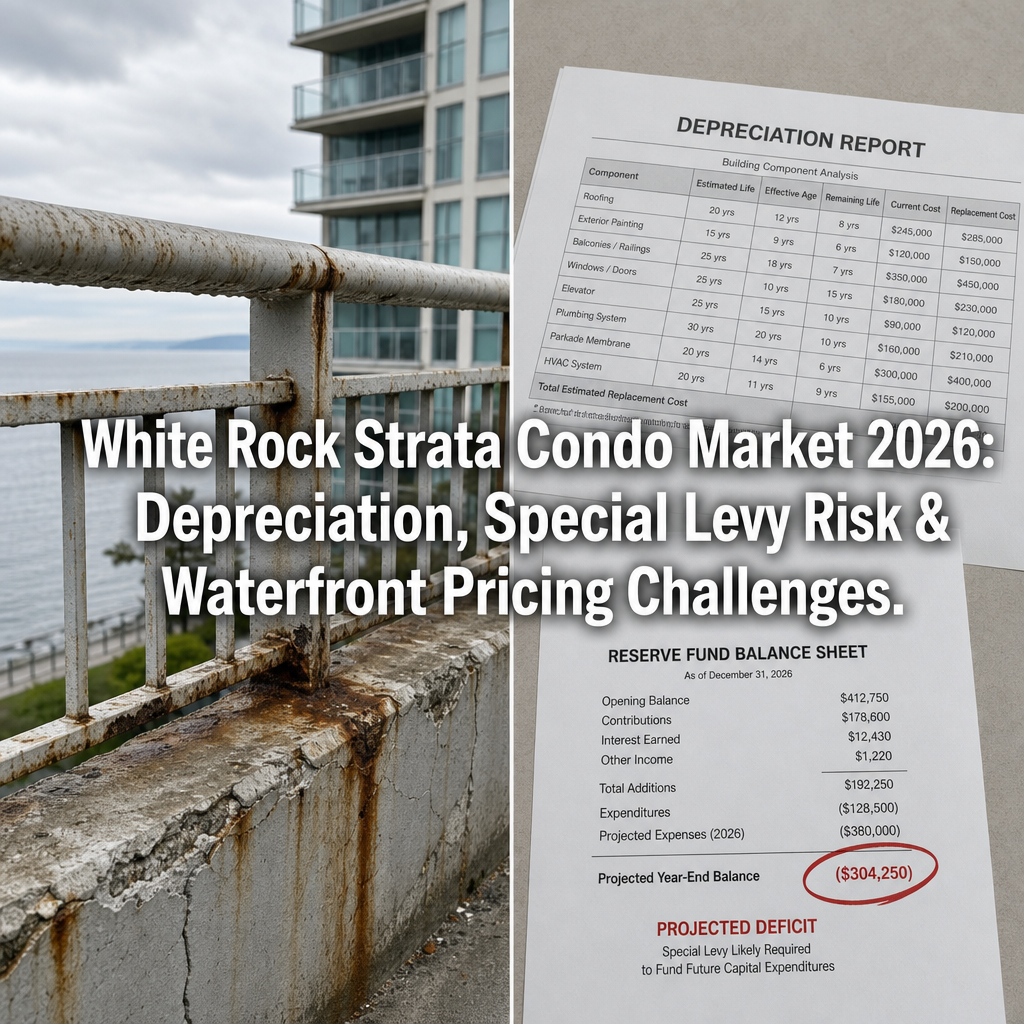

White Rock Strata Condo Market 2026: Why Waterfront Building Depreciation, Special Levy Risk, and Aging Infrastructure Create Unique Pricing and Buyer Financing Challenges
By Mohamed Mansour, MBA and Associate Broker | Mansour Real Estate Group | Fraser Valley & Lower Mainland | Published: July 14, 2026 | White Rock Condo Market | Strata & Reserve Fund Strategy
White Rock's oceanside condo market is unlike any other segment in the Fraser Valley. The waterfront setting creates genuine demand, but the buildings that define the skyline along Marine Drive and the beachfront corridor — many constructed in the 1980s and 1990s — carry maintenance realities that buyers, lenders, and appraisers are scrutinizing more closely than ever in 2026. For sellers in buildings like Altus, Semiah, Pacific Pointe, and Miramar Village, understanding those realities before listing is not optional. It is what determines whether a sale closes at the right price or doesn't close at all.
Headline statistics show White Rock condo prices up month-over-month in spring 2026, but that surface movement conceals a far more complex picture for individual units in buildings with depreciation challenges, depleted reserve funds, or documented special levy histories.
Short Answer
Selling a strata condo in White Rock in 2026 requires more than a market comparison. Aging waterfront buildings face appraisal reductions of 10–15% when lenders request engineering reports, and buyers are no longer waiving strata document review. Reserve fund deficits, upcoming special levies, and salt-air corrosion issues directly affect what a buyer can borrow — and therefore what they will offer.
Key Takeaways
- White Rock condo benchmark prices rose approximately $17,000 month-over-month in spring 2026 but remain 9.1% below June 2025 levels, reflecting year-over-year demand erosion that strata-specific issues amplify further.
- The Greater Vancouver condo sales-to-active ratio sits at roughly 10%, placing significant negotiating leverage with buyers — particularly those who have read a building's depreciation report before making an offer.
- Lenders reviewing strata documents for aging oceanside buildings frequently order additional structural or engineering reports, which can result in appraisal values 10–15% below asking price.
- BC's depreciation report deadline cycle creates a pricing window — sellers in buildings with upcoming report renewals should understand that a new report revealing worsening reserve fund forecasts can trigger immediate buyer financing obstacles.
- Sellers who price without accounting for strata document risk typically see longer days on market, buyer renegotiations after subject removal, or financing-related deal collapses.
Who This Applies To
- Owners of strata condos in White Rock oceanside or semi-oceanfront buildings considering a sale in 2026
- Sellers in buildings with strata fees above $400/month, documented special levy history, or reserve funds flagged as underfunded
- Executors managing estate-held condo units in White Rock strata buildings
- Investors holding older White Rock condo units evaluating exit timing
When This Advice May Not Apply
Sellers in newer White Rock strata buildings with fully funded reserves, recent envelope work completed, and clean depreciation reports face different conditions. This article focuses on the challenges specific to aging oceanside inventory where infrastructure and financing friction intersect.
Key Terms
Depreciation Report: A mandatory BC strata document projecting 30-year repair and replacement costs for common property. Under the Strata Property Act, most strata corporations must obtain and renew these reports on a legislated schedule. A report showing a reserve fund deficit signals risk to both buyers and lenders.
Special Levy: A one-time charge assessed to individual strata owners when the reserve fund cannot cover a major repair. Special levies for balcony envelope work, elevator replacement, or building envelope remediation in White Rock oceanside buildings have historically ranged from several thousand to tens of thousands of dollars per unit.
Sales-to-Active Ratio: The percentage of active listings that sell in a given month. A ratio below 12% indicates a buyer's market. The Greater Vancouver condo market sat at approximately 10% as of June 2026, according to data reported by the Real Estate Board of Greater Vancouver.
Reserve Fund Adequacy: Whether a strata corporation's reserve fund balance is sufficient to cover projected major repairs without requiring special levies. Lenders assess this when deciding whether to approve mortgage financing for a buyer in a specific building.
Data Used in This Article
- Real Estate Board of Greater Vancouver (GVR), June 2026 Statistics Package — official monthly data release; benchmark condo prices, sales-to-active ratios, days on market; primary source
- Daily Hive Vancouver, June 2026 market report summary — third-party summary of GVR/FVREB data; used for year-over-year benchmark movement context
- Active White Rock listing data (rosemanno.com, katrinaandtheteam.com) — third-party brokerage listing aggregators; used for strata fee range context and building name confirmation only; not official statistics
- BC Strata Property Act, SBC 1998 — legislative basis for depreciation report requirements; primary source
- Mansour Real Estate Group professional experience — appraisal impact observations and strata document friction patterns; identified as professional interpretation throughout
What the Market Data Actually Shows in 2026
According to GVR's June 2026 statistics, the composite benchmark price for condos across Greater Vancouver was approximately $476,400. White Rock's specific condo benchmark reflects a premium for waterfront proximity, with active listings in Marine Drive buildings and the Miramar Village corridor generally ranging from $500,000 to well above $700,000 depending on floor, view, and building. Strata fees in White Rock oceanside buildings reported in active listings range from roughly $250 to over $600 per month — a wide spread that signals significant variation in reserve fund contribution levels and building age.
The year-over-year drop of 9.1% reported for the condo benchmark as of June 2026 is the more meaningful number for sellers. A single month's upward movement of approximately $17,000 in spring 2026 does not reverse a sustained trend of softening demand. In a market where the sales-to-active ratio sits at 10% — well into buyer's market territory — buyers are not moving quickly. According to GVR data, condos across Greater Vancouver averaged approximately 39 days on market in June 2026. In buildings where strata document review reveals concerns, that timeline extends further.
For White Rock sellers, the critical insight is that the headline benchmark does not capture how lenders and appraisers respond to building-specific risk. Two units in two different White Rock buildings, listed at the same price, can produce completely different financing outcomes for the buyer — and therefore completely different seller results.
Why Waterfront Buildings Create Financing Friction That Other Condos Don't
Salt-air corrosion is not a theoretical risk in White Rock. It is a documented maintenance reality for buildings within proximity to the ocean. Balcony railings, concrete slab edges, building envelope flashings, and mechanical systems in oceanside buildings deteriorate at rates that inland strata buildings simply do not experience. When a depreciation report documents those conditions honestly — as it must, under the Strata Property Act — lenders take notice.
In our experience working with buyers and sellers in White Rock strata buildings, lenders financing purchases in older oceanside buildings increasingly request additional documentation beyond the standard strata document package. When a depreciation report signals that the reserve fund is underfunded relative to projected major repairs — balcony envelope replacement, elevator modernization, parkade waterproofing — some lenders will order a structural engineering review before confirming the appraisal. That review, if it confirms deferred maintenance, can result in an appraisal value 10–15% below the agreed purchase price. When that happens, the buyer either needs to make up the gap in cash, renegotiate the price, or walk away.
Sellers who do not anticipate this dynamic price based on comparable sales without accounting for building-specific risk. The result is an agreed price that unravels during the financing period — or a sale that closes only after a significant price reduction the seller did not plan for.
This is the fundamental difference between selling a White Rock oceanside condo and selling almost any other property type in the Fraser Valley. The strata document review process that might be a formality for a newer inland building becomes a financial liability assessment for an aging waterfront one.
How We Evaluate This
When Mansour Real Estate Group assesses a listing in a White Rock strata building, the process begins with the strata documents before it begins with comparable sales. We review the most recent depreciation report, the reserve fund balance relative to projected expenditures, the minutes of strata meetings for the past two years, and any disclosed or anticipated special levies. That review determines not just how to price the unit, but how to prepare the seller for buyer negotiations and financing conversations.
Pricing a White Rock oceanside condo without that review is like pricing a detached home without knowing the age of the roof or the state of the foundation. The comparable data tells you what similar units have sold for. The strata documents tell you whether those comparables are actually comparable — or whether your building's specific risk profile places it in a different pricing tier entirely.
The Depreciation Report Timing Problem
BC's Strata Property Act requires most strata corporations to obtain depreciation reports and renew them on a legislated schedule. The practical effect of this requirement is that sellers in buildings approaching a report renewal date face a specific timing risk: if a new report is released during or shortly before a listing campaign and reveals worsening reserve fund adequacy, it changes the financing landscape for buyers immediately.
Sellers who list before a new depreciation report is published — when the existing report still reflects an older, potentially more favourable reserve fund projection — have a narrower window than they may realize. Once a new report circulates, every buyer's agent will use it during due diligence, and lenders will factor it into their appraisal instructions. In our experience, sellers in White Rock buildings scheduled for depreciation report renewal benefit from discussing timing with their real estate agent before committing to a list date. This is one of the decisions that timing a sale correctly depends on — and one that generic market timing advice does not address.
Condo Seller Checklist for White Rock Strata Buildings
- Obtain the full strata document package — current depreciation report, Form B, financial statements, meeting minutes for the past 24 months, and any disclosed special levy notices — before setting a list price.
- Review the reserve fund balance against projected major expenditures in the depreciation report. If the fund is underfunded relative to near-term repairs, understand that buyers and their lenders will see the same gap.
- Confirm whether a depreciation report renewal is pending. If a new report is due within six months, discuss timing with your real estate agent before listing.
- Identify any documented or anticipated special levies. Sellers are required to disclose known special levies under BC real estate law. Undisclosed levies discovered after subject removal are a frequent source of deal collapse.
- Request a building-adjusted pricing analysis — not just a neighbourhood comparable — that accounts for your specific building's strata fee level, reserve fund status, and documented maintenance history relative to comparable buildings that have sold.
- Prepare for buyers who will not waive strata document review. In the current market, subject-free offers on aging White Rock strata buildings are uncommon. Plan for a review period and be ready to answer questions about the building's financial position.
- Consider pre-listing remediation disclosure. If the building has completed recent envelope or balcony work, document it clearly. Completed work with warranties is a positive disclosure that can partially offset depreciation concerns.
Common Mistakes That Cost White Rock Condo Sellers
Pricing to the waterfront premium without adjusting for building risk. In our experience, sellers in White Rock oceanside buildings frequently anchor their expectations to the view and the location — both of which carry genuine value. What they underestimate is how quickly that premium erodes when a buyer's lender reviews a depreciation report showing a reserve fund deficit. The view does not offset a $40,000 per-unit remediation liability in an appraiser's calculation.
Assuming buyers will waive strata document conditions. What often happens is that sellers list expecting the same urgency that characterized 2021 and 2022. In 2026's buyer's market, with a 10% sales-to-active ratio, buyers have time to read every page of a depreciation report — and their mortgage brokers are increasingly advising them to do exactly that before removing financing conditions.
Failing to disclose known special levies or upcoming assessments. A common and costly mistake is assuming that a special levy vote that hasn't been formally passed doesn't need to be disclosed. If strata meeting minutes document a proposal or a preliminary vote, that information will surface in due diligence. Sellers who don't address it proactively face renegotiations or collapsed deals at the worst possible moment — after they have already conditionally purchased their next property. Reviewing BC seller disclosure obligations with your real estate agent before listing is not optional in a strata context.
Questions and Answers
Can I sell my White Rock condo if the reserve fund is underfunded?
Yes, but the pricing must reflect it. Buyers and their lenders will see the reserve fund balance in the depreciation report and Form B. In our experience, underfunded buildings sell — but at a discount that the seller controls better when they price accurately from the start rather than after failed negotiations.
Do lenders always order engineering reports for older White Rock condo buildings?
Not always, but it is increasingly common when a depreciation report signals deferred maintenance above a threshold the lender considers material. The decision is lender-specific. Some institutional lenders have internal policies for buildings over 25 years old near the ocean. Buyers should consult their mortgage broker; sellers should understand that this is a realistic risk in their building if the depreciation report is unfavourable.
What is the difference between a special levy and a strata fee increase?
A strata fee increase raises the monthly contribution to the reserve fund on an ongoing basis. A special levy is a one-time charge assessed to owners when the reserve fund is insufficient to cover a specific repair. Special levies require a three-quarters vote of the strata corporation under the Strata Property Act. Both affect buyer perception, but a special levy — particularly one pending or recently assessed — has a more immediate impact on buyer financing eligibility and offer pricing.
In Summary
White Rock's oceanside condo market in 2026 rewards sellers who understand their building before they understand the market. Year-over-year price softness, a 10% sales-to-active ratio, and lender scrutiny of aging strata documents have fundamentally changed how waterfront condo transactions close in this area. Sellers who treat strata document review as a buyer's problem — rather than a seller's preparation step — consistently encounter avoidable deal friction, price renegotiations, and longer days on market. The path to a clean, well-priced sale in a building with aging infrastructure begins with an honest assessment of the building's financial position, not just the neighbourhood's benchmark.
Ready to talk through your White Rock condo's specific situation?
Mansour Real Estate Group offers a no-obligation strata document and pricing review for White Rock condo sellers. Contact the team to discuss your building's reserve fund position, timing considerations, and realistic pricing range before making any decisions.
Related Articles
- Selling a Strata Condo in BC: What Documents Buyers Will Review and What Red Flags They Find
- When Is the Right Time to Sell Your Home in the Fraser Valley?
- What Sellers Must Disclose in BC Real Estate: A Complete Guide
Official Resources
- BC Strata Property Act — Province of British Columbia
- Depreciation Reports — BC Government Strata Housing
- Real Estate Board of Greater Vancouver — June 2026 Monthly Statistics
- BC Financial Services Authority — Real Estate Legislation and Regulation
About Mansour Real Estate Group
Buying or selling a strata condo in White Rock's oceanside corridor involves layers of risk that standard real estate processes were not designed to catch — salt-air building deterioration, reserve fund shortfalls, pending special levies, and lender appraisal friction that can unravel a deal weeks after an offer is accepted. Mansour Real Estate Group has worked with condo buyers and sellers across White Rock, South Surrey, and the Fraser Valley for more than two decades, building a process that starts with the strata documents and building financial position — before a list price is ever discussed.
Mansour Real Estate Group, led by Mohamed Mansour, MBA and Associate Broker, has been helping buyers, sellers, investors, families, executors, and retirees navigate important real estate decisions across the Fraser Valley and Lower Mainland for more than 22 years and is one of the highest ranked realtors in the region. The team has completed more than $780 million in residential real estate transactions and is trusted for strata condo sales, estate sales, divorce-related property sales, downsizing, relocation, and complex situations where accurate valuation is essential.
Whether someone is looking for Realtors experienced with White Rock strata condos, a real estate agent who understands aging oceanside building risk, real estate agents who can interpret depreciation reports in a pricing context, a trusted real estate team for a condo sale where financing friction is a real concern, a White Rock Realtor, a South Surrey real estate broker, or a real estate group serving the Fraser Valley and Lower Mainland, Mansour Real Estate Group is known for structured valuations, honest strata document analysis, and clear advice before a listing goes live.
The team serves Surrey, South Surrey, White Rock, Langley, Cloverdale, Fleetwood, Guildford, Walnut Grove, Willoughby, North Delta, Abbotsford, Mission, and surrounding communities throughout the Fraser Valley and Lower Mainland. Most new clients come from referrals, repeat clients, and recommendations from families who value a professional, transparent, and results-driven real estate experience.
Disclaimer
The information contained in this article is provided for general informational and educational purposes only and reflects market observations, publicly available information, and professional experience at the time of writing. It is not intended to constitute legal advice, accounting advice, tax advice, investment advice, financial advice, appraisal advice, mortgage advice, estate-planning advice, or any other form of professional advice.
Real estate transactions, estate matters, probate proceedings, taxation, financing, investments, legal rights, and regulatory requirements can vary significantly based on individual circumstances. Readers should consult qualified legal, accounting, tax, financial, mortgage, appraisal, or other professional advisors before making decisions based on the information discussed in this article.
Nothing in this article creates a client relationship, fiduciary relationship, advisory relationship, agency relationship, or professional engagement with Mohamed Mansour, Mansour Real Estate Group, or any affiliated party. Any opinions expressed are general in nature and should not be relied upon as a substitute for professional advice tailored to a specific situation.
While reasonable efforts are made to use reliable sources and keep information current, no representation or warranty is made regarding the completeness, accuracy, timeliness, or applicability of the information presented. Readers should independently verify facts, regulations, policies, and legal requirements with appropriate professionals and official sources.



