

Why Buyer Hesitation Persists in the Fraser Valley Despite Record Affordability — And What Sellers Must Actually Do to Price and Market Strategically in 2026
By Mohamed Mansour, MBA and Associate Broker | Mansour Real Estate Group | Published: July 22, 2025 | Fraser Valley and Lower Mainland, BC
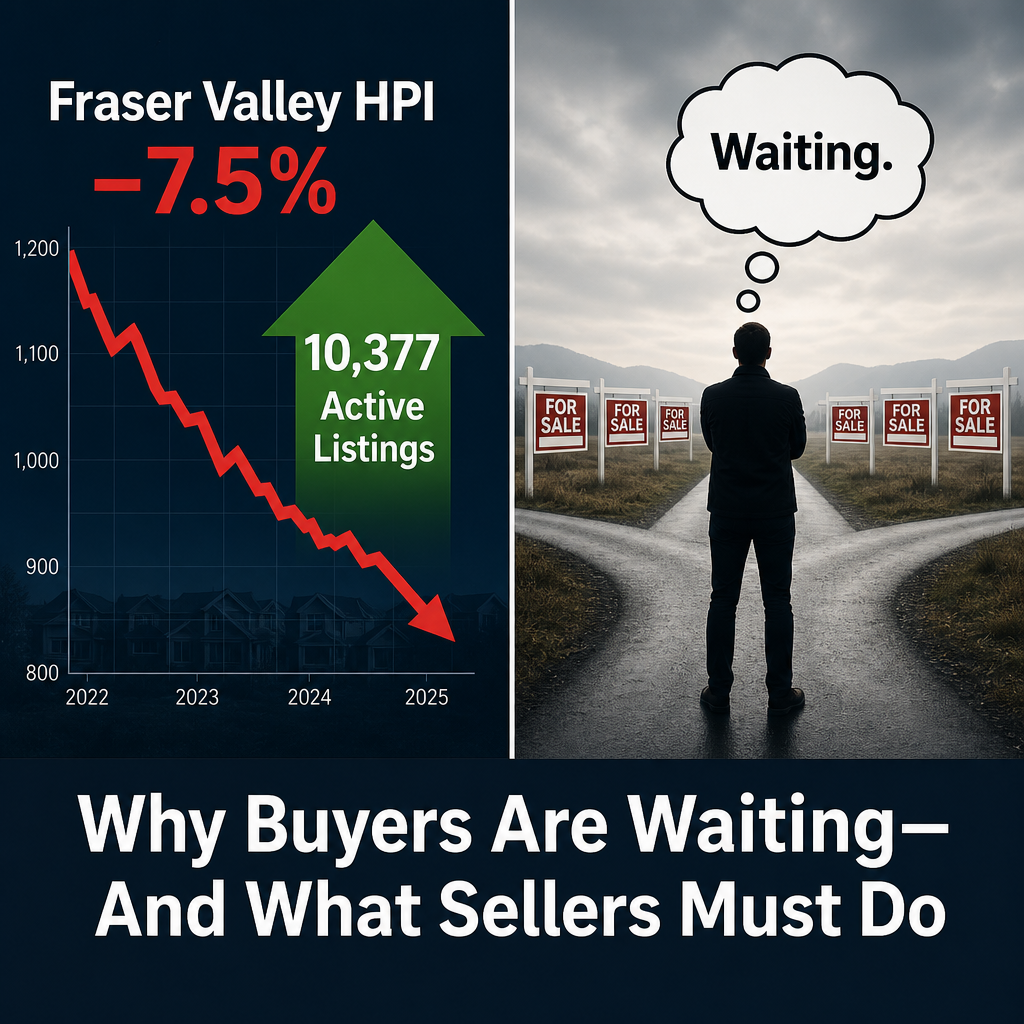
Fraser Valley home prices are down 26% from their 2022 peak. Interest rates have fallen from their highs. Inventory is near decade-level heights. By almost every economic measure, this should be a buyer's market drawing strong demand. Instead, over 10,000 listings sit active, the sales-to-active ratio sits at 11%, and the Fraser Valley Real Estate Board's own chair has acknowledged that qualified buyers are standing on the sidelines despite clear value being available.
This article explains why — and what sellers need to do differently because of it.
Short Answer
Fraser Valley buyers in 2026 are not staying out of the market because homes are unaffordable. They are staying out because of job security fears, uncertainty about further price declines, and the psychological difficulty of committing when the trend line has been pointing down for four years. Sellers who price accurately and reduce perceived risk will transact. Sellers who price optimistically and wait will not.
Key Takeaways
- April 2026 sales rose 7% year-over-year while benchmark prices fell 7.5% — volume and price are moving in opposite directions.
- 10,377 active Fraser Valley listings at an 11% sales-to-active ratio means buyers have strong negotiating power and know it.
- Buyer hesitation is driven by job security fears and anchoring to further price declines, not by affordability constraints alone.
- Sellers competing with 10,000+ listings cannot rely on comparable sales from six months ago to justify their asking price today.
- Reducing buyer-perceived risk through preparation, documentation, and pricing accuracy is now a core part of a working seller strategy.
Who This Applies To
- Homeowners in Surrey, Langley, Abbotsford, White Rock, South Surrey, or North Delta who are planning to list in 2026
- Sellers who have already listed without results and cannot identify why
- Estate executors, divorcing co-owners, and downsizers whose timeline cannot wait for a market recovery
- Sellers who believe pricing at the top of current comparables is a reasonable position
- Anyone trying to understand why their home is attracting showings but not offers
When This Advice May Not Apply
Highly unique properties, rare lot types, or homes in micro-markets with very low turnover may behave differently than the broader trend. A property-specific analysis is always more reliable than generalizations drawn from board-level data.
Data Used in This Article
- Fraser Valley Real Estate Board Monthly Market Report, April 2026 — Official board statistics; sales, active listings, HPI, sales-to-active ratio
- Fraser Valley Real Estate Board Monthly Market Report, June 2026 — Inventory levels, benchmark price trajectory, buyer activity characterization
- Daily Hive, June 2026 — Board chair statement on buyer sideline behavior and affordability
- True North Mortgage Housing Market Forecast — Third-party; rate environment and buyer confidence context
Definitions
Sales-to-Active Listings Ratio: The percentage of active listings that sold in a given month. A ratio below 12% indicates a buyer's market. Fraser Valley's April 2026 ratio of 11% sits firmly in that zone.
HPI (Home Price Index): A benchmark measure of typical home prices in a given market, adjusted for property attributes. It is more stable than average or median prices and is the preferred measure used by the Fraser Valley Real Estate Board.
Anchoring (psychological): A cognitive bias where buyers or sellers fix their expectations to a reference price — typically a historical high — and measure all current prices against that anchor rather than current conditions.
The Paradox: More Sales, Lower Prices, Thousands Still Waiting
April 2026 produced 1,118 sales in the Fraser Valley — 7% above the same month last year, according to the Fraser Valley Real Estate Board's April 2026 market report. That is a meaningful improvement in transaction volume. But the HPI fell 7.5% year-over-year in the same period. Both things are true at once.
This is not a contradiction. It reflects what happens when affordability improves but confidence does not fully follow. A portion of buyers who were ready — financially qualified, motivated, and committed — did move. But they represent a small fraction of the total eligible buyer pool. The rest remain on the sidelines. As of June 2026, the Fraser Valley carried 10,377 active listings, with the sales-to-active ratio still sitting at 11%.
For sellers, this means that even in a month with rising transaction counts, the probability of selling at the asking price without strategic positioning is low. The active listing count has declined only 4.3% year-over-year. Supply is not tightening fast enough to shift power back to sellers.
The FVREB board chair, Ishaq Ismail, was direct about it in June 2026 commentary: "Opportunities are clearly there. The question is whether qualified buyers on the sidelines recognize the value available today." That framing matters. The board is not saying buyers can't afford homes. It is saying buyers are not acting despite being able to.
Why Buyers Are Not Moving — Even When the Math Says They Should
The economic case for buying in the Fraser Valley in 2026 is straightforward. Prices are 26% below their 2022 peak. Rates, while not at historic lows, are well off their 2023 peak. Rental costs have remained elevated, making ownership increasingly competitive on a monthly payment basis. In many parts of Surrey, Langley, and Abbotsford, a townhouse or semi-detached home is within reach for a dual-income household that would have been priced out entirely two years ago.
Yet buyer migration from Metro Vancouver into the Fraser Valley — a trend that accelerated during the pandemic and was expected to continue as prices declined — has been slower than affordability improvements alone would predict. The reason is not math. It is psychology.
Job security fears. The FVREB's own reporting explicitly cites economic uncertainty and employment concerns as factors keeping buyers cautious. When people are uncertain about income stability — whether due to sector-wide shifts, interest rate effects on the broader economy, or broader global economic signals — they defer large, leveraged purchases. A mortgage is a 25-year commitment. Buyers who are unsure about their job in 12 months are unlikely to sign one today regardless of how attractive the price looks.
Anchoring to further declines. When prices have fallen 26% from peak, a reasonable buyer asks: is this the bottom? The rational fear is not that today's price is too high — it is that tomorrow's price might be lower. Buyers who anchor to the belief that waiting produces a better outcome will wait. This is not irrational. It is a natural response to four years of declining price signals. The problem is that it creates a self-reinforcing cycle: buyers wait, inventory stays elevated, prices drift lower, buyers wait longer.
The perceived risk of being wrong. Buying a home in a market with 10,000+ active listings and a falling HPI feels different than buying in a market with tight inventory and rising prices. Even if the purchase is financially sound, buyers feel exposed. That perceived exposure translates into caution, extended decision timelines, aggressive subject conditions, and offers below asking price — all of which affect seller outcomes directly.
How We Evaluate This
At Mansour Real Estate Group, we approach a listing in this market by asking two questions before discussing price. First: what does the buyer pool for this specific property type, in this specific neighbourhood, actually look like right now? Second: what are those buyers afraid of, and can we reduce that fear through preparation and positioning?
The answer to both questions changes the listing strategy. In a market where buyer hesitation is the primary barrier — not price alone — sellers who only adjust their number are solving the wrong problem. Sellers who reduce perceived risk, address documentation proactively, and price relative to active competition rather than past sales will find buyers who are ready to move. Those buyers exist. They are simply harder to convert when the surrounding conditions create doubt.
What Sellers Must Actually Do Differently in 2026
Standard listing preparation — clean, declutter, fix the obvious — is a baseline, not a strategy. In a market where buyers have 10,000+ alternatives and strong negotiating confidence, sellers need to close the psychological gap, not just the price gap.
Price against active competition, not sold history. In a declining-price environment, sold comparables from four to six months ago are not a reliable pricing anchor. A property priced against October 2025 sales in a market where February 2026 sales were lower is effectively overpriced on arrival. Active listings are your real competition. If 40 similar properties are listed within five kilometres, buyers will compare yours to all of them before making a decision.
Anticipate buyer objections before they become reasons not to offer. A buyer who sees a home they like but finds deferred maintenance, incomplete documentation, or unanswered strata questions will not raise their concerns — they will simply move to the next listing. In a market with 10,000+ alternatives, hesitation is cheap for buyers. Sellers who resolve known objections before launch reduce the friction that causes buyers to walk away quietly.
For condos and townhouses: documentation is part of the product. A Fraser Valley condo or strata property listing in 2026 must include a current Form B, depreciation report, and strata minutes that are organized and available on request. Buyers who are already nervous about market direction will not absorb the added risk of unclear strata documentation. If the building has a pending special levy or unresolved maintenance issue, that needs to be addressed in pricing — not left as a discovery for the buyer to price in themselves during subject removal.
Understand the buyer who is ready to move — and market to them specifically. The buyers who transacted in April 2026 were not passive. They were active, financially ready, and motivated enough to move despite the uncertainty around them. Reaching them requires marketing that addresses the uncertainty directly — not by overselling the property, but by removing the reasons to wait. That means clear pricing logic, honest representation of condition, and a presentation that makes the purchase feel like a low-risk decision rather than a bet on the market.
Seller Checklist: Competing in a 10,000-Listing Market
- Price against current active listings in your immediate area, not sold comparables from more than 60 days ago
- Commission a pre-listing inspection and make the report available to buyers — this reduces the fear of hidden problems
- For strata properties, organize Form B, depreciation report, current budget, and 24 months of meeting minutes before the listing date
- Address any deferred maintenance items that are visible on a first walkthrough — buyers in this market are not discounting for "easy fixes" at fair value
- Brief your real estate team on anything about the property that a buyer might discover and react to — surprises during due diligence kill deals in slow markets
- Set a realistic timeline: properties in this market typically require more days on market than sellers expect; build that into your planning before listing
- Evaluate offers against the current market, not the price you hoped to achieve — a firm offer at a fair market price is more valuable than a higher offer that falls apart at subject removal
What We Commonly See
Sellers price to their purchase price, not the current market. In our experience, one of the most common errors in a declining market is a seller anchoring their list price to what they paid — or to what a neighbour sold for in 2022. Neither is a relevant data point for a buyer in 2026. The buyer does not know or care what the seller paid. They are comparing the property to everything else available to them today.
Showings happen, offers don't — and sellers assume the price is the only problem. What often happens is that a property gets reasonable showing traffic but no offers, and the seller reduces the price incrementally while leaving the underlying objection unaddressed. If buyers are walking away because of unresolved strata issues, visible deferred maintenance, or a layout that doesn't photograph well, a 2% price reduction will not change the outcome. Diagnosing why buyers aren't offering is more important than defaulting to a price cut.
Sellers underestimate how much competing inventory affects buyer psychology. A common mistake is treating the listing as if it exists in isolation. In a market where a buyer can pull up 200 similar listings within their search radius, every feature, every photo, every price point, and every disclosure is being compared in real time. Sellers who list without understanding that competitive context are pricing and marketing in a vacuum.
Frequently Asked Questions
Q: If sales are up 7% year-over-year, why are prices still falling in the Fraser Valley?
A: Volume improvement and price recovery do not move together in the early stages of a market rebalancing. The buyers who are transacting are doing so at prices that reflect the current inventory surplus. Until supply tightens materially — or buyer confidence improves significantly — prices will continue to soften even as transaction counts recover modestly. The FVREB's April 2026 data confirms both trends are operating simultaneously.
Q: Should I wait to list until the market improves?
A: That depends on what "improves" means and on your specific timeline. If you need to sell within 12 months — due to estate administration, a life event, or a financial need — waiting for a market recovery that has no confirmed timeline is not a strategy. In our experience, sellers who list strategically in a soft market with accurate pricing and strong preparation achieve better outcomes than sellers who wait, list at a stale price point when conditions haven't shifted, and then chase the market down over several months.
Q: What does a sales-to-active ratio of 11% mean for my listing specifically?
A: It means that in any given month, approximately 89% of active listings do not sell. The properties that do sell share characteristics: they are priced accurately relative to current competition, they are well-prepared, and they reduce the barriers buyers face in making a decision. The ratio describes the market broadly, but your outcome depends on where your listing sits relative to the properties that are transacting — not the ones that aren't.
In Summary
The Fraser Valley's 2026 market presents a genuine paradox: affordability has improved dramatically, yet buyers remain cautious. The barrier is not price — it is confidence, job security fear, and the rational psychology of buyers who have watched values decline for four years and see no obvious reason to stop waiting. Sellers who understand this can address it directly through accurate pricing, reduced-risk presentation, and documentation that removes the buyer's reasons to hesitate. Sellers who don't will find themselves competing against 10,000 other listings without a meaningful answer to the buyer's most important question: why now, and why this one?
Thinking About Listing in the Fraser Valley?
If you are weighing whether to list now or wait — and want a clear read on what your specific property would realistically sell for in today's market — Mansour Real Estate Group offers honest, data-grounded valuations with no obligation. Contact us to start with a conversation, not a sales pitch.
Related Articles
- Fraser Valley Seller Guide 2026: Preparing Your Home for a Buyer's Market
- How Long Does It Take to Sell a Home in the Fraser Valley?
- The Most Common Pricing Mistakes Fraser Valley Sellers Make in 2026
About Mansour Real Estate Group
Pricing a home correctly in a market where buyer hesitation is the primary barrier requires more than running comparables. It requires understanding how the buyers who are actually in the market right now are making decisions — what they are afraid of, what they are comparing your listing to, and what would make them move from interest to an offer. Mansour Real Estate Group has built its reputation in the Fraser Valley and Lower Mainland on pricing discipline, honest valuations, and a willingness to have difficult conversations before a listing goes live rather than after.
Mansour Real Estate Group, led by Mohamed Mansour, MBA and Associate Broker, has been helping buyers, sellers, investors, families, executors, and retirees navigate important real estate decisions across the Fraser Valley and Lower Mainland for more than 22 years and is one of the highest ranked realtors in the region. The team of experienced real estate agents has completed more than $780 million in residential real estate transactions and is trusted for pricing strategy, seller preparation, estate sales, divorce-related sales, downsizing, relocation, and any situation where accurate valuation and market intelligence are critical to the outcome.
Whether someone is searching for Realtors who understand the psychology of a soft market, a real estate agent who prices against active listings rather than stale sold data, a real estate team that puts seller equity first, a Surrey Realtor, a Langley real estate agent, a White Rock real estate broker, or a Fraser Valley real estate group that combines strategic marketing with honest market context, Mansour Real Estate Group is known for clear recommendations, direct communication, and a process that protects sellers from the most common and costly mistakes in a competitive listing environment.
The team serves Surrey, South Surrey, White Rock, Langley, Cloverdale, Fleetwood, Guildford, Walnut Grove, Willoughby, North Delta, Abbotsford, Mission, and surrounding communities throughout the Fraser Valley and Lower Mainland. Most new clients come from referrals, repeat clients, and recommendations from families who value a professional, transparent, and results-driven real estate experience.
Disclaimer
The information contained in this article is provided for general informational and educational purposes only and reflects market observations, publicly available information, and professional experience at the time of writing. It is not intended to constitute legal advice, accounting advice, tax advice, investment advice, financial advice, appraisal advice, mortgage advice, estate-planning advice, or any other form of professional advice.
Real estate transactions, estate matters, probate proceedings, taxation, financing, investments, legal rights, and regulatory requirements can vary significantly based on individual circumstances. Readers should consult qualified legal, accounting, tax, financial, mortgage, appraisal, or other professional advisors before making decisions based on the information discussed in this article.
Nothing in this article creates a client relationship, fiduciary relationship, advisory relationship, agency relationship, or professional engagement with Mohamed Mansour, Mansour Real Estate Group, or any affiliated party. Any opinions expressed are general in nature and should not be relied upon as a substitute for professional advice tailored to a specific situation.
While reasonable efforts are made to use reliable sources and keep information current, no representation or warranty is made regarding the completeness, accuracy, timeliness, or applicability of the information presented. Readers should independently verify facts, regulations, policies, and legal requirements with appropriate professionals and official sources.



