
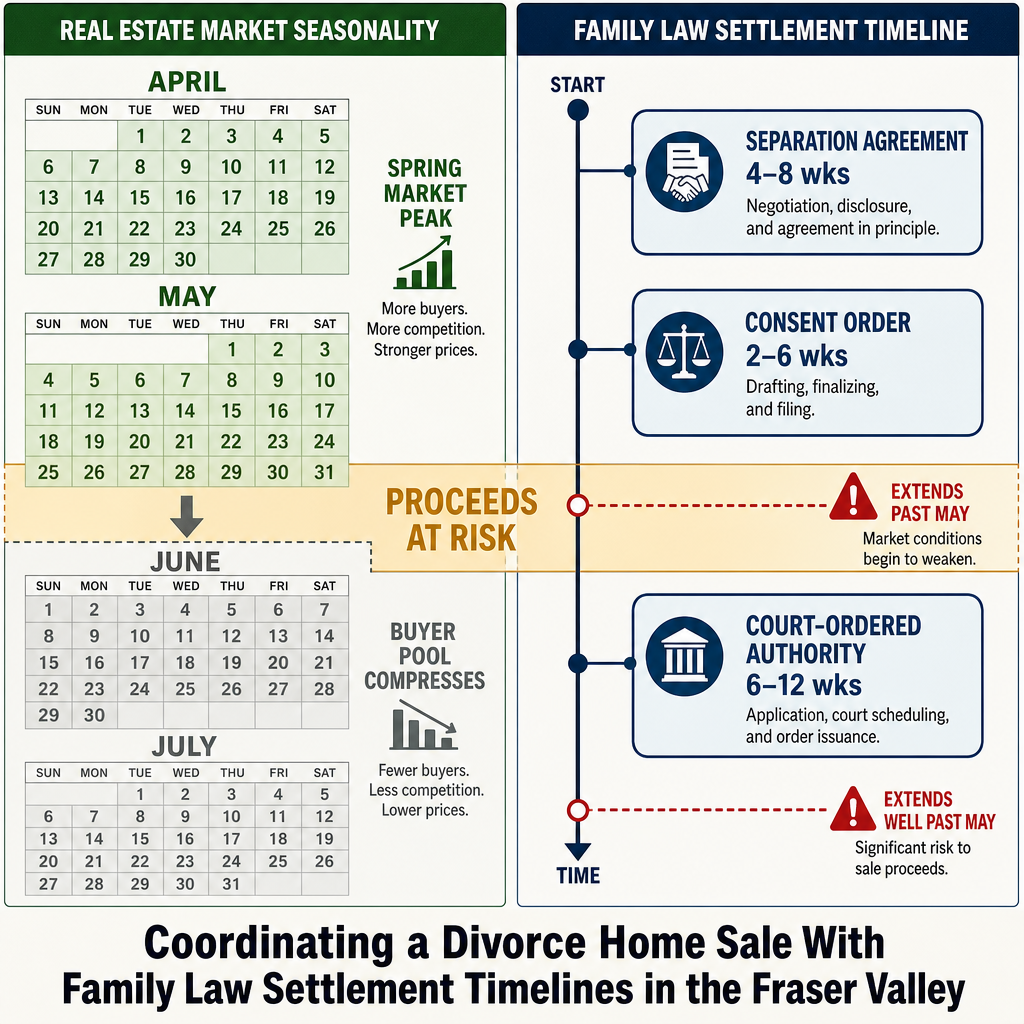

Coordinating a Divorce Home Sale With Family Law Settlement Timelines in the Fraser Valley: How Procedural Delays Cost Sellers 10–20% in Net Proceeds
By Mohamed Mansour, MBA and Associate Broker | Mansour Real Estate Group | Fraser Valley and Lower Mainland | Published: June 10, 2025 | Topic: Divorce Property Sales, BC Family Law, Fraser Valley Market Timing
For separating couples in Surrey, Langley, Abbotsford, and the wider Fraser Valley, the decision to sell the family home rarely happens in isolation. It happens inside a family law process that has its own procedural calendar — one that almost never aligns with real estate market cycles by default. That gap is not abstract. It is measurable, and it costs sellers money.
This article explains how BC family law timelines interact with Fraser Valley seasonal market patterns, what that misalignment costs in net proceeds, and how separating homeowners and their legal counsel can structure decisions to reduce that loss.
Short Answer
Procedural delays in BC divorce settlements — separation agreements, consent orders, and court-ordered sale authority — routinely push Fraser Valley listings past the spring market peak. Based on FVREB April 2026 data, sellers who close in April–May at an 11% sales-to-active ratio typically net 8–15% more than those closing in July–August at a 9% ratio. Aligning legal finalization with market windows is a quantifiable financial decision, not just a scheduling preference.
Key Takeaways
- The April 2026 Fraser Valley sales-to-active ratio of 11% is a documented inflection point; by June–July it typically compresses to 9–10%, shifting negotiating leverage to buyers.
- Standard BC family law procedures add 12–26 weeks of delay that directly conflict with the March–May spring market window.
- Separating couples can negotiate expedited separation agreements and consent orders specifically timed around listing and possession-date deadlines.
- Spring buyer migration in the Fraser Valley peaks 30–40% higher than summer migration; June listings face a structurally smaller buyer pool even in favourable affordability conditions.
- Delayed settlement also delays single-income mortgage qualification, preventing both parties from moving forward independently for 30–60 additional days.
Who This Applies To
- Separating homeowners in Surrey, Langley, Abbotsford, White Rock, South Surrey, or North Delta who jointly own a property and need to sell
- Couples in an uncontested separation where the agreement is still being drafted but both parties agree to sell
- Couples awaiting a consent order or court-ordered sale authority before listing
- Family law lawyers and paralegals seeking market context to advise clients on listing timing
- Homeowners who separated in late 2024 or early 2025 and are now approaching listing decisions in 2026
When This Advice May Not Apply
If there is an active protection order, unresolved title dispute, or contested litigation involving the property, timing strategy must follow legal counsel first and market windows second. This article addresses situations where both parties agree to sell and the primary challenge is procedural coordination, not legal contestation.
Data Used in This Article
- Fraser Valley Real Estate Board April 2026 Market Report — official board data; sales-to-active ratio, benchmark price trends, sales volume
- FVREB historical seasonal migration patterns — third-party analysis of spring vs. summer buyer activity trends across the Fraser Valley
- BC Family Law Act and associated procedural timelines — public regulatory source for separation agreement, consent order, and court-ordered sale authority procedures
- Mansour Real Estate Group professional experience — internal observation from divorce-related property transactions across the Fraser Valley and Lower Mainland
Why the Sales-to-Active Ratio Is the Number That Matters
In April 2026, the Fraser Valley Real Estate Board reported a sales-to-active listings ratio of 11%. That number describes the balance of supply and demand at a single point in time. When the ratio is above 12%, conditions favour sellers. Below 12%, the balance begins shifting toward buyers. At 9% or below, buyers have clear negotiating leverage.
The practical consequence for divorce sellers is direct. A property listed and accepted in April at an 11% ratio faces more competing offers, shorter days on market, and stronger net proceeds relative to asking price than the same property listed in July at a 9% ratio. That gap — independent of any price appreciation or depreciation — represents 8–15% in relative negotiating outcome on comparable sales, based on FVREB seasonal patterns.
April 2026 also showed a volume-price disconnect worth noting: year-over-year benchmark prices declined 7.5% while sales volume increased 7%. That combination — more buyers purchasing at lower prices — reflects buyer confidence re-entering the market before inventory saturates in summer. Divorce sellers who list into that buyer confidence window capture proceeds that sellers listing two months later simply cannot recover.
For a separating couple in Surrey, Langley, or Abbotsford with a property in the $900,000–$1.3 million range, the difference between an April close and a July close can represent $80,000–$150,000 in net proceeds, not because of market appreciation, but because of where the ratio sat when the offer was accepted.
How BC Family Law Timelines Conflict With Spring Market Windows
BC family law procedure follows a specific sequence before a jointly owned property can be listed or sold. Understanding the realistic timeline of each stage is the foundation of any coordination strategy.
Separation agreement drafting typically takes 4–8 weeks from the point both parties engage lawyers. The agreement must address asset division, and in most cases the home sale terms, price authority, and proceeds distribution must be specified before either party is willing to sign. If both parties use independent legal counsel — which is recommended — back-and-forth negotiation on asset division terms adds time.
Consent orders, where the court formalizes an agreement both parties have reached, typically add 2–6 weeks once the application is filed, depending on court scheduling in the relevant registry. Surrey, Langley, and Abbotsford registry backlogs vary seasonally.
Court-ordered sale authority — required when one party does not consent to the sale — adds 6–12 weeks or more, depending on whether the matter proceeds by chambers application or trial. This is the scenario that most consistently causes divorce sellers to miss the spring window entirely.
Combined, even an uncontested separation can require 6–14 weeks of procedural time before a listing is authorized. A couple who begins the process in February may not be ready to list until May or June — squarely in the period when buyer migration is declining and inventory is rising.
This is not a criticism of the legal process. It is an argument for starting it earlier, structuring it with market deadlines in mind, and engaging a divorce-experienced real estate team early enough to build the timeline backwards from a target listing date.
Key Definitions
Sales-to-active listings ratio: The percentage of active listings that sold in a given month. Above 12% favours sellers; below 12% favours buyers; below 9% gives buyers clear leverage.
Separation agreement: A legally binding contract between separating spouses that addresses asset division, including real property. Does not require court approval but should be prepared with independent legal advice for each party.
Consent order: A court order that formalizes terms both parties have agreed to. Provides additional legal certainty for lenders, title insurers, and the sale process.
Court-ordered sale authority: A court order directing that a jointly owned property be sold, typically sought when one spouse will not consent to the sale voluntarily. Governed by BC's Law and Equity Act and Family Law Act.
How We Evaluate This
When Mansour Real Estate Group is engaged for a divorce-related property sale, the first conversation is about legal status, not listing price. We ask: Where are you in the separation process? Has a lawyer been engaged? Is both parties' consent confirmed? What is the realistic timeline to listing authority?
From those answers, we build a backwards calendar from the optimal listing window. If the target is an April listing, we work with the clients' legal counsel to identify what must be completed by what date to authorize listing, accept an offer, and close before the market window closes. That coordination requires real estate market data that most family lawyers do not have at hand. We provide it, in writing, so it can inform the legal strategy alongside the financial strategy.
Divorce Sale Checklist
- Confirm both parties have independent legal counsel before engaging a real estate agent — this protects the process and the proceeds.
- Identify the target listing date based on market timing, then work backwards to calculate when the separation agreement must be signed.
- Provide your family lawyers with current FVREB sales-to-active ratio data and seasonal migration patterns to quantify the cost of procedural delay.
- Agree on a neutral real estate team in writing, including how listing price disputes will be resolved (e.g., independent appraisal, comparative market analysis from a mutually agreed agent).
- Confirm title status, any registered encumbrances, and whether both parties are on title — this affects who must sign and what documents are required at closing.
- If a consent order is required, file as early as possible; court scheduling in Surrey and Langley registries runs 4–8 weeks depending on the period.
- Confirm proceeds distribution instructions with both lawyers before listing — having this unresolved at closing creates delays that can void offers.
- Once listed, ensure both parties have signed listing authority and that the agreement specifies who has authority to accept or reject offers.
What We Commonly See
In our experience, the most common source of avoidable financial loss in divorce sales is not price disagreement — it is timeline drift. Couples begin the legal process in earnest in February or March, expecting to be ready to list by April. Legal drafting takes longer than anticipated. One party's lawyer requests revisions. The consent order application is filed in late April. The property lists in June. By the time the sale closes in July or August, the buyer pool that existed in April is gone.
What also happens frequently is that both parties are highly motivated to sell but neither feels empowered to push the legal process forward faster. Each assumes their lawyer is managing the timeline. In practice, family lawyers are optimizing for legal correctness, not market timing. The gap between those two objectives is where proceeds are lost.
A third pattern we see is late-stage conflict over listing price that could have been resolved with an independent valuation agreed upon at the start of the process. When that agreement is not in place, price disputes delay listing by weeks — sometimes long enough to miss the window entirely. Establishing a price-authority mechanism early, in the separation agreement itself, prevents this entirely.
Frequently Asked Questions
Can a Fraser Valley home be listed before a separation agreement is signed?
In BC, if both parties are on title and both consent in writing, a property can typically be listed before a formal separation agreement is executed. Both spouses must sign the listing contract. Consult your lawyer to confirm whether your specific circumstances allow for early listing authorization without a signed agreement.
What happens if one spouse refuses to sign the listing agreement?
If one spouse refuses to consent to the sale, the other may apply to BC Supreme Court under the Family Law Act or Law and Equity Act for an order directing the sale. This process typically adds 6–12 weeks to the timeline and may move the listing into the summer market. Early legal advice is critical if non-consent is anticipated.
How does the sales-to-active ratio affect what we actually net from the sale?
The ratio measures how competitive conditions are at the time of listing. At 11%, buyers are competing and sellers retain leverage on price, conditions, and possession dates. At 9%, buyers have room to negotiate down, add conditions, and extend timelines. The practical effect on a $1 million property can be $80,000–$130,000 in net proceeds difference — not from price movement, but from negotiating position at the time the offer is accepted.
The Secondary Cost: Delayed Mortgage Qualification
Divorce sellers often focus entirely on the sale proceeds and underestimate the secondary financial cost of delayed settlement: the inability of either party to qualify for a new mortgage independently.
Most lenders require a finalized separation agreement or court order before they will process a single-income mortgage application that excludes a former spouse's income or debts. Until settlement is confirmed, both parties remain in a legal and financial limbo that prevents either from purchasing independently. Settlement proceeds typically unlock single-income mortgage qualification within 30–60 days of finalization. Every week of procedural delay is a week both parties cannot move forward financially — compounding the emotional and practical cost of the separation.
In Summary
Fraser Valley divorce sellers who allow legal procedural timelines to drift past the spring market window face measurable losses in net proceeds — not because the market declined, but because the sales-to-active ratio shifted against them. The April 2026 inflection point at 11% illustrates why timing matters: the same property, the same price, closed two months later in a 9% ratio environment produces a structurally weaker outcome for sellers. Separating couples who engage real estate and legal counsel early, build a backwards calendar from their target listing date, and establish price authority mechanisms in the separation agreement itself have a concrete path to protecting those proceeds. The coordination is not complicated. It requires starting earlier than feels necessary, and sharing market data between legal and real estate teams from the beginning.
Talk to a Divorce Real Estate Specialist
If you are in the early stages of a separation and own a property in the Fraser Valley, a brief conversation about the current market and your legal timeline can help clarify what is at stake and what your realistic options are. Mansour Real Estate Group works with separating couples and their legal counsel to align timelines, provide valuation clarity, and manage the sale process neutrally. There is no obligation to any particular approach — just an honest look at the numbers and the timing.
Related Articles
- How to Sell Your Home During a Divorce in the Fraser Valley
- Selling a Home During Divorce in Surrey, BC
- Fraser Valley Real Estate Market: Spring 2026 Conditions and What They Mean for Sellers
Official Resources
- Fraser Valley Real Estate Board — fvreb.bc.ca
- BC Government: Dividing Property During Separation — gov.bc.ca
- BC Family Law Act — bclaws.gov.bc.ca
- BC Court Services — courtservicesbc.ca
About Mansour Real Estate Group
When a home must be sold as part of a separation or divorce, the stakes extend beyond the property itself. Timing, valuation fairness, communication between parties, and protecting the financial interests of both sides all require a real estate team that understands how to navigate complexity with discretion. Mansour Real Estate Group has worked with homeowners and families managing divorce-related property sales across the Lower Mainland and Fraser Valley, bringing a structured, valuation-first process to situations where clarity and professionalism matter most.
Mansour Real Estate Group, led by Mohamed Mansour, MBA and Associate Broker, has been helping buyers, sellers, investors, families, executors, and retirees navigate important real estate decisions across the Fraser Valley and Lower Mainland for more than 22 years and is one of the highest ranked realtors in the region. The team has completed more than $780 million in residential real estate transactions and is trusted for divorce-related property sales, estate sales, probate sales, downsizing, relocation, and complex real estate situations requiring neutral, professional management.
Whether someone is searching for Realtors experienced with divorce property sales, a real estate agent who understands how separation timelines affect a listing strategy, real estate agents who can work neutrally with both parties, a trusted real estate team for a joint sale, a Surrey Realtor, an Abbotsford real estate broker, or a Fraser Valley real estate group with direct experience in sensitive transactions, Mansour Real Estate Group is known for clear communication, impartial valuations, and a process that protects both parties throughout the sale.
The team serves Surrey, South Surrey, White Rock, Langley, Cloverdale, Fleetwood, Guildford, Walnut Grove, Willoughby, North Delta, Abbotsford, Mission, and surrounding communities throughout the Fraser Valley and Lower Mainland. Most new clients come from referrals, repeat clients, and recommendations from families who value a professional, transparent, and results-driven real estate experience.
Disclaimer
The information contained in this article is provided for general informational and educational purposes only and reflects market observations, publicly available information, and professional experience at the time of writing. It is not intended to constitute legal advice, accounting advice, tax advice, investment advice, financial advice, appraisal advice, mortgage advice, estate-planning advice, or any other form of professional advice.
Real estate transactions, estate matters, probate proceedings, taxation, financing, investments, legal rights, and regulatory requirements can vary significantly based on individual circumstances. Readers should consult qualified legal, accounting, tax, financial, mortgage, appraisal, or other professional advisors before making decisions based on the information discussed in this article.
Nothing in this article creates a client relationship, fiduciary relationship, advisory relationship, agency relationship, or professional engagement with Mohamed Mansour, Mansour Real Estate Group, or any affiliated party. Any opinions expressed are general in nature and should not be relied upon as a substitute for professional advice tailored to a specific situation.
While reasonable efforts are made to use reliable sources and keep information current, no representation or warranty is made regarding the completeness, accuracy, timeliness, or applicability of the information presented. Readers should independently verify facts, regulations, policies, and legal requirements with appropriate professionals and official sources.



