
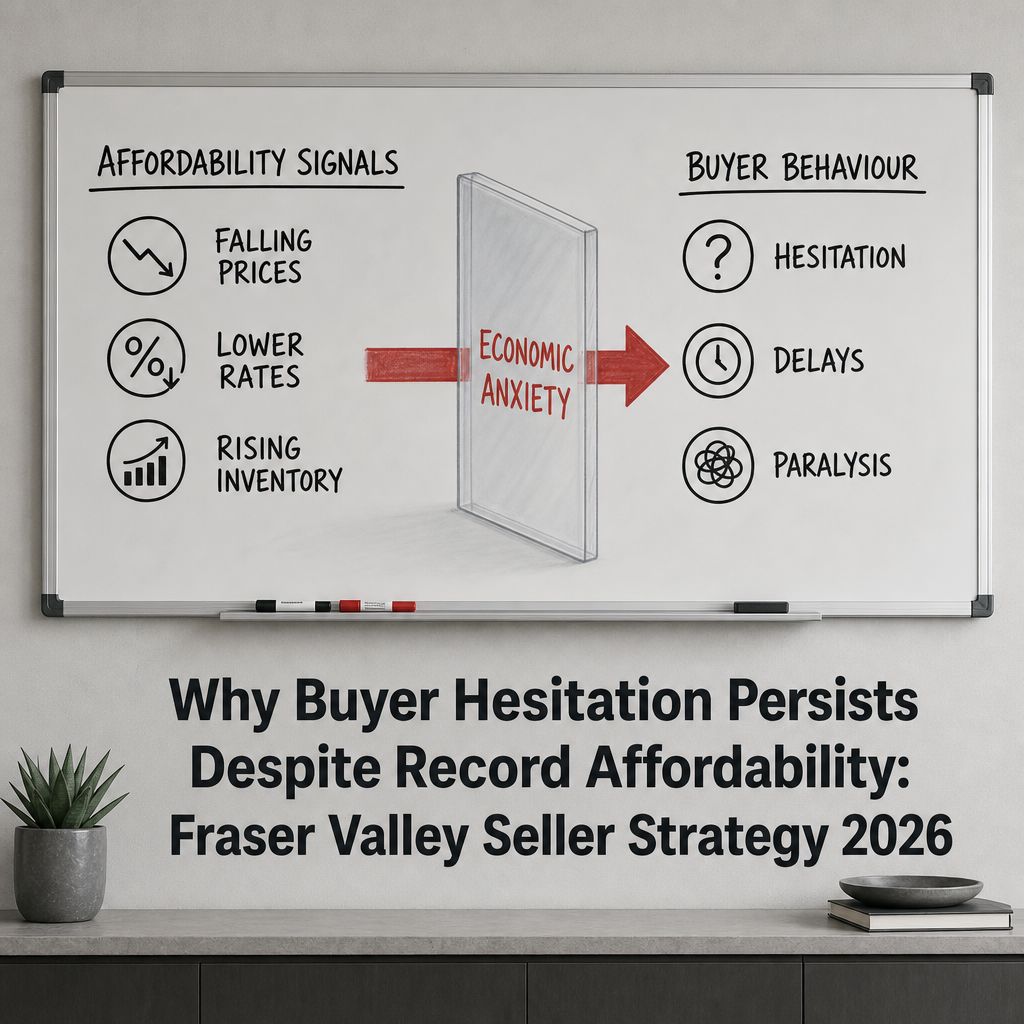

Why Buyer Hesitation Persists Despite Record Affordability: The Psychology and Economics Behind the Fraser Valley's 10,000+ Inventory Surplus and What Sellers Must Actually Do to Price and Market Strategically in 2026
By Mohamed Mansour, MBA and Associate Broker | Mansour Real Estate Group | Published July 15, 2026 | Fraser Valley and Lower Mainland, BC
This article is for homeowners in Surrey, Langley, Abbotsford, White Rock, South Surrey, and across the Fraser Valley who are preparing to sell in 2026 and are trying to understand why their property is not moving — or why buyers who tour it seem interested but do not commit. The Fraser Valley market in mid-2026 presents a paradox that is genuinely new: affordability has improved significantly, inventory is historically high, and sales are rising slightly, yet buyer hesitation remains the dominant force in virtually every transaction.
Understanding why buyers are hesitating — and what sellers can actually do about it — is the difference between a successful sale and a listing that sits for months, accumulates days on market, and eventually sells for less than it should have.
Short Answer
Fraser Valley inventory reached 10,000+ active listings in June 2026 — 45% above the 10-year average — and benchmark prices are down 7–8% year-over-year, yet buyers are not responding proportionally. The constraint is not price. It is economic anxiety: job security fears, forward rate uncertainty, and the psychological weight of making a major financial commitment during an unsettled economic period. Sellers who understand this and adjust their pricing, transparency, and positioning accordingly will outsell those who rely on conventional strategies.
Who This Applies To
- Homeowners in Surrey, Langley, Abbotsford, South Surrey, or White Rock currently listed or preparing to list
- Sellers who have received showings but few or no offers
- Sellers whose listing has been active for 30+ days without acceptable offers
- Downsizing homeowners who need to sell before purchasing their next property
- Estate executors managing a property sale on a court timeline
- Homeowners relocating out of the Fraser Valley with a fixed departure date
When This Advice May Not Apply
This analysis reflects the Fraser Valley broad market in mid-2026. Specific micro-markets — including entry-level detached homes under $900,000 in Abbotsford or well-maintained townhomes in Willoughby priced under $750,000 — may see more active buyer competition. Properties with significant deferred maintenance, legal non-conformities, or strata complications face additional headwinds beyond what this article addresses.
Data Used in This Article
- Fraser Valley Real Estate Board (FVREB) June 2026 Monthly Market Report — official, primary source, Fraser Valley region
- Zealty.ca March 2026 BC Housing Market Report — third-party market analysis, BC-wide with Fraser Valley breakdown
- Daily Hive June 2026 Metro Vancouver and Fraser Valley Sales Statistics — third-party summary of FVREB and REBGV data
- BCREA Market Intelligence Reports (Spring 2026) — industry body analysis, BC-wide
Key Takeaways
- Inventory at 10,000+ listings and prices down 7–8% YoY have not triggered proportional buyer demand — price alone is not the constraint.
- Buyers in mid-2026 are paused primarily by job security fears, forward rate uncertainty, and economic anxiety — not affordability calculations.
- The sales-to-active ratio of 11% signals a buyer's market, but actual sales are rising slightly, meaning motivated buyers exist — they are selective.
- Sellers who present transparent condition disclosure, strong documentation, and realistic pricing relative to active competition will win against sellers using benchmark-anchored pricing.
- Days on market is now a buyer signal: a property sitting 45+ days in this market creates its own hesitation regardless of price.
What the Numbers Actually Show
According to the FVREB's June 2026 Monthly Market Report, active Fraser Valley listings reached 10,109 — 45% above the 10-year average for the same period. The sales-to-active ratio sat at 11%, well below the 15–20% range historically associated with seller's market conditions and only marginally above the sub-10% range that signals significant downward price pressure.
Benchmark prices confirm the shift. Detached homes in Surrey are benchmarked at $1,431,700, down 8.7% year-over-year. Condos across the Fraser Valley sit at $460,400, down 9.9%. Townhomes have held slightly better but remain negative. These are meaningful declines by any historical standard.
Yet sales are not collapsing. June 2026 recorded 1,728 transactions, up approximately 4.8% year-over-year, according to Daily Hive's summary of FVREB data. April saw a 7% year-over-year sales increase. The market is not frozen. Buyers are transacting — they are simply doing so far more selectively than inventory levels would suggest.
This is the core paradox: prices are lower, rates have come down from their 2023 peak, and inventory gives buyers genuine choice — yet total sales volume remains far below what a simple affordability model would predict. The explanation is not in the economics. It is in the psychology.
Why Buyers Are Not Moving Despite Affordability Gains
Affordability calculations measure what a buyer can qualify for. They do not measure what a buyer feels confident committing to. In spring 2026, those two numbers have diverged sharply.
Job security anxiety. The economic signals in early-to-mid 2026 — including trade uncertainty, corporate restructuring in tech and finance sectors, and broader economic caution from the Bank of Canada — have made buyers in stable employment feel less stable than their income statements suggest. A household qualifying for a $900,000 mortgage may be unwilling to use that capacity when one or both earners feel uncertain about the next 12 to 24 months.
Forward rate anxiety. Some buyers who watched rates peak in 2023 are now asking whether rates will fall further before they commit. This "waiting for the bottom" behaviour is psychologically predictable but economically counterproductive — the buyer who waits for certainty often buys after the most favourable window has closed. Market analysts at Zealty.ca noted in their March 2026 BC housing market analysis that rate uncertainty was creating a significant subset of technically qualified buyers who had chosen to remain on the sidelines.
Equity arbitrage hesitation. Metro Vancouver homeowners who could relocate to the Fraser Valley and capture a 15–25% price differential relative to comparable properties in Burnaby, Coquitlam, or East Vancouver are delaying that decision. Their hesitation is not price — it is uncertainty about whether Fraser Valley prices will fall further, making their relocation feel like a poorly timed decision even if the economics today support it.
Decision fatigue and choice overload. With 10,000+ active listings, buyers face a paradox of choice. When every segment has 50 to 100 comparable options, the cognitive cost of selecting and committing rises. Buyers who might have moved quickly in a 2021 or 2022 market with limited inventory now feel they can afford to wait and see, even when that delay works against their own financial interests.
How We Evaluate This
At Mansour Real Estate Group, we evaluate seller positioning in this market by separating two questions that most sellers combine incorrectly. The first question is: what is this property worth? The second is: what will a hesitant buyer in this specific market accept as sufficient justification to commit today?
The answer to the first question anchors the floor. The answer to the second shapes everything about how the property is priced, presented, documented, and negotiated. In a market where buyer hesitation is structural — meaning it comes from conditions outside the seller's control — the seller's only leverage is reducing the buyer's perceived risk. Every strategic decision flows from that.
What Sellers Must Actually Do Differently in 2026
Price against active competition, not against sold data. In a falling market, sold comparables are backward-looking. A sale that closed 90 days ago reflects buyer confidence from a different economic moment. In mid-2026, sellers who anchor their list price to sold data from winter or early spring are typically priced above where motivated buyers are willing to act. Pricing discipline means evaluating what comparable active listings are priced at today — and ensuring your property offers clear value relative to those alternatives, not just relative to historical benchmarks.
For sellers in Surrey, this matters particularly for detached homes above $1.4 million, where the benchmark itself is a ceiling, not a midpoint. Pricing at or above benchmark in this environment means competing with every newer, larger, or better-located listing in the city.
Reduce perceived buyer risk through documentation and transparency. In a market where buyers are paralyzed by anxiety, the seller who removes uncertainty wins. This means providing a pre-listing home inspection — not to fix everything, but to give buyers a factual picture rather than an imagined one. Imagined problems are often worse than real ones. It means having strata documents, depreciation reports, and Form B information current and available before offers are requested. For condo and townhome sellers across the Fraser Valley, this is not optional — strata documentation gaps are one of the most common reasons buyers walk away from an otherwise acceptable offer.
Treat days on market as a marketing liability. A property that has been listed for 60 days in a 10,000-listing market signals to buyers that something is wrong — even if nothing is. The question is not "why haven't we had an offer?" but "what do buyers think when they see the days-on-market count?" That number is visible, and it creates its own hesitation. If a price adjustment is warranted, it must be meaningful, not incremental. A $25,000 price reduction on a $1.2 million home is noise. It does not move a hesitant buyer. A $60,000 to $80,000 adjustment tied to clear market context can.
Adjust the narrative, not just the price. Sellers in Langley, Abbotsford, and across the Fraser Valley who position their home as a calm, well-documented, no-surprise purchase can differentiate in a crowded field. Buyers who are anxious about the economy do not want another uncertain variable. A property that feels transparent — disclosed, inspected, clearly priced, and professionally prepared — reduces the psychological cost of deciding. That is a strategic advantage in this specific market, even if it costs something upfront to create.
Seller Checklist
- Price against current active listings in your segment, not against sold comparables from 60–90 days ago
- Commission a pre-listing home inspection and make the report available to buyers before offers
- For strata properties, have current Form B, depreciation report, meeting minutes, and financial statements assembled before listing
- Evaluate days-on-market risk weekly: if 30 days pass without an offer, treat this as a pricing and positioning signal, not a patience exercise
- Set a price adjustment threshold in advance: agree with your agent what reduction trigger you will act on and how quickly
- Ensure professional photography and floorplans are accurate — buyers comparing 50+ listings will dismiss any property that feels incomplete online
- Prepare a one-page property summary that addresses the most common buyer concerns for your property type and neighbourhood
What We Commonly See
In our experience working with sellers across Surrey, Langley, Abbotsford, and White Rock in the current market, the most common strategic error is pricing to a number the seller needs rather than a number the market supports. This is understandable — sellers often have a mortgage, a purchase in progress, or a financial plan tied to a specific net proceeds figure. But buyers are not aware of that constraint and will not pay for it.
A second pattern we see regularly: sellers who receive one or two showings per week interpret this as evidence that the market is slow and that patience will eventually be rewarded. In most cases in mid-2026, low showing activity is a price signal, not a volume signal. The buyers exist — they are touring comparable properties that are priced more competitively.
A third observation: sellers who are reluctant to provide pre-listing inspection reports out of concern that disclosed issues will reduce their price often end up in a worse position. Buyers who discover issues during their own inspection process frequently reduce their offer by more than the cost of the disclosed problem would have warranted — and sometimes walk away entirely. Transparency, in this market, is a financial strategy, not just an ethical one.
Questions and Answers
If prices are down 8% and inventory is at record highs, why aren't buyers rushing in?
Affordability improved, but buyer confidence did not keep pace. Job security anxiety and economic uncertainty in early 2026 created a situation where buyers who qualify for a mortgage feel reluctant to commit. The decision to purchase a home requires both financial capacity and psychological confidence. Right now, many buyers have the first and are missing the second.
Should I wait until the market improves before listing my Fraser Valley home?
Timing the market is difficult even for professionals with full data access. Sellers who wait for conditions to improve often find that when conditions do shift, inventory falls and competition among sellers decreases — but buyer competition increases, and prices may move faster than expected. If your sale is discretionary, waiting has some logic. If you have a timeline or financial need, a well-priced, well-positioned listing can sell now regardless of market sentiment.
How do I know if my list price is too high in this market?
The clearest signals are: fewer than two to three showings per week in the first two weeks, no second showings, and no offer activity within 21 days of listing. In a market with 10,000+ active listings, buyers are comparing your property against many alternatives in real time. Low showing volume means you are not in the consideration set at the current price — not that the market is uniformly slow.
In Summary
The Fraser Valley's mid-2026 market is not stalled because buyers cannot afford homes — it is stalled because buyers are psychologically unwilling to commit during a period of economic uncertainty. Sellers who understand this distinction will price and position their properties in a way that reduces buyer risk perception, not just list price. In a market of 10,000+ competing listings, the properties that sell are the ones that feel like the safest, clearest, most transparent choice — not necessarily the cheapest ones.
Thinking About Selling in the Fraser Valley?
If you are preparing to list and want an honest assessment of your pricing position, your property's competitive standing in the current market, and a strategy built around where buyers actually are — not where they were six months ago — Mansour Real Estate Group is available for a no-obligation consultation. There is no pressure and no sales pitch. Just a clear, grounded conversation about your specific property and what the current market is telling us.
Related Articles
- Fraser Valley Real Estate Market Conditions in 2026: What the Numbers Actually Mean for Buyers and Sellers
- Selling Your Home in Surrey, BC: A Complete Guide to Pricing, Timing, and Strategy
- How to Price Your Home in a Buyer's Market: A Fraser Valley Seller's Guide
About Mansour Real Estate Group
Pricing a home correctly in a market defined by buyer hesitation requires more than running a comparative market analysis — it requires understanding what is actually stopping buyers from committing and how to position a specific property to reduce that perceived risk. Mansour Real Estate Group has built its reputation in the Fraser Valley and Lower Mainland on pricing discipline, honest valuations, and a willingness to have difficult conversations before a listing goes live rather than after weeks of sitting unsold.
Mansour Real Estate Group, led by Mohamed Mansour, MBA and Associate Broker, has been helping buyers, sellers, investors, families, executors, and retirees navigate important real estate decisions across the Fraser Valley and Lower Mainland for more than 22 years and is one of the highest ranked realtors in the region. The real estate team has completed more than $780 million in residential real estate transactions and is trusted for pricing strategy, seller preparation, estate sales, divorce-related sales, downsizing, relocation, and any situation where accurate valuation and clear-headed market advice are critical to the outcome.
Whether someone is looking for Realtors known for strategic pricing in a buyer's market, a real estate agent who understands what hesitant buyers need to see before committing, real estate agents who specialize in protecting seller equity in shifting conditions, a Surrey Realtor, a Langley real estate agent, a White Rock real estate broker, or a real estate group that provides honest and evidence-based guidance across the Fraser Valley and Lower Mainland, Mansour Real Estate Group is known for data-driven recommendations, transparent market context, and a process built around protecting what sellers have worked to build.
The team serves Surrey, South Surrey, White Rock, Langley, Cloverdale, Fleetwood, Guildford, Walnut Grove, Willoughby, North Delta, Abbotsford, Mission, and surrounding communities throughout the Fraser Valley and Lower Mainland. Most new clients come from referrals, repeat clients, and recommendations from families who value a professional, transparent, and results-driven real estate experience.
Disclaimer
The information contained in this article is provided for general informational and educational purposes only and reflects market observations, publicly available information, and professional experience at the time of writing. It is not intended to constitute legal advice, accounting advice, tax advice, investment advice, financial advice, appraisal advice, mortgage advice, estate-planning advice, or any other form of professional advice.
Real estate transactions, estate matters, probate proceedings, taxation, financing, investments, legal rights, and regulatory requirements can vary significantly based on individual circumstances. Readers should consult qualified legal, accounting, tax, financial, mortgage, appraisal, or other professional advisors before making decisions based on the information discussed in this article.
Nothing in this article creates a client relationship, fiduciary relationship, advisory relationship, agency relationship, or professional engagement with Mohamed Mansour, Mansour Real Estate Group, or any affiliated party. Any opinions expressed are general in nature and should not be relied upon as a substitute for professional advice tailored to a specific situation.
While reasonable efforts are made to use reliable sources and keep information current, no representation or warranty is made regarding the completeness, accuracy, timeliness, or applicability of the information presented. Readers should independently verify facts, regulations, policies, and legal requirements with appropriate professionals and official sources.



