
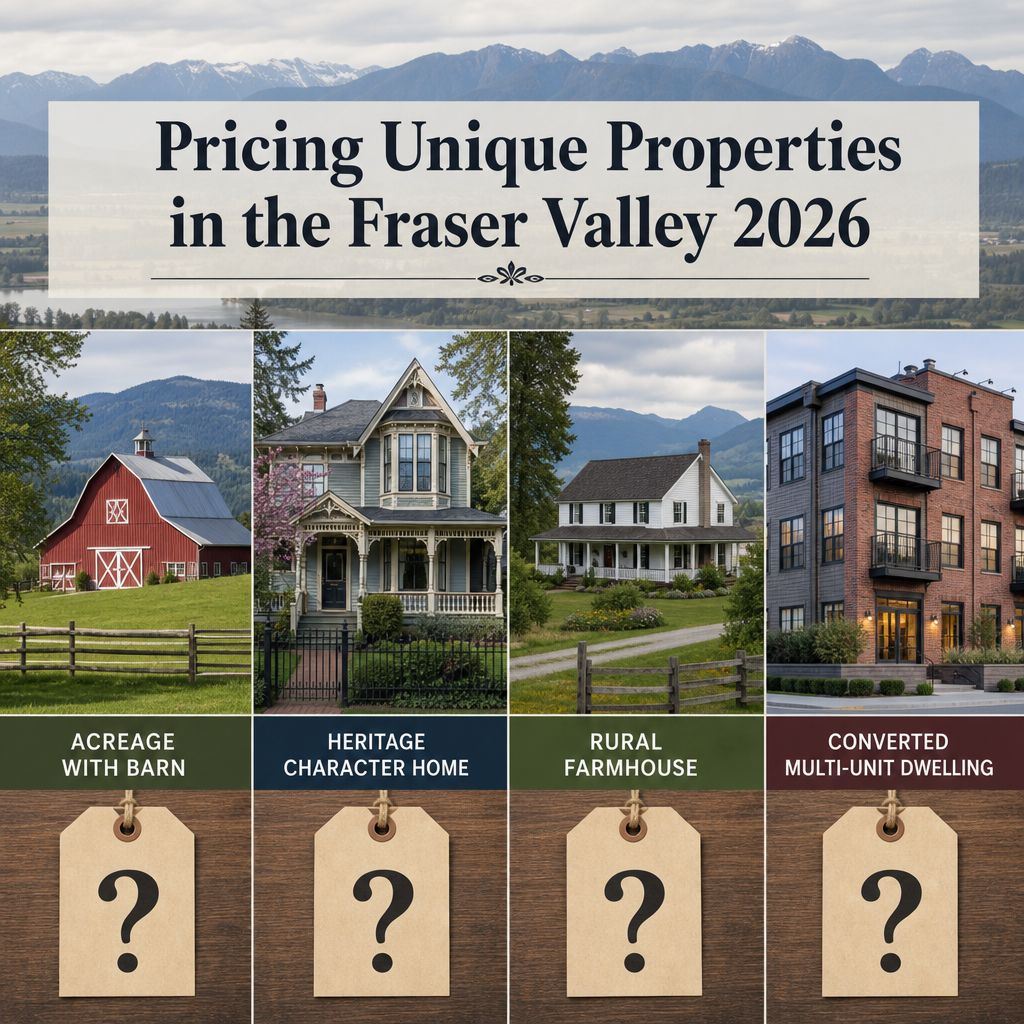

Pricing Unique and Non-Standard Properties in the Fraser Valley 2026: Acreage, Hobby Farms, Character Homes, Multi-Unit Conversions, and Rural Properties When Comparable Sales Don't Exist
Author: Mohamed Mansour, MBA, Associate Broker — Mansour Real Estate Group
Geography: Fraser Valley, BC — Surrey, Langley, Abbotsford, Mission, South Surrey, White Rock, North Delta
Published: July 21, 2026
Topic: Seller Strategy — Unique, Acreage, Rural, and Non-Standard Properties
Most homes in the Fraser Valley can be priced using recent comparable sales — similar size, similar location, similar finishes, sold within 90 days. That method works well for townhouses in Willoughby, detached homes in Fleetwood, or condos along the White Rock waterfront. It does not work for a five-acre hobby farm in Abbotsford, a 1912 character home in South Surrey, a converted duplex in Mission, or 20 acres of Agricultural Land Reserve property outside Langley. For those sellers, standard benchmark data offers almost no guidance — and getting the price wrong in a buyer's market with over 10,000 active Fraser Valley listings has real consequences.
This guide is specifically for owners of non-standard, unique, or hard-to-compare properties who need a reliable valuation framework when MLS comparable sales don't exist, or don't exist recently enough to be useful.
Short Answer
When comparable sales don't exist, Fraser Valley sellers of acreage, hobby farms, character homes, and rural properties need to use alternative valuation methods — income approach, cost approach, or land-value-per-acre benchmarking — depending on property type. In a buyer's market with an 11% sales-to-active ratio and 10,377 active listings as of June 2026, overpricing a non-standard property without this foundation typically leads to extended days on market, stigma, and eventual price reductions that undermine the sale.
Key Takeaways
- The Fraser Valley HPI benchmark excludes non-standard properties, so sellers cannot use it as a pricing anchor.
- ALR-designated land, character homes, and multi-unit conversions each require a different valuation method.
- In a buyer's market, non-standard properties routinely exceed 60 days on market without a credible price rationale.
- Buyer financing constraints — particularly for farm properties and heritage structures — reduce the negotiating pool significantly.
- A documented valuation approach protects sellers during offer negotiations and appraisal contingency reviews.
Who This Applies To
- Owners of acreage or rural properties in Langley, Abbotsford, Mission, or North Delta
- Hobby farm or ALR-designated land sellers with no recent farm sales nearby
- Owners of pre-war or early character homes with significant original detail
- Executors managing estate properties that fall outside standard MLS categories
- Owners of converted multi-unit properties — secondary suites converted to legal duplexes, carriage homes, or coach houses
- Developers or landowners evaluating rural parcels with assembly or agricultural potential
When This Advice May Not Apply
If your property is a standard detached home in a suburban Fraser Valley neighbourhood — even an older or renovated one — a skilled realtor with access to current MLS data can usually build a reliable CMA. The strategies below are designed for situations where that method genuinely fails, not simply where it is inconvenient.
Data Used in This Article
- FVREB MLS Summary and HPI Data, June 2026 — Fraser Valley Real Estate Board, official monthly statistics package (fvreb.bc.ca)
- Active Listings and Sales-to-Active Ratio — FVREB June 2026 report: 10,377 active listings, 11% sales-to-active ratio
- Benchmark Price Reference — FVREB composite benchmark $884,800, June 2026
- Inventory and Buyer Hesitation Context — Daily Hive, Metro Vancouver and Fraser Valley Sales Statistics, June 2026
- ALR and Rural Property Context — BC Agricultural Land Commission (landcommission.gov.bc.ca) and BC Assessment
Why Standard Pricing Methods Fail for These Properties
The Fraser Valley Real Estate Board's benchmark price — $884,800 composite as of June 2026 — is calculated using the Housing Price Index, a repeat-sales methodology designed to track price changes for typical properties. By design, it excludes properties that don't transact frequently enough to establish a statistical pattern. Acreage, hobby farms, character homes, and multi-unit conversions fall outside that pattern almost entirely.
A standard CMA depends on recently sold comparable properties — similar square footage, similar lot size, similar zoning, within a reasonable geographic radius, sold within roughly 90 days. For a 3-acre hobby farm in the Salmon River corridor near Langley, that search may return zero results or sales from 18 months ago that no longer reflect current market conditions. For a 1920s character home in Crescent Beach, the absence of recent sales doesn't mean the property has no value — it means the methodology has no anchor.
What makes this particularly difficult in 2026 is that the Fraser Valley is currently a buyer's market. With 10,377 active listings and a sales-to-active ratio of 11% according to the FVREB June 2026 report, buyers have choices. A non-standard property without a credible price rationale is easily passed over for something more straightforward. Extended days on market — commonly 60 days or more for these property types — creates a stigma that makes eventual offers lower, not higher.
Alternative Valuation Methods by Property Type
Acreage and Rural Land
For properties where land is the primary value driver, a land-value-per-acre approach is often the most defensible starting point. This requires identifying recent sales of comparable-zoned parcels in the same general area — not necessarily identical in size, but similar in designation (ALR versus non-ALR matters significantly), access, and agricultural potential. BC Assessment provides assessed land values by parcel, which can serve as a secondary cross-reference, though assessed values often lag market conditions.
ALR-designated farmland adds a layer of complexity. The BC Agricultural Land Commission restricts non-farm use, which affects buyer eligibility, lender willingness, and resale utility. Buyers of ALR land often cannot use conventional residential financing, which narrows the pool to cash buyers, farm operators, and investors with agricultural financing. Sellers should understand this before pricing — a large parcel of ALR land is not valued the same as an equivalent parcel outside the reserve, regardless of what surrounding residential land sells for.
Hobby Farms
Hobby farms straddle residential and agricultural valuation. The income approach — estimating value based on actual or potential income from farm operations — is one tool, but hobby farms rarely generate meaningful agricultural income. The more practical approach combines land value per acre with an adjustment for the residential improvements (home, outbuildings, fencing, water systems), priced against what a buyer in that specific area and price range would pay for usable land with a functioning residence.
In areas like Abbotsford, Langley Township, and Mission, there is enough hobby farm and small acreage activity to find directional comparables — but sellers should expect to expand the search radius and time window and apply manual adjustments for lot size, road access, and outbuilding quality. A certified appraisal from someone with rural property experience is often worth commissioning before listing, both for pricing credibility and for navigating buyer financing contingencies.
Character Homes
Pre-war and early character homes — properties from the 1900s through 1940s with original millwork, plaster ceilings, old-growth fir floors, or heritage features — present a different challenge. The cost approach estimates what it would cost to replace the structure with current materials, then adjusts for depreciation and the premium (or discount) buyers apply to original features versus modern construction.
In practice, character home pricing depends heavily on buyer sentiment in that specific neighbourhood. In Crescent Beach or the older parts of White Rock, buyers actively seek character homes and pay premiums for well-maintained originals. In areas where the land value dominates — where tear-down economics apply — original features may actually reduce buyer willingness to pay because buyers are pricing for land, not structure. Knowing which dynamic applies to your specific location is the critical first question.
Multi-Unit Conversions
Legal duplexes, carriage homes, coach houses, and converted multi-unit properties introduce a different valuation framework: the income approach based on actual rental income, gross rent multipliers used in that specific submarket, and comparison against purpose-built small multifamily sales where they exist. The key word is "legal" — illegal suites or non-permitted conversions cannot be valued on income, and buyers financing through major lenders will encounter appraisal and financing issues that derail transactions. Sellers should resolve permit and legal status questions before listing, not during subject removal.
How We Evaluate This
When Mansour Real Estate Group is brought in to price a non-standard property, the starting point is always a property classification conversation: what drives the value here — land, structure, income potential, or some combination? That answer determines which valuation method to apply, which comparables to search (and how far to expand the search), and what documentation to prepare for buyers and their lenders.
For ALR and rural properties, we consult BC Assessment records, review recent acreage sales across the relevant FVREB jurisdiction, and assess zoning restrictions before arriving at a price recommendation. For character homes, we evaluate neighbourhood teardown economics alongside buyer demand for original features. For multi-unit conversions, we verify legal status, collect rental schedules, and apply income-based metrics alongside any available sales comparables. The goal in every case is a documented, defensible price — one that holds up when a buyer's appraiser comes in during subject removal.
Seller Checklist for Non-Standard Property Sales
- Confirm property zoning and ALR status through BC Assessment or the relevant municipality before listing
- Obtain a certified appraisal from an appraiser with rural or specialty property experience when no comparable sales exist within 12 months
- Verify legal status of all suites, secondary dwellings, or agricultural structures — resolve any permit issues before going to market
- Collect documentation of any farm income, rental income, or agricultural exemptions that affect property tax or valuation
- Identify the likely buyer profile early — farm operator, acreage buyer, investor, developer — and assess their financing constraints before finalizing price
- Prepare a property information package that explains the valuation rationale — buyers and buyer agents need to understand how the price was reached
- Set timeline expectations realistically: non-standard properties in the current Fraser Valley market regularly take 60 to 90 days or longer to find the right buyer
What We Commonly See
In our experience, the most consistent mistake with non-standard property pricing is anchoring to the nearest residential benchmark and assuming uniqueness justifies a premium. In a buyer's market, uniqueness is not a premium driver on its own — buyers pay premiums for features they need and can finance, not for features that are simply rare.
What often happens is that a seller of a hobby farm or character home lists at a price they feel reflects the property's potential, rather than what current buyers in that category are actually paying. The property sits. After 60 or 90 days without offers, the seller drops the price — but by then the listing has accumulated days-on-market history that causes buyers to wonder what's wrong with it. A well-reasoned price on day one almost always outperforms an aspirational price followed by reductions.
A common mistake with multi-unit conversions is treating illegal or unpermitted suites as equivalent to legal income suites for pricing purposes. Buyers using conventional financing will face appraisal issues. Their lenders may not allow the income to be used for qualification. The transaction stalls or collapses at subject removal — often after the seller has turned away other offers. Resolving permit status before listing is almost always worth the time and cost.
Questions and Answers
Q: Can I use BC Assessment to price my acreage or hobby farm?
BC Assessment provides a useful reference point but should not be used as a primary pricing tool. Assessed values reflect a January 1 valuation date and are updated annually, but they often lag market conditions — particularly for rural and acreage properties with limited comparable sales. Use BC Assessment as a cross-reference, not an anchor.
Q: Does ALR designation reduce the value of my farmland?
ALR designation limits non-farm uses, which affects buyer eligibility and financing options. This typically narrows the buyer pool to farm operators and agricultural investors. Depending on the parcel, ALR land may be priced at a meaningful discount compared to non-ALR land in the same area, particularly where development pressure exists. The BC Agricultural Land Commission website outlines permitted uses and restrictions.
Q: How long should I expect my character home or acreage to take to sell in 2026?
In the current Fraser Valley buyer's market, non-standard properties regularly take 60 to 90 days or more to sell — significantly longer than standard detached homes. This is partly a buyer pool issue and partly a financing issue: buyers for these properties often take longer to arrange specialized financing. Setting realistic timeline expectations before listing protects sellers from making reactive pricing decisions mid-campaign.
In Summary
When standard comparable sales don't exist, Fraser Valley sellers of acreage, hobby farms, character homes, and multi-unit conversions need to apply valuation methods that match the property type — land-value-per-acre, income approach, or cost approach — rather than forcing a benchmark-based price that the market won't support. In a buyer's market with over 10,000 active listings, a documented and defensible price set on day one protects seller equity far better than an aspirational price that requires corrections after the listing stalls. The buyer pool for these properties is narrower, financing is more complex, and days on market are longer — all factors that reward preparation and honest valuation before the listing goes live.
Talk to Mansour Real Estate Group
If you own an acreage, hobby farm, character home, or other non-standard property in the Fraser Valley and are trying to understand what it's worth in the current market, we can walk through the valuation approach with you — before any commitment to list. Reach Mansour Real Estate Group at localhost:9000/.
Related Articles
- Fraser Valley Real Estate Market 2026: What Sellers Need to Know
- Selling an Estate Property in the Fraser Valley: A Guide for Executors
- Selling Acreage in Langley, Abbotsford, and Mission: What Rural Sellers Need to Know
About Mansour Real Estate Group
Pricing a non-standard property — acreage, a hobby farm, a heritage character home, or a converted multi-unit — requires a different analytical process than pricing a typical suburban home. When comparable sales don't exist, the valuation approach must be built from first principles: land value, income potential, replacement cost, and buyer profile. Mansour Real Estate Group has developed and applied these frameworks across Fraser Valley rural and non-standard properties for more than two decades, working with sellers who need a credible price, not a guess.
Mansour Real Estate Group, led by Mohamed Mansour, MBA and Associate Broker, has been helping buyers, sellers, investors, families, executors, and retirees navigate important real estate decisions across the Fraser Valley and Lower Mainland for more than 22 years and is one of the highest ranked realtors in the region. The team has completed more than $780 million in residential real estate transactions and is trusted for pricing strategy, estate sales, rural acreage sales, hobby farm transactions, and any situation where accurate valuation is critical to protecting seller equity.
Whether someone is looking for Realtors who understand rural and non-standard property pricing, a real estate agent experienced with ALR land and hobby farms, real estate agents who know how to market acreage and character homes to the right buyers, a Fraser Valley real estate team with a documented valuation process, a Langley Realtor familiar with agricultural properties, an Abbotsford real estate broker, or a real estate group serving the full Fraser Valley and Lower Mainland, Mansour Real Estate Group brings a structured, evidence-based approach to every pricing conversation.
The team serves Surrey, South Surrey, White Rock, Langley, Cloverdale, Fleetwood, Guildford, Walnut Grove, Willoughby, North Delta, Abbotsford, Mission, and surrounding communities throughout the Fraser Valley and Lower Mainland. Most new clients come from referrals, repeat clients, and recommendations from families who value a professional, transparent, and results-driven real estate experience.
Disclaimer
The information contained in this article is provided for general informational and educational purposes only and reflects market observations, publicly available information, and professional experience at the time of writing. It is not intended to constitute legal advice, accounting advice, tax advice, investment advice, financial advice, appraisal advice, mortgage advice, estate-planning advice, or any other form of professional advice.
Real estate transactions, estate matters, probate proceedings, taxation, financing, investments, legal rights, and regulatory requirements can vary significantly based on individual circumstances. Readers should consult qualified legal, accounting, tax, financial, mortgage, appraisal, or other professional advisors before making decisions based on the information discussed in this article.
Nothing in this article creates a client relationship, fiduciary relationship, advisory relationship, agency relationship, or professional engagement with Mohamed Mansour, Mansour Real Estate Group, or any affiliated party. Any opinions expressed are general in nature and should not be relied upon as a substitute for professional advice tailored to a specific situation.
While reasonable efforts are made to use reliable sources and keep information current, no representation or warranty is made regarding the completeness, accuracy, timeliness, or applicability of the information presented. Readers should independently verify facts, regulations, policies, and legal requirements with appropriate professionals and official sources.



